As we’re going to be hosting the ebullient Alastair Caldwell on next week’s edition of The Racer’s Edge, I thought I’d include this neg scan of AC in conference with the Goodyear brass (specifically Leo Mehl, left) and Lee Gaug (right). Leo always made me smile; he had this knack of always being able to mix racing politics with a true grasp of real life. And, through Leo, I discovered one of my favourite authors – Herman Wouk. “What’s that tome you’re reading?” I asked Leo once, at some airport. “War and Remembrance,” he replied. “It’s got just enough fiction to make it sizzle and more than enough history to be real. Can’t put it down.” How right he was. Lee was also a player. A pipe-smoker and an ex-marine who flew Brewster Buffalos from flat-tops, Lee always used to joke about his wives: “They’re all homekeepers. They’ve kept every one I ever owned…” Alastair, meanwhile…well…you can find out for yourselves what makes Mr Caldwell tick on next week’s show. I don’t think you’ll be disappointed.
For good measure, here’s another AC shot. This time we’re taking part in the annual Grosse Pointe sailing regatta that preceded the Detroit Grand Prix every year. That’s the largely under-rated and multi-talented (F1, Indy, WRC) Chilean driver, Eliseo Salazar, on Al’s right and on his left is Dieter Stappert, who for many years wrote for the magazine with the greatest of all titles – Powerslide. Dieter was always impressive, I think: small note book in his hip pocket, nice pen, astute questions. He later worked for BMW.
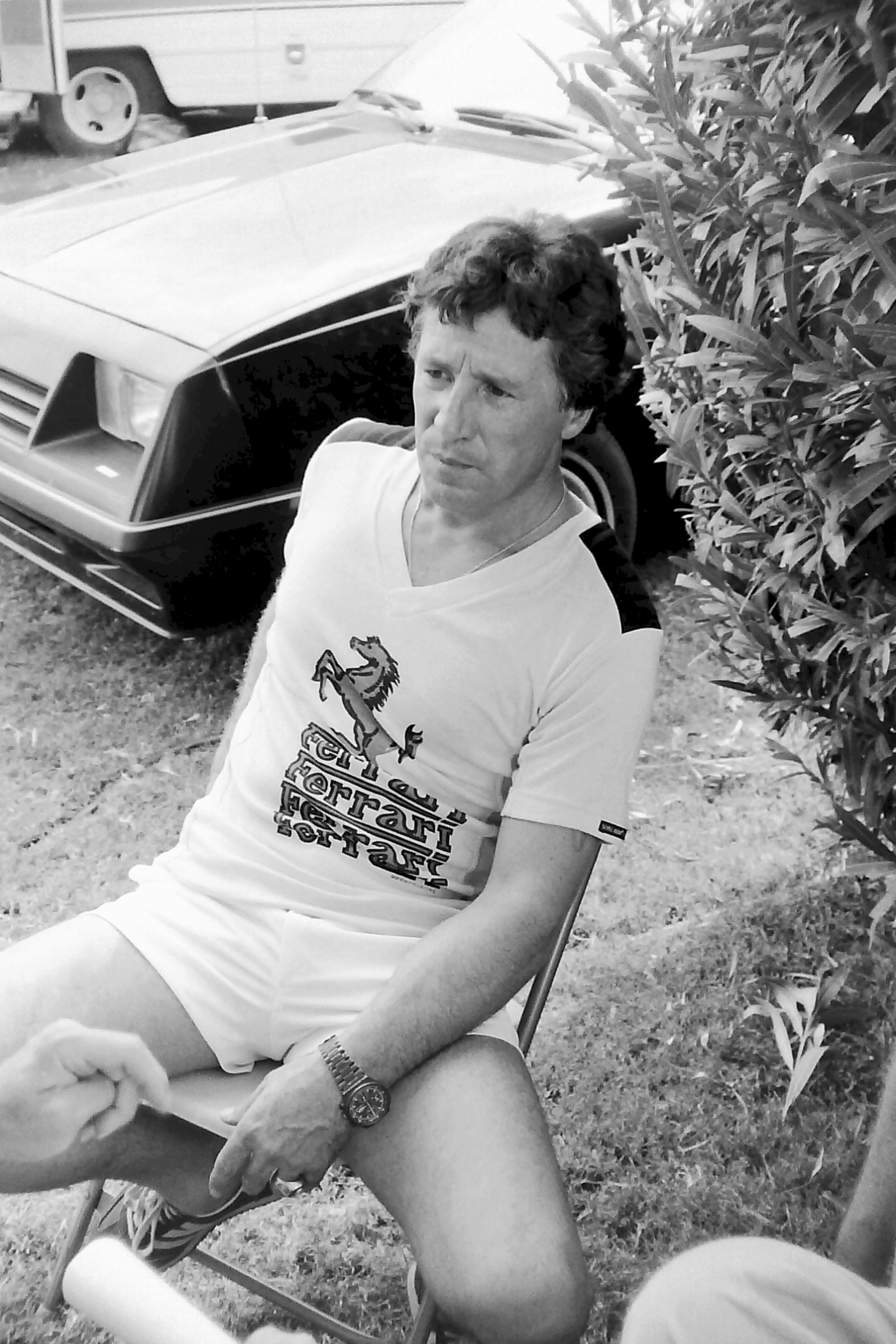
Now let’s drop in on Mario Andretti, wearing one of his favourite t-shirts as he talks set-up and engine revs, and, below, on the Reutemann family and friends, seen here enjoying an early-evening game of soccer in the back yard of Carlos’ home on the Circuit Cap Ferrat, South of France. That’s Cora Reutemann, who would in time become a first-rate photographer, looking as though she’s about to score a goal. Jose-Maria Candiotti, one of Carlos’ mates – and tennis doubles partner – from Carlos’ home town of Santa Fe, is on the right. I used to stay at Carlos’ place before the Monaco GP – and sometimes before the French GP, too.
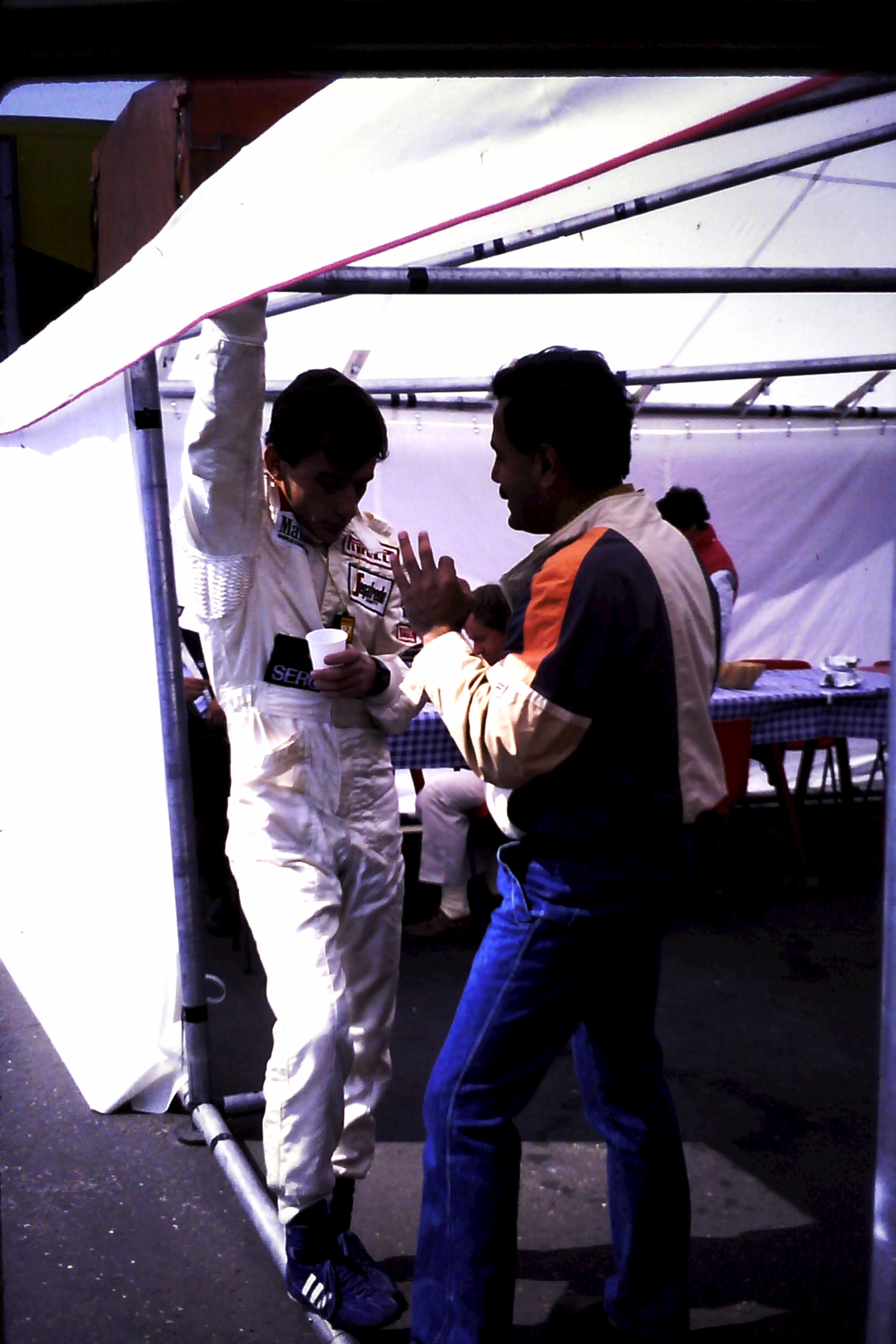
Finally, below, here’s Ayrton Senna, sipping a Segafredo coffee while he talks safety with Rafael Grajales-Robles, the very talented Panamanian heart surgeon. Rafael was a personal F1 doctor to drivers like Emerson Fittipaldi, Carlos Reutemann and Nelson Piquet long before Syd Watkins arrived on the scene and was the first medic of importance to ensure that helicopters were in place before practice sessions began, or that marshals’ posts were properly equipped with medical equipment at regular intervals. As such, he wasn ‘t flavour-of-the-month amongst the F1 power brokers for very long, as you can imagine. As the politics of the 1980s grew in intensity, Rafael – and his stringent safety demands – were inevitably shuffled sideways. He nonetheless remained close to drivers like Ayrton, and Nigel Mansell, for several years thereafter.
As the Hunt vs Lauda documentary has now been withdrawn from YouTube we are sadly unable to show it on these pages. It is available, though, on the BBC iPlayer and it will be screened again on BBC2 in the UK in near future. We will publish dates of those screenings via Twitter @peterdwindsor. Richard Wiseman, the archivist responsible for the video sourcing of the documentary, will also be our guest on The Racer’s Edge on August 22.
As some of you will know, I was raised in Sydney, Australia, where, looking back now, the sun usually shone, the air was scented by eucalyptus and Warwick Farm was the heart and the soul of motor racing in all its forms. I grew up in the knowledge that, every summer, I would see a bunch of F1 drivers competing in the International 100 and that, in between times, I would see five national race meetings of extraordinary quality. Drivers like Frank Matich, Leo and Ian Geoghegan, Greg Cusack, Kevin Bartlett, Niel Allen, Bib Stillwell, Johnny Harvey, Spencer Martin, Max Stewart, Brian Foley, Peter Manton, Norm Beechey, Allan Moffatt and Bob Jane were my “national” heroes; Sports Car World, Modern Motor and Racing Car News were my regular fare.
Then there were the F1 drivers in their Tasman-engined F1 cars.
I still find it hard to capture accurately what motor racing was like back then. Was it the way the Warwick Farm paddock was laid out, by the lake, with the marshalling area opposite the huge grandstands? Was it the colour- and word-perfect attention to detail of the Australian Automobile Racing Club (AARC)? Was it the relatively safe circuit layout, designed by the immaculate Geoff Sykes? I know not the answers, even now. All I know is that it was motor racing. Nothing, since, has compared. Not even Monaco on a good day. Not even a packed Brands Hatch. When I was at The Farm, first as a young kid, smuggled into the paddock area in the boot of a car owned by a marshal who worked with my Dad, then as a marshal myself and finally as Press Officer, I was at one with the world. Flags would flutter in the breeze. Jim Clark and Jackie Stewart, sun-tanned and shirtless, would laugh their famous laughs. Then the sun would set, the beer cans would pour and, over the PA, they would play The Long and Winding Road.
I have lots of photos from that era. Some I took with a black-and-white Kodak Box Brownie. Then, in 1967, I bought a half-frame Fujica. The quality from both was not great, but for me that didn’t matter. I had captured the moment, cut a slice from time. That was all I needed. I had been there, seen it happen.
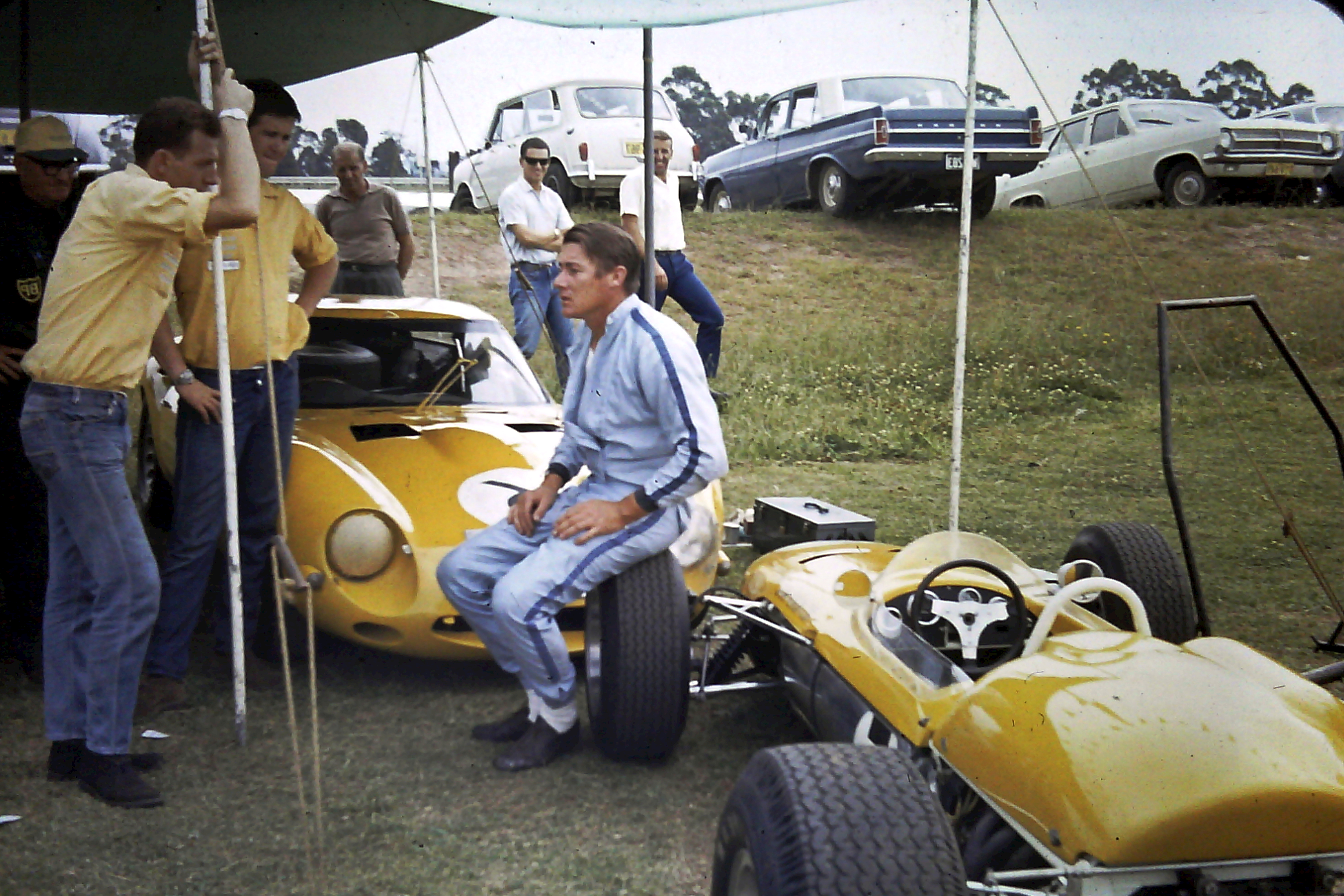
Kevin Bartlett, in blue Nomex, sits on the front wheel of Alex Mildren’s 2.5 litre Tasman Brabham-Climax.
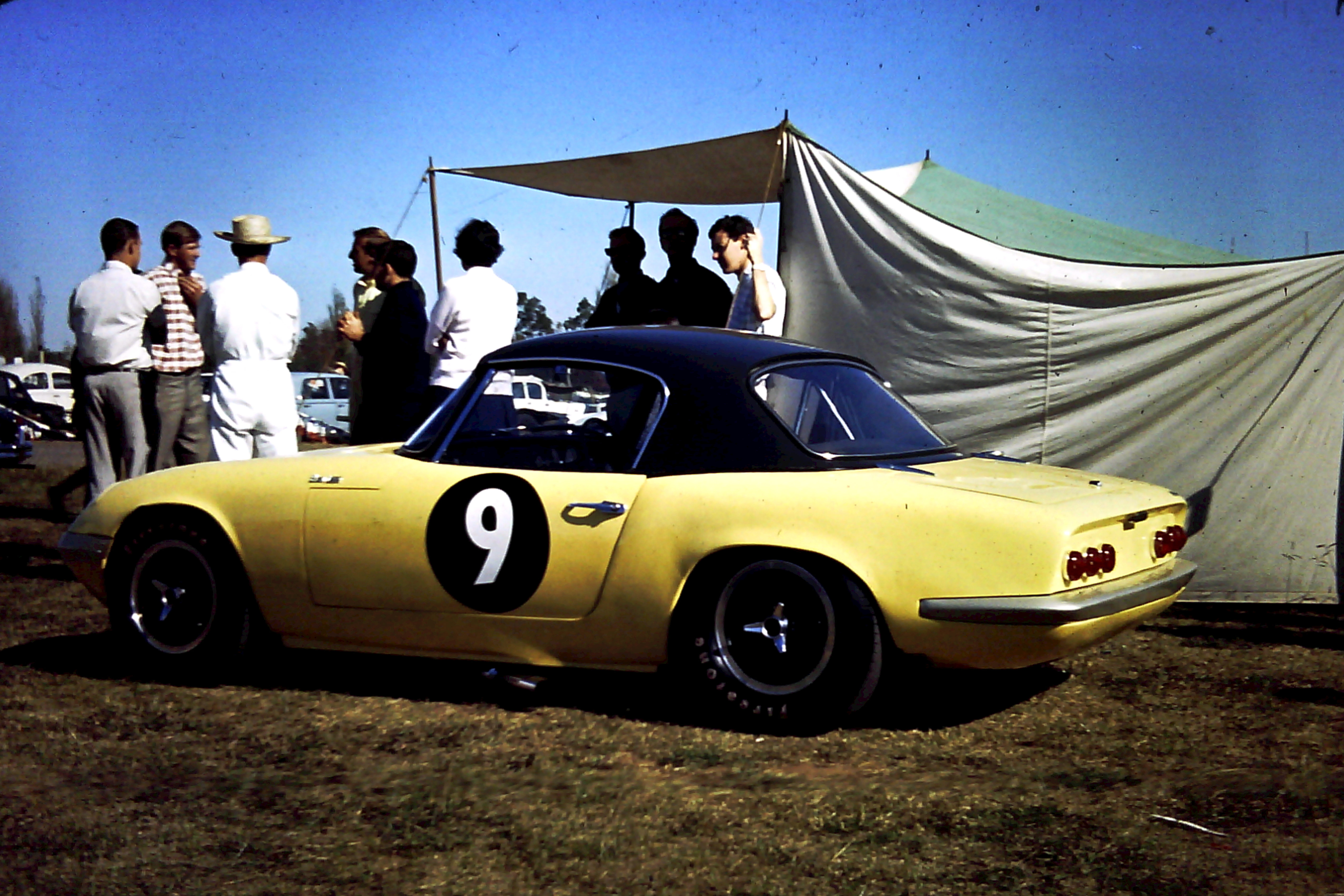
The Mildren team was a mid-1960s staple at The Farm. The cars were always painted yellow; Glenn Abbey, the team’s Chief Mechanic, was a master. Kevin’s car control was superb. To this day I’d put him up there with Le Mans winners and GP2 front-runners. He could balance an Alfa GTA on the outer extremities of opposite lock through Paddock Bend and then in the next race glide the Tasman Brabham through Homestead with fingertip precision. That’s actually the Mildren Alfa GTZ behind the Brabham; and there, in the background, smiling, is Fred Gibson, whose yellow lightweight Elan (shown here, not Mildren yellow) was both gorgeous and very fast. I don’t recall its inside front wheel touching the road very often. I know you think the cars in the background have not been parked with FOM-like precision but that’s what I liked about The Farm: it was neat but natural and retained lots of grass. Note the Mini Cooper S and the two Holdens. You were in one of two sectors back then: the Mini brigade or The Rest.
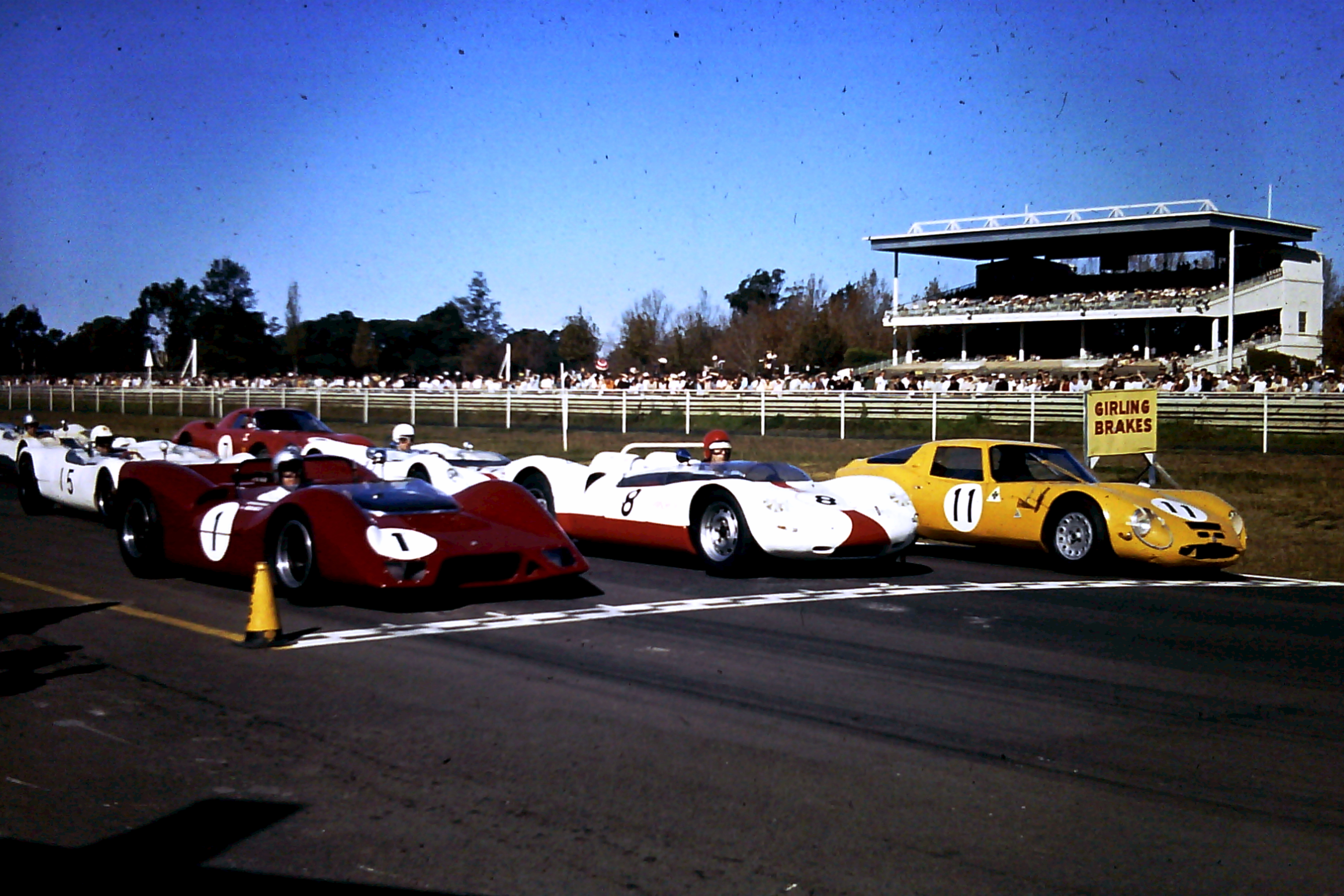
And here’s a shot of said Alfa GTZ lined up and ready to go. The genius that is Frank Matich is on the pole in one of his first races with the big Elfin sports car he developed in 1966; Alan Hamilton, who always seemed to have access to exotica, is in the middle of the front row in his Porsche Spyder; and KB is there in the Alfa. Two lovely, white Lotus 23Bs fill the second row (I think driven by Frank Demuth and Niel Allen) and on the outside of the third row you can see David McKay’s famous Ferrari 250LM, driven by Spencer Martin. From memory, Hamilton jumped this start by a mile and was leading by about 100 yards when the flag dropped! This is a typical Warwick Farm scene: packed grandstands, perfect weather, stunning collection of cars and drivers.
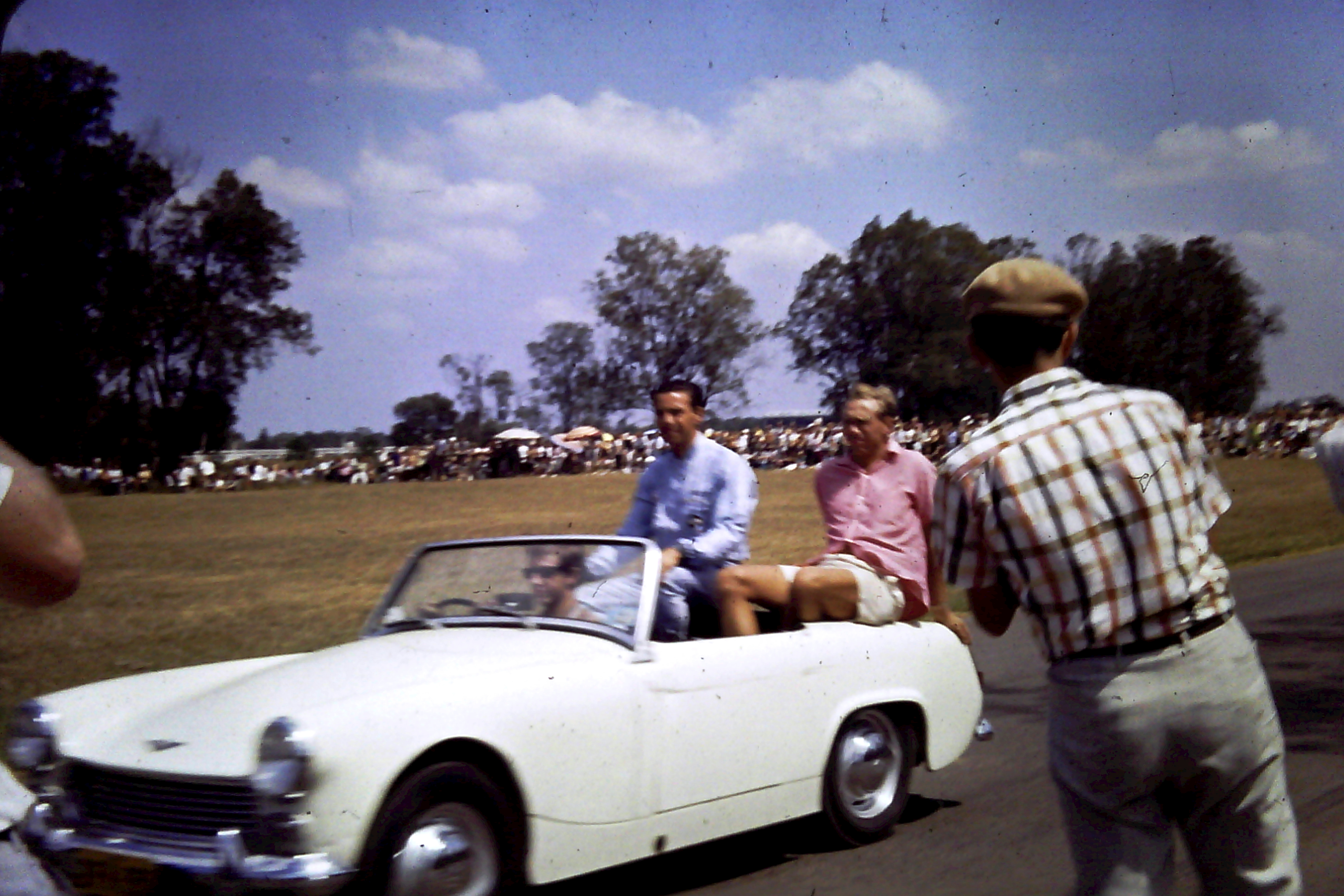
My last picture today is one I’ve always treasured. I watched the 1965 International 100 from the spectator bank at Creek Corner. Jim Clark won the race in his green and yellow Lotus 32B-Climax, with Frank Matich a brilliant third in the Total Team Brabham. All was right with the world. Then came The Moment: as one, the crowd jumped the wooden fences and swarmed onto the track, there to greet the winner on his parade lap. I remember standing there, hot and sweaty, so nervous that I could barely breathe. I was going to see Jim Clark! He was going to be driven right past me, mere feet away!
The white Sprite shimmered into view. I could pick out the light blue overalls of the winner, black hair glistening in the afternoon sun. Who was that next to him, though, in the red-and-white checked shirt? I was mystified. I didn’t know whether to line up the camera or to keep peering at the slowly-approaching car, trying to identify The Other Guy. Then suddenly it hit me: Mike Spence! Mike Spence! Jim Clark’s F1 team-mate. He hadn’t raced at The Farm that day. I didn’t even know he was in Australia. In a panic, I raised my camera and fired. The result wasn’t very pretty.
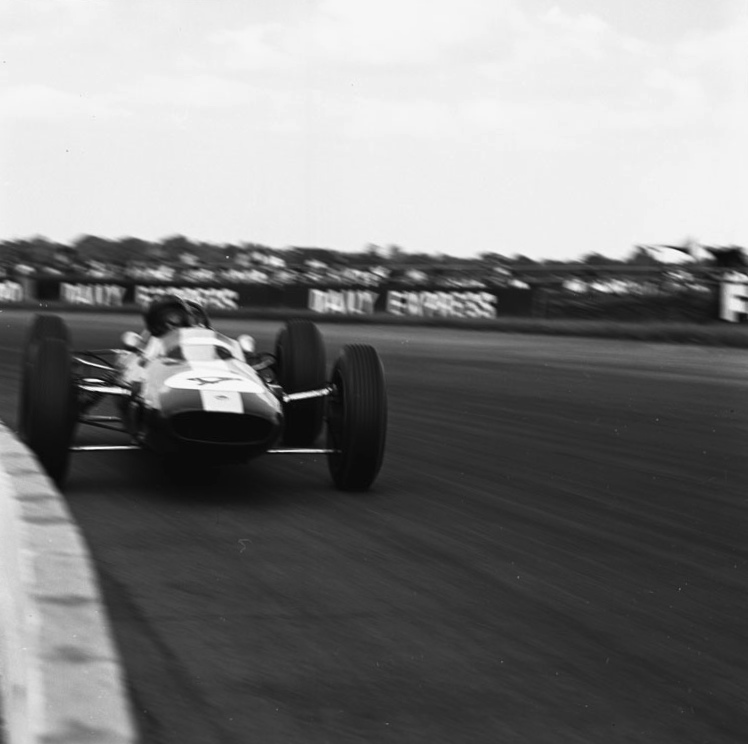
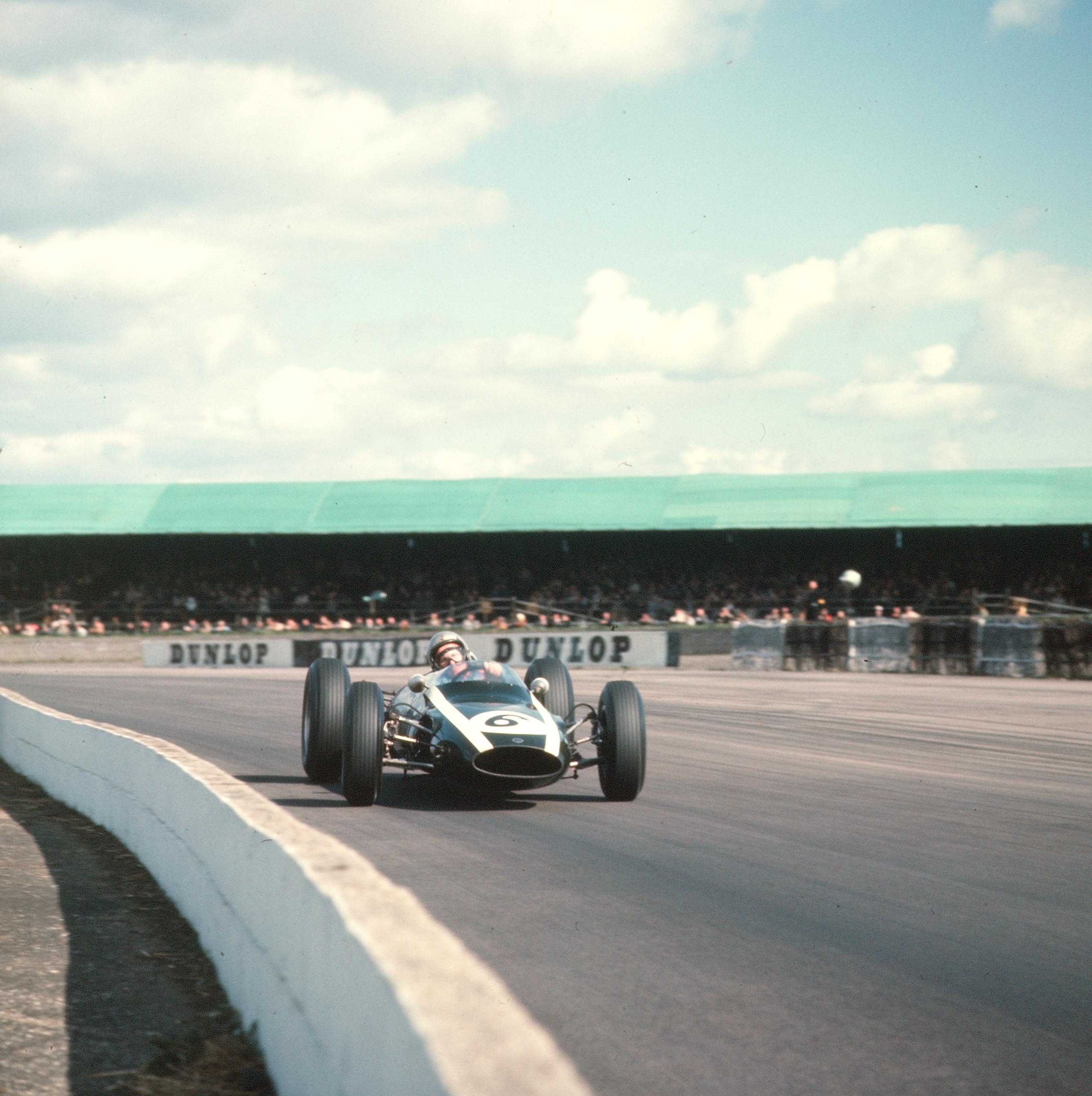
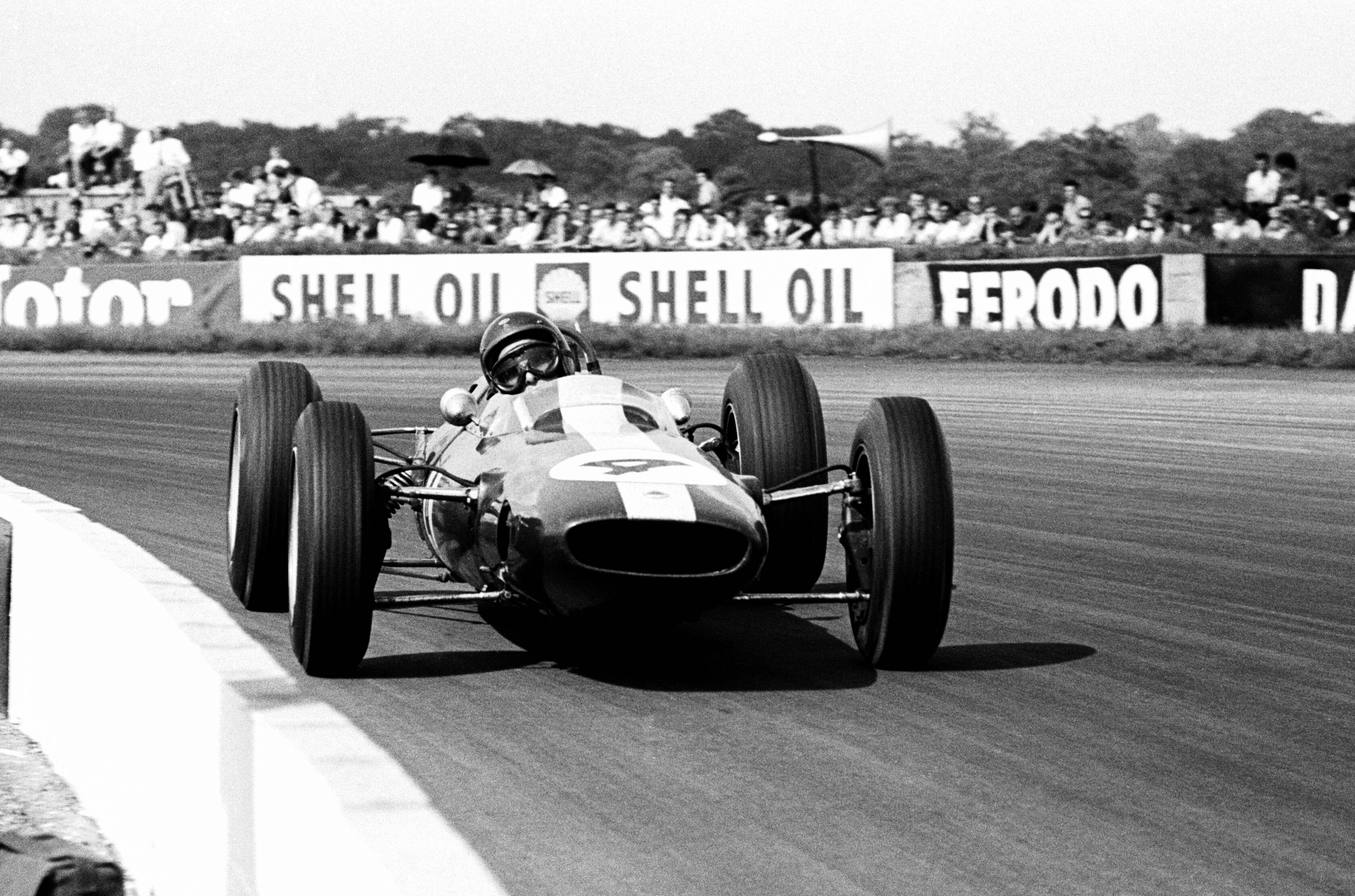
Perfectly balancing smaller diameter rear Dunlops on an oily Silverstone track surface, Jim Clark wins the British GP
After a whirlwind start to the year Jim Clark was able to relax for a few days. Three successive wins enabled him to enjoy the farm like never before; and, back in Balfour Place for a few days before the run up to Silverstone, Sir John Whitmore was full of Rob Slotemaker’s antics and all the recent racing news. In between, however, there was the little matter of the Milwaukee test. The Indy Lotus 29-Fords had basically been garaged at the Speedway since the race but, in the build-up to the Milwaukee 200 on August 18, rebuilds and further fettling took place at Ford’s headquarters in Dearborn, Michigan. Jim flew to Chicago on July 10 and on July 12 completed a successful day at the one-mile Milwaukee oval, running through Dunlop tyre compounds and in the process raising the average lap speed – over one mile! – by nearly 5mph.
Dan Gurney, who also tested at Milwaukee, had meanwhile shared a Ford Galaxie with Jack Brabham in the Six-Hour Race at Brands Hatch on July 7. A massive spin at Paddock in the rain (due to having to run Firestone wets on the front and Goodyear dries on the back) had cramped his style somewhat. Mike Parkes had cleaned up at Silverstone in his GTO Ferrari but, worryingly, the day had been ruined by two fatal accidents – one (John Dunn) at Abbey in the Formula Junior race and another in the pit lane (Mark Fielden, whose stationary Lotus was hit by a car spinning its way out of Woodcote). The excellent Sheridan Thynne, who would later become Commerical Director of Williams F1, won his class and set fastest lap at Snetterton in a Mini and a few days later wrote poignantly to Autosport, suggesting that a Safety Committee be convened to look into all matters of motor racing safety “before they were underlined by fatal accidents”. Sadly, as ever, his words went unheeded: a third person (a pit lane scrutineer, Harald Cree) would be killed at Silverstone on British GP race day when the very talented Christabel Carlisle spun her Sprite into the Woodcote pit wall. In another Woodcote incident, former driver and future Goldhawk Road car dealer, Cliff Davis, would exhibit immense bravery as he leapt onto the track to clear it of debris after an MGB rolled itself to destruction. Davis was later deemed to have saved several lives. Lorenzo Bandini, who would finish an excellent fifth at Silverstone in his the old, red, Centro Sud BRM, had not only won for Ferrari in the big sports car race at Clermont-Ferrand but had also been a part of the first all-Italian win at Le Mans on June 15-16. He co-drove a Ferrari 250P with Ludovico Scarfiotti; and, in the Formula Junior race at Clermont, Jo Schlesser had won from an amazing line-up of future stars – Mike Spence, Peter Arundell, Tim Mayer, Richard Attwood, David Hobbs, Alan Rees and Peter Revson. John Whitmore himself had won the Mini race at Silverstone after a big dice with Paddy Hopkirk – and Tim Mayer, that FJ star and future McLaren driver – had even raced a Mini at Mallory Park, door-to-door with Paddy Hopkirk. Whilst up in Scotland, Jim had been able to catch up with young Jackie Stewart, who had won at Charterhall in the Ecurie Ecosse Tojeiro on the same day as the French GP; and, finally, with the London premiere of Cleopatra set for July 31, Jim had thought it a good moment to ask Sally Stokes if she might be free for a night on the town…
The British Grand Prix was held on Saturday, July 20, (oh for a return to Saturday racing!) which meant that the big event of the weekend would undoubtedly be Graham Hill’s party at his Mill Hill house on the Sunday. Prior to that, there was a little bit of business to which to attend. Most of the F1 teams began testing on Tuesday, prior to practice on Thursday and Friday morning, and Jim was almost immediately on the pace. I say “immediately”: a loose oil line lost him time on Thursday morning but he was quickest by a whole second from Graham Hill (spaceframe BRM) later that day and fractionally faster than his Indy team-mate, Dan Gurney (Brabham), on Friday. Jim thus took the pole with a 1min 34.4sec lap of Silverstone, equaling Innes Ireland’s very fast practice times with the BRP Lotus 24-BRM at the International Trophy meeting on May 11. (Years later, when I chatted to Jim Clark at some length, he re-iterated what he frequently said about the space-frame Lotus 24: it was an easier car to drive than the 25 and in Jim’s view could just have capably have won races in both 1962 and 1963. Indeed, Innes’ Goodwood-winning Lotus 24 was actually being advertised for sale by the time of the British GP, viewable at BRP’s headquarters in Duke’s Head Yard, Highgate High Street, London N6. It wasn’t sold that year, as it turned out, and was raced again, in Austria and Oulton Park, by Innes. Jim Hall then drove it – for BRP – at Watkins Glen and Mexico.)
Still running a five-speed ZF gearbox (whilst team-mate Trevor Taylor persisted with the six-speed Colotti on carburettors), Jim’s trusty, fuel-injected Lotus 25/R4 had now blossomed into its ultimate, legendary 1963 form: Colin Chapman had decided to run a wide yellow stripe down the car, front to rear, co-ordinating the yellow with the wheels and the “Team Lotus” lettering and pin-striping down the cockpit sides. The car also ran the Zandvoort-spec aeroscreen. Jim, as ever, wore his Dunlop blue overalls, his peakless Bell helmet, string-backed gloves, Westover boots and, for when he was out of the car, helping the mechanics or strolling over to the Esso caravan or the paddock cafe for a cuppa, his dark blue Indy Pure jacket. The 25, meanwhile, finally wore a new set of Dunlops – around which revolved the usual number of discussion points. On this occasion it was gear ratios: as part of the compromise with the five-speed (but more reliable) gearbox, Jim and Colin decided to race smaller-diameter rear Dunlops.
Bruce McLaren, driving the beautiful, low-line works Cooper-Climax, stopped practice early on Friday to begin preparation for the race. While John Cooper supervised the job list, Bruce, as was his style, took his new E-Type Jag down the infield runway to the apex of Club Corner, there to watch his peers. At this point I can do no better than to record the words he later gave to Eoin Young for Bruce’s wonderful, regular, Autosport column, From the Cockpit:
“Dan Gurney had got down to a time equaling Jim’s best, and Jim was out to see if he could do better. Graham was in danger of being knocked off the front row so he was out too, and for 15 minutes, while Jim, Graham and Dan pounded round, I was graphically reminded of the reason why people go to see motor racing.
“When you’re out in an F1 car you haven’t got time to think about the fact that you’re moving fast: you’re concentrating on keeping the movement of the car as smooth and as graceful as possible, getting the throttle opened just that fraction quicker than last time and keeping it open all the way when you’ve got it there.
“At Silverstone you concentrate on shaving the brick walls on the inside, just an inch or two away, and you hold the car in a drift that, if it were any faster, would take you into a bank or onto the grass. If you are any slower you know you are not going to be up with those first three or four. You know perfectly well you are trying just as hard as you possibly can, and I know when I’ve done a few laps like this I come in and think to myself, well, if anyone tries harder than that, good luck to them.
“But you haven’t thought about the people who are watching. At least I haven’t, anyway, but there at Club Corner the role was reversed and I was watching…
“Jim came in so fast and left his braking so late that I leapt back four feet, convinced that he wouldn’t make the corner, but when he went through, working and concentrating hard, I’m sure his front wheel just rubbed the wall. I barely dared to watch him come out the other end.
“It struck me that Clark and Gurney’s experience at Indy this year may have had something to do with their first and second places on the grid. Silverstone is just one fast corner after another, taken with all the power turned right on and the whole car in a pretty fair slide but, nevertheless, in the groove for that corner. Something like Indy, I should imagine.
“I’ve seen a lot of motor racing and if I could get excited over this I can imagine how the crowd of 115,000 on Saturday must have felt.”
Saturday was one of those great sporting occasions in the United Kingdom. One hundred and fifteen thousand people were crammed into Silverstone by 10:00am; and by 2:00pm, by which time they’d seen Jose Canga two-wheeling a Simca up and down pit straight; Peter Arundell win the FJ race from “Sally’s MRP pair” (Richard Attwood and David Hobbs); Graham Hill demonstrating the Rover-BRM turbine Le Mans car; an aerobatic display and the traditional drivers’ briefing, everyone was ready for the big event. Dan Gurney settled into his Brabham with Jim Clark to his right in the Lotus 25. To Dan’s left, Graham Hill, the World Champion, lowered his goggles under the pit lane gaze of young Damon. Making it four-up at the front, Dan’s team-mate, Jack Brabham, sat calmly in his BT7. With but minutes to go, Jim asked for more rear tyre pressure: Silverstone had felt decidedly oily on the formation lap. The 25 had never been more oversteery.
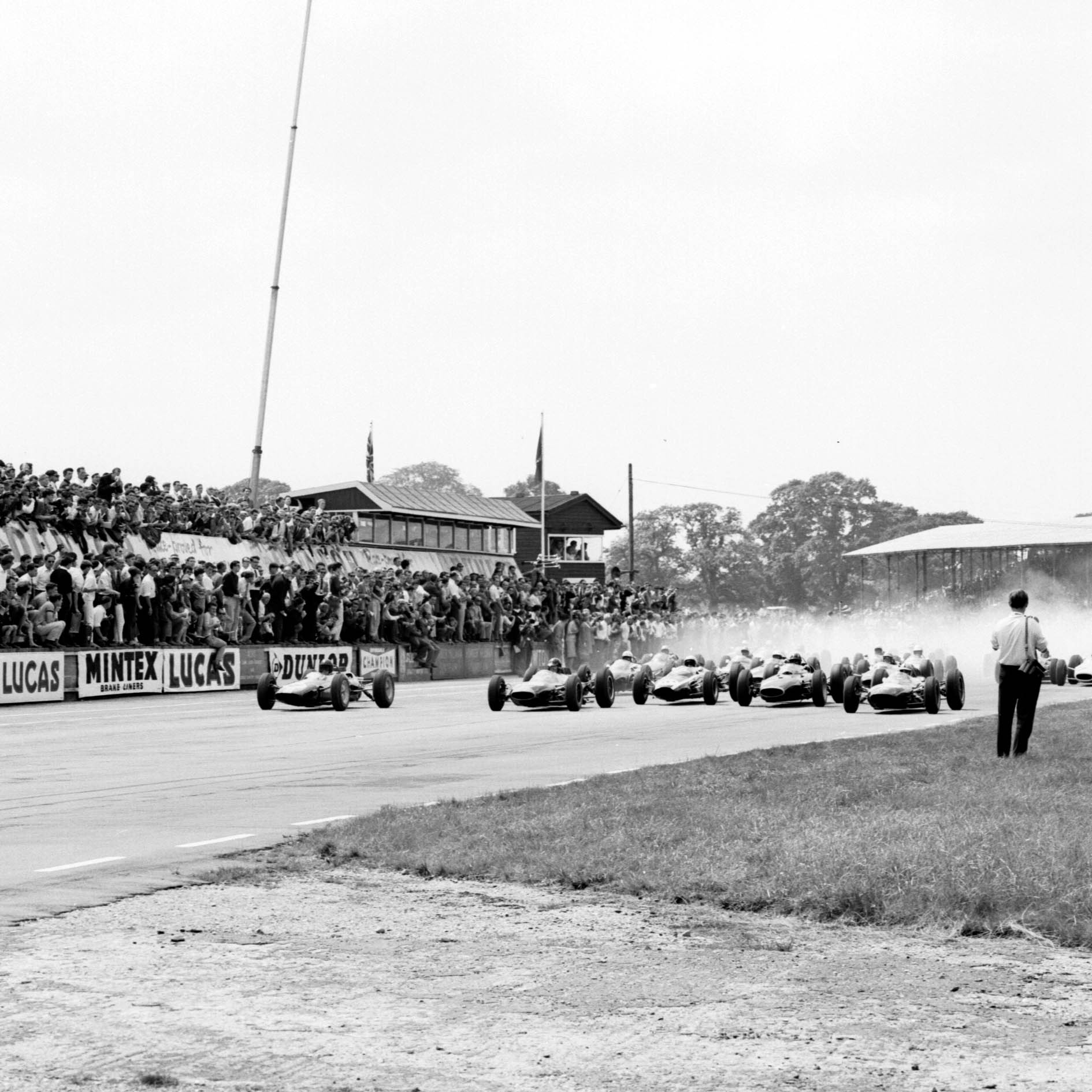
Jim was slow away on this occasion: wheelspin bogged him down. He was swarmed by the lead pack as they headed out of Copse and then onwards to Maggotts and Becketts. The two Brabham drivers – showing how relatively closely-matched the top Climax teams were in 1963 – ran one-two; then came Bruce McLaren in the svelte Cooper, then Hill and then Jim. They were running nose-to-tail – and sometimes closer than that. Gurney pitched the Brabham into oversteer at Club; Jack, helmet leaning forwards, kicked up dirt at the exit of Woodcote.
The 25 was also tail-happy; you could say that. Jim felt the car to be little better than it had been before the start – particularly now, on full tanks. Around him, though, everyone else seemed to sliding around. Maybe it was just the circuit after all…
Jim began to dive deeper into the corners, to gain a tow – and then to pull out of that tow under braking. By lap four he was in the lead and pulling away…whilst Bruce McLaren was pulling up on the entry to Becketts Corner, the Climax engine blown in his Cooper. There was no quick rush back to the pits for Bruce, no beat-the-traffic early departure. Instead, as on Friday, he stayed and watched, for that is what great athletes do.
Bruce: “Jimmy came through with his mouth open and occasionally his tongue between his teeth. The tyres were holding a tenuous grip on the road with the body and chassis leaning and pulling at the suspension like a lizard trying to avoid being prized off a rock by a small boy. Then Dan arrived, really throwing the Brabham into the corner, understeering and flicking the car hard until he had it almost sideways, then sliding through with the rear wheels spinning and the inside front wheel just on the ground…”It was a demonstration of four-wheel-drifts; it was Jim Clark rhythmically poised like never before in an F1 car, the small-diameter Dunlops combining with the surface oil to produce a slide-fest of classic proportions. There was no need for a score of passing manoeuvres to make this British GP “work” for the crowds; there was no need for forced pit stops or for overtaking aids. It was enough, this day at Silverstone, for the fans, and for drivers of the quality of Bruce McLaren, merely to see a genius at work.
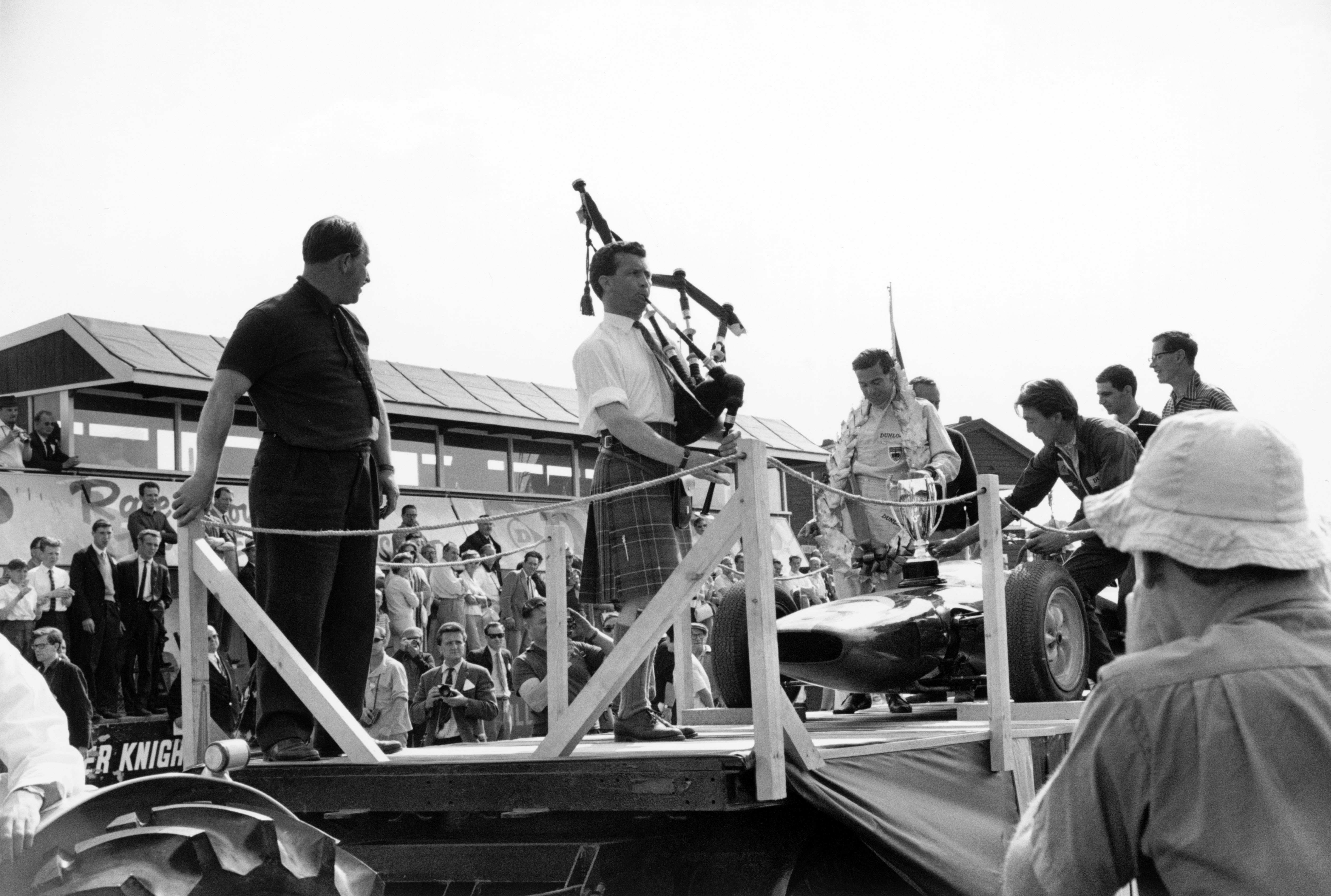
Jim won the British Grand Prix by 20sec from John Surtees’ Ferrari and Graham Hill’s BRM (for both Brabham drivers also lost their engines after excellent runs). Graham, who, like Innes Ireland, was always fast at Silverstone, ran short of fuel on the final lap and was pipped by Big John, the lone Ferrari driver, on the exit from Woodcote. The race was also notable for Mike Hailwood’s F1 debut – he finished an excellent eighth (or, in today’s parlance, “in the points”) with his Parnell Lotus 24, and for the seventh place of his exhausted team-mate, the 19-year-old Chris Amon. Chaparral creator/driver, Jim Hall, also drove well to finish sixth with his Lotus 24. For this was a tough, hard race – 50 miles longer than the 2013 version and two and a quarter hours in duration. Jim Clark waved to the ecstatic crowd on his slow-down lap (no raised digits from James Clark Jnr) and, to the sound of Scotland the Brave – a nice touch by the BRDC – and to the lucid commentary of Anthony Marsh, bashfully accepted the trophies on a mobile podium that also carried the 25. Colin Chapman wore a v-necked pullover and tie; Jim looked exalted. He had won again at home. He had won his fourth race in a row. He had the championship in sight.
To Mill Hill, then, they repaired – and then, for a change in pace, to the following weekend’s non-championship race at Solitude, near Stuttgart.
Captions, from top: Jim Clark drifts the Lotus 25 on the greasy Silverstone surface; racing driver/flag marshal, Cliff Davis, whose selfless action at Silverstone saved several lives; Bruce McLaren finds slight understeer on the Cooper at Stowe; the two Brabham drivers, Gurney and Jack, together with McLaren and Hill, crowd Jim’s 25 at the start; classic four-wheel-drift from Jim Clark. The low apex walls were always a test at 1960s Silverstone; Scotland the Brave heralds the winner of a long, fast British Grand Prix. Two hours, 14 min of brilliant motor racing Images: LAT Photographic. Our thanks to AP and Movietone News for the following superb, colour, video highlights:
The drive down to Reims was the usual cavalcade. They left Zandvoort, after a celebratory dinner/cabaret at the Bouwes Hotel, early on Monday morning. First practice for the French GP would commence on Wednesday afternoon (or just one clear working day from the Dutch GP. As with Monaco now, there was a “free” day within the French GP schedule back then. At Reims, this was on the Saturday, following three successive afternoons of official practice. No thought, apparently, was given to the ‘double-header’ pressures facing the mechanics.) At some point in the road trip Ian Scott-Watson joined Jim and Colin in their rental car and allowed Trevor Taylor behind the wheel of his yellow Elan. Ian would thereafter spend much time telling the French police that, no, it wasn’t he who had been driving the English sports car at the time in question and that his friend, the culprit, had since flown to Canada…or anywhere…
This wasn’t the usual sun-baked French Grand Prix. Showers muddied the paddock on Thursday, leaving the Wednesday and Friday sessions for grid-shaping; Taylor, indeed, set his fastest lap on that Wednesday – and on Thursday, in the rain, neither Lotus driver completed a lap. (One significant casualty that day was Ludovico Scarfiotti, who crashed heavily in the works Ferrari. He was for the most part uninjured but shortly afterwards would announce his retirement from racing. Rescinding this a few months later, he went on to win the 1966 Italian GP for Ferrari at Monza. He would sadly lose his life in 1968, in a hill-climbing accident. He was a good friend of Jim’s.)
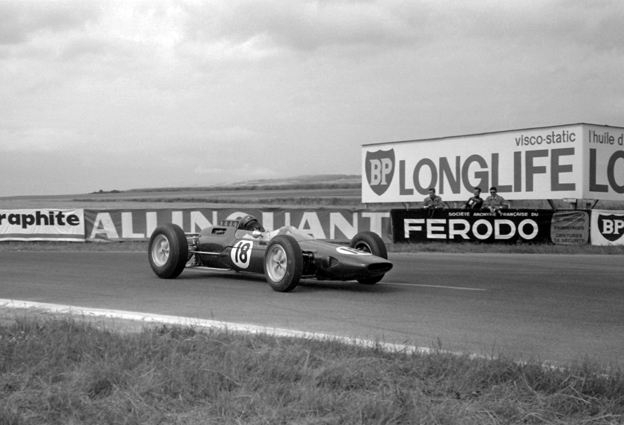
Wet or dry, flying stones were always an issue at Reims, inducing Lotus to revert to standard windscreens for this race. With the aeroscreen, it was thought, there was always a risk of debris finding its way into the “jet”. Slipstreaming on the long, ultra-fast (160mph) French public roads could gain you seconds per lap; the trick in practice, if you were searching for the pole, was to keep your mirrors free. Despite a considerable straight-line speed deficiency to the BRMs (including Innes Ireland’s BRP-BRM) and also to the Ferraris, Jim took the pole – and the local champagne that came with it. In the 25, running the same set of Dunlop R6s he had raced at Monaco, Spa and Zandvoort, Jim found a sweetness in the balance on high-speed corners that he had not felt before – or would feel again in 1963. “I could set the car up in a whacking great drift around the back, keep my foot it it and achieve cornering speeds that I wouldn’t have thought possible,” he would say later. Very few photographers – if any – seemed to venture out to these corners in those days (they focussed on the “long” shots on the pit straight and the 90 deg right hander leading on to it) so we are left only to imagine what Jim describes as that “whacking great drift”. To my mind, given the understeer with which he lived at the International Trophy race at May, the 25 at Reims was now far more neutral – neutral leading to oversteer. I think it’s also probably significant that by this race Team Lotus seemed to have found some sort of fix for their gearbox drams. Jim, at last, was able to drive the 25 with both hands on his red leather-rimmed wheel.
Saturday was support-race day, which meant big sports cars and Formula Junior. Jim was at the track, of course, primarily supporting the Normand Lotus 23Bs (Mike Beckwith and Tony Hegbourne) and Peter Arundell in the FJ race. There had even been talk of Peter racing the third (spare) 25 in the Grand Prix but ultimately it was felt (when balancing prize money against running expenses!) that Peter should race the works (“mini-25”) 27 FJ. Denny Hulme again won the FJ battle in the works Brabham, pulling away definitively from the second-place slipstreaming group and finally finishing ahead of Peter, Richard Attwood (MRP Lola), fellow Lotus drivers, Mike Spence and John Fenning, and David Hobbs (MRP Lola). (As the 50th anniversary of the formation of Bruce McLaren Motor Racing Ltd approaches, it’s also worth noting that the talented American, Tim Mayer, finished eighth in this Reims FJ race in one of Ken Tyrrell’s Cooper-BMWs. Tim and his brother, Teddy, would in the months that follow become an integral part of the new McLaren team.)
Tall and talented Mike Parkes should have won the sports car event with his formidable 4-litre Ferrari but a clutch problem early in the one-hour event effectively handed victory to Carlo Abate (also of powerboat fame) and his 3-litre Ferrari. Lucien Bianchi (great uncle of Jules) placed third behind Dick Protheroe – and the tough Australian, Paul Hawkins, finished fifth overall with his Ian Walker Lotus 23. Mike Beckwith had been right up there in third place in the early phase, when Jo Schlesser was leading with his 4-litre Aston, but he fell back a little after a slight “off”. The small-car class was won by Jose Rosinski, who would go on to become one of the greatest of all French motor racing journalists.
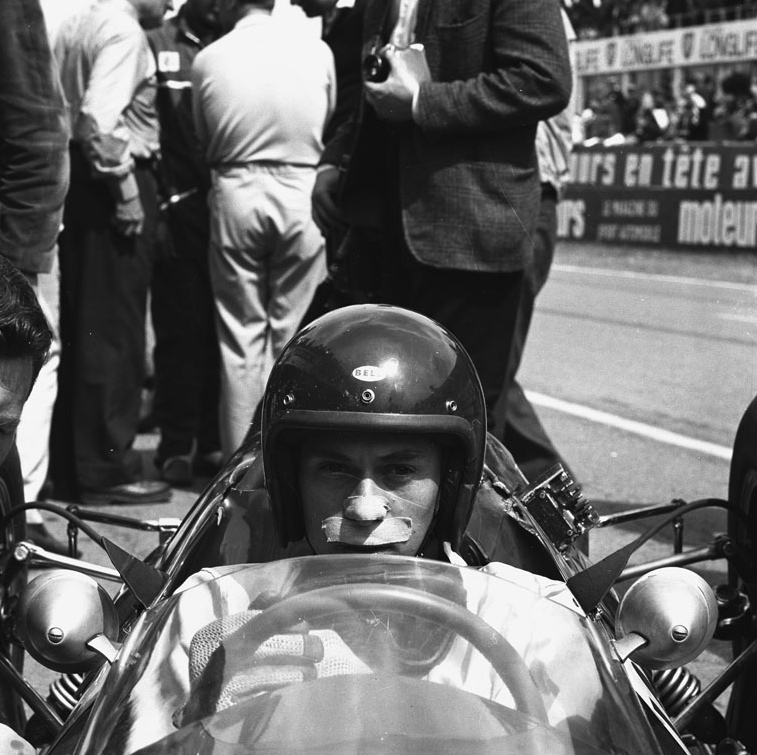
On Sunday – another overcast day – Jim prepared for a torrid French GP as a fighter prepares for a bout, applying white masking tape across his face for extra protection. Even in the dry, this race would run for well over two hours.
The start, as they say, was the usual shambles. A fuel vapour lock killed the engine in Graham Hill’s BRM. Push-starts were forbidden by the regulations…but “Toto Roche”, the autocratic leader of French motor sport and official starter, instructed the BRM mechanics to push Hill’s car nonetheless. The V8 now revving purely, Roche then quickly stepped away and dropped the flag – except that he dropped a red flag rather than the French national tricolor. No-one was exactly sure what to do – but they went for it nonetheless.
Jim Clark accelerated hard through the gears to 9,600 (with a max set at 9,800) and then focused on driving the perfect lap: “Before the race,” he would say later, “I had said to Colin that if I could make the fast corners in front I felt I could open a gap and break the tow. If I wasn’t in front we agreed that it would be better if I just sat back for a while and let them get on with it…”
Jim was in the lead by the time he reached the first, quick right-hander. And the second. And the third. Full tanks or not, he four-wheel-drifted the 25 with fluid inputs and pin-sharp judgement. By the time he reached Muizon, the right-hand hairpin, he had free air behind him. He could forget about his mirrors.
Jim’s standing lap was completed in 2min 31.0sec; his Indy team-mate and friend, Dan Gurney, lay second a full 2.7sec behind. Richie Ginther, powered by probably the best engine on the circuit that day, catapulted his BRM up to second place on lap two. Even so, Jim was leading by nearly four seconds as he passed the Team Lotus signalling board, the 25 sitting on 9,600rpm.
And so it went on. John Surtees (Ferrari), Dan and Jack (working together in the Brabhams), Bruce McLaren (Cooper), Trevor and Graham Hill scrapped over second place, swapping track space either in top gear, in the tow – or under braking. At the front, Jim continued to pull away. By lap 12 of the 53-lap race, he was 19 seconds ahead of Brabham.
Then, for Jim, it all seemed to go wrong. His Climax engine began to mis-fire at 9,600rpm. Jim immediately throttled back to 8,000 rpm, where he found a “sweet spot” around which the engine seemed to be half-ok. He then concentrated even harder on those fast corners but was forced to sit back helplessly on the straights, waiting for the engine to blow – and/or for the next round of bad news on the pit board, for Brabham was now catching him. All around the circuit, what’s more, Jim could see parked cars. Reims was forever tough on all mechanical components – so why was this circuit, on this day, going to be any different for him?
Because on this day – as it had been all week – it would rain. Jim felt the grease on the track even before his goggles went smeary, for the grooves of the R6s were now worn virtually to slicks. He was dancing on ice – focussing once again on those fast, very drifty corners where still the 25 felt perfect. His lap times climbed by ten, 15 seconds; Graham Hill’s ballooned by 20 seconds. Maximum revs became irrelevant; it was all about delicacy.
And so, maintaining that lead, Jim Clark crossed the line, acknowledging Toto Roche’s chequered flag with a raised left arm. In the grandstands, umbrellas dominated the visage. On the rev-counter of Jim’s 25, the tell-tale needle sat resolutely at 9,600rpm. On the work bench later, back in Coventry, Jim’s engine was found to have two broken valve springs. Trevor (who for this high-speed race, like Jim, raced without a peak on his helmet) might well have finished second had the crown-wheel-and-pinion not failed. As it was, Graham Hill’s second place was subsequently disallowed due to that push start (subsequently, as in “by the time they got to Monza”.) Tony Maggs therefore finished an excellent second for Cooper, catching and passing Hill in the closing stages when the monocoque BRM ran into both clutch and brake issues. Jack took Graham’s third place, with Dan finishing fourth.
Post-race, there was more pandemonium: a policeman suffered an epileptic fit as he was attempted to clear the crowds from the pit area. Through the melee, though, Jim and Colin found their way opposite to “the press box”, where they chatted to journalists like Gregor Grant (Autosport), Philip Turner (Motor), Peter Garnier (Autocar) and several of the Fleet Street types.
Thus it was done. A new era had begun. Jim Clark and Team Lotus had won three in a row – Spa, Zandvoort and Reims – and had changed the face of Formula One. The driver lay low in his monocoque car. The speed, and the suppleness of that speed, was extraordinary.
Next: the British Grand Prix at Silverstone.
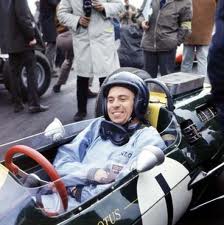
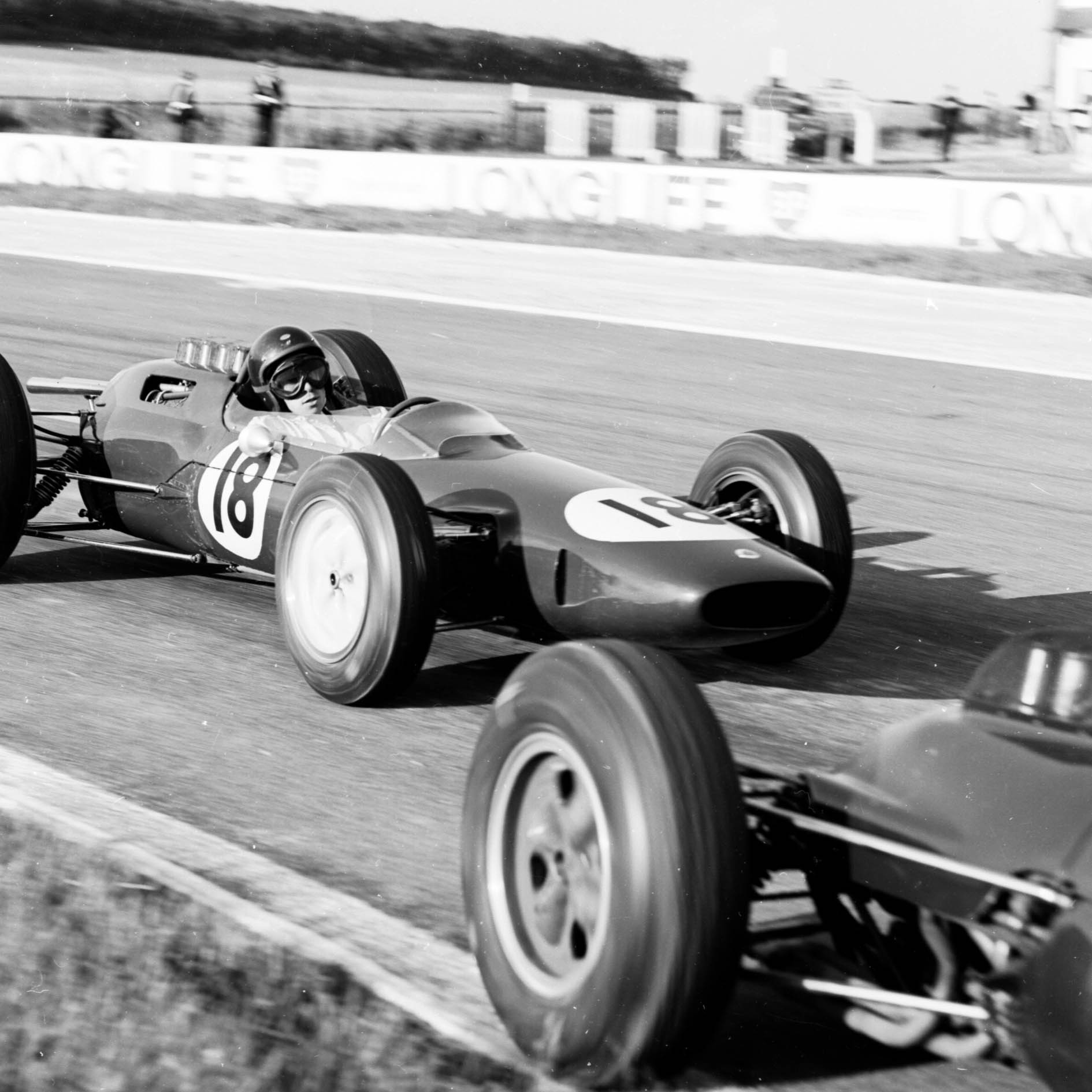
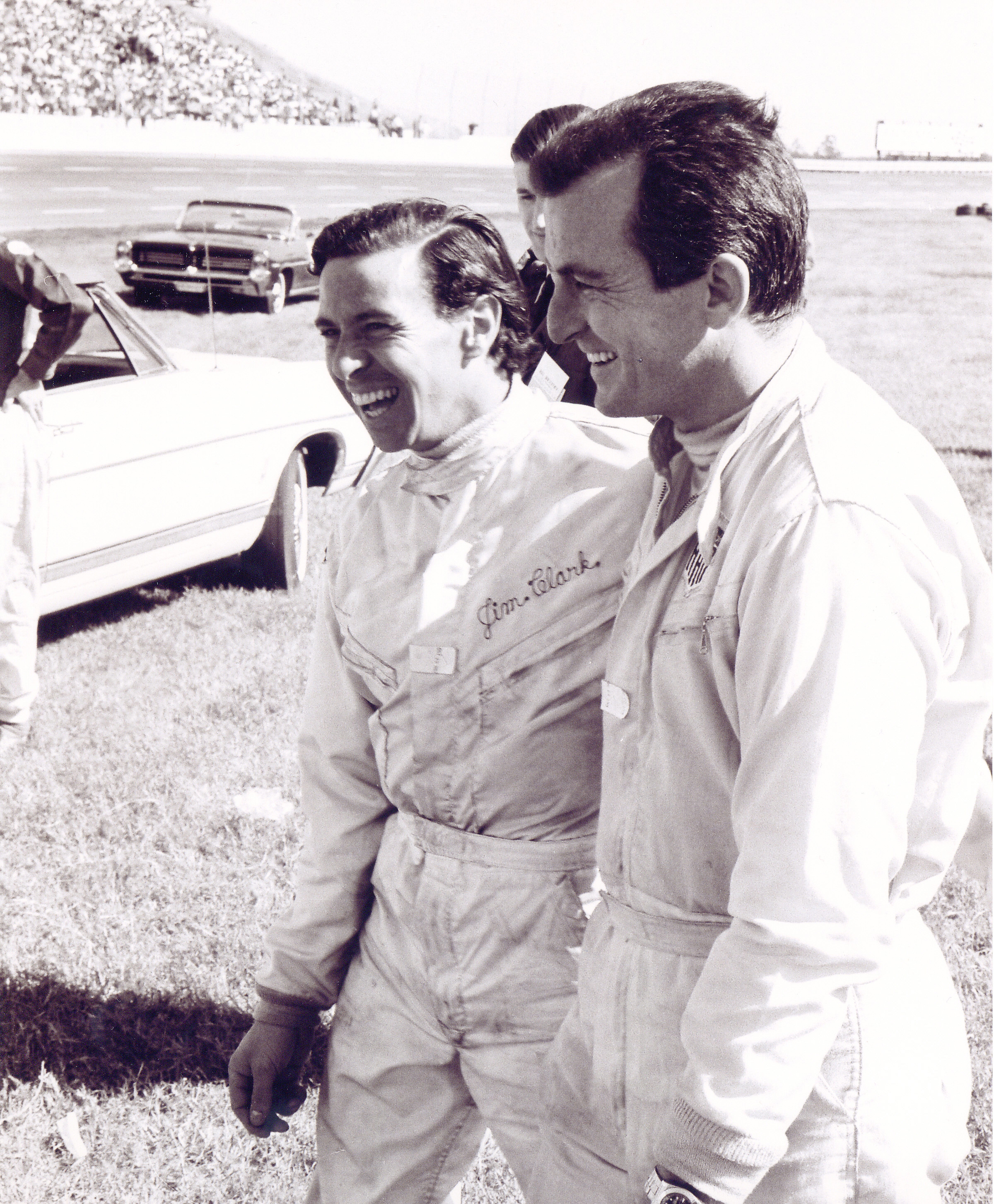
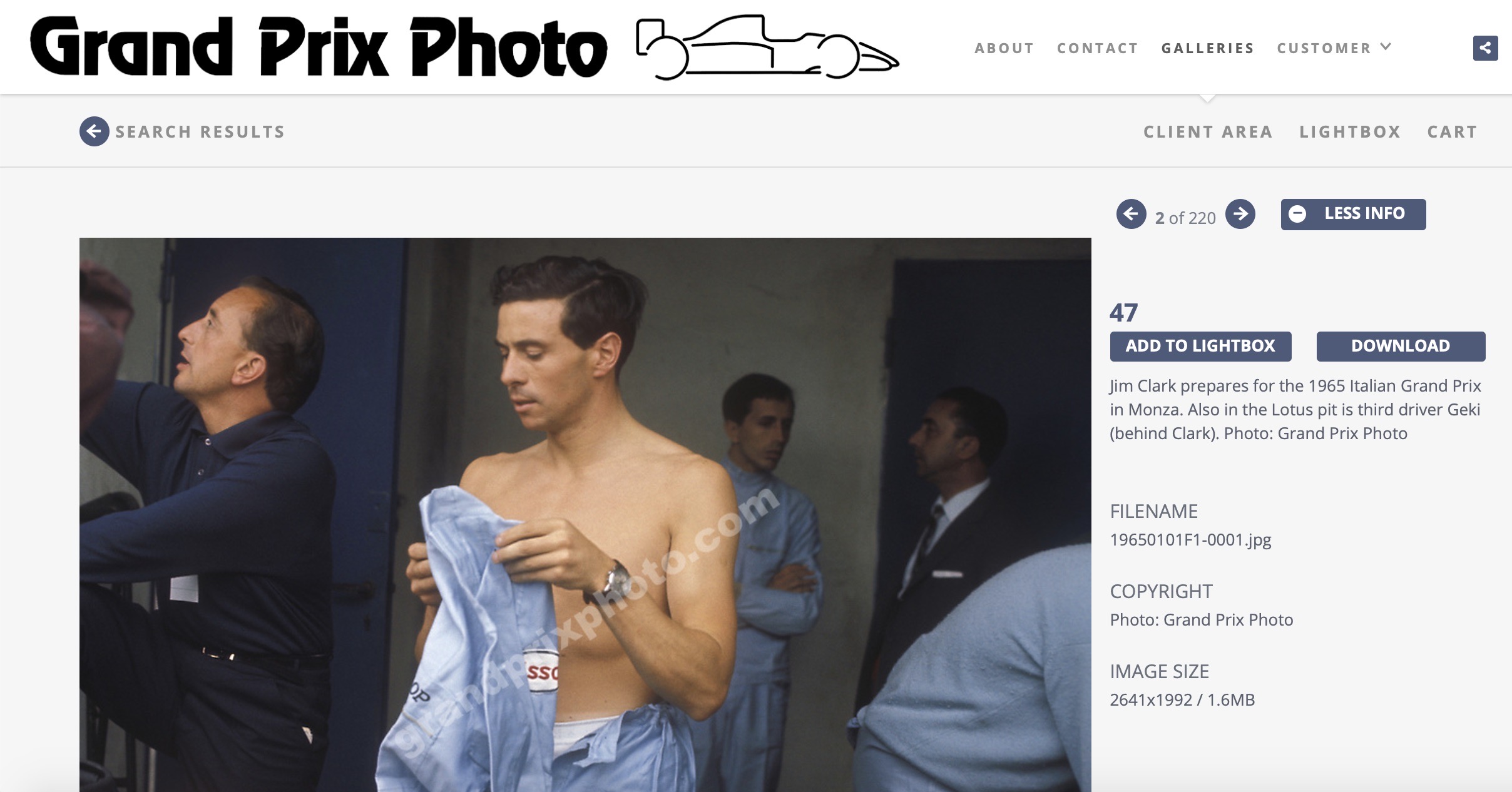
Captions from top: face taped to provide at least some protection from flying stones, Jim Clark readies for battle at Reims; Reims practice shot of Jim in the aeroscreened 25; for the race, the conventional screen was used. This was also the last race for a 25 sans yellow stripe; Jim and his friend, Ludovico Scarfiotti, photographed at the Rockingham NASCAR race in 1967 Images: LAT Photographic; Peter Nygaard Collection; Peter Windsor Collection
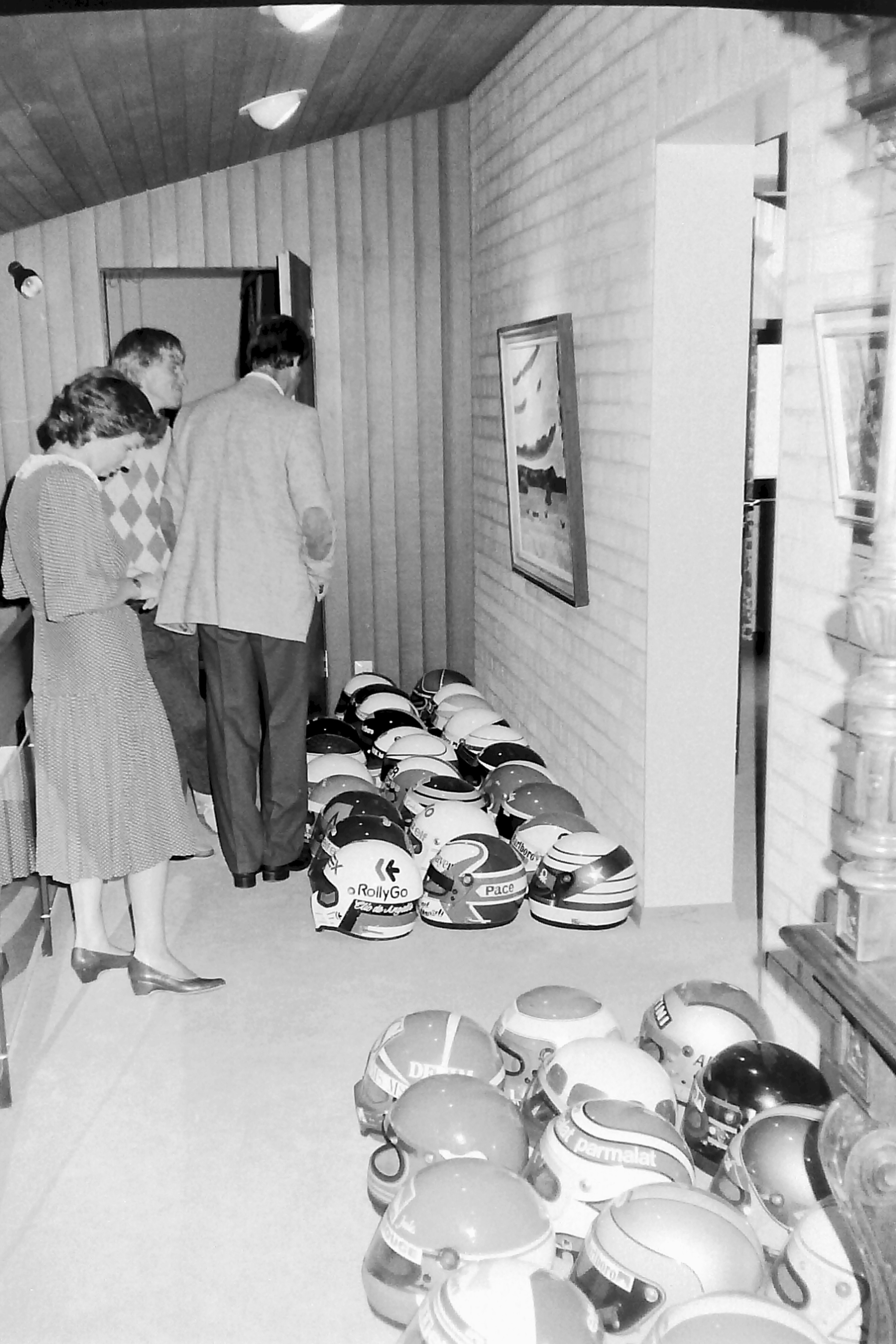
I’ve given up waiting for John Surtees to be awarded a knighthood so I’m just going to go ahead and call him “Sir John” from here on in. Anyone who can drive and engineer F1 cars as well as he did – and win World Championships on both two wheels and four – deserves to be a Lord in my book, let alone a Knight. Accentuating the theme, I came across this photo in the files the other day: it’s of me wearing Sir John’s 1964 Championship-winning Everoak helmet, taken in the house of Gert Kramer in 1984. Gert is a friend who used to work for Daimler Benz; and, as you can see from the other photo, he has/had one of the best F1 driver helmet collections in the world. Senna? Prost? Reutemann? No problem. And, yes: that is Nigel and Rosanne Mansell there with Stefan Johansson.
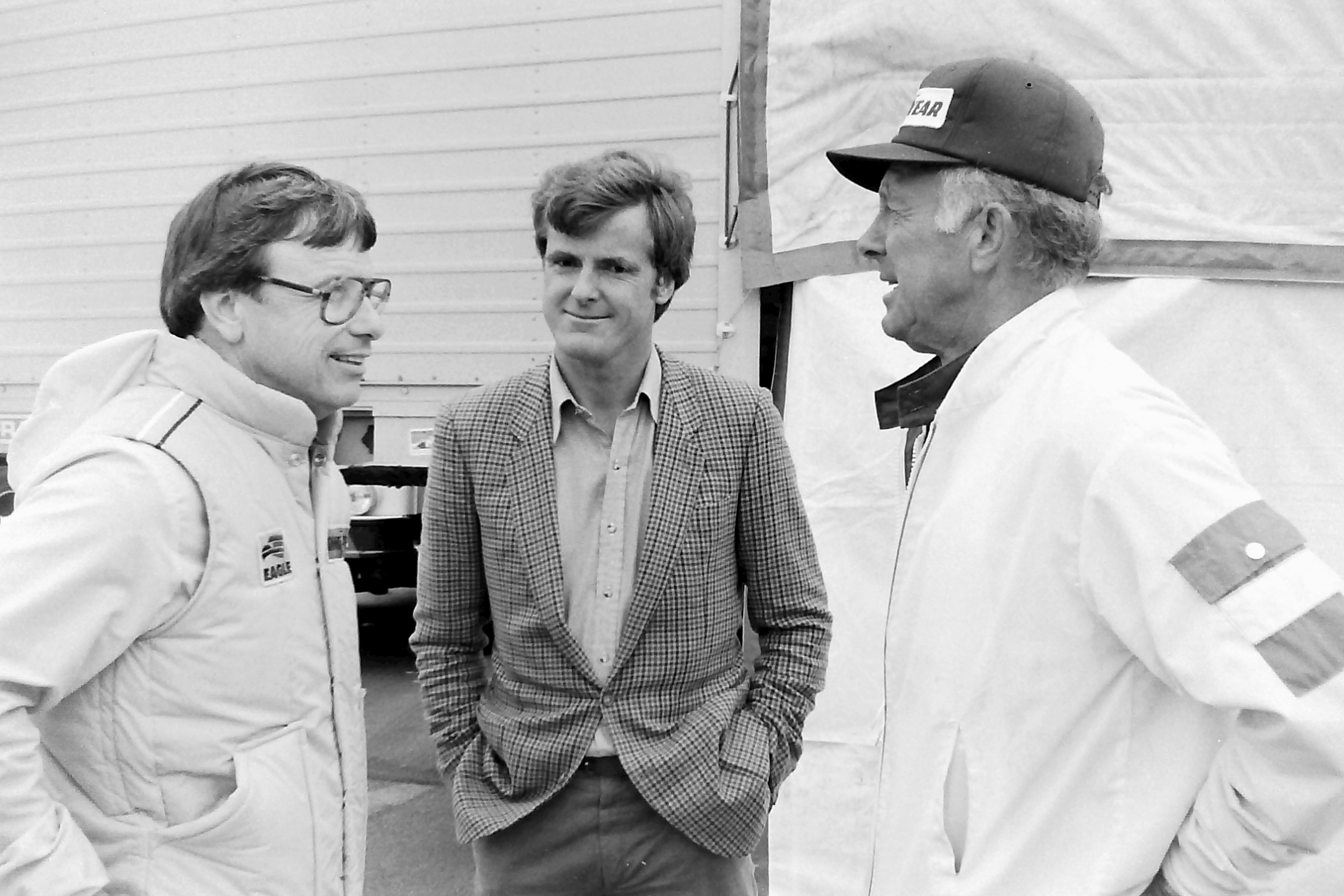 As we’re going to be hosting the ebullient Alastair Caldwell on next week’s edition of The Racer’s Edge, I thought I’d include this neg scan of AC in conference with the Goodyear brass (specifically Leo Mehl, left) and Lee Gaug (right). Leo always made me smile; he had this knack of always being able to mix racing politics with a true grasp of real life. And, through Leo, I discovered one of my favourite authors – Herman Wouk. “What’s that tome you’re reading?” I asked Leo once, at some airport. “War and Remembrance,” he replied. “It’s got just enough fiction to make it sizzle and more than enough history to be real. Can’t put it down.” How right he was. Lee was also a player. A pipe-smoker and an ex-marine who flew Brewster Buffalos from flat-tops, Lee always used to joke about his wives: “They’re all homekeepers. They’ve kept every one I ever owned…” Alastair, meanwhile…well…you can find out for yourselves what makes Mr Caldwell tick on next week’s show. I don’t think you’ll be disappointed.
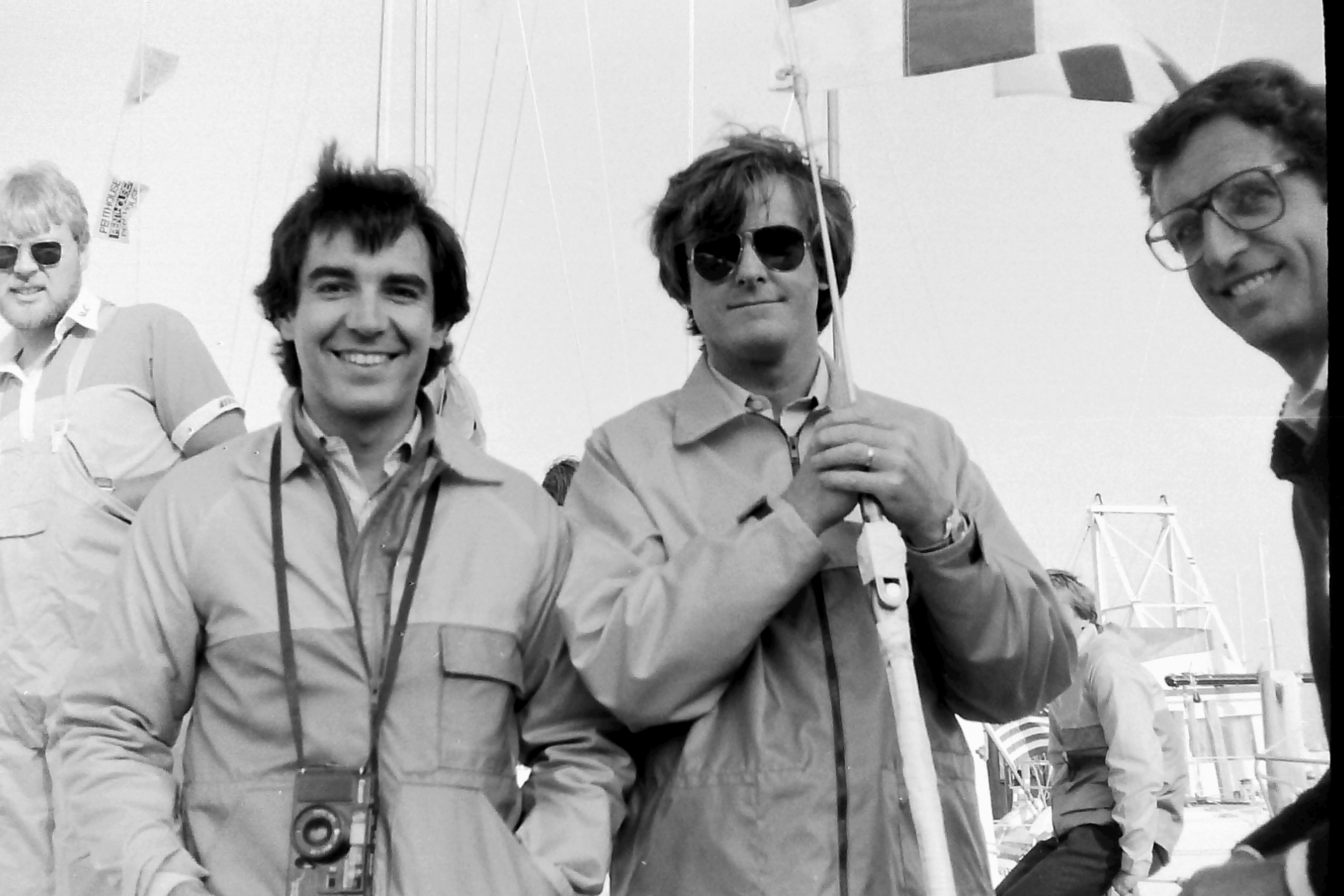 For good measure, here’s another AC shot. This time we’re taking part in the annual Grosse Pointe sailing regatta that preceded the Detroit Grand Prix every year. That’s the largely under-rated and multi-talented (F1, Indy, WRC) Chilean driver, Eliseo Salazar, on Al’s right and on his left is Dieter Stappert, who for many years wrote for the magazine with the greatest of all titles – Powerslide. Dieter was always impressive, I think: small note book in his hip pocket, nice pen, astute questions. He later worked for BMW.
 and, below, on the Reutemann family and friends, seen here enjoying an early-evening game of soccer in the back yard of Carlos’ home on the Circuit Cap Ferrat, South of France. That’s Cora Reutemann, who would in time become a first-rate photographer, looking as though she’s about to score a goal. Jose-Maria Candiotti, one of Carlos’ mates – and tennis doubles partner – from Carlos’ home town of Santa Fe, is on the right. I used to stay at Carlos’ place before the Monaco GP – and sometimes before the French GP, too.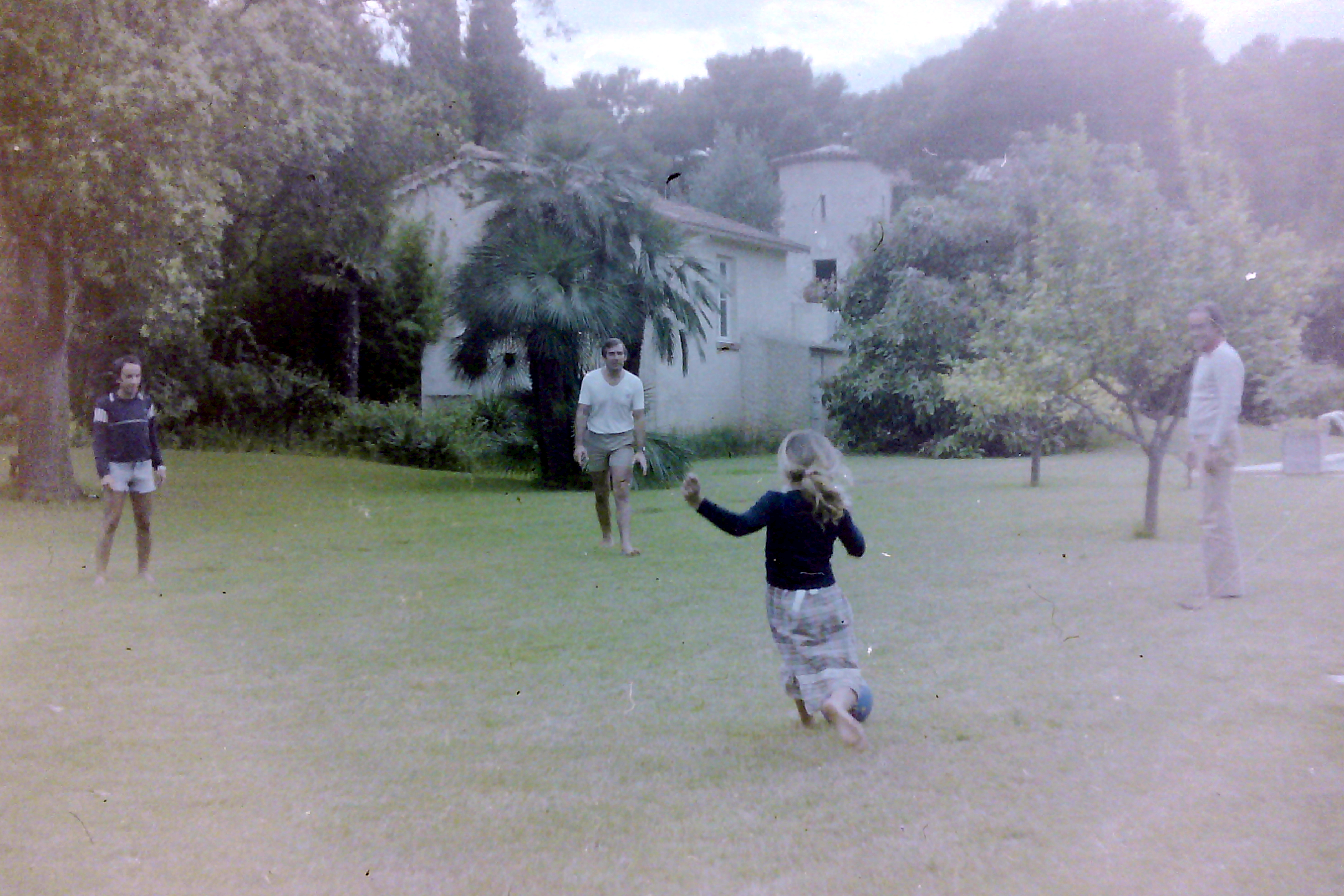












 peterwindsor.com