peterwindsor.com

…chance doesn't exist; there's always a cause and a reason for everything – Elahi

Archive for the tag “Ford”

At last: the Arciero 19

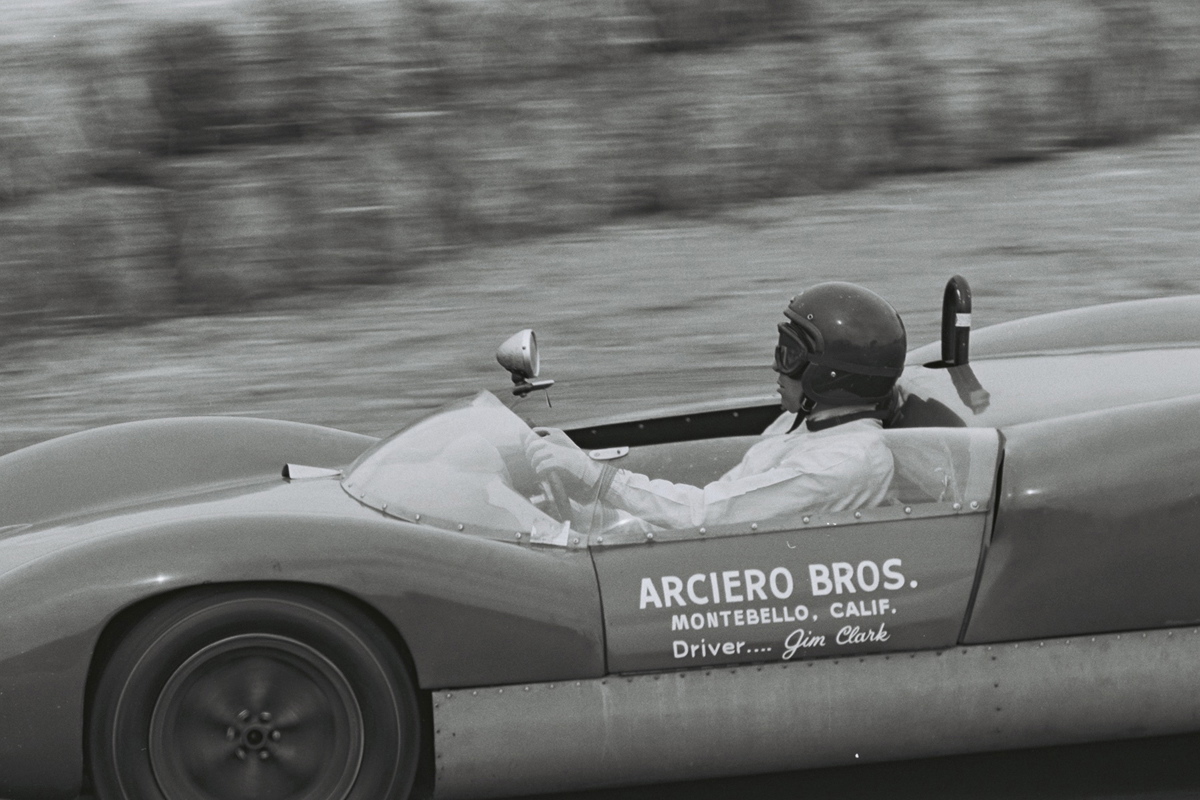
1963PacificGPatLagunaSeca_012Laguna Seca was Jim Clark’s next temporary home, for the LA Times and Pacific GPs were held over consecutive weekends.  The entry for Laguna, then, was as enticing as it had been at Riverside – with one major exception:  Jim Clark was now a major contender for overall victory. The Arciero Brothers had rebuilt the 2.7 litre Climax engine in their famous Lotus 19 and Jim was now all set to go.  At one stage an Indy Lotus 29 development test had been planned for this weekend – new Dunlops to be tried, together with new engine ancillaries prior to the arrival of the overhead cam Ford V8 – but this test had now been postponed until after the October 27 Mexican GP.  Good thing too.  The Monterey coast was a nice place to be in late October – and the Arciero Lotus 19 was going to be a nice car to drive.  Jim had until now never raced a 19 but he’d heard lots about the speed of Innes Ireland in the Rosebud 19 (now badly damaged following Innes’ serious accident at Kent, Washington, a few weeks earlier) and Stirling’s mastery, of course, of the BRP 19.  It would be the one and only time he’d race a 19 in the States but he would win again with one at Oulton Park in 1964.

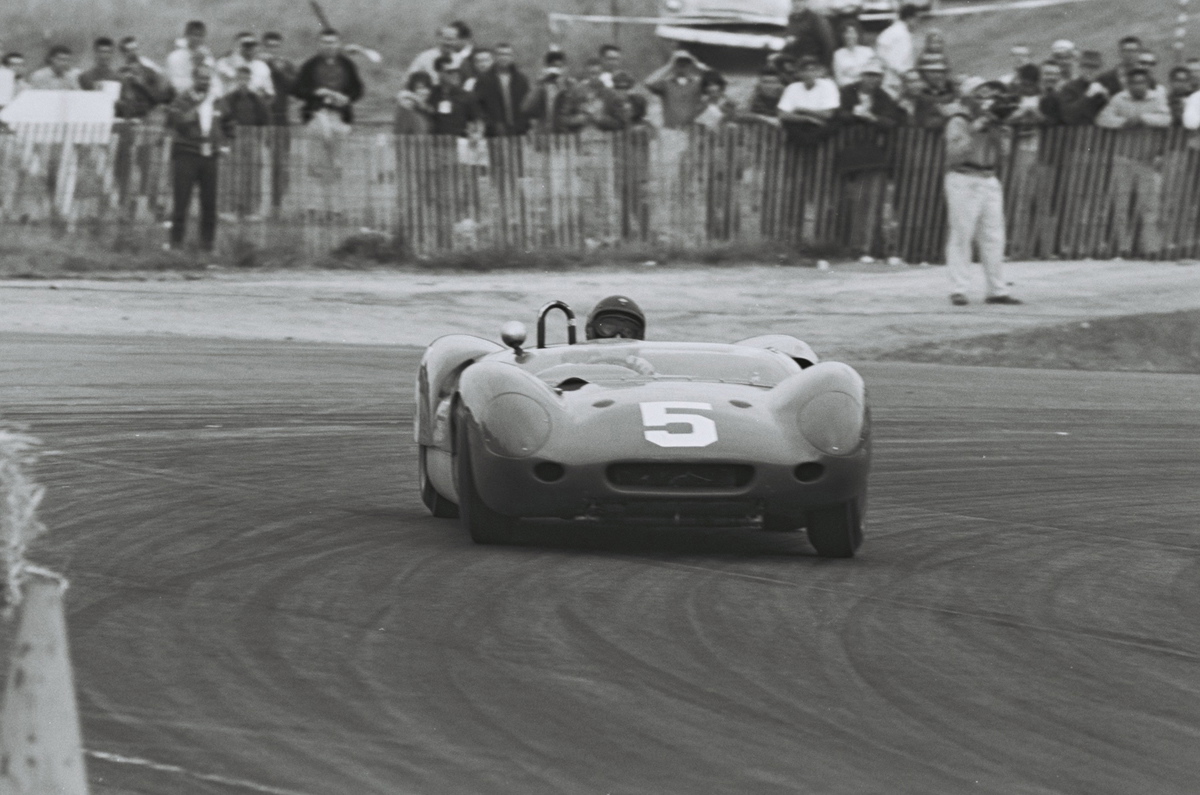
It was no surprise that Jim adapted quickly to the car and to the new circuit. That Arciero 19 was loved by all who drove It – and a fair few drivers sat in the car. He knocked half a second off the lap record after only a few minutes of practice and would have started from the pole but for Bob Holbert’s pace in the much quicker, Cooper-based Shelby King Cobra; team-mate MacDonald, on this occasion, was way back on the grid after various problems necessitated an engine change.1963PacificGPatLagunaSeca_402

I am delighted to publish more classic photographs from this Laguna meeting, courtesy of The Henry Ford – and to be able to catch a flavour of the event on the adjoining video. Poor Chris Ekonomaki is so excited about seeing AJ and Parnelli in the same race, let alone other heroes like Dan Gurney, Bob Holbert, Dave MacDonald, Pedro Rodriguez, Graham Hill and Jim Hall, that he plain forgets even to mention Jim Clark in his opening salvo.

Suddenly, though, after a slowish start, there he is, pushing Holbert hard and then taking the lead when the King Cobra’s engine begins to overheat: Holbert had nudged a back-marker whilst lapping it and had crumpled a radiator inlet.

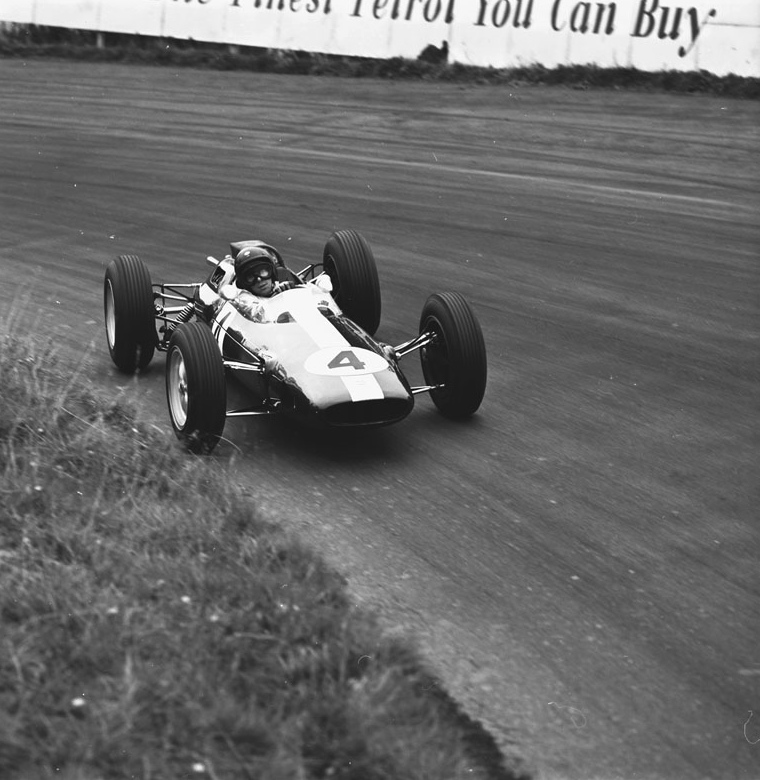
Driving beautifully in the 19, sliding the rear in best Dave MacDonald tradition, Jim then looked set for victory.Then he, too, fell victim to the sort of incident that would never happen today. Slightly off-line whilst lapping Richie Ginther’s Porsche, Jim suddenly found a half-tyre marker right in his path; another car had flicked it up only a few seconds before.  Rather than swerve to avoid it – and thus either hit Richie or risk a high-speed trip into the infield – Jim chose to run over it. There was a loud THWUMP and then smoke, lots of it, from a broken nose auxiliary oil cooler. Jim pulled off the track. Chris called it as an engine problem but Jim’s immediate examination of the front of the car tells the real story.  He sees the oil and he knows his day is over.

Dave MacDonald eventually won this race, too, spearing his rebuilt King Cobra up through the field in another epic drive. AJ Foyt was second in the gorgeous Scarab, Jim Hall third in the curious Chaparral and “Corporal” Tim Mayer (for he had been in the army) an excellent sixth with his ex-Normand Lotus 23B. It’s also worth noting that a certain Ronnie Bucknum dominated one of the support races at Laguna with his MGB. Less than a year later he would be making his F1 debut at the Nurburgring at the wheel of the brand new Honda!1963PacificGPatLagunaSeca_3291963PacificGPatLagunaSeca_335

Thus ended Jim’s Californian interlude.  Now it was time to re-jig and to fly to Mexico City, where Jim had won the year before in the non-championship F1 race, when he’d taken over Trevor’s 25 after being black-flagged for receiving a push-start. (As well as splitting the prize money, Jim had given Trevor his Breitling watch as a way of saying ‘thankyou’.) Ricardo Rodriguez had been killed in practice for that race in ‘62. Now, 12 months on, Ricardo’s brother, Pedro, would be Jim’s team-mate for the second time.

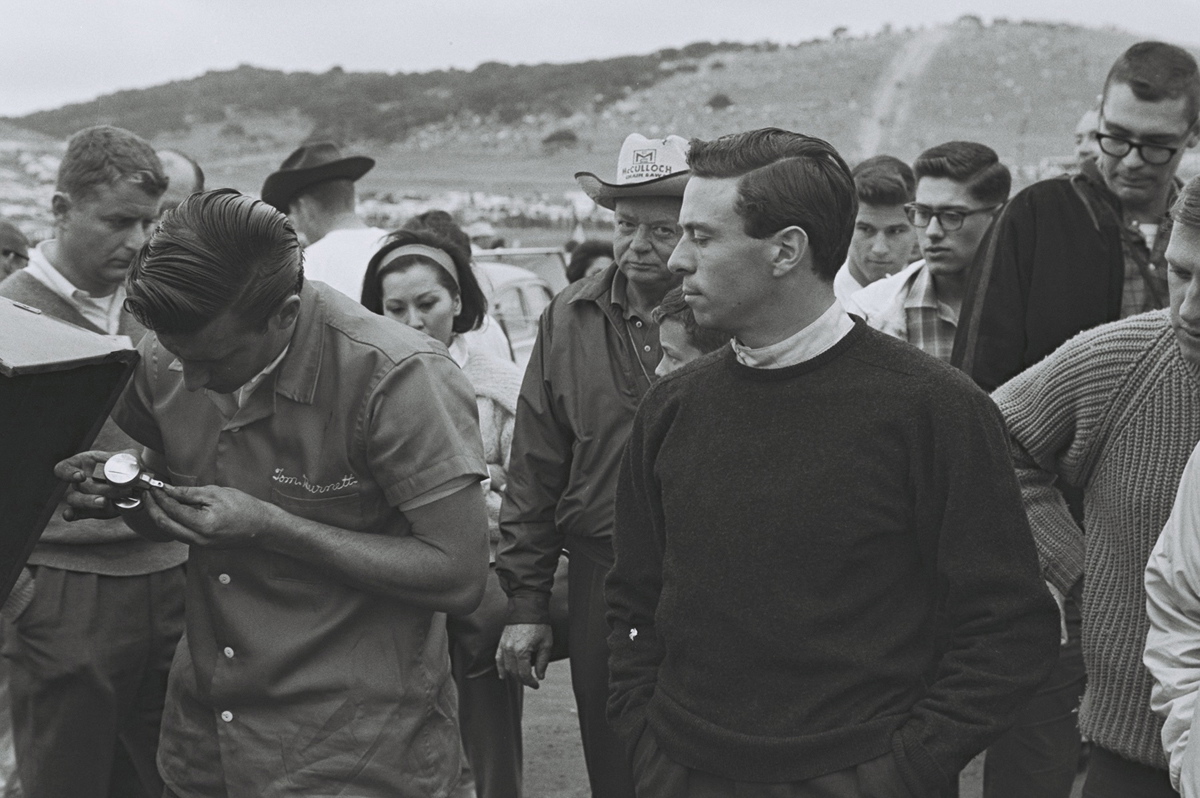
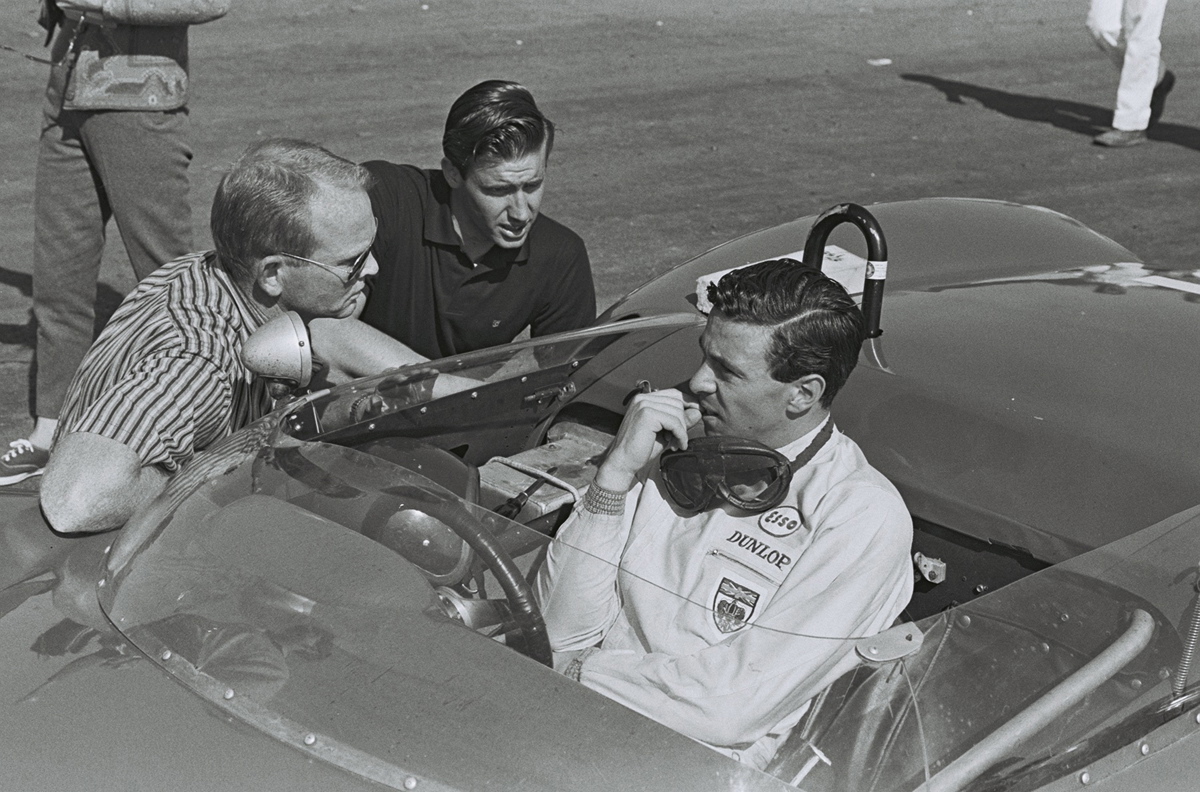
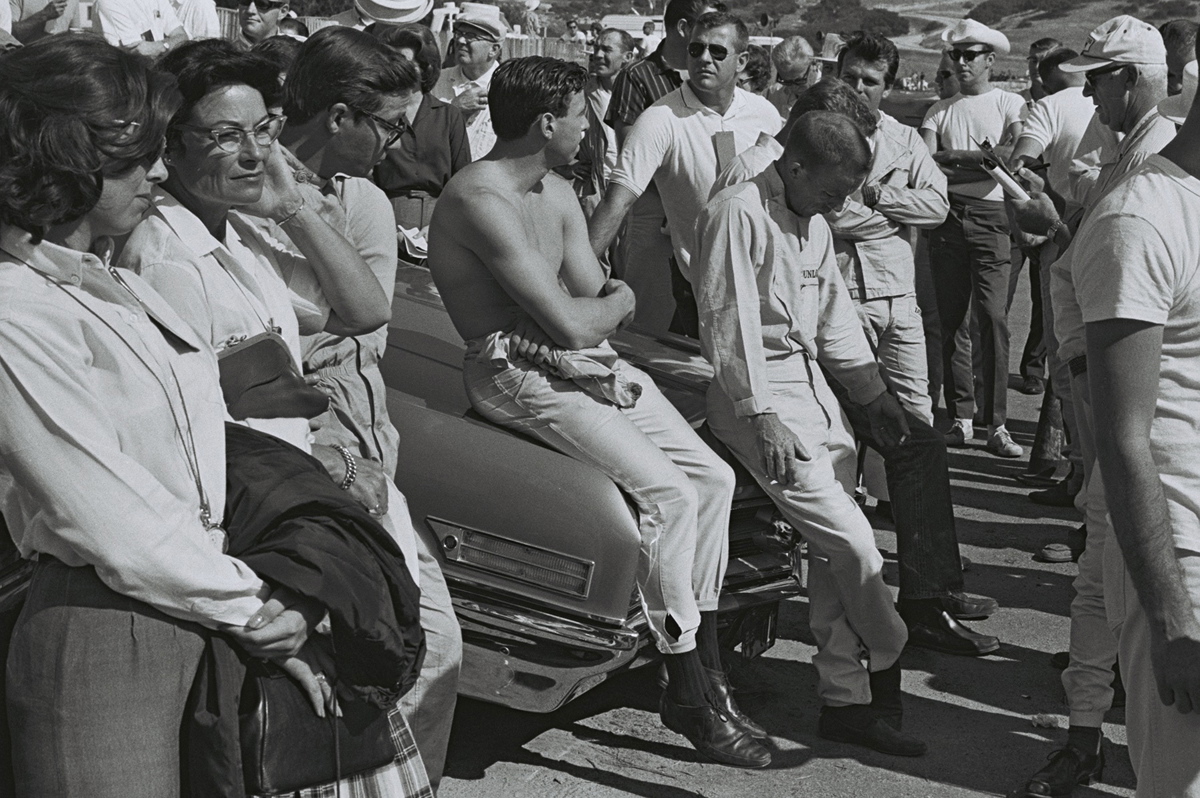
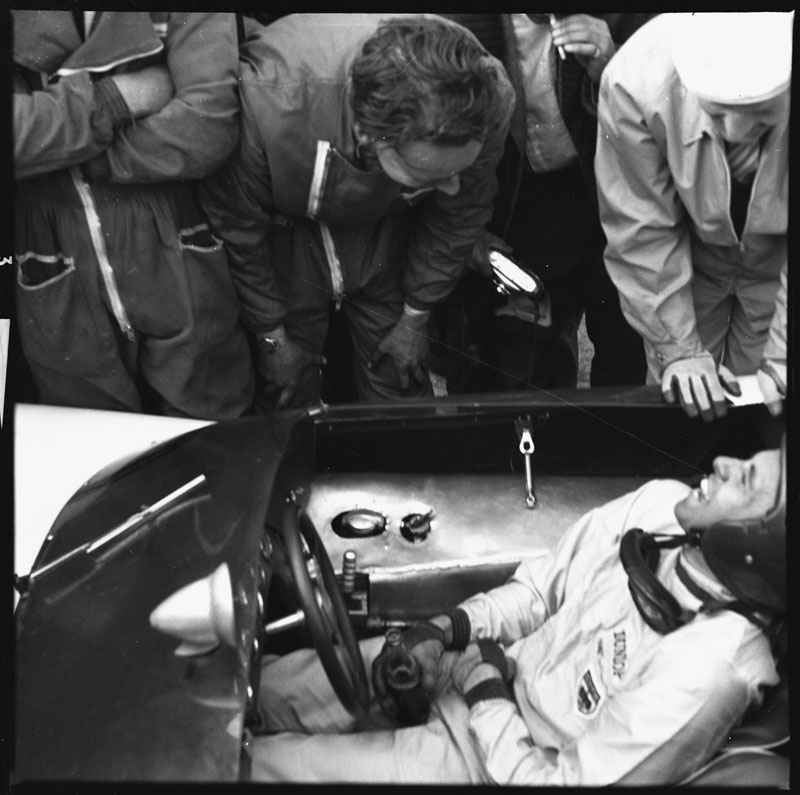
Captions, from top: Jim in typically relaxed pose in the Lotus 19.  Note the ironed creases down the arms of his Dunlop blue overalls and – as ever – the absence of seat belts.  The Pitt 19 Jim raced in ’64 was fitted with wire wheels rather than the Lotus wheels on this car; a Pacific breeze induced a pullover for Friday practice; Jim bites some more nail prior to qualifying; drivers briefing.  Jim enjoys the fall sunshine.  On his left – Richie Ginther, Walt Hansgen, a very young Peter Revson and Jim Hall.  On his right – the driver he most admired in the late 1950s:  Masten Gregory; below – Jim turns it on, MacDonald-style, as he exits the last corner of the Laguna lap Images: The Henry Ford http://www.thehenryford.org1963PacificGPatLagunaSeca_580

Our lifeblood

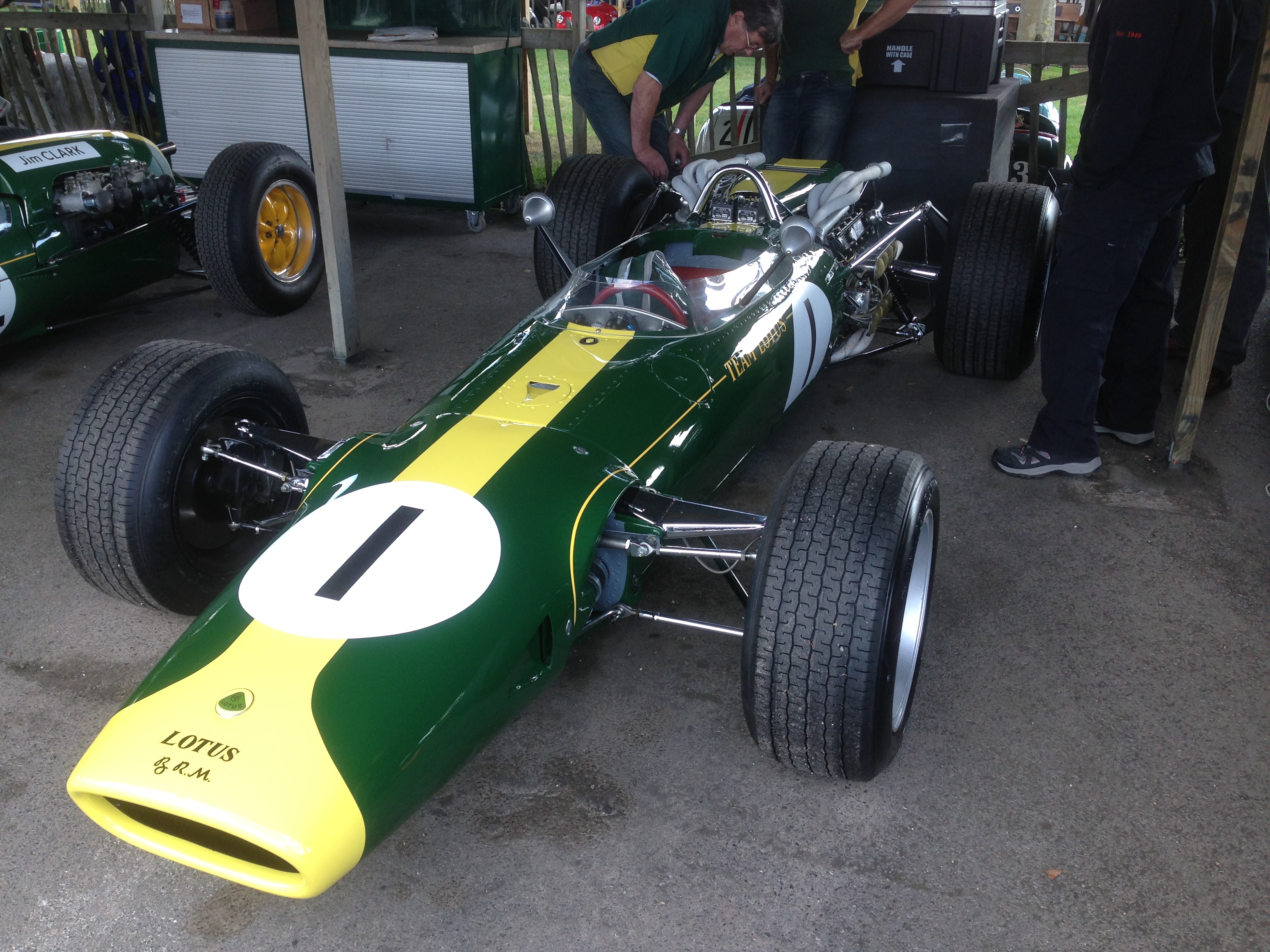
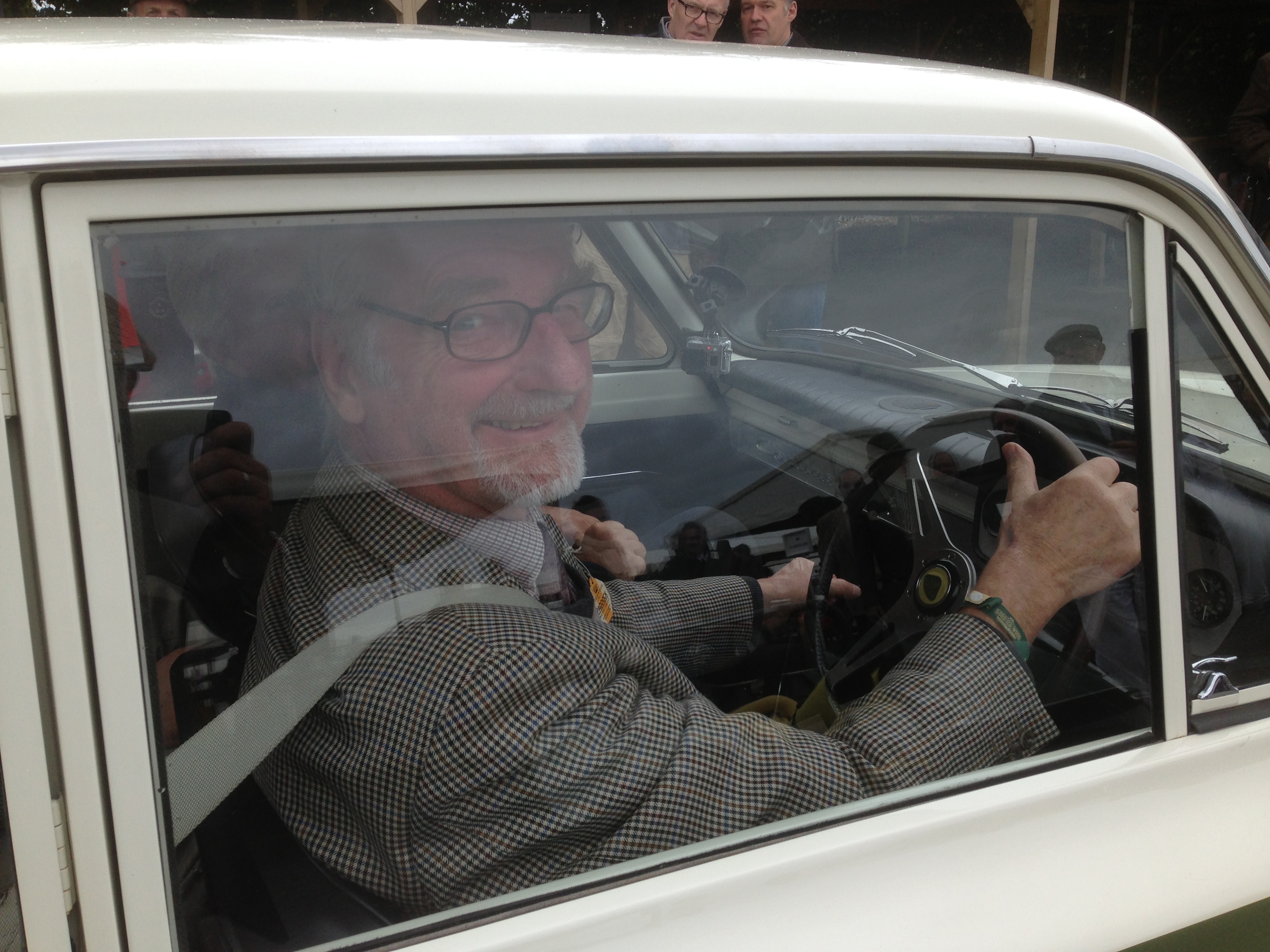
With all the travelling at present it’s taken a while to put together some of my memories from Goodwood, 2013.  In short, it was a magnificent event.  I don’t think we’re ever going to see as many Jim Clark cars  together again in one place.  To me, none of this represents “the past”.  Instead, it is our lifeblood;  it is what motor racing was, and still is, all aboutIMG_0666IMG_0808IMG_0671IMG_0675IMG_0673IMG_0734IMG_0751IMG_0763IMG_0788IMG_0748IMG_0856

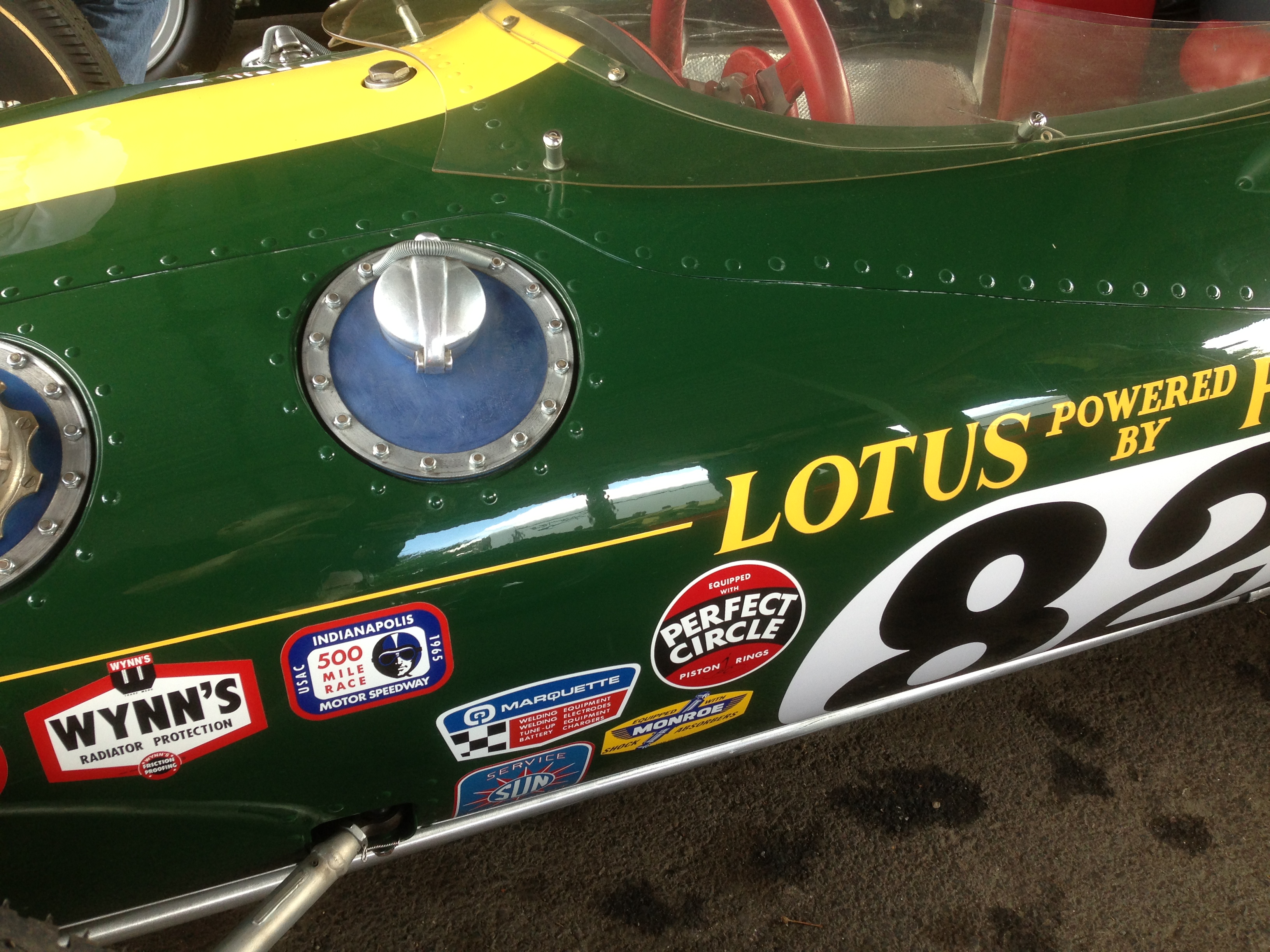
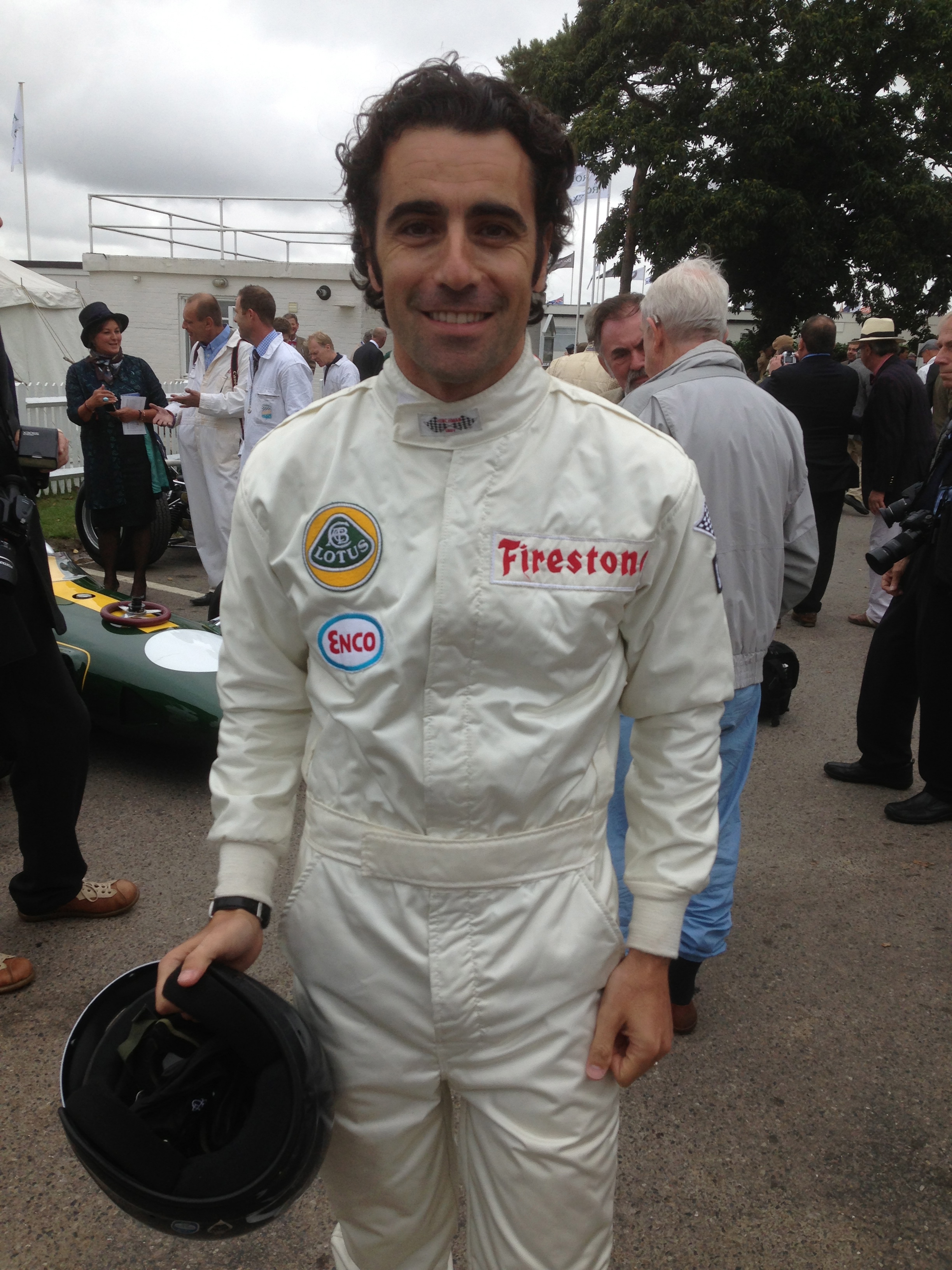
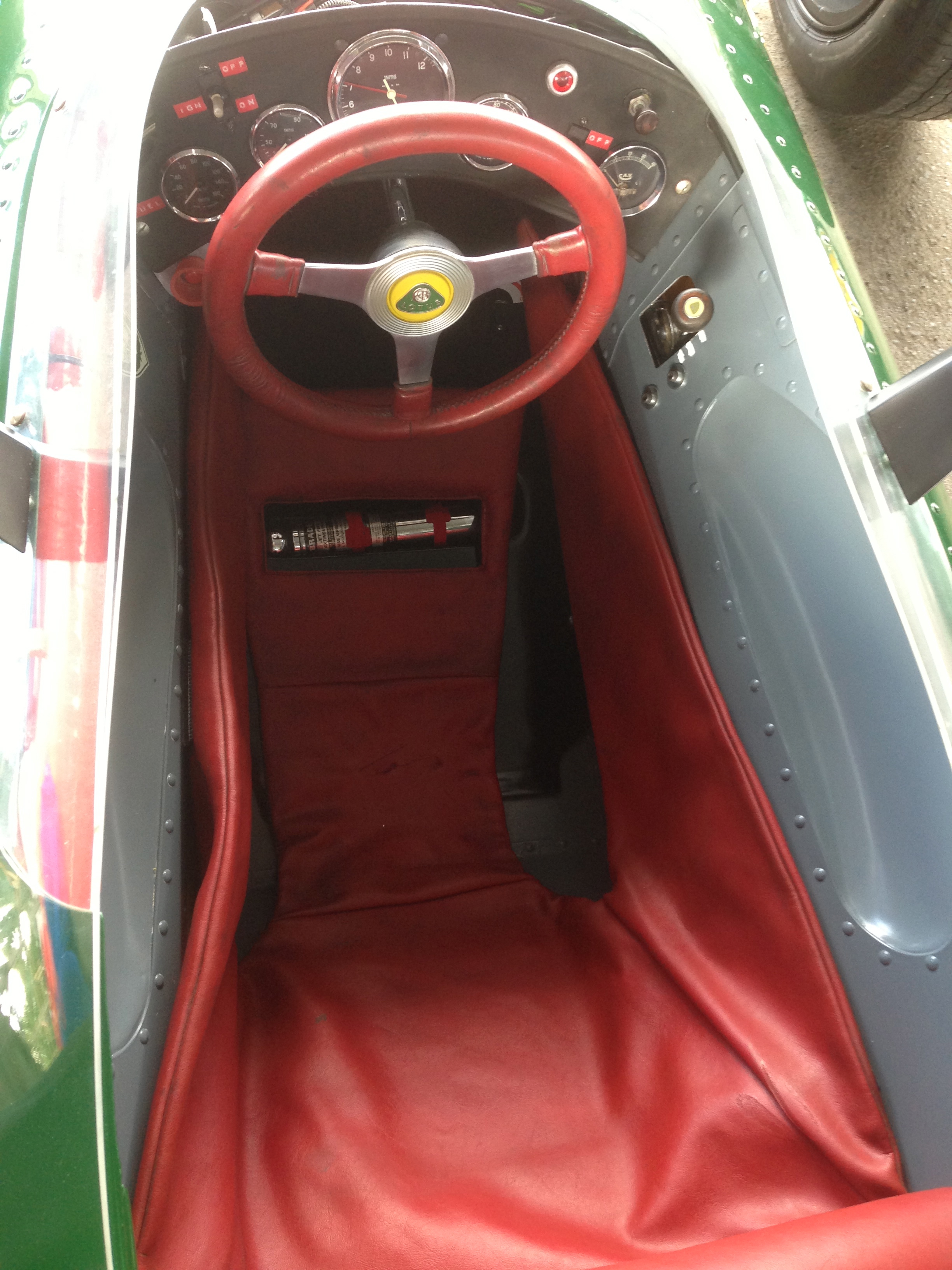
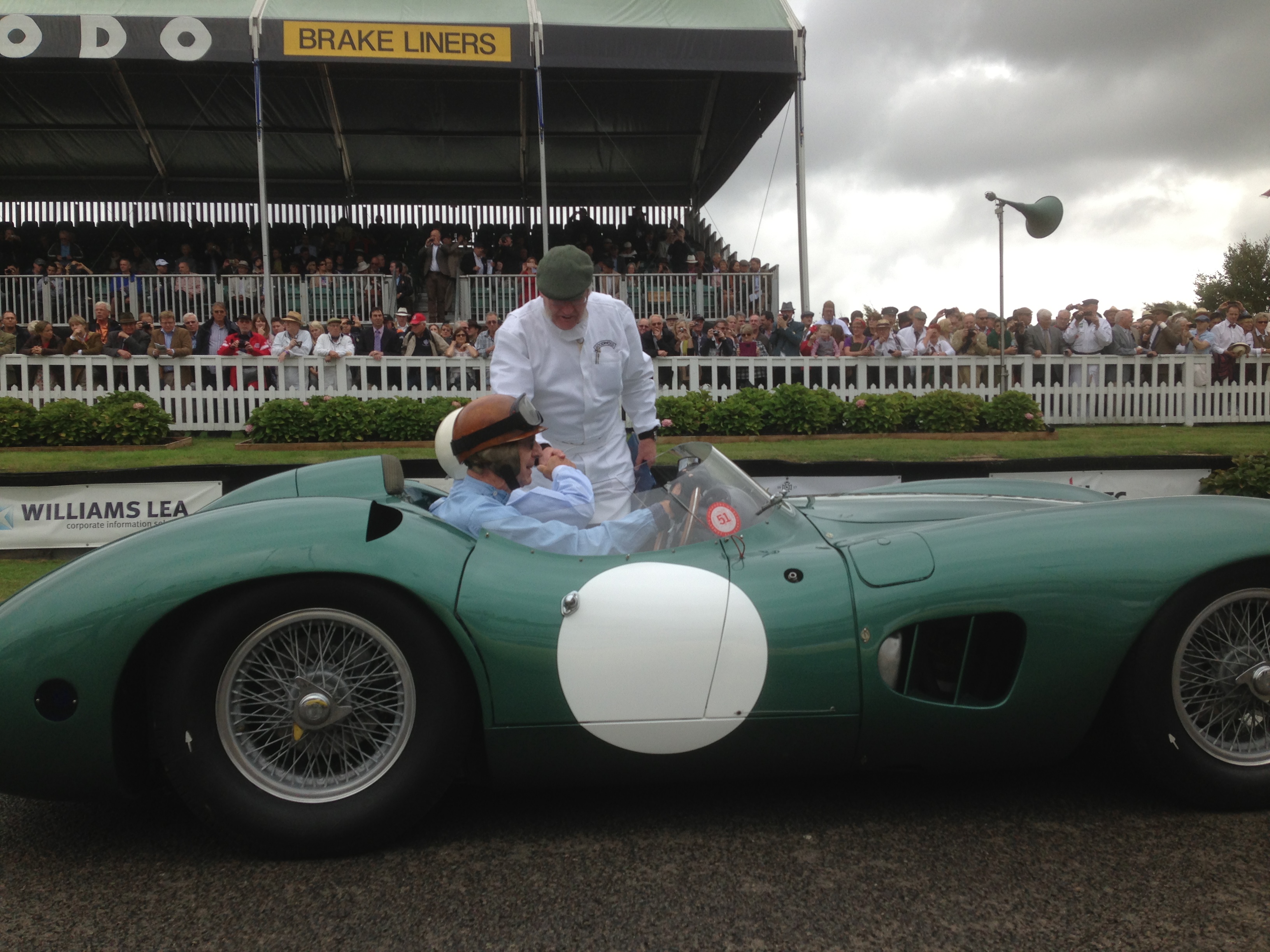
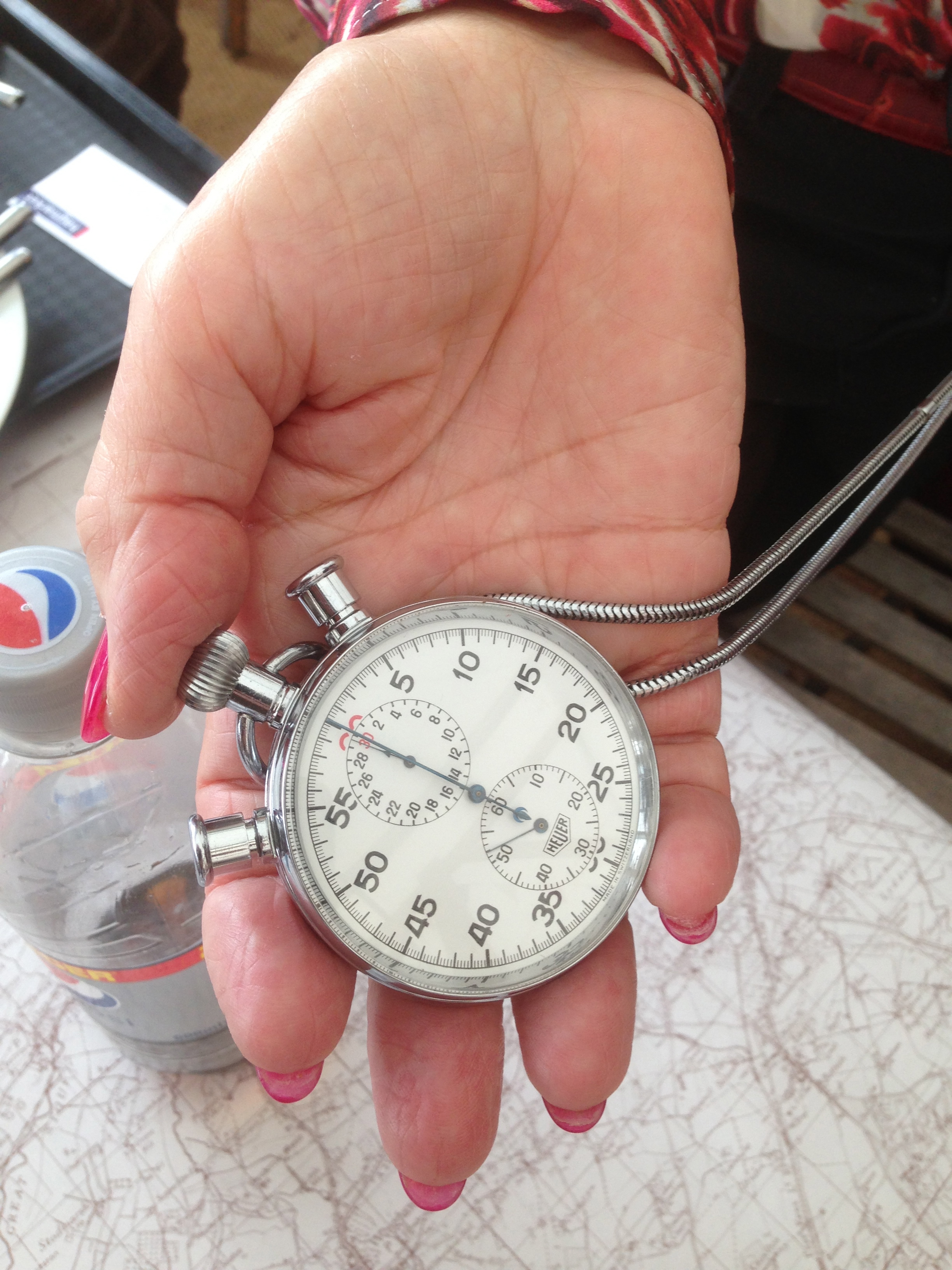
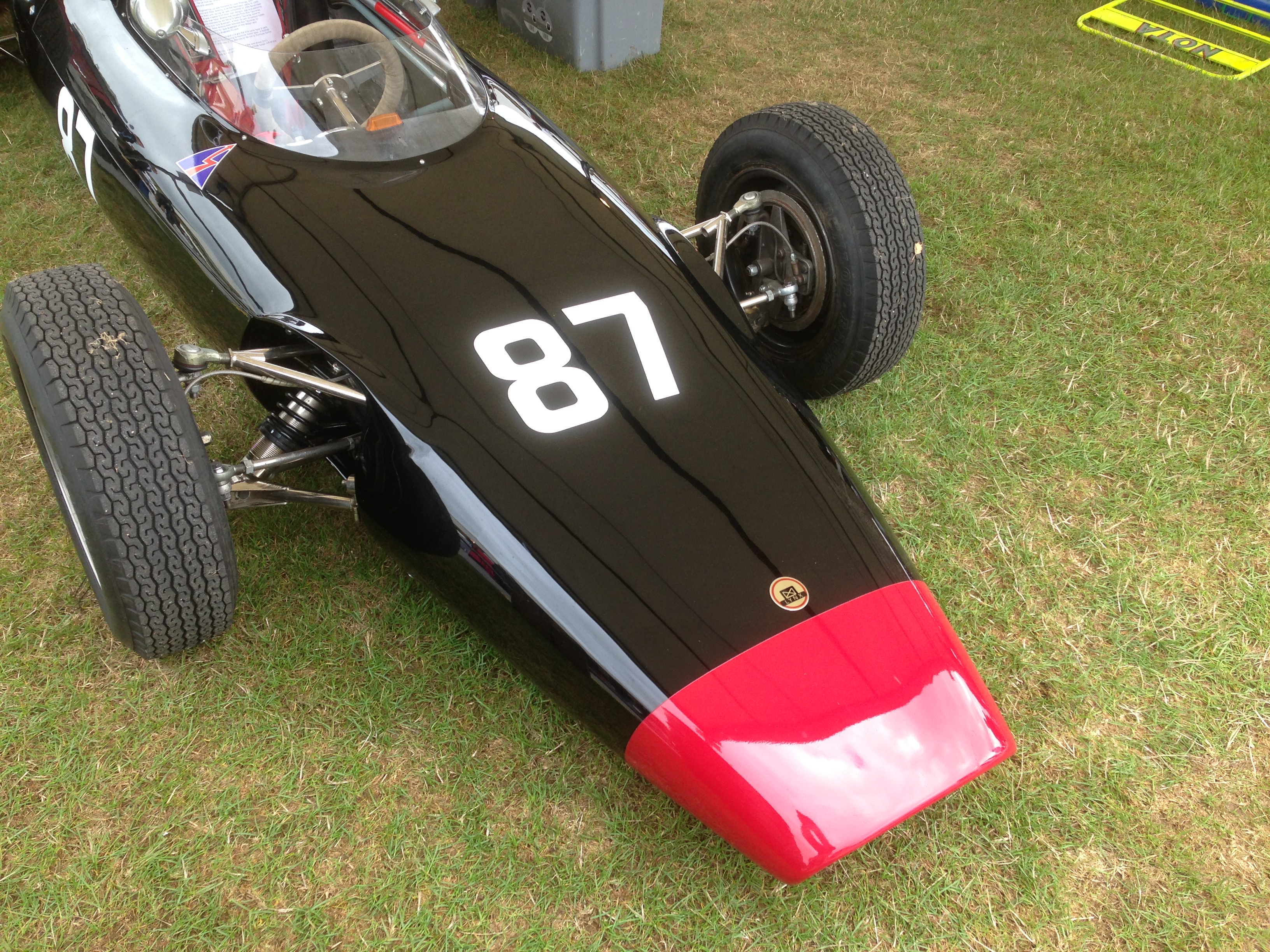
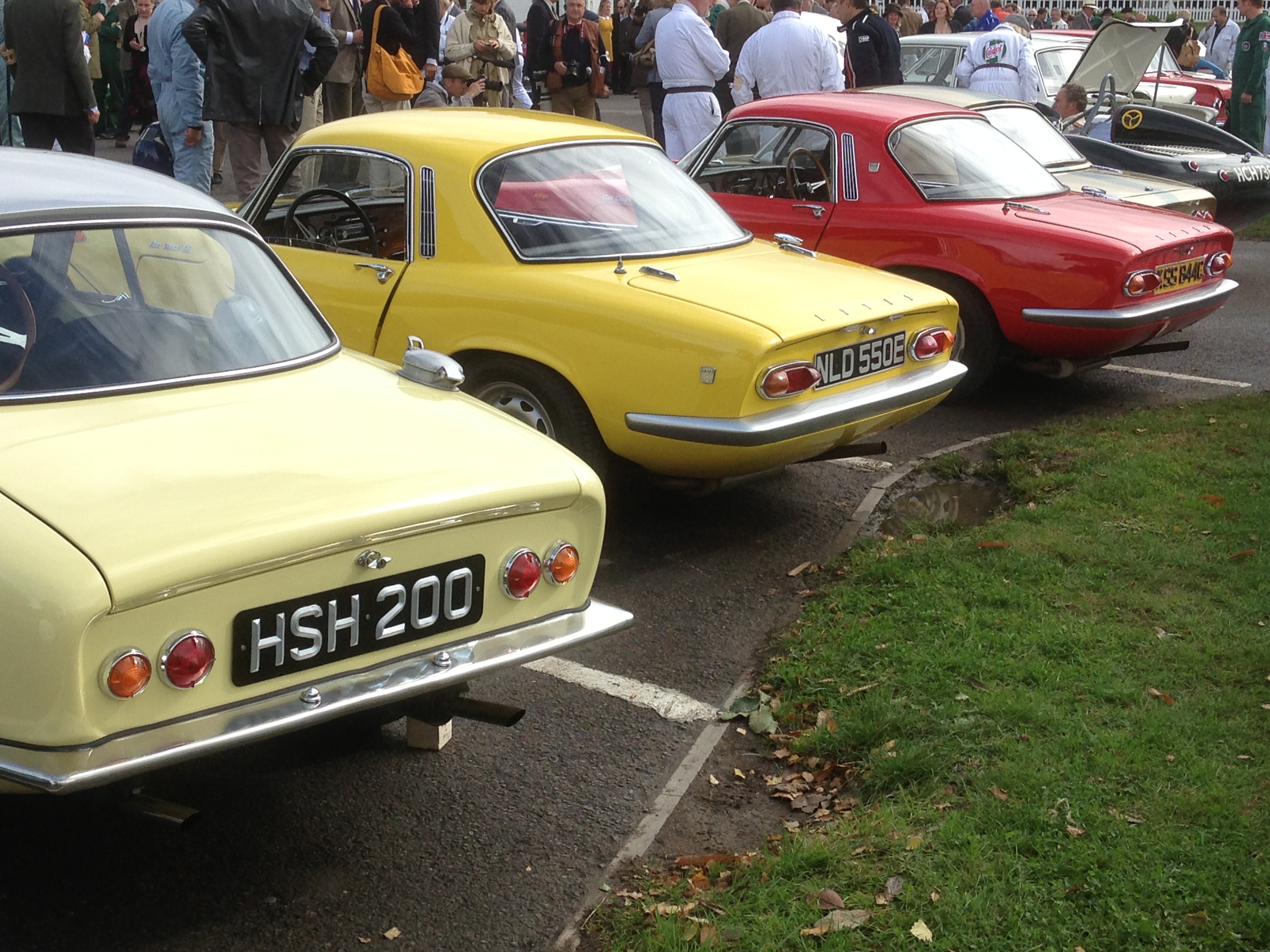
Captions, from top: One of the most significant racing cars of all time: Jim Clark’s 1965 Indy-winning Lotus 38-Ford.  Trucked over to the Ford Museum straight after the race, it has only recently been again fired-up and restored; wearing a new set of Hinchman overalls (complete with Enco badge), and of course Jim Clark driving gloves, Dario Franchitti took the 38 for a few laps of Goodwood; the Lotus 56 Turbine Indy car of 1968 – futuristic then, as now.  Jim tested the 56 after the Tasman Series and was looking forward to racing it in May; cockpit of Jim Clark’s 1966 US GP-winning Lotus 43-BRM. The car’s new owner, Andy Middlehurst, was aware that Jock Russell (who bought the car from Team Lotus in 1967) quickly discarded the original, red, upholstery and replaced it with a tartan job (!) but was delighted to find that the  the seat and interior that Jim had used at the Glen in ’66 were still in perfect condition in Jock’s barn.  They are in the car now;  the Lotus 43-BRM in its glory.  The amazingly complex 3-litre H16 engine started virtually first turn and ran perfectly at Goodwood;  a beautiful restoration job, too, on a 1.5 litre flat-12, 1965 Ferrari.  It would have been great to have seen this car in blue-and-white NART colours but someone at Ferrari (Maranello) demanded that it be painted red before heritage papers could be issued. Shame; grid-side view of Tony Brooks and Stirling Moss in the Border Reivers Aston DBR31/300 with which Jim Clark and Roy Salvadori finished third at Le Mans in 1960;  Jim’s girl-friend at the time, Sally Stokes (now Swart), holds the Heuer stopwatch that Jim gave her in early 1964.  Jim had been presented with this watch at the 1964 Geneva Motor Show and Sally used it on the Team Lotus pit stand throughout ’64-’65.  It still works perfectly; three road cars much-used by Jim Clark:  the 1961-’62 Hobbs-automatic-transmission Lotus Elite; his 1967 left-hand-drive Lotus Elan S3; and Ian Scott-Watson’s 1965 Elan S3, build by Jock McBain’s boys and used by Jim up in Scotland throughout that summer of ’65; it was brilliant to see again a 1963 Australian-made Lynx Formula Junior (left). To my eye, this is still one of the most beautiful little racing cars ever built; and it’s always a special treat to see real drivers in real cars.  Here’s Sir John Whitmore in a factory Lotus Cortina. Images: Peter Windsor Collection


…And now for a bit of fun

21676.tifJim flew from Newark straight back to the UK…even though the USGP was to be run at Watkins Glen on October 6.  Jim’s 707 probably passed in the night the BOAC Canadair CL44 heading in the opposite flight path with 19 F1 cars on board – the largest single F1 airlift yet seen.  As tempting as it might have been to spend a few days in the States – perhaps even to test one or two of the sports cars he was now scheduled to drive  there in a month or so – Jim stood by his obligations.  He was entered to drive the Normand Lotus 23B in the Autosport-sponsored Snetterton Three Hours and also to have his first race in the works Cortina-Lotus on the same day (Saturday, September 28).

In today’s parlance, that roughly amounts to Sebastian Vettel flying back to Germany after the US GP in Austin to race a Mini and then re-joining the F1 circuit in Abu Dhabi.  The thing is, Seb would cause a sensation if he did that.  Jim Clark?  Even though he had just won the World Championship, and was setting records all over the world in a variety of different cars, an astonishingly small number of spectators actually travelled to Snetterton to see him drive.  And it wasn’t only Jim who drove up the A11 this weekend 50 years ago:  Jack Brabham, a double World Champion, would drive the Alan Brown Galaxie;  Jim’s team-mate, Trevor Taylor, would race a Team Elite Lotus Elan and Sir John Whitmore the Stirling Moss re-bodied Elan;  Denny Hulme was there in the works Brabham FJ and both Mike Parkes and Jack Sears were out in Ferrari GTOs.  Today, we can only drool at the line-up;  at the time, it appears as though the British fans were disappointed that the Three Hours would be run as a day race rather than as the traditional day-nighter.  One can understand this to some extent – but to boycott a race for which Jim Clark had flown all the way back from Trenton?  Fifty years on, it defies belief.

On the plus side, of course, there were few traffic jams and race day was free and easy, with Autosport organizing sumptuous hospitality courtesy of Martini and Rossi.

And it’s nice to record that Jim’s travels – and jet lag – were entirely worth it:  he sliced past Jack’s GTO on the opening lap, lost out to the superior power of the Tommy Atkins Cooper Monaco driven by Roy Salvadori but then took over a commanding lead when the Cooper blew its engine.  Jim then won as he chose, drifting the beautiful little 23B through Coram and Riches with fingertip precision.  Jim had won this event in 1959 at the wheel of Ian Scott-Watson’s Border Reivers Lotus Elite and now he had returned as World Champion in one of the nicest racing cars yet built by Lotus.  He loved every minute of it.

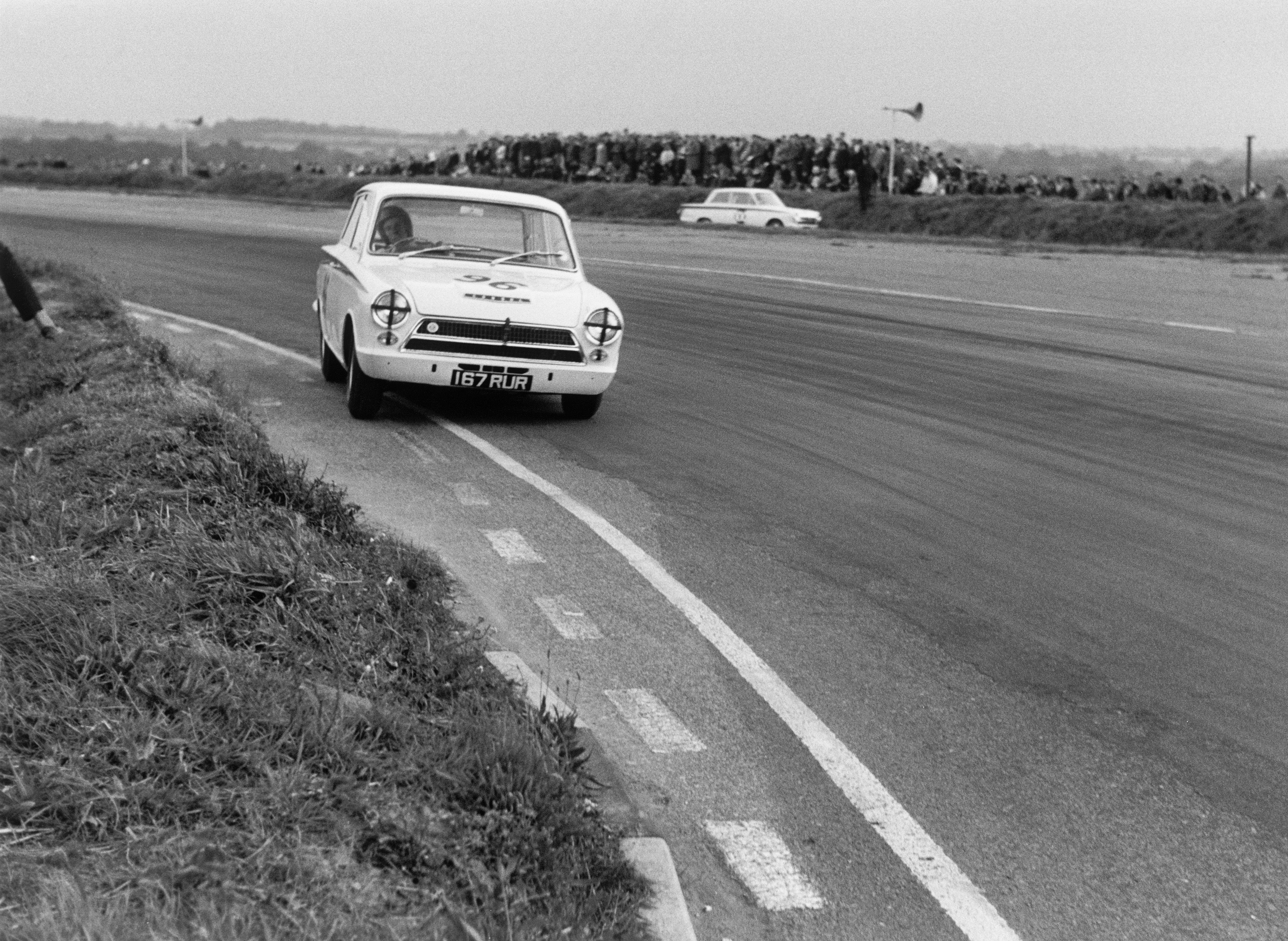
There was more to come, too:  Jack Brabham won the Slip-Molyslip Trophy race for saloon cars but Jim finished second overall, and won his class, with the new Lotus-Cortina.  Supported by new transporters and tow cars, the Ford-backed Lotus-Cortina programme set new standards in every department, not the least of which was pace: Jim was approx three seconds quicker than the fastest Jaguars.  He also introduced to the public for the first time the concept of three-wheeled cornering:“I again drove a saloon car,” he wrote in Jim Clark at the Wheel, “this time a racing Lotus Cortina at Snetterton towards the end of the 1963 season.  This proved to be a real laugh.  I kept finding the inside front wheel lifting off the ground.  This set me thinking, so I started going closer and closer to the semi-circular rubber tyres which mark the inside of one of the bends.  Eventually I found that I could tricycle the corner with the front wheel well over the tyres on the inside.  When I had practiced the car at Oulton in the gold Cup meeting I had had another odd experience.  I found that if I went into Cascades hard enough, both inside wheels would come off the ground but this was a very hairy thing, and not to be recommended if you wanted to stay on the road in one piece.”1963 British Saloon Car Championship.

How did Jim remember weekends like Snetterton?  “I had a lot of fun on these occasions.  It was a great relief to find that I could still enjoy light-hearted dicing after the tremendous strain of the Grand Prix battles which had won me the Championship.”

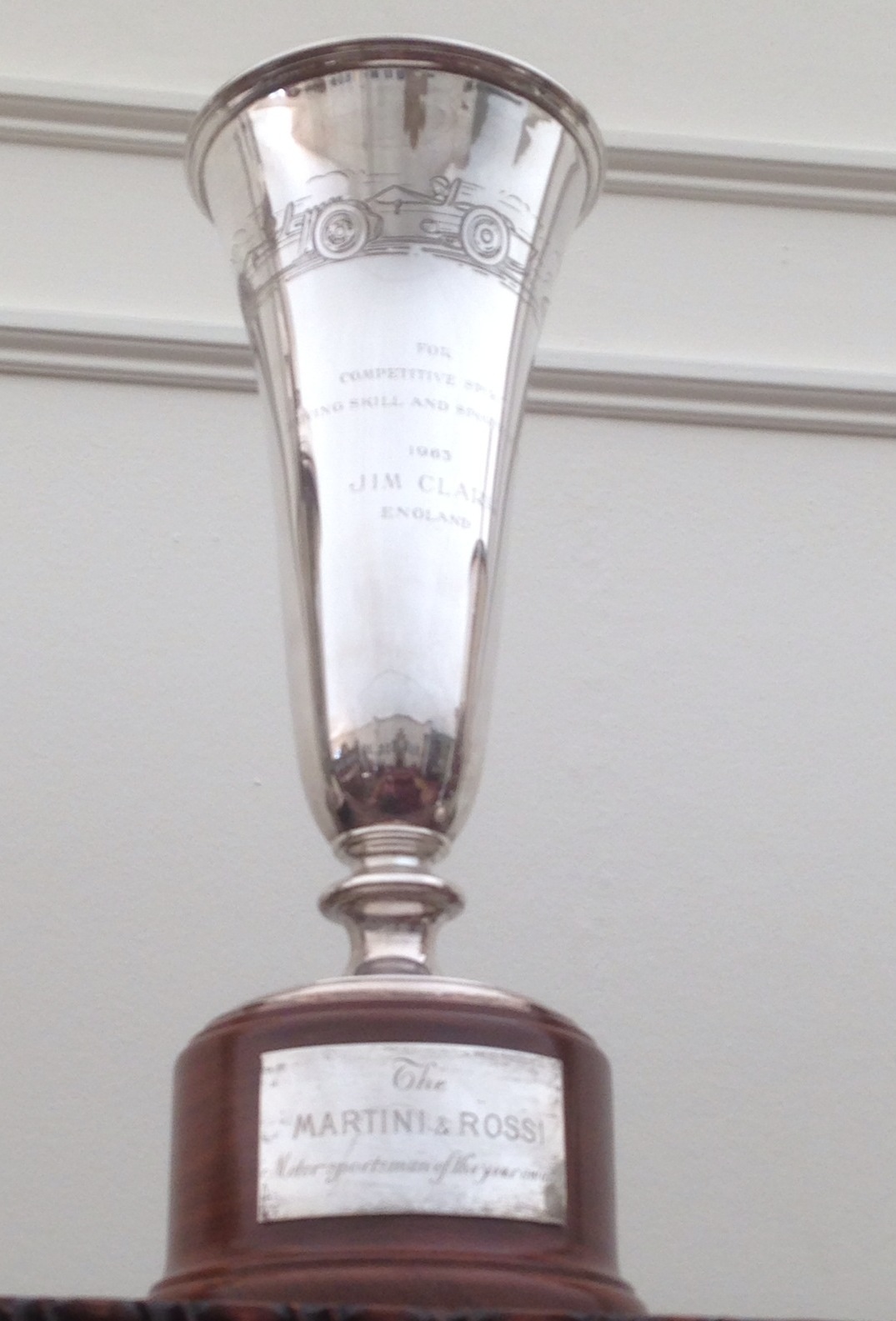
imageFor the record, Jim not only won the Martini and Rossi Trophy for his victory in the Three Hours but also the Daily Mirror Cup for being the best-placed driver of a British car in the saloon car event and the Autosport trophy for winning his class in that championship during the season overall. With his engine losing power in the closing stages of the saloon car event, Jim did try to stage another dead-heat with his Team Lotus F1 team-mate, Trevor Taylor (who drove the other factory Lotus-Cortina) but the verdict went to Jim by a couple of feet (reported the excellent Mike Kettlewell in Autosport).  Denny Hulme duly won the FJ race from the talented David Hobbs (MRP Lola), Alan Rees and Timmy Mayer; and Sid Taylor, featured recently in The Racer’s Edge (interviewed by Alain de Cadenet, Episode 28) drove his Elite home to second in class in the Three Hours.  Jack Sears, who had driven Willment’s Galaxy and Lotus-Cortina (finishing behind Jim and Trevor at Snet) also clinched the British Touring Car Championship at this meeting.

Racing over, Jim had time for a day in Scotland before leaving again for the US.  For this race, Team Lotus would be entering a third car for the winner of the recent Canadian GP (for sports cars) – Pedro Rodriguez.

Captions, from top:  Surrounded by well-wishers, Jim sips a bottle of Perrier after his win in the Snetterton Autosport Three Hours with the Normand Lotus 23B. Neither of his team-mates – Mike Beckwith and Tony Hegbourne – finished the race but Jim enjoyed a trouble-free afternoon. Note the absence of seat belts. Amazing to think that Jim had only a few days before raced the Lotus 29-Ford at Trenton, fully strapped-in;  Jim’s first race with a Lotus-Cortina.  Sadly here, at Riches, there are no half-tyres over which to lift the inside front wheel, so Jim can only drift the car in his usual way. In the Cortina Jim did wear belts but there was no roll cage  Images: LAT Photographic 

“Where’s Clark…?”

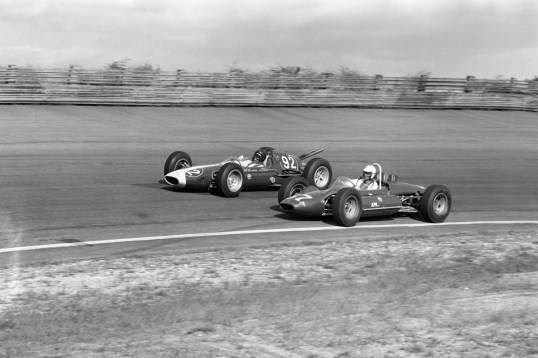
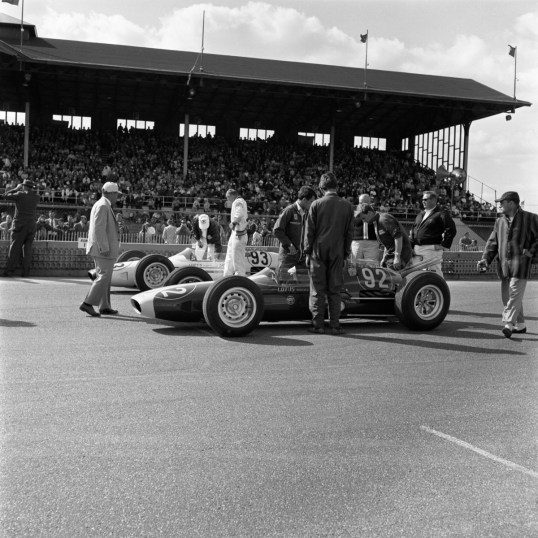
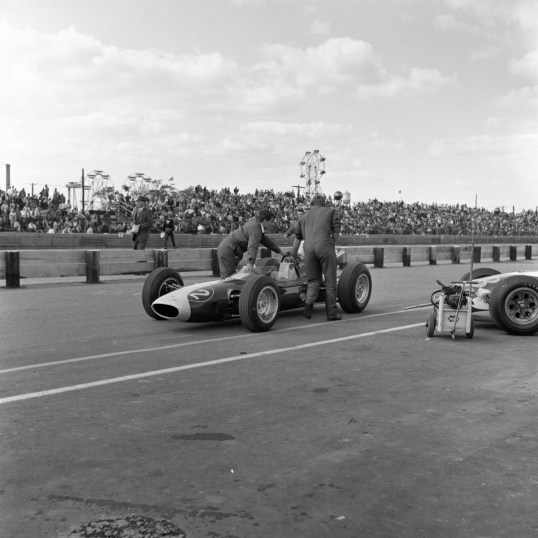
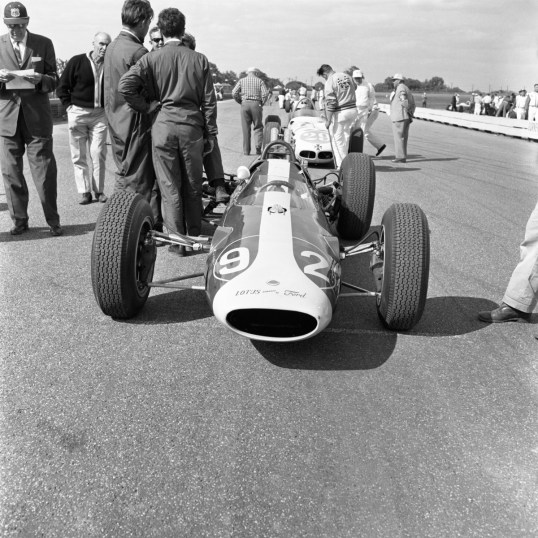
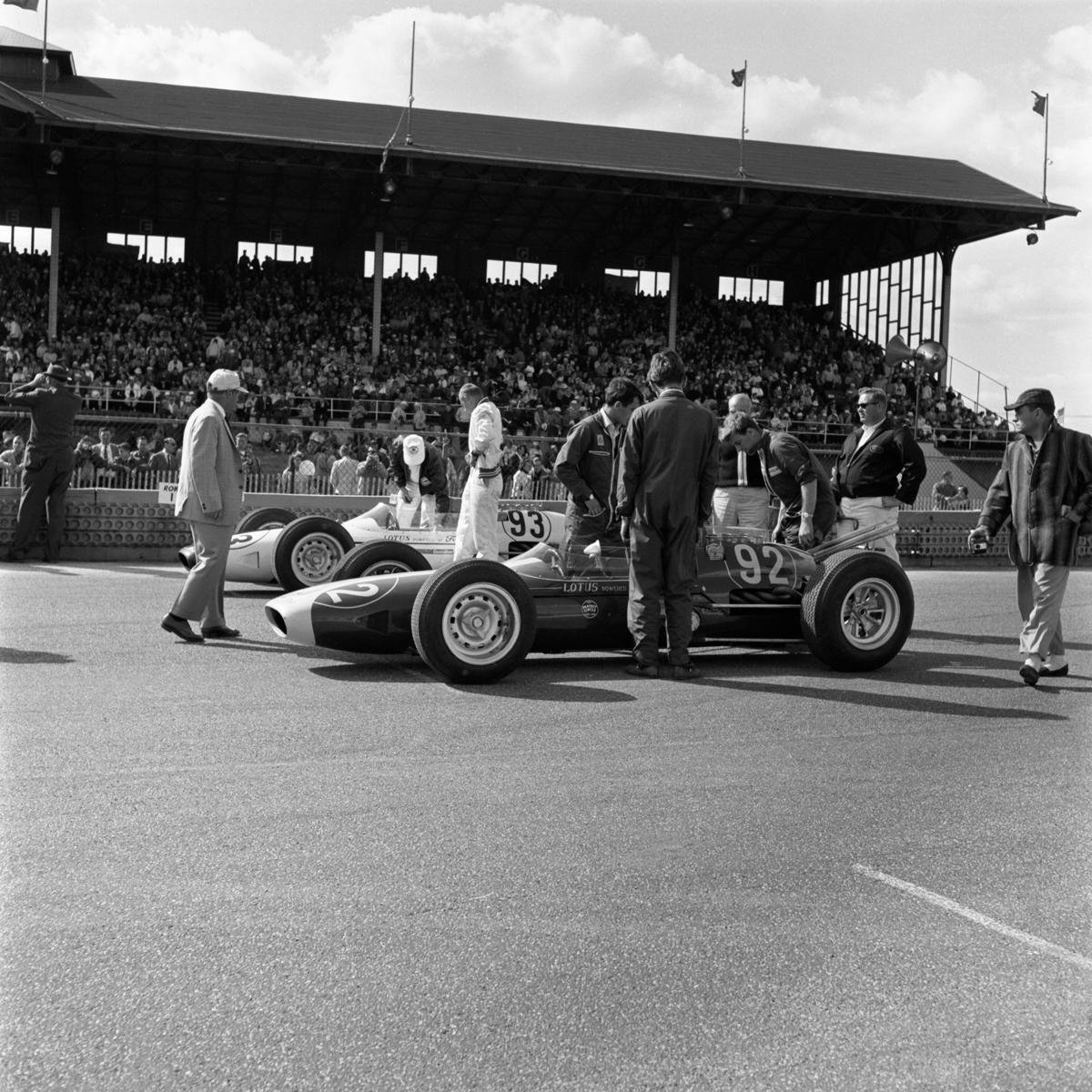
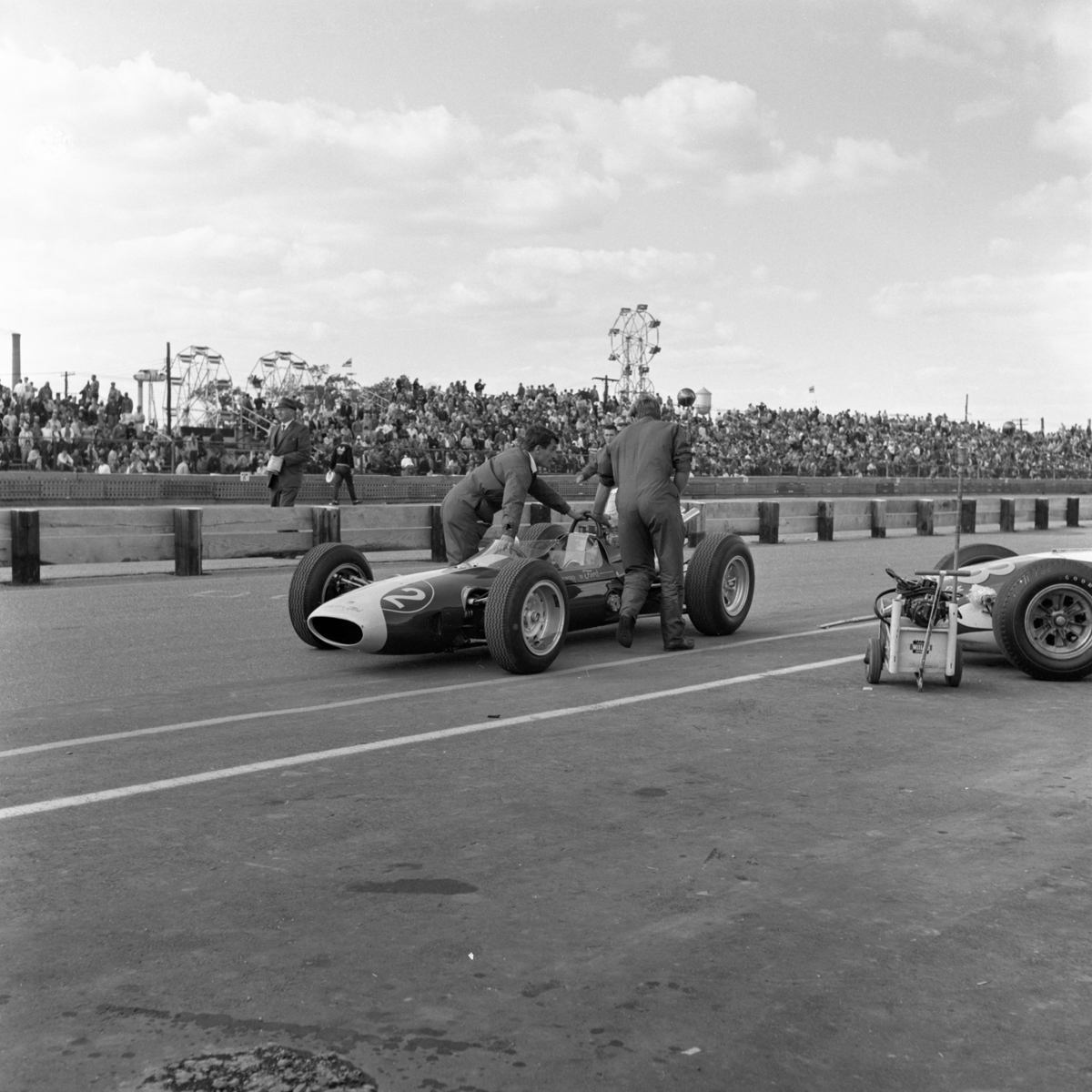
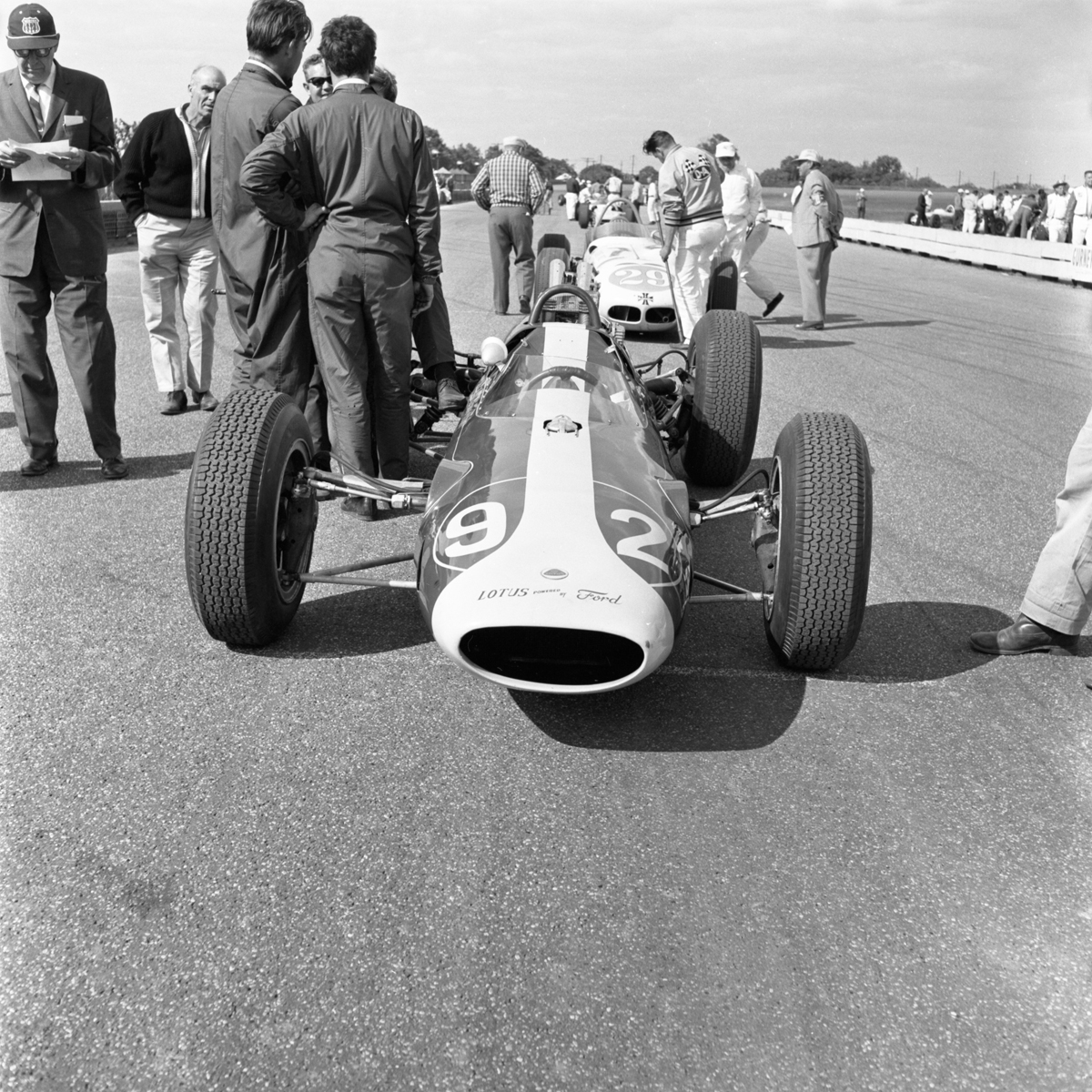
THF110901_JimClark-DanGurney-Trenton200_09-22-1963Incredibly, amazingly, Jim Clark and Dan Gurney arrived at the venerable Trenton State Fairgrounds in New Jersey ready to qualify and to race.  They had slept for but a couple of hours at the nearby team motel;  Oulton Park already seemed an age away.  Both would drive their Indy and Milwaukee Lotus 29-Fords, although on this occasion the exhausts had been angled skywards in physical testimony to the sheer speed of the two rear-engined cars.  At both of the preceding races, the drivers of the higher, front-engined roadsters had complained about the fumes caused by the lower exhaust flows from the two little Lotus.  As it was by now clear that the older cars would inevitably be trailing the 29s, Colin Chapman (and designer Len Terry) agreed to re-angle the exhausts upwards.  The ungainly mod (which also, as it turned out, provided a performance boost!) would thereafter be a reminder of all that was achieved by Team Lotus in America in 1963.

For coverage of the Trenton 200 I can do no better than to hand over to that excellent American writer, John Hearst Jnr, and to (the sadly now defunct) Sports Car Digest:

“The two-lap qualifications proved to be almost as exciting as the race itself,” wrote Hearst. “Knowing voices said that AJ Foyt’s one-lap record of 106.635 mph could not be beaten, for conditions weren’t ‘right’.  Clouds polka-dotted the sky and outnumbered the sun.  The day was cold and brisk, and the long grass in the infield was beaten flat by a gusty wind.  The wind.  That would be the problem.

“And it was…for some.  Indy roasters and ‘spring cars’ made two laps apiece.  Each driver fought to stay in the blacker part of the grey asphalt ribbon: ‘the groove’.  Some were quick and skillfull while others worked with arms flailing and right foot stabbing in a furious exhibition of over/under oversteer.  A couple reached the point of no return as their mounts went into gut-wrenching, rubber-burning slides.

“Dan Gurney’ (whose engine now had the 48mm longitudinal Weber carburettors) “took his turn.  Dressed in plain overalls, with black helmet and leather face mask, first thoughts were, ‘He must have come to the wrong place!’ The little blue-and-white car sang its way around once, and then again.  Accelerating earlier, and backing-off earlier, Dan made it all look so easy as he averaged 109.024 mph.  AJ Foyt, 28 years old and twice USAC Champion, could manage no more than a shrug as his record fell.

“Minutes later, Jim Clark took his turn with a flourish, provided by promoter Sam Nunis.  A local bagpipe band huffed and wheezed at ‘Scotland, the Brave’ as Clark, in his green-and-yellow car, was pushed out before the cheering fans on the grandstand straight.  All work stopped.  Wrenches were laid aside and heads came out from beneath raised hoods.  Everyone knew what was going to happen.

“The crowd became silent.  The only sounds were the skirling pipes and the wind.  Then came the hum of the starter motor, followed by the high-pitched wail of the unmuffled, pushrod Ford V8.  The young Scot was given a shove to engage first, and he was away.

“The air held one sound:  a note that worked itself higher and higher up the scale.  The car seemed to float around the track others had made appear so bumpy.  Green flag, white flag and then the checker.  It was over, and everyone knew – but by how much?

“Clark had just lowered Gurney’s newly-set record by 0.332 mph when he turned the mile over in 33.02 seconds, and was over 3 mph faster than Foyt’s old record.

“A weak smile was all that was offered in return as one roadster owner turned to his driver and cracked, ‘How do you spell ‘For Sale’?’

“Finally, the 26 starters were assembled, started and pushed away on the first of four warm-up laps.  On the pole was Clark and next to him was Gurney.  Both stifled yawns, for both had spent the night flying the Atlantic.  Both had won races at Oulton Park the previous day and Gurney the previous weekend had won at Bridgehampton, where he had been the first to drive an American car, the Shelby Cobra, to victory in a World Manufacturers’ Championship race.

“The green flag was waved furiously and a roar shook the earth as 26 cars accelerated as one.  Yet the sound of the Lotus-Fords was unmistakable, for they were two trumpets in an orchestra of tubas.  Appearing comparatively relaxed, Clark and Gurney, nose to tail, pulled away from the 24 others.  At first only a second, then two, then five, soon to be seven, ten, twelve, and more.

“Meanwhile others were having their problems.  On lap six, Rodger Ward saw his USAC Championship hopes fizzle when a fuel line burst, covering him with the volatile stuff.  Next to quit was Jim Hurtubise, whose fuel-laden car was bottoming through the turns.  When the seat pan started to wear away, Jim started getting a little warm.  Then his gas tank ruptured and Jim wisely gave up.  Speechmaker Eddie Sachs retired, to be joined five laps later by Indy winner Parnelli Jones, whose magneto went sour.

“By now, Clark led Gurney and 12 seconds, who in turn led Foyt by 10 seconds.  Clark had lapped every car in the field except Foyt.  That was lap 49.  On lap 50 everyone looked at everyone else and finally someone said it:  ‘Where’s Clark?’

“The young Scot had pulled into the pits.  A glance at his oil pressure gauge brought him in, and an ever-growing puddle of black under his car kept him in.  Through for the day, the primrose-yellow-overalled driver” (the Hinchmans!) “climbed atop a nearby truck and joined Rodger Ward as a spectator.  Englishman Colin Chapman, builder of the Lotus-Fords, stood by as the crew removed the engine cover, revealing a ruptured four-inch hose, used to join the chassis oil tube to the cast-aluminium ‘Fairlane’ engine.  Unceremoniously, the car was shoved into its van.

“Gurney calmly kept his mount in first place.  Foyt, however, closed the gap to seven seconds as three Offy types put Dan in a neat little box for some five laps. When they became committed to a line in a turn, he changed his, and eventually picked them off, one at a time.  The Lotus held the upper hand.

“Mounting elation suddenly turned to depression for on lap 147 Gurney was followed down the main straight by a large cloud of white smoke.  Dan backed off and cars he had just lapped, some for the fifth and sixth time, came streaming by him.  Silently, with engine cut, he pulled into pit lane as Foyt, with a quick glance to the left, accepted the lead.  Gurney’s acute disappointment was mirrored in the faces of his crew.  And for many of the fans, the race was over, for they had come to ‘…See the Fabulous Lotus-Fords!  See Jim Clark! See Dan Gurney!’

“An oil seal on an accessory drive on the front of the block had let go, causing Dan’s retirement.  This was the reason given by one Ford representative (of almost 50 present) after almost an hour of searching by Chapman and crew.

“Foyt led for the remaining 53 laps.  He not only won the race but the USAC Championship for the third time in his career.  Over a lap behind, and finishing second and third, were Bud Tinglestad and Troy Ruttman, who brought the remaining crowd to their fee with some hearty dicing.  It was a good race and an exciting race but for many it was over back on lap 147.

“Only ten cars finished.  Foyt’s share of the $42,210 purse was nearly $12,000, which might just b e enough for a down-payment on a Lotus-Ford.  Chapman said (and a Ford PR man verified it) that he will build cars for private owners after he fulfils his primary commitment to Ford.   He refused, at present to state a price.  And, according to a Dunlop tyre man who was present, the R6s the cars were shod with showed very little wear at Trenton and ‘…may be the answer to a no-change Indy’.

“When a Ford man was asked if these cars would run again next year at Indy, the answer was ‘No!’. When asked why, he answered, ‘…’cause we’re going to build new ones.’  The 1963 cars will be used for display and research and development.

“The capper of the day came when one railbird remarked that he didn’t think the Lotus-Ford were really that amazing after all.  ‘Hell,’ he explained, ‘a guy in track shoes can beat a guy in combat boots any day of the week.”

Thanks again to Sports Car Digest for John’s reporting in the way of the classic, 1960s US sportswriter.

Additional notes:  Dan would have at least been cheered by Troy Ruttman’s third place because he still rates Troy as one of the great, hidden-away American talents.  (Ruttman won the 1952 Indy 500 at the age of 22 and showed his versatility with a strong Maserati 250F drive in the 1958 French GP at Reims.)  With Jim’s hectic schedule precluding any sort of consistent commitment to a 1963-64 US test programme, young Bobby Marshman was duly hired by Team Lotus (financed by Lindsey Hopkins) to carry out development work on the new double overhead-cam engines. There was also talk after Trenton that the two Lotus failures had been indirectly caused by incidents during the shipping of parts.  This was later rescinded when it was discovered that on Dan’s car a piston had fractured and thus damaged the oil line – but this does give a flavour of the sort of differences that quickly grew between Ford and Lotus (and between the Americans and the British).  Hearst’s report, indeed, is remarkable for its objectivity. In most contemporary American publications, and particularly over at Car and Driver, the emphasis was very much on the Ford-Lotus cars, with Lotus, in the main, considered to be lucky, and slightly unworthy, partners.  Sports Car Digest, by contrast, was a brilliant mix of Americana and Bernard Cahier. Need I say more.

So ended Jim’s 1963 American oval racing season.  A win and a second.  He would return to Trenton – and Indy, of course – in 1964.

“It had been hard work and a great deal of travelling for just three races,” he would write later in Jim Clark at the Wheel, “but it was worth it in the results we gained and the impact we made.  I now have an ambition to drive the Lotus 29 on a road circuit but I suppose that dream will have to wait.”

Jim would, of course, drive the 1965 Lotus 38 Indy car up the Ste Ursanne hill-climb, as we have described elsewhere on these pages, but in 1963, after the US and Mexican GPs, there were American sports car races still to pursue.  From New Jersey, meanwhile, the new World Champion took a 707 back to England for a different kind of race:  the Snetterton Three Hours with the Normand Racing Lotus 23B.

Personal trainer?  Gym?  Nutritionist?  “Racing keeps me fit,” said Jim.  “Racing and getting to races.  There’s no time for anything else.”22259.tif
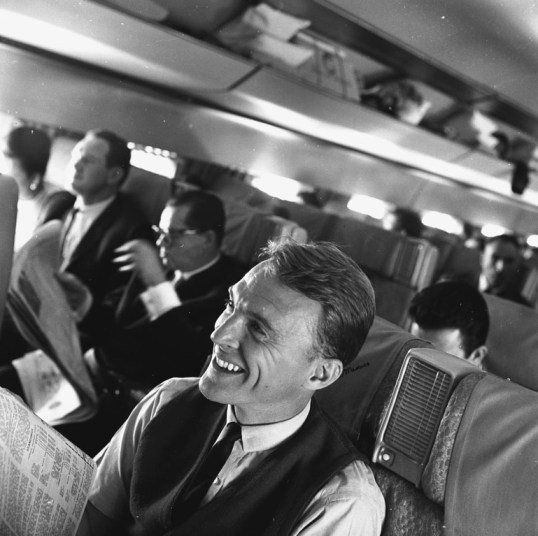
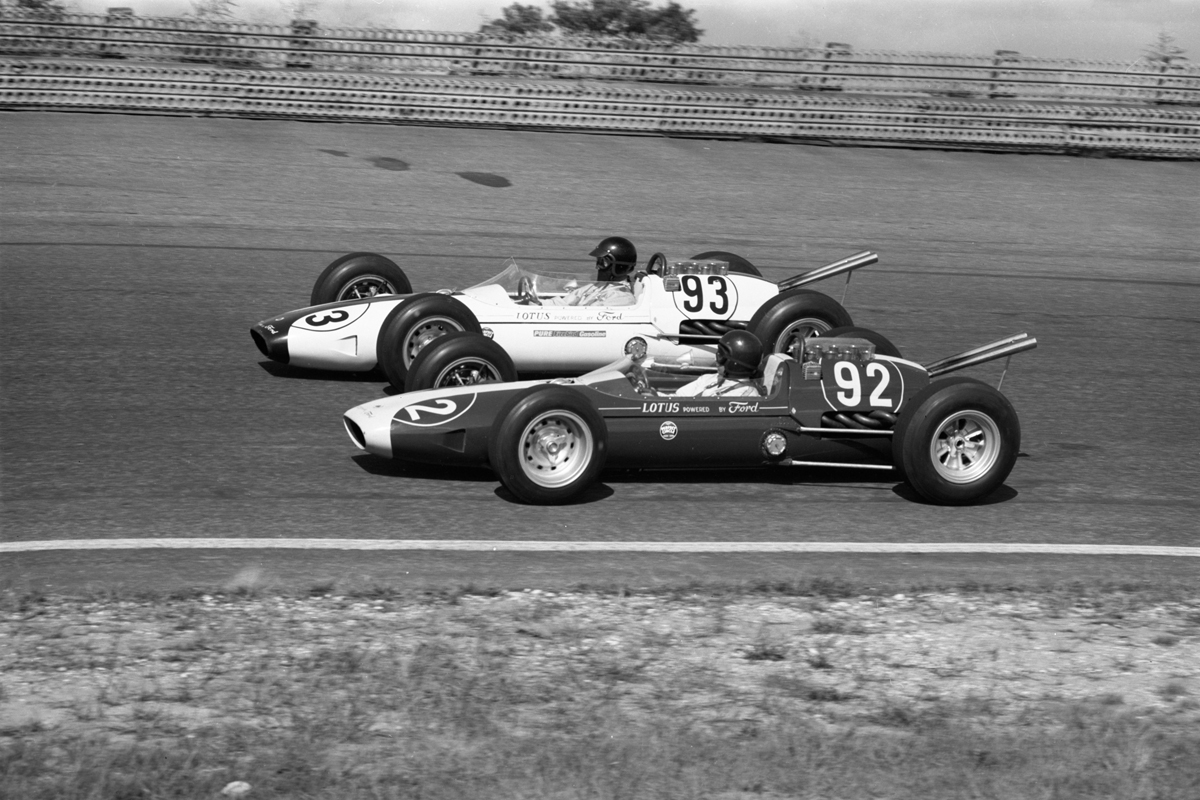
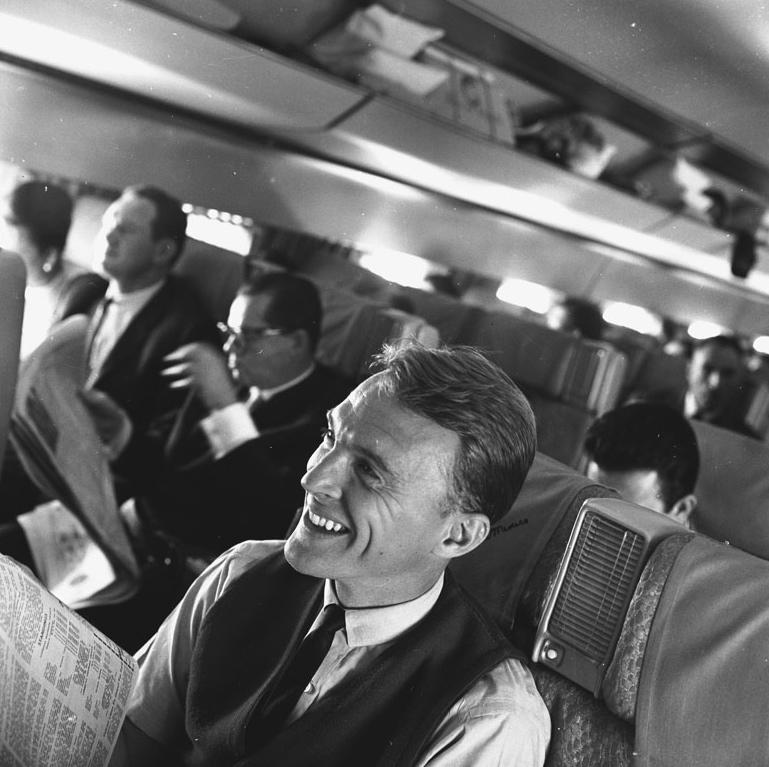
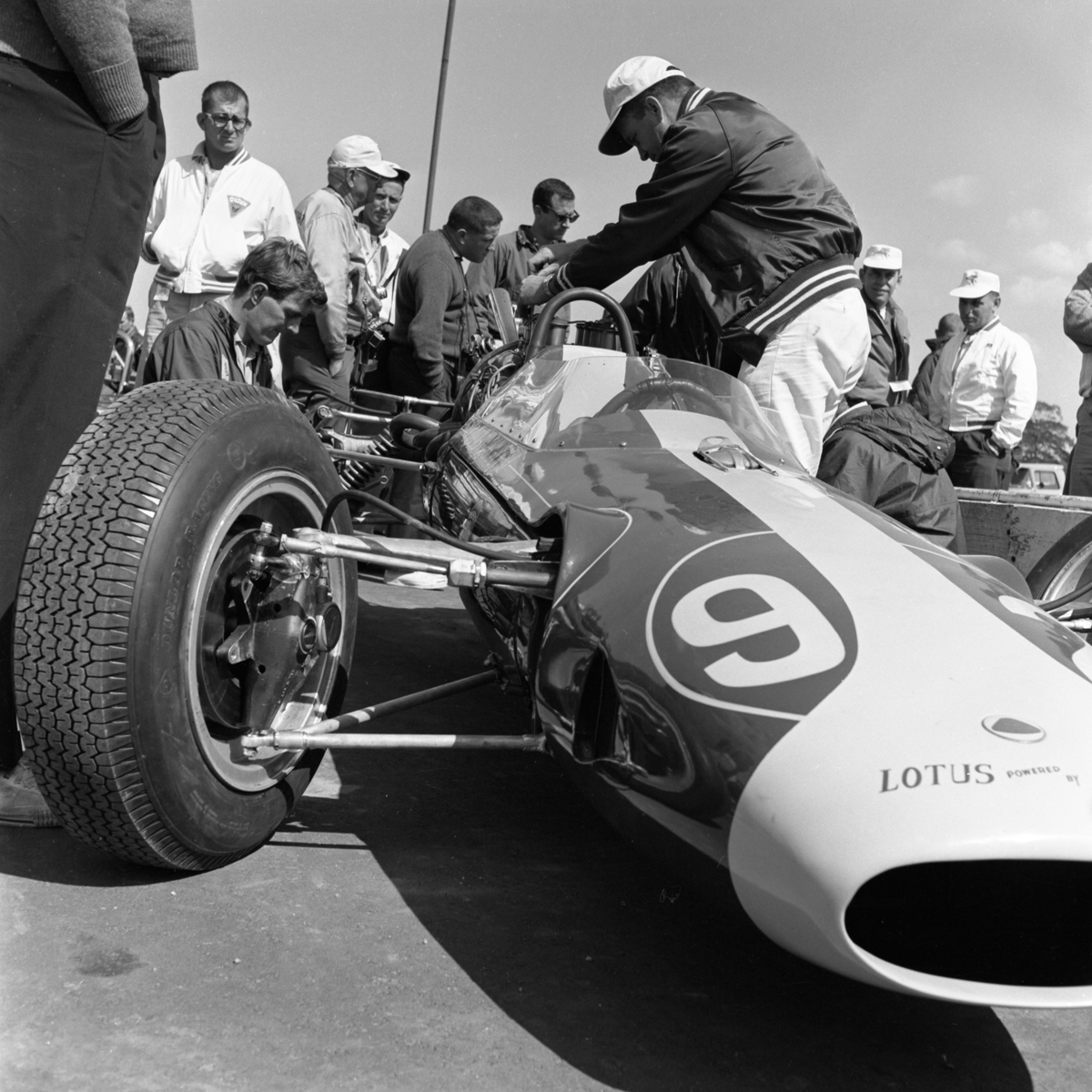
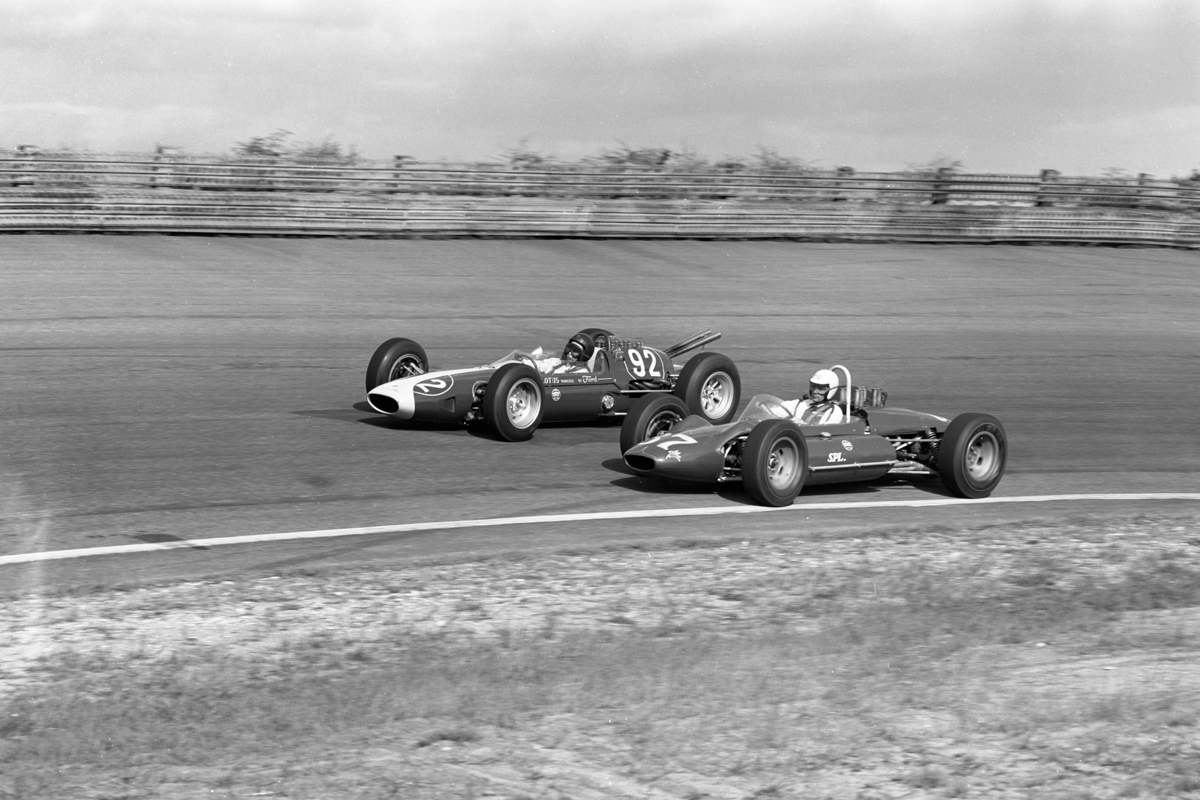
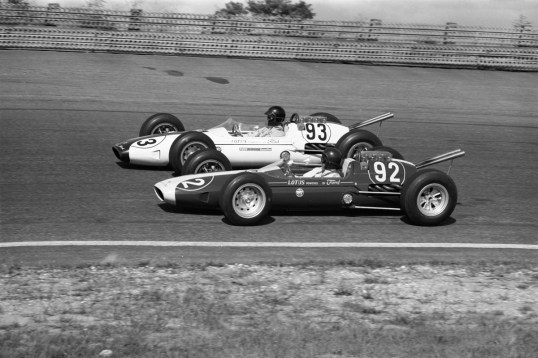
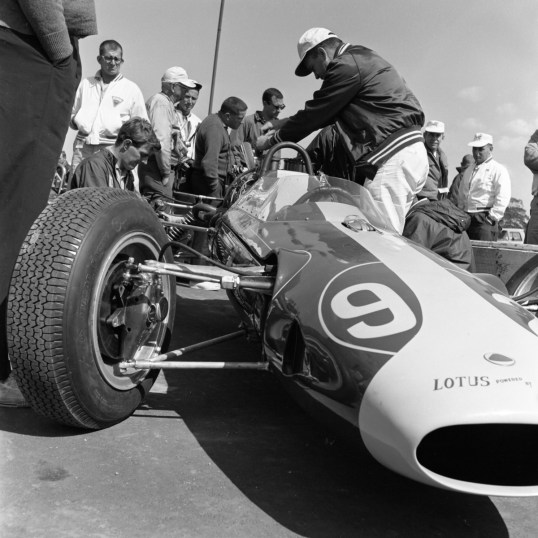
Captions (from top):  looking slightly less elegant thanks to its angled exhausts, the Lotus 29-Fords nonetheless set the pace at Trenton.  Jim, wearing his regular, peakless Bell Magnum but on this occasion (as per the USAC regularions) a shoulder harness, was leading easily before an oil leak forced his retirement; Dan then took over in the blue-and-white car – but retired with a broken piston.  Note that they are running the same Dunlop-Halibrand wheel combination as Milwaukee; Dan Gurney, on board a 707, gives some idea of what it was like in 1963, when trans-Atlantic crossings were for drivers like Dan and Jim Clark as frequent as trips to the local market.  Economy class was a little more spacious back then; the seat backs included a serious reading light; and everyone dressed for the occasion, regardless of the route or the timings Photographs: Ford Motor Company and LAT Photographic

It was initially difficult to find images from the 1963 Trenton 200.  I wrote to most of the leading US journalists for leads;  I contacted local, New Jersey, newspapers and agencies.  No luck.  Then, the day after the above report was published, I received this bundle (below) from the Ford Motor Company.  To say I’m delighted is massively to under-state.  Finally, we can gain a picture of what it was like back then on the track that is no longer.  Look at the old grandstand; look at Jim Endruweit and the Lotus mechanics, all neat in green.  Look at the sandy infield;  look at the Fairground in the background.  Look at the 29s out there in the groove.  That’s the rear-engined Kurtis-Offy of the  Canadian, Ed Kostenuk, that Jim is lapping.  That looks like the nose of Parnelli’s Watson on the right as Jim’s 29 is pushed backwards down the pit lane – and that’s Roger McCluskey’s Vita Fresh Orange Juice Special behind Jim’s car at bottom.  Again, many thanks to FoMoCo.
THF110896_JimClark-Trenton200_09-22-1963THF110898_JimClark-ChuckRogee-Trenton200_09-22-1963THF110899_JimClark-DanGurney-Trenton200_09-22-1963THF110900_JimClark-Trenton200_09-22-1963THF110902_JimClark-Trenton200_09-22-1963

Clark’s Gold Cup

21594.tifJim’s hectic schedule was a blessing:  he had little time to dwell upon the post-Monza traumas.  After the Chapman party, Jim returned to Edington Mains for a couple of days, there at last to savour the feeling of securing the World Championship. There were interviews to handle; and the concept of an autobiography was quickly gathering strength. Too quickly, though, it was time to drive down to Tarporley in his new, prototype Lotus Elan for the Daily Express-sponsored Gold Cup meeting at Oulton Park. Although this was a two-day meeting, with practice on Friday and racing on Saturday, Jim was additionally required to drive the 25 in a filming session for Esso. Unusually, movie cameras were mounted on a specially-made, triangulated section behind the driver and in the footwell area.  Everyone remembered Graham Hill’s scare at the Nurburgring the year before, when he had clouted a camera that had fallen off another car, but this session, at least, would take place with no other cars on the circuit.

Cedric Selzer recalls Colin Chapman’s reaction to the filming in his superb new autobiography, “Jim Clark”“The camera on top was operated by a battery pack – basically a wooden box containing a number of batteries.  No-one had thought of how this box was going to be mounted.  It was too big to go on the driver’s lap.  While we were dithering over what to do, Colin Chapman came over, slightly irate, as he wanted to get away as soon as filming was over.

“He put the box on top of the two rear tailpipes and bound it on with tank tape.  We all looked at each other, knowing what the outcome would be.  Jim went out in the car and on the second lap he came in with the battery box missing. We were not surprised. The camera crew went around the circuit to collect it. They came back with the battery pack completely wrecked. Fortunately for them, they had a spare. Chapman played no further part in remounting the battery box.   The mechanics took over, did it their way, and there was no further trouble! Jim never went over 7,000rpm as he was worried about the battery box going missing again but he drove as if he was driving at full speed.”

Many of you will have seen this on-board lap already on YouTube – but I am pleased to show here the entire film made by Esso, beginning with the Esso caravan’s departure (with Joe and Lofty!) from the Fulham oil dump by Wandsworth Bridge, London. It also includes some nice shots from the British GP and the Oulton Park Gold Cup. Watch for Cedric Selzer in the closing sequence, fingering the Cup itself!

Jim was scheduled to drive three different cars at Oulton – the 25 in the F1 Gold Cup; the Normand Lotus 23B; and, finally, now that it had been homologated, the brand new Lotus-Cortina.  He indeed raced the 25, and won with ease from the pole.  His new lap record established him as the first driver officially to lap Oulton at over 100mph; and top speeds in the F1 race, recorded for the first time over one-tenth of a mile on the back straight, underlined Jim’s feelings about the superior power of the BRMs.  Richie Ginther broke the trap at 139mph, Innes Ireland at 138.4 mph and Graham Hill 137.8 mph. Jim was the quickest Climax runner at 136 mph.  After this race, Selzer also wrote: “There have been many stories about the tyres on Jim Clark’s car lasting four races.  This is true, but also the brake pads lasted three times longer than those any other driver.  Derek Wild used to say that you could put all the gearboxes on the bench in front of him in random order and he could tell which gearbox came out of Jim’s car as it showed less signs of wear.   The point is that the standard of preparation was no different between Jim’s car and the number two car.  It was just that the man was very ‘soft’ on his car and so he tended to last the race distance as a result.”1963 International Gold Cup.1963 International Gold Cup.

The remainder of Jim’s Oulton racecard was more complicated.  Having taken the lead from the front row of the sports car race – the first event of the day – Jim amazingly spun on the opening lap and dropped to eighth.  Frank Gardner, who had driven beautifully in practice to take the pole with the little works Brabham, crashed heavily in avoidance and was very lucky to escape serious injury. Despite all this, Jim sliced his way back through the field to win his class and to finish second overall behind Roy Salvadori’s venerable Tommy Atkins Cooper Monaco. 21580.tifJim practised the Lotus Cortina but stood aside to let Jack Sears race it: Ford of America enjoyed a relationship with Willment that extended far beyond motor racing and specially requested that Jack be allowed to debut the car officially. (Without in any way detracting either from Jack or Willment, it seems odd that Ford considered this to be more significant than having Jim Clark, Indy-Ford driver and new World Champion, in the car.  Such, though, were the times.) Jim watched happily with Colin as Trevor Taylor, now recovered from his Enna shunt, jumped straight into the other Cortina to qualify only a shade slower than Jack. 21605.tifTrevor sat on Jack’s bumper for the duration of the race – and in addition qualified fourth for the Gold Cup, in the 25, 0.6 slower than Jim.  Again, though, he DNF’d with more transmission problems.  Mike Beckwith, Jim’s Normand team-mate, made his F1 debut in the Gold Cup, driving Jim Hall’s BRP Lotus 24-BRM, but Mike remembers it as an unhappy time:  “We never got the thing sorted and it all ended when the gearbox seized going into Old Hall.  I hit the bank hard.”  Mike, like Frank Gardner, was fortunately able to return to the pits on foot.

Also in the Oulton saloon car event:  Dan Gurney, driving “Jim’s” Alan Brown Ford Galaxie.  Dan, who had retired from the Gold Cup with a blown engine in his Brabham, arrived very late on the grid amidst frantic PA-calls for his presence.  He then calmly peeled open a packet of chewing gum, climbed into the car…and won from the pole.21611.tif  Graham Hill replaced Sears in the Willment Galaxy and duly finished second – and Phil Middlehurst, father of Andy, was again right in the midst of it with his Cooper S.  About the first thing Andy remembers, as a baby in a pram at Oulton, is staring at the rear light cluster of a factory Lotus–Cortina.  Last weekend, at Goodwood, Andy, still obsessed with mid-1960s Lotus, debuted his stunning rebuild of Jim’s 1966 US GP-winning Lotus 43-BRM.

60,000 people watched the racing at Oulton:  it was another of those classic, brilliant, British motor racing days at one of the all-time great circuits. Old Hall, crammed with spectators, was cambered, quick and very conducive to four-wheel-drifts. Or you watched from further down the hill, on the approach to Cascades, where you could see the cars plunge into the left-hander – or accelerate away over in the background, down the straight, noses dipping as they flicked through the gears. The mist rose in the early mornings at Oulton; the light flecked through the trees. The aroma of high-octane fuel mixed perfectly with the gentle flavour of English parkland. The drivers gathered around the Esso caravan in the paddock for cups of tea and a sandwich. The team transporters were parked in natural but logical random. Flags flew.  And, In a field nearby, the makeshift runway ran diagonally, giving maximum length for take-off.

Jim, Colin and Dan flew from it in Colin’s Piper Aztec, narrowly missing the trees as the engine thrashed away.  From Heathrow, they flew on to Toronto, where they transferred to a Ford company plane for the ongoing flight to Newark.  The following day, Sunday, despite the full programme of Oulton, despite the trans-Atlantic flight and all the connections, Jim and Dan would be racing Lotus 29-Fords in the Trenton 200.

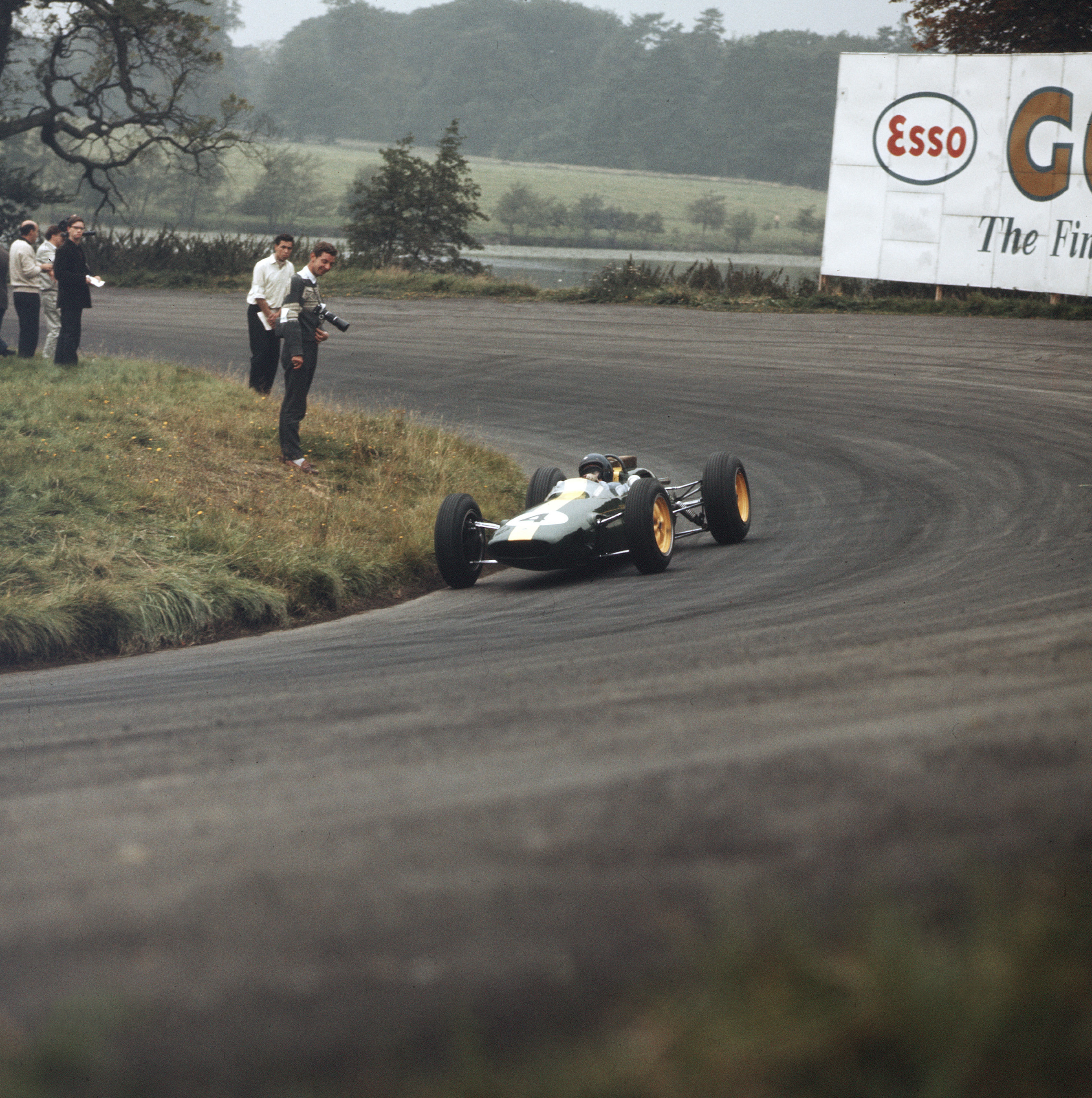
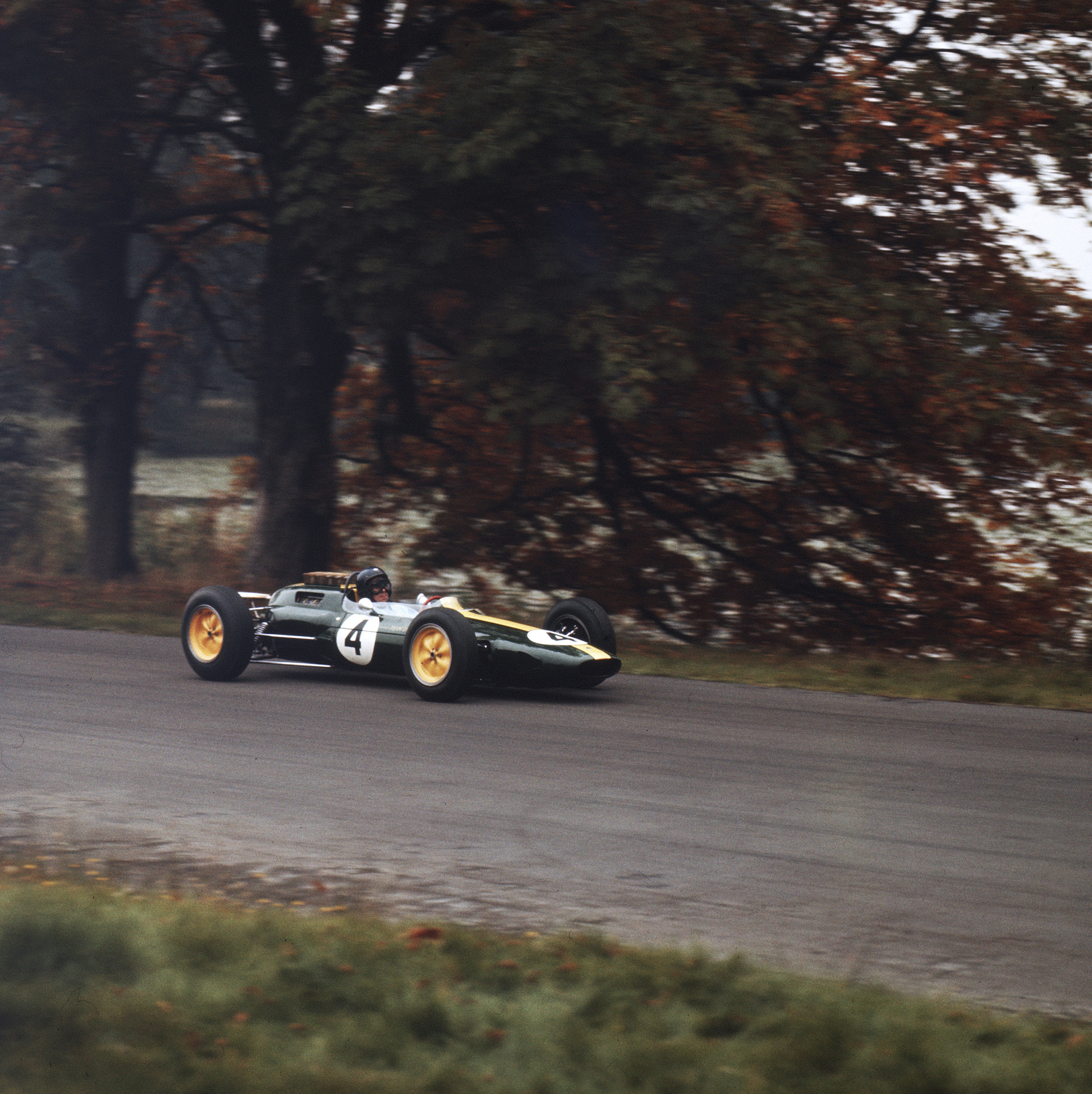
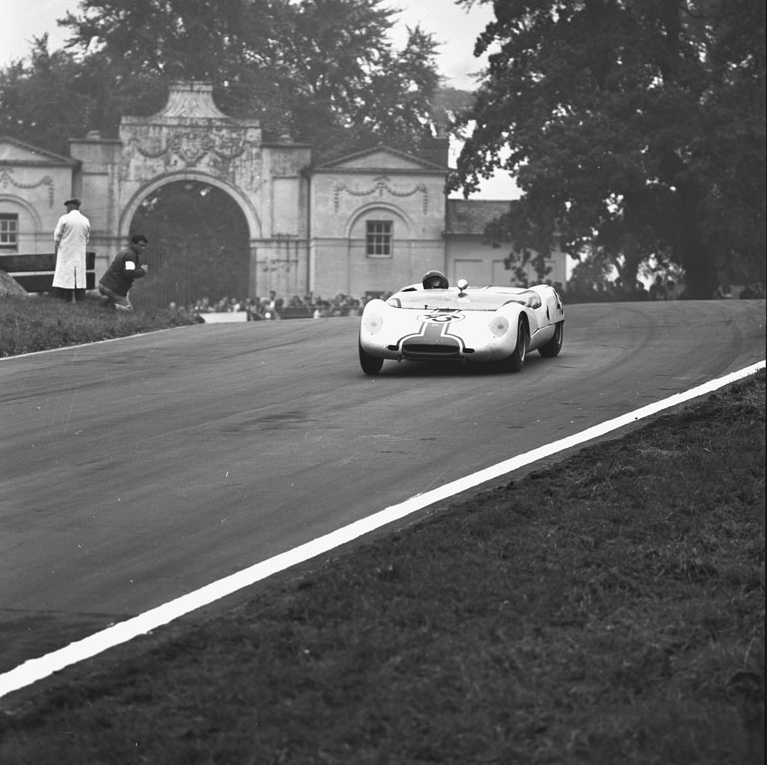
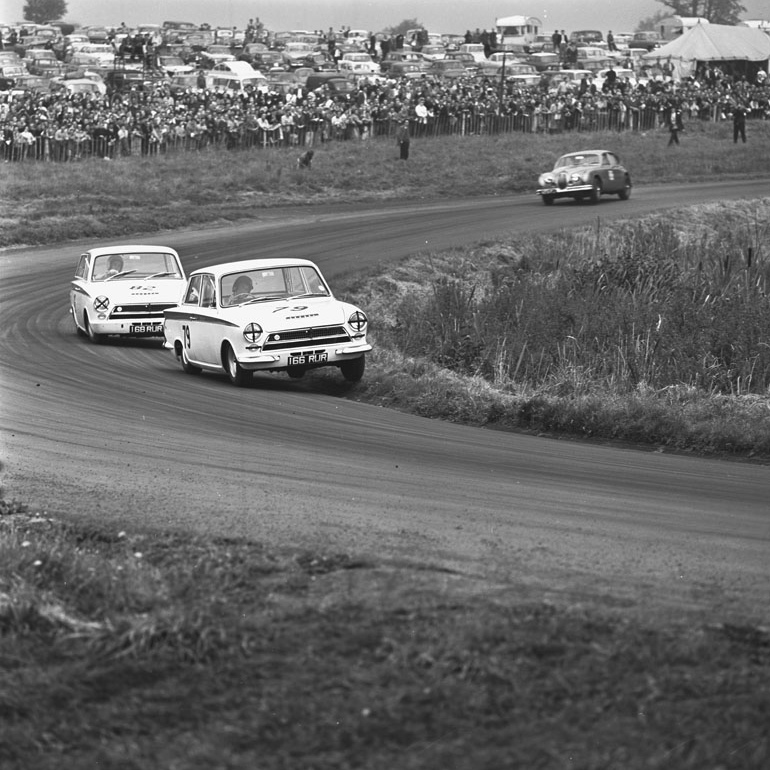
Captions, from top:  Jim glides the 25 through the Esso Hairpin at Oulton Park.  He won the Gold Cup with impunity; the full version of the Esso film made before, and during, the Gold Cup meeting;  photographer Max Le Grand peers down at Jim as the Lotus 25 prepares to exit the Esso Hairpin; the nose dips as Jim squeezes the brakes between the autumn leaves; Jim exits Lodge Corner in the Normand Lotus 23B.  On this occasion he wore his Bell Magnum, creating a very different look from the April meeting at Oulton; Jack Sears and Trevor Taylor stunned the crowd with their new Ford Lotus-Cortinas; Dan Gurney won the saloon car race overall with “Jim’s” Alan Brown’s Ford Galaxie Photographs: LAT Photographic, Peter Windsor Collection

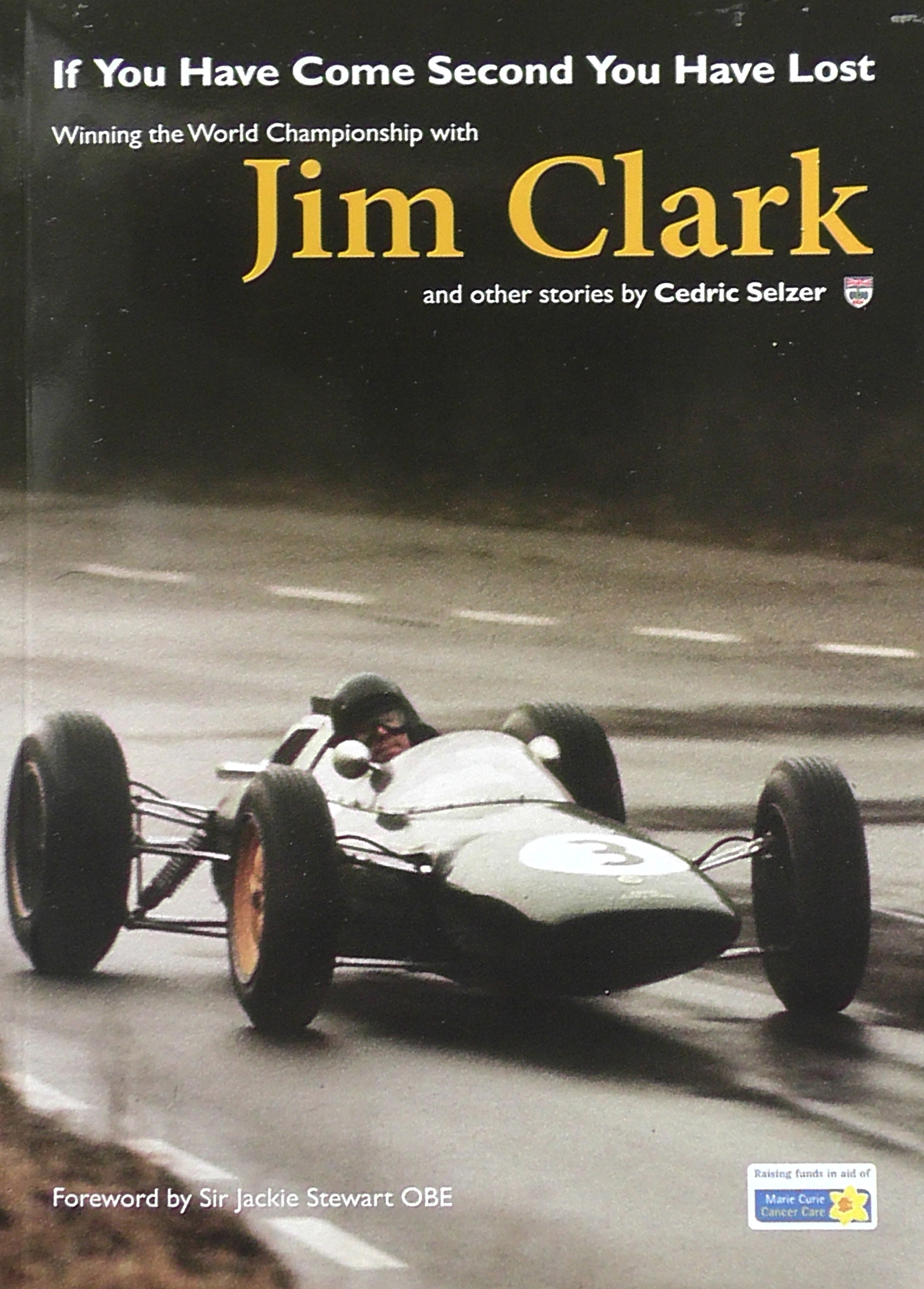
With grateful thanks to Cedric Selzer, whose new autobiography contains many Jim Clark gems. Cedric has published the book himself, with proceeds going to the Marie Cure Cancer Care Charity. It can be ordered on-line or via good bookshopsS2740001

Milwaukee Magic

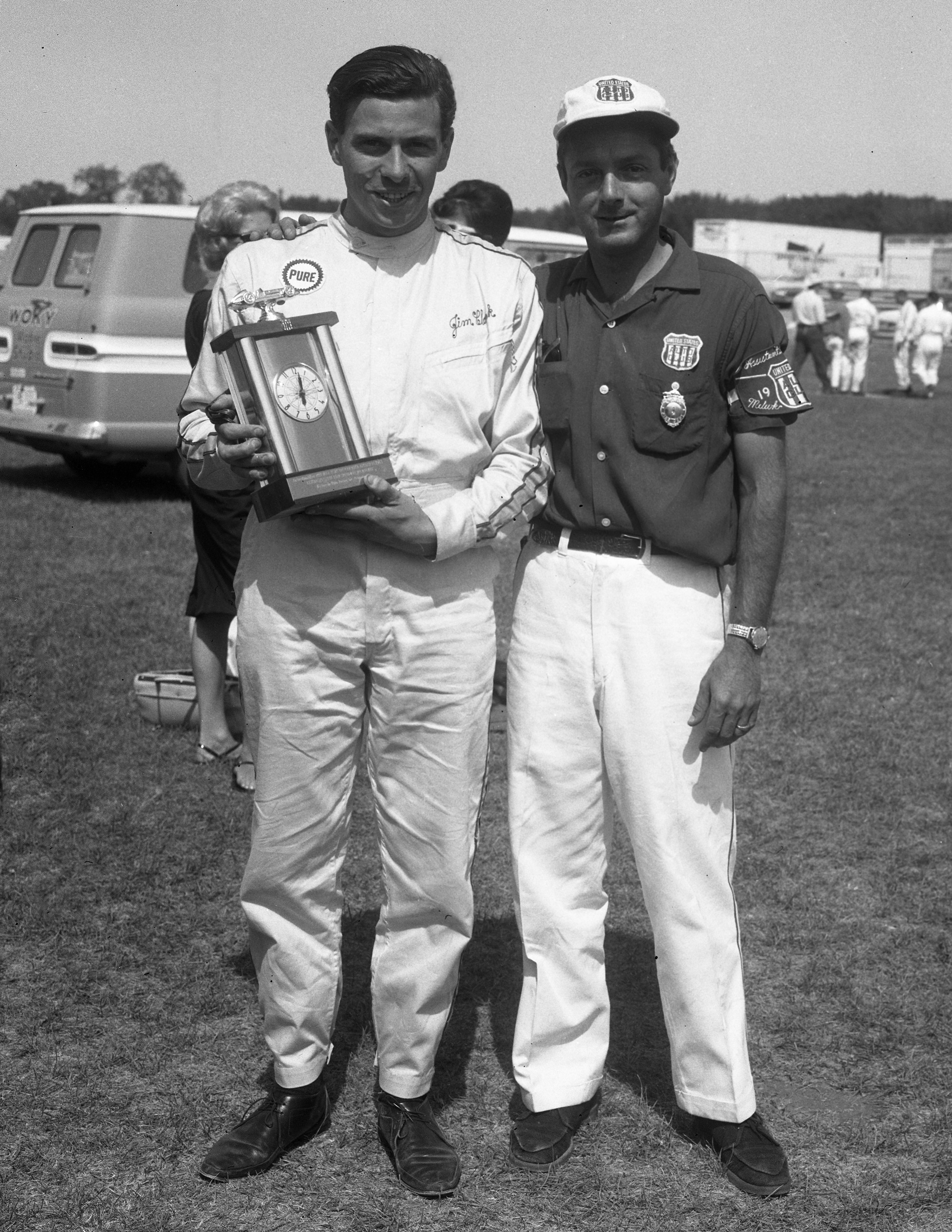
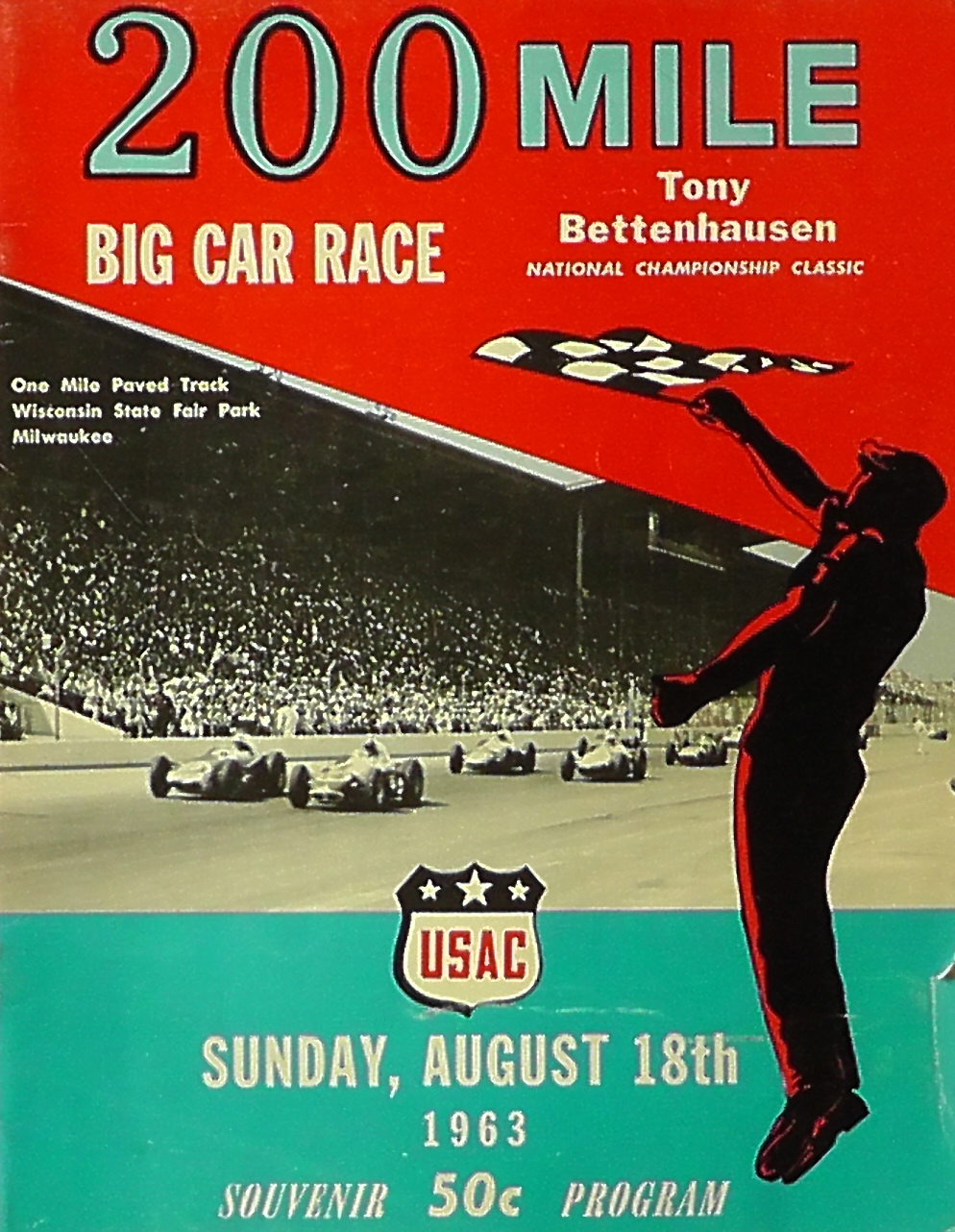
63-8-18 J Clark With Fast Time Trophy& Mike Billing USAC Official _268With that excellent Milwaukee July test behind him (see “Jim Clark, Delicately Poised”), Jim flew with Dan Gurney and Colin Chapman to Chicago on Wednesday, August 14, 1963, for the 200-mile Tony Bettenhausen National Championship Classic – Jim’s second oval race in America. The Milwaukee Mile was already a part of American racing folklore and this race, the biggest of the year on that track, was named after the superquick Indy driver who had died in a testing accident at Indy (caused by a suspension failure) in 1961. S2650001 By now, the Lotus 29-Fords had become the major talking-point in American racing circles.  Jim hadn’t won Indy; and many, amazingly, remained front-engined proponents, AJ Foyt and Parnelli Jones firmly amongst them.  On the other hand, the might of the Ford Motor Company was now pouring money into its race programmes, and it was no secret that several customer teams would be chosen for 1964.  The American view at the time was that Ford were allowing Lotus – “those British guys” – to build a car around the brilliantly-developed 4.2 litre V8 pushrod engine.  Key American journalists even referred to Jim’s car as a “Ford-Lotus”.  For his part, Jim was happy to go along with it all.  Although he could live without the attention and the fanfare, he was impressed not only by the challenges of racing in America but also by the prize-money.  He expected nothing on a plate – but he liked the idea of being rewarded for a job well done.  This was in stark contrast to Europe’s start-money system, which engendered reasonable retainers for the drivers but relatively small prize funds.

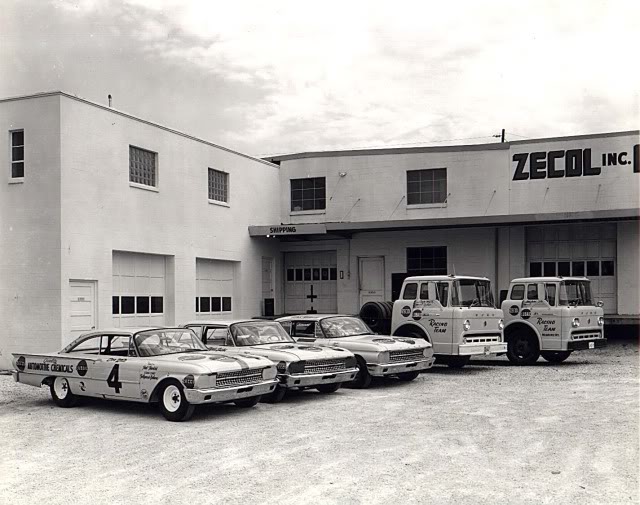
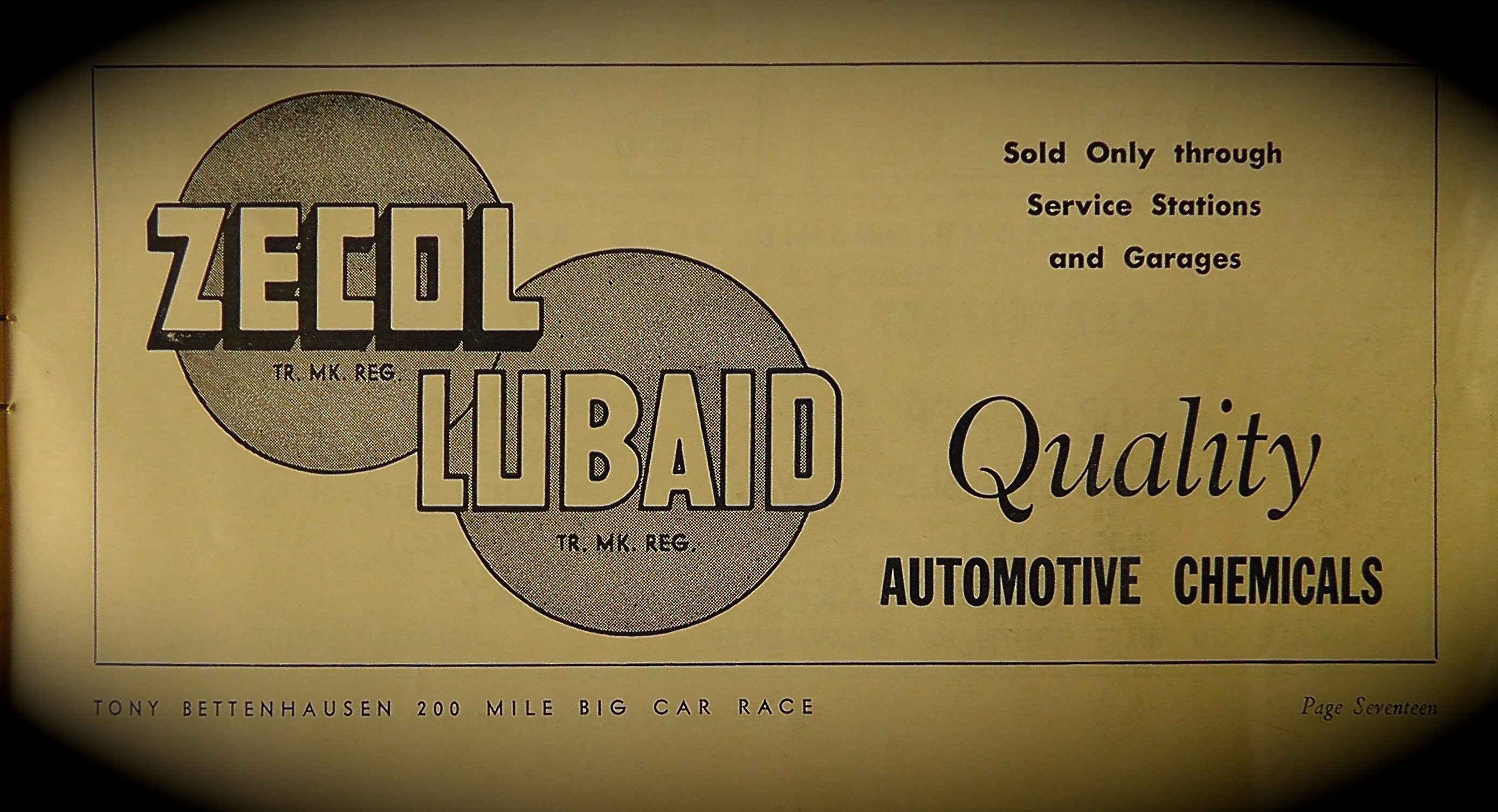
The 29s for this race were housed nearby at Bill Trainor’s Zecol “Lubaid” (as in “lubrication aid”) garage favoured by NASCAR teams.  Zecol4aBoth cars raced with the softer-compound Dunlops (as distinct from Firestones or Goodyears) but ran with different carburettor layouts:  Jim used the only set of 48mm Webers (mounted longitudinally) available, Dan the older 58mm Webers (mounted laterally).  Bottom line:  Jim dominated practice, qualifying and the race but Dan could only finish third, hampered hugely by fuel-feed problems caused by surge on the lightly-banked turns.  AJ Foyt finished second in his venerable roadster, with Jim resisting the temptation to lap the American star in the closing stages. “I had a field day,” Jim would recall in his autobiography.  “I found I could run tight, round the inside of the circuit, and I used this to get inside the big Indy cars and beat them along the straights to the next corner.  In this way I lapped everyone except AJ Foyt in second place with his Meyer-Drake special.  Towards the end of the race I came up behind him but decided not to lap him because that would have been rubbing it in too hard.  Already the Indianapolis designers were off to build new cars for 1964 due to our efforts!”

All this is relatively well-known.  Much more difficult to find are photos from that Milwaukee race.  I wrote, therefore, to David Hobbs, the very quick and successful British driver who today lives with his family in Milwaukee.  David recommended that I contact his dear friend, Russ Lake.  Although not a professional in the sense of relying solely on motor sport for his livelihood, Russ is by any standards a “true pro”.  He has eaten, slept and captured American motor sports on film for going on 50 years.  And, yes, he had some pictures from Milwaukee, 1963.

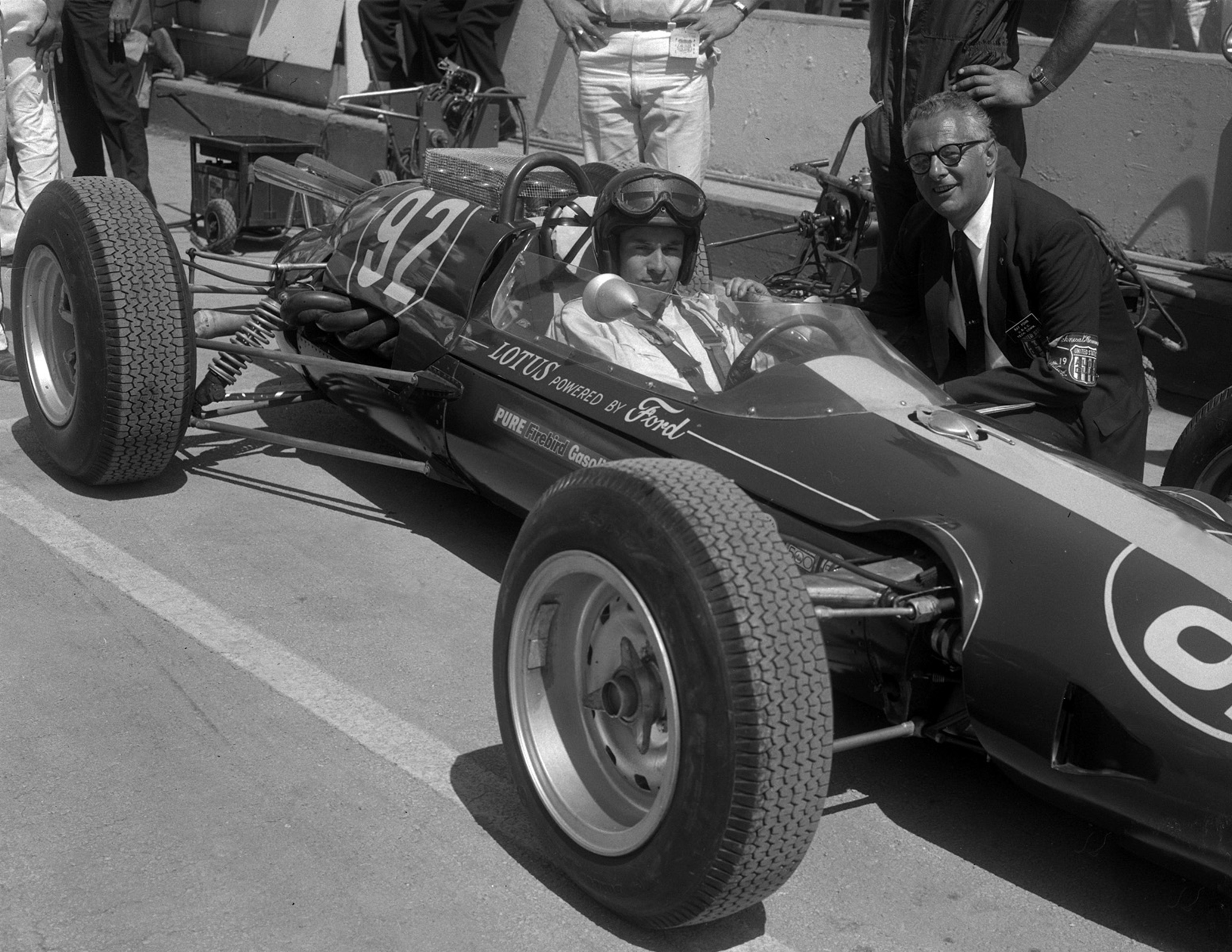
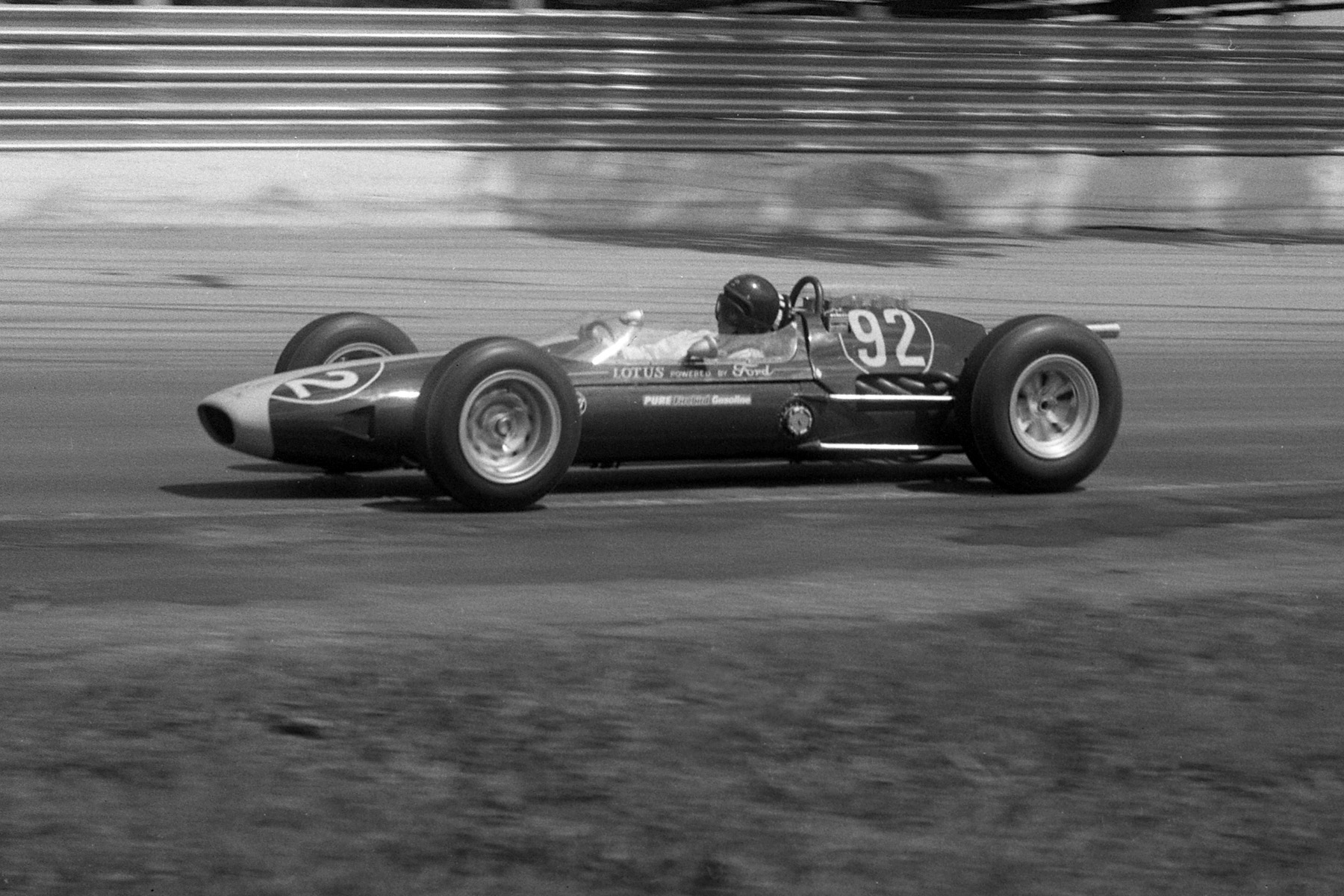
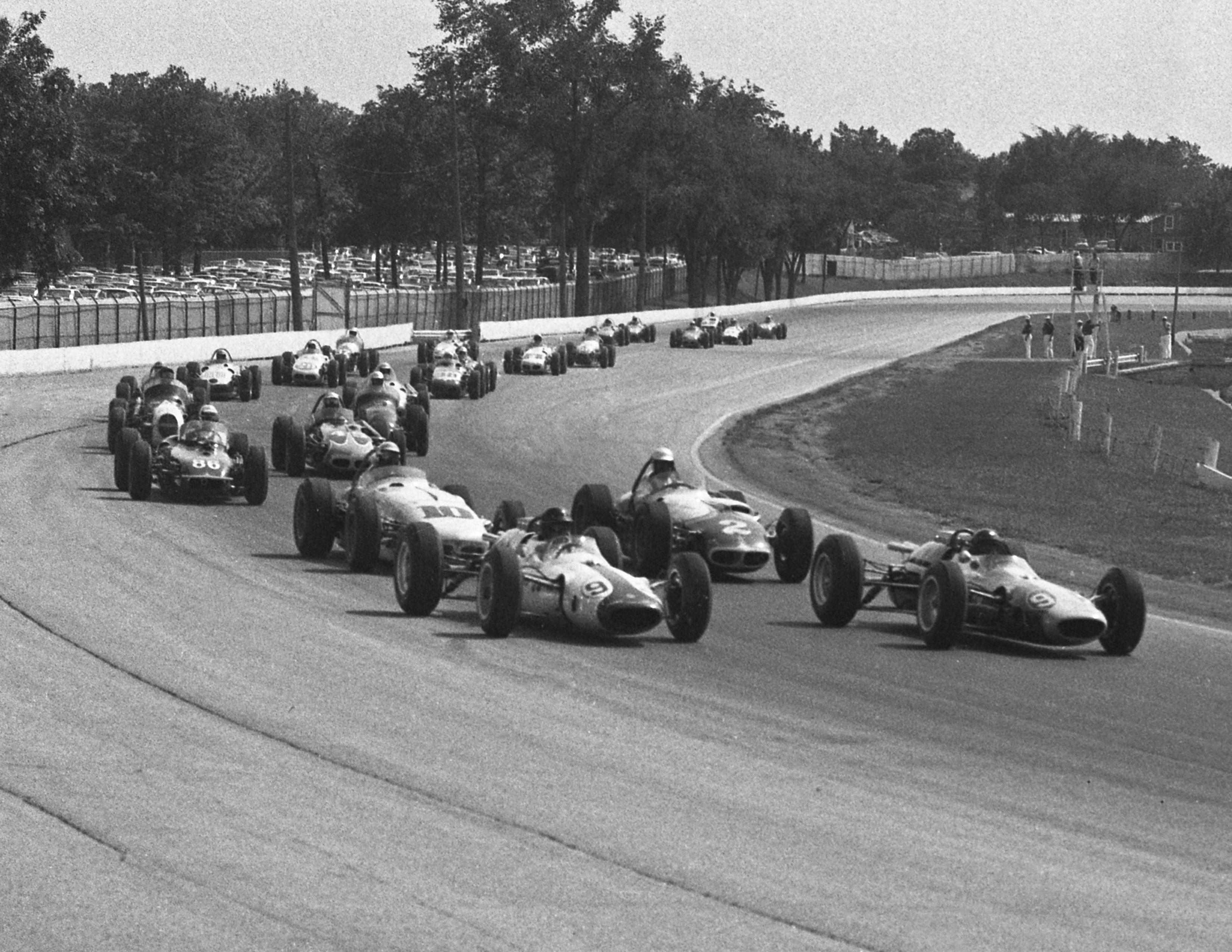
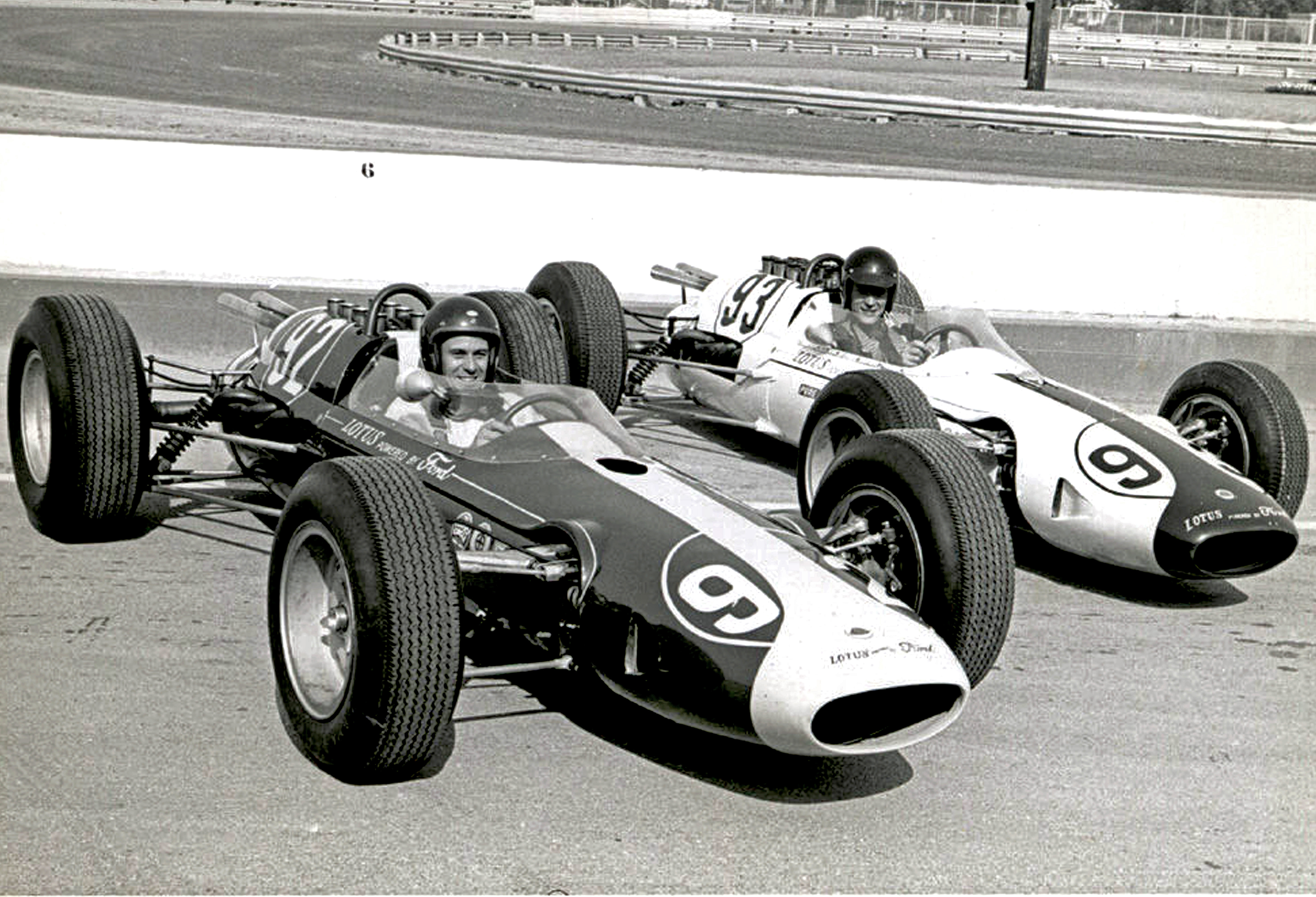
You can see them here – Jim accepting his pole award, or in the car, side-by-side with Dan.  Jim in the pit lane.  Jim mid-corner, head leaning to the left, arms nearly straight. Study them closely.  Remember that the Clark you see here is the driver who has just won the Belgian, Dutch, French and British Grands Prix, has finished a fighting second at the Nurburgring, and who has flown to the States almost directly from his win in Sweden.  Look at his Westover driving shoes – slightly tatty and worn from driving the Lotus 25s, the Galaxy, the Lotus 23Bs and the Indy Lotus 29s.  He wore his Hinchman overalls in Milwaukee – minus Firestone logos – and raced with his now-customary peakless Bell (unlike Indy, where he wore the white peak).  Note, too, the “Pure Firebird Gasoline” stickers on the sides of the cars (instead of the Pure roundels), the gauze filters over the carburettor inlets, the pad taped to Jim’s headrest to support his neck and the Dunlop wheels on the front (and Halibrands on the rear).  All these details were different from the Indy spec; and – again – a big thanks to Russ Lake for enabling us to see them – in my case certainly for the first time.  1963-8-18 Jim Clark & USAC Official Ray Pohn_6481963-8-18 Action Milw_6491963-8-18 Pace Lap Clark on Pole_269Jim Clark & Dan Gurney_382

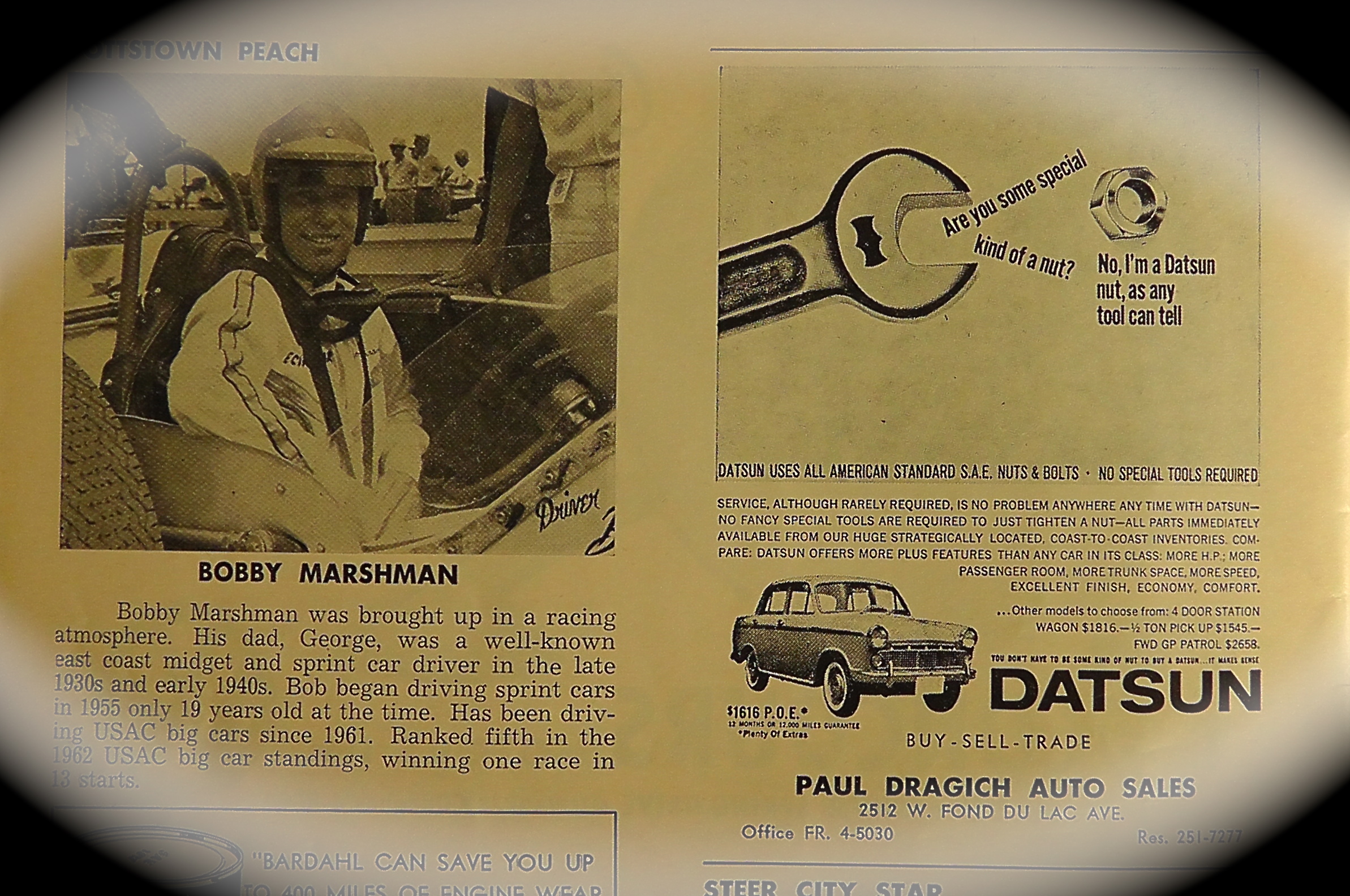
Jim’s winnings totalled $44,225, boosted massively by the lap prizes on offer from such companies as Augie Pabst Motors, Flambeau Motor Repairs, Hoosier Beer Cats, Datsun, Golden Slipper Lounge, Dunkels White Oakes Inn, Zecol Inc, Banner Welder Inc, Baumgartner Imported Cars and Ben Shumow Used Truck Sales.  In addition, Jim received winner’s bonuses from Autolite, Champion, Monroe and Willard Battery.

Jim loved his motor racing – loved driving and also loved learning about it in all its forms.  When AJ Foyt and Rodger Ward invited him to the Springfield sprint car meeting on the Saturday afternoon of Milwaukee, therefore, he instantly accepted.  Dan and Colin also came along.  Remembers Jim: “AJ, whom I knew quite well by then, shouted, ‘Hi Jimbo!  How’s about bringing the Lotus out for this type of race?’  The race was hair-raising and looked dangerous as the drivers power-slid their cars round in great style.  When I was asked if I wanted to have a go, I, for once, declined, but this racing was really a spectacle.”

Below, I’m delighted to be able to embed some video footage of that 1963 Springfield race, complete with glimpses of Jim, Dan and Colin having fun in the paddock area.  You’ll see them at the start and then there’s another shot of Jim near the end, stop watches in hand, absorbed by the proceedings.  He was close to AJ Foyt and to Rodger Ward, and so he would have enjoyed this race immensely.  Note his official pass, dutifully worn, and his Lotus green polo shirt.  (Only the first half of the video is from Springfield but I recommend you watch it in its entirety.) Watch, too, for the brilliant Bobby Marshman.  He’s at the start of the video, showing Jim and Dan around his sprinter, and he’s out there, leading the race, when his engine fails.  He impressed Jim and Colin, of course, and the following year he would race Jim’s 1963 Lotus 29 at Indy (repainted red-and-white, sponsored again by Pure and entered by Lindsay Hopkins).  Bobby led Jim in the 500 before running a little too low on the banking and damaging the sump plug.  Chapman thereafter resolved to include Marshman in upcoming Team Lotus US race programmes and perhaps even to give him an opportunity in Europe.  Very sadly, though, Bobby was killed in a Firestone testing accident at Phoenix late in 1964.
Postscript: Immediately after Milwaukee Jim flew to Newark to test the 29 on the Trenton 1.5-mile oval in the New Jersey State Fairgrounds.  Trenton was more banked than Milwaukee and very quickly, on an empty circuit, with only the Team Lotus boys on hand, the 29 ran into handling problems.  Jim then hit the wall when a steering arm broke.  He was unharmed and resolved immediately not to allow himself to fall into the Lotus “fragile” syndrome.  “I didn’t put this down to Colin Chapman,” he would say later, “because at that Trenton test we were running tyres unsuitable for the banking.  To his credit, though, Colin not only changed the steering layout on that car but he also came straight back and changed all the F1 cars, even though we had been running for five years and had never had one break before.”
S2650002

Captions, from top: Jim accepts the clock trophy for pole position from USAC’s Ray Pohn.  Note the roadster atop the timepiece; the Zecol Lubaid garage where the 29s were based in Milwaukee; Jim in pit lane; Jim in action; Jim and Dan lead the field towards the green flag; and a nice one-three for Team Lotus Photos: Russ LakeS2650004

Post Navigation