peterwindsor.com

…chance doesn't exist; there's always a cause and a reason for everything – Elahi

Archive for the tag “Migrate to Substack”

Jim Clark in Mexico: 66% at 7,000ft
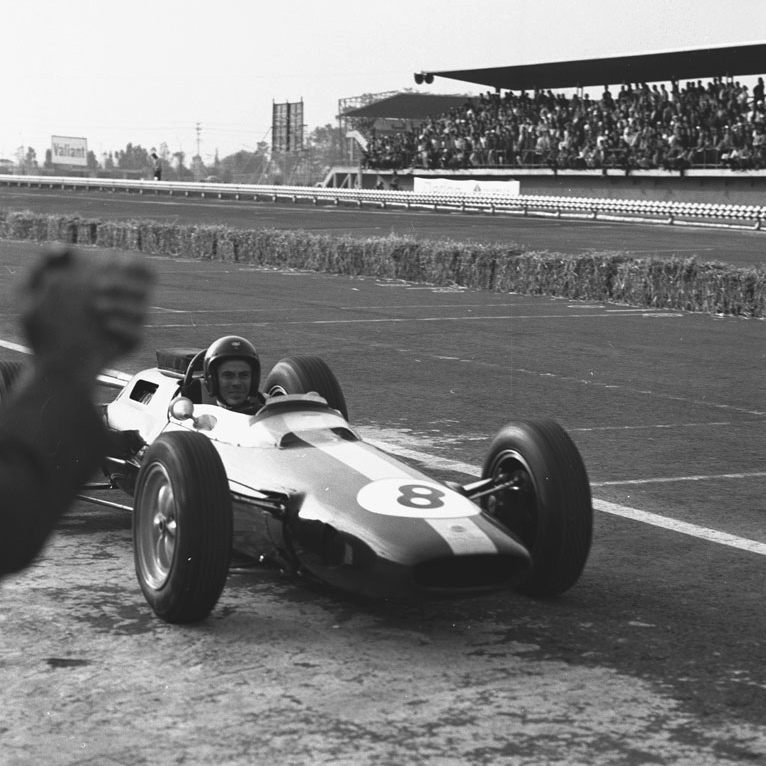
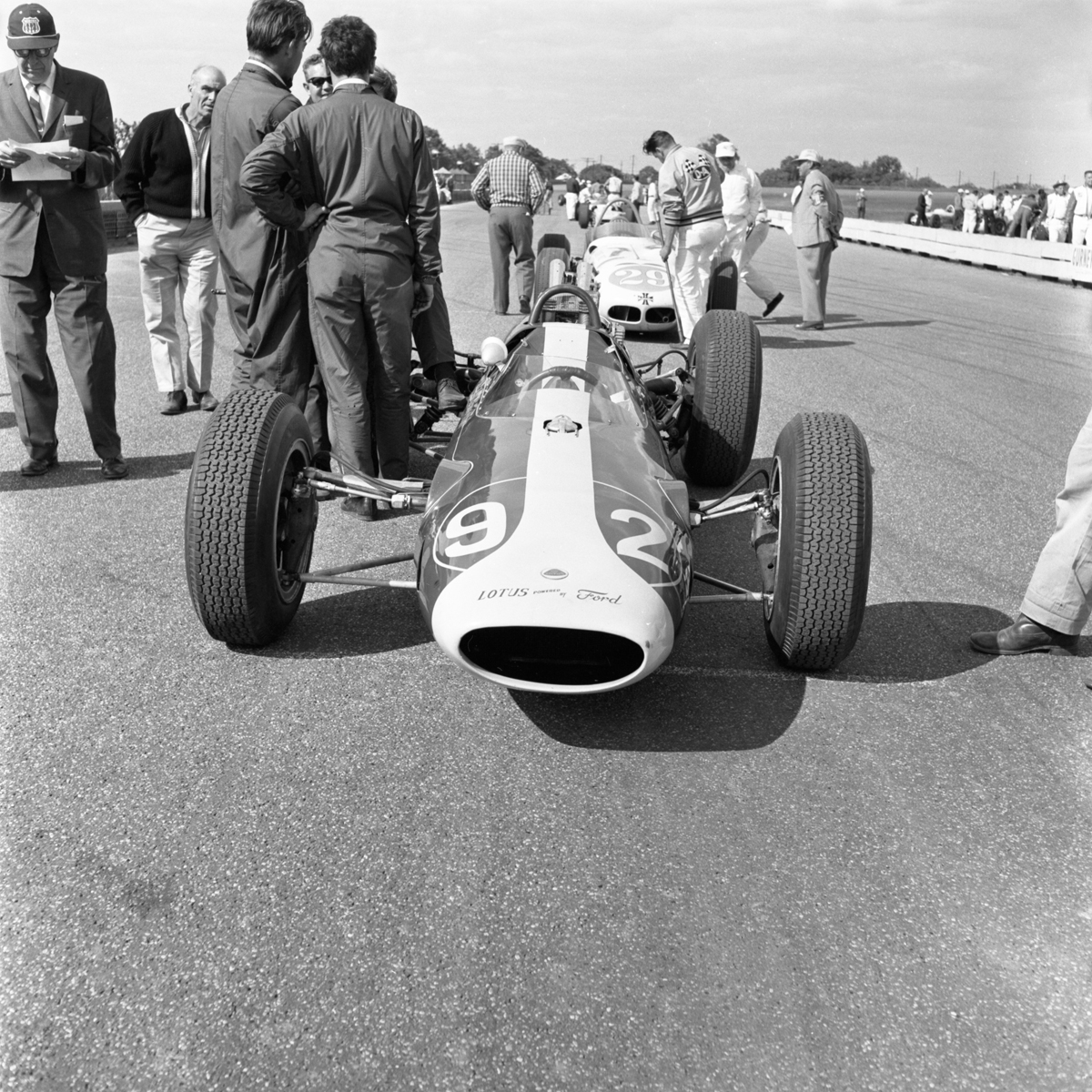
22034.tifThe Team Lotus mechanics had been usefully employed at Ford’s Dearborn headquarters whilst Jim was racing at Riverside and Laguna, for the development Lotus 29-Ford was now scheduled to be tested at Indianapolis on the Tuesday and Wednesday (October 29/30) after the Mexican Grand Prix.  As a group, though, they all re-assembled in Mexico City on Wednesday, October 23, for the first World Championship F1 race ever to be run on the futuristic autodrome. Following the sad death of Ricardo Rodriguez in the 1962 non-championship event, the last corner (Peraltada) had been re-modelled slightly but, otherwise, the circuit remained unchanged and a definite standard-setter. Over to Jim Clark’s mechanic, Cedric Selzer, for his description:

“The circuit was absolutely spectacular. The most amazing thing, so far as we were concerned, was that the garages were built into the back of the pits. Electricity, water and compressed air were laid on – and we had a work bench, too!”

The F1 cars all remained at The Glen for a week before being trucked across to Mexico on four huge semis – open-top semis! “As if this was not bad enough,” recalls Cedric, “the cars had been chained through the suspension wishbones. When they ran out of chain, they had then used bailing wire. This meant that some of the wishbones had to be changed as they were bent and no longer serviceable. Where the chrome plating had come off there was not a lot we could do about it. It was part of Team Lotus policy to keep the cars in Concours condition so we then spent a whole day just making the cars look the part. Then we set about making them reliable and quick…

“Coventry Climax and Lucas had designed a metering unit to compensate for Mexico’s 7,000ft altitude. This was not a five minute adjustment job because the metering unit was in the middle of the engine vee, under the throttle slides. It was impossible to get your hand in there so, being the smallest of the mechanics, I was required to remove the inlet trumpets and find my way through. Even so, the engines wouldn’t run very well during first practice. We then discovered a Vernier adjustment on the back of the revised metering unit. It was a simple question of pushing in a pin and rotating a little wheel.”

Bruce McLaren described the power loss in his Autosport column the week after the race: “The loss of power was generally accepted to be about 25 per cent. You gradually became accustomed to this during the practice sessions but it was the start of the race that really showed up the difference. I let out the clutch on my Cooper with the rev-counter showing the usual 7,000rpm and the engine nearly stalled, obliging me to slip the clutch a couple of times. Even so, I managed to pass three cars off the line (the two BRMs and Dan Gurney’s Brabham)!”

Jim received a bit of fright early on Friday’s four-hour practice session when a dog ran out in front of him. He narrowly avoided the stray but it would be a portent of the chaos that would typify the Mexican GP for several years thereafter. There were track invasions as the decade wore on; and, as late as 1991, I was stopped by the local police en route to the circuit for no obvious reason  than that they wanted a couple of $100 bills; nor will anyone  who was at that race forget Anthony Marsh’s hotel room in Mexico City being robbed in the dead of night…by one of the hotel security guards. Such was the Mexican GP.  I guess it was all summed-up by the local Automobile Club being based in, um, a former house of disrepute. Everyone loved racing in Mexico…and will again love racing in Mexico…but you had to be ready for what you knew it was going to throw at you.

Practice was inconclusive – and very hard work for Team Lotus. Pedro Rodriguez’ carburettor engine had blown at The Glen – and did so again in Mexico: a tiny piece of debris had remained lodged near the timing chain. Trevor Taylor’s Colotti-gearbox 25 stopped with a broken first gear – and Jim stopped practice early when his ZF car developed its familiar tendency to jump out of gear. Even so – and partly because Saturday practice was rained-off – Jim started from the pole. Such was his ability to put together The Quick Lap. The Team Lotus boys left the circuit at 4:00am on Sunday morning.  “Not bad, if I do say so myself,” says Selzer, who typically (but totally falsely) blamed himself for the ongoing problems with Pedro’s engine. “The mechanics got down to the job of fixing Pedro’s car as though a World Championship depended on it,” remembers Jim Clark. “It was just like the old days. The boys managed to get some Reynolds bicycle chanin from a Mexico City cycle shop and then started to rebuild the engine.”

In his autobiography, Jim Clark, Cedric remembers arriving back at his hotel to find Phil Hill walking about in the gardens.  “’What are you doing?’ I asked.  ‘You should be in bed.  You’re racing in under 12 hours.’ Phil replied that he couldn’t sleep and had decided to take a walk. I understood later that this was fairly common practice for him.  For our part, we were back in the garages at 8.00am…”
21758.tif22060a.tifThe Mexicans put together an amazing programme on race day. On Sunday morning none other than “Fireball” Roberts won an exhibition stock car race;  and then, to much fanfare, the F1 drivers were introduced to the Mexican President, Adolfo López Mateos. Jim anticipated a decidedly early flag-drop, allowed for the power loss, seized an immediate lead…and was never headed, despite a problem with fuel starvation late in the race. (As he would at the British GP in two year’s time, Jim magically adapted his driving to absorb the troughs of the engine. Over the long, 2hr 10min race, and despite that fuel problem, his lap time average was never further than two seconds away from his fastest lap. Thus, with style, Jim won his sixth GP of the year.21995.tif

At a time when much is made of Sebastian Vettel’s amazing run this year, it’s worth recording that Jim in Mexico became the first driver since Alberto Ascari (1952) to win six races in a season and that his scoring rate for 1963 at this point was a stunning 66 per cent. Seb’s, post-India, is currently 55 per cent.

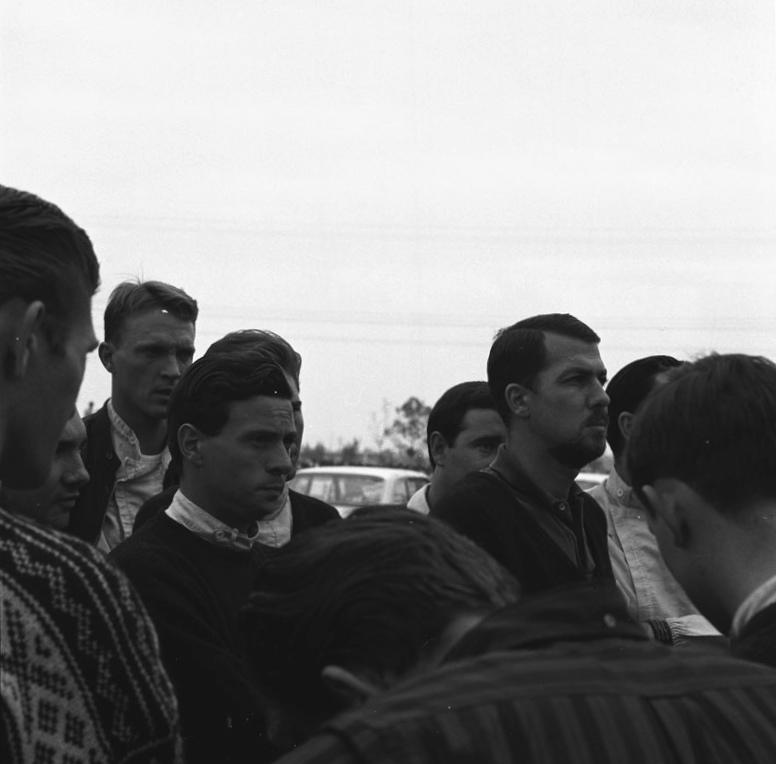
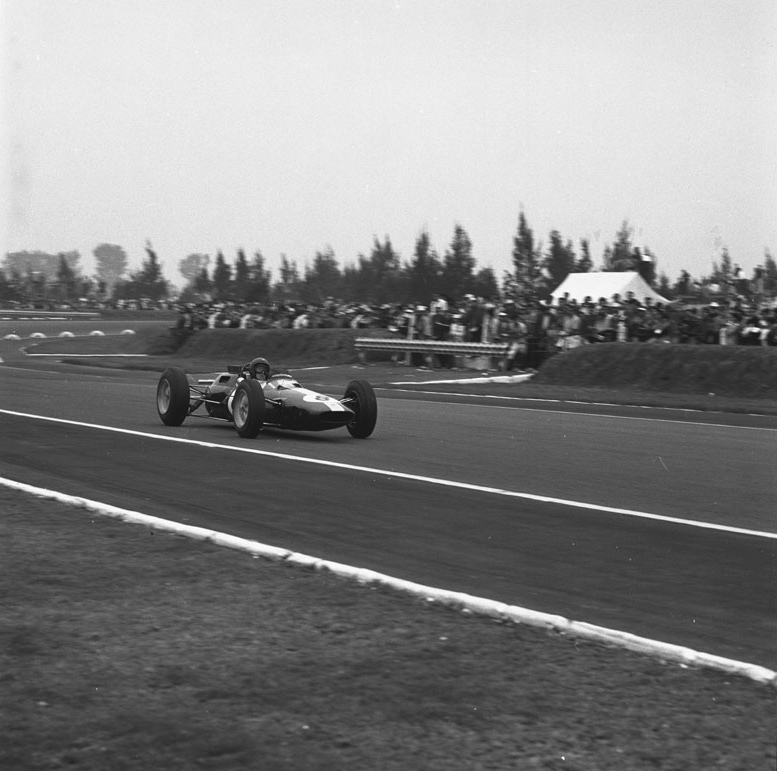
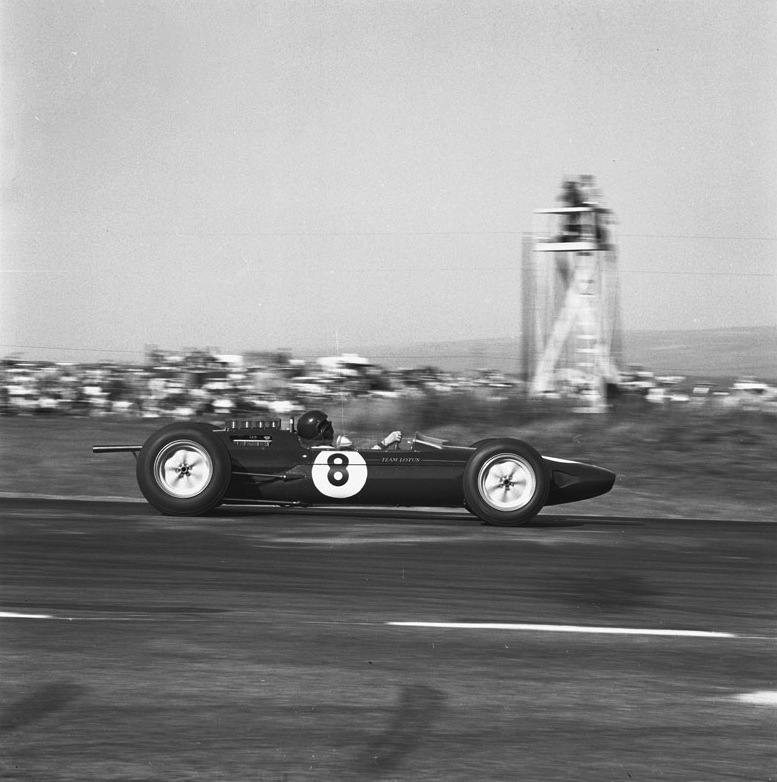
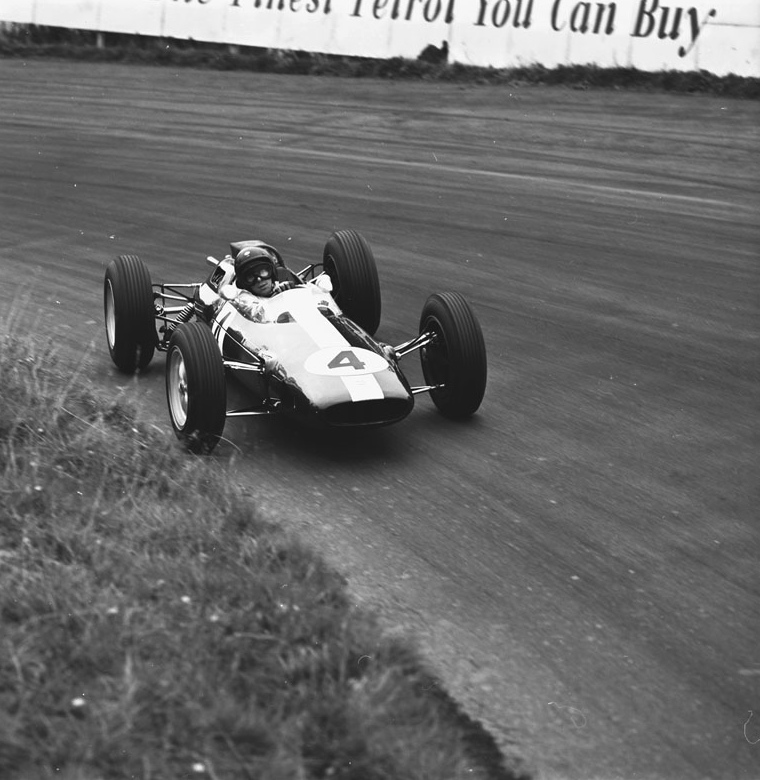
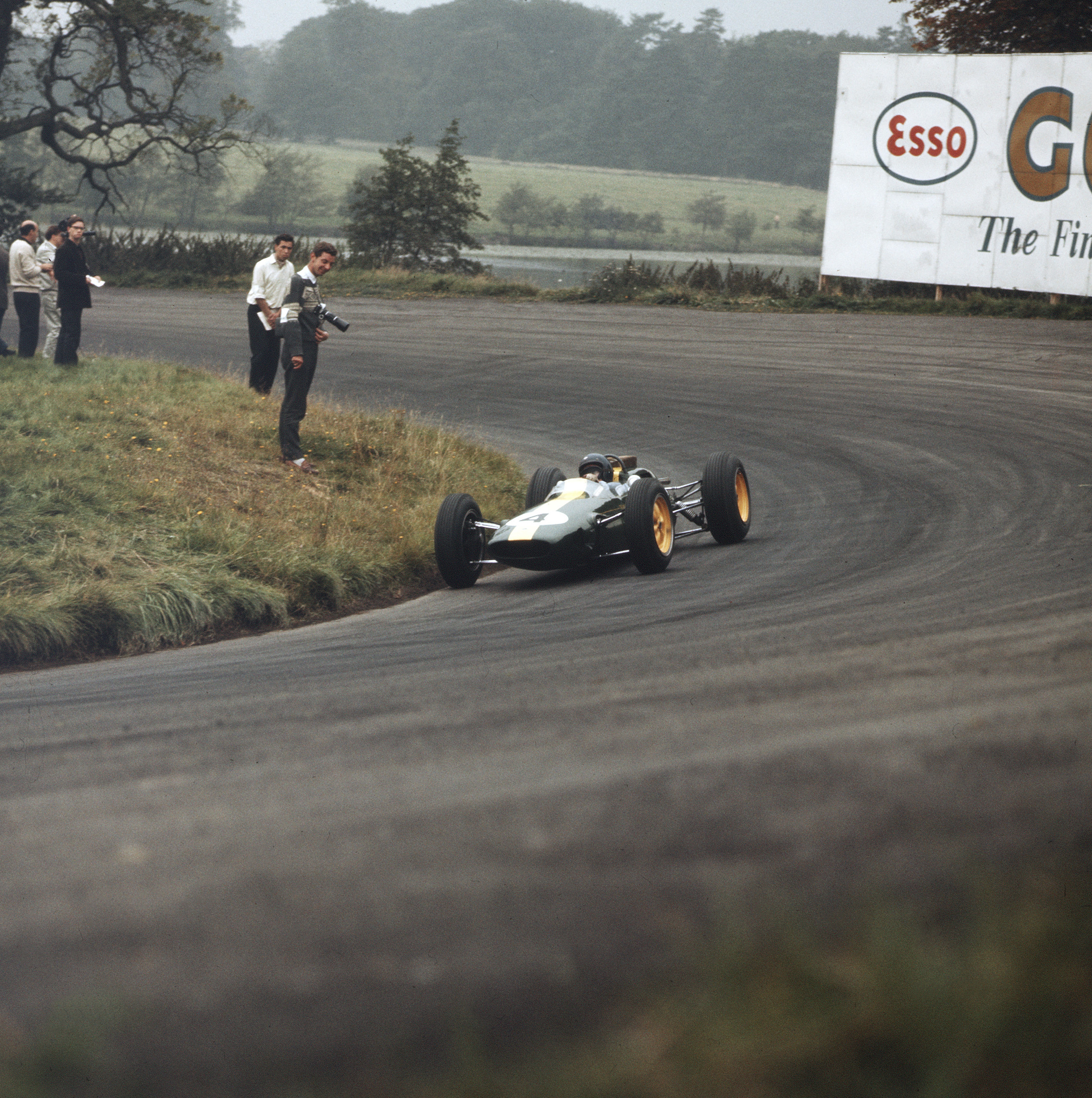
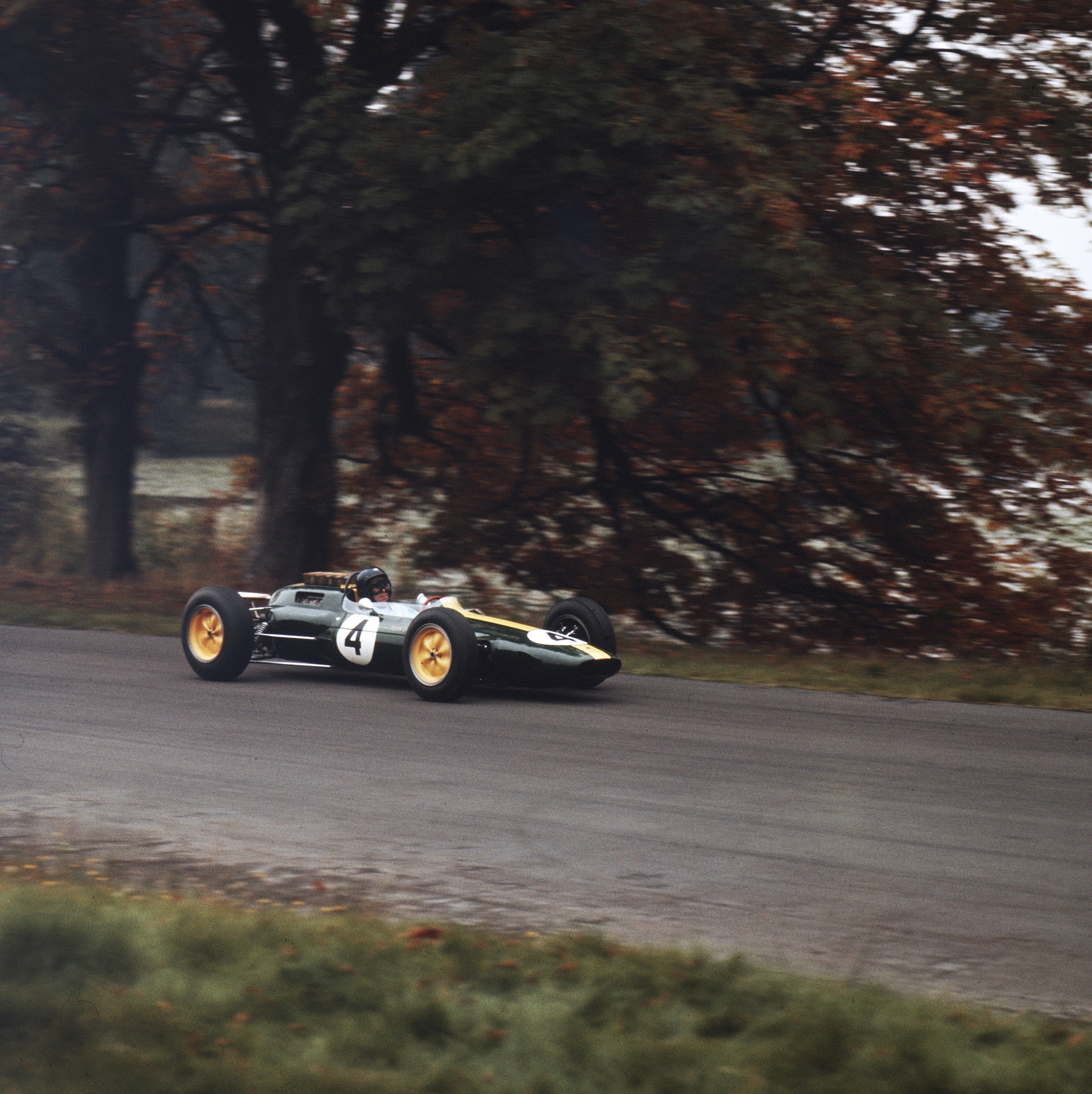
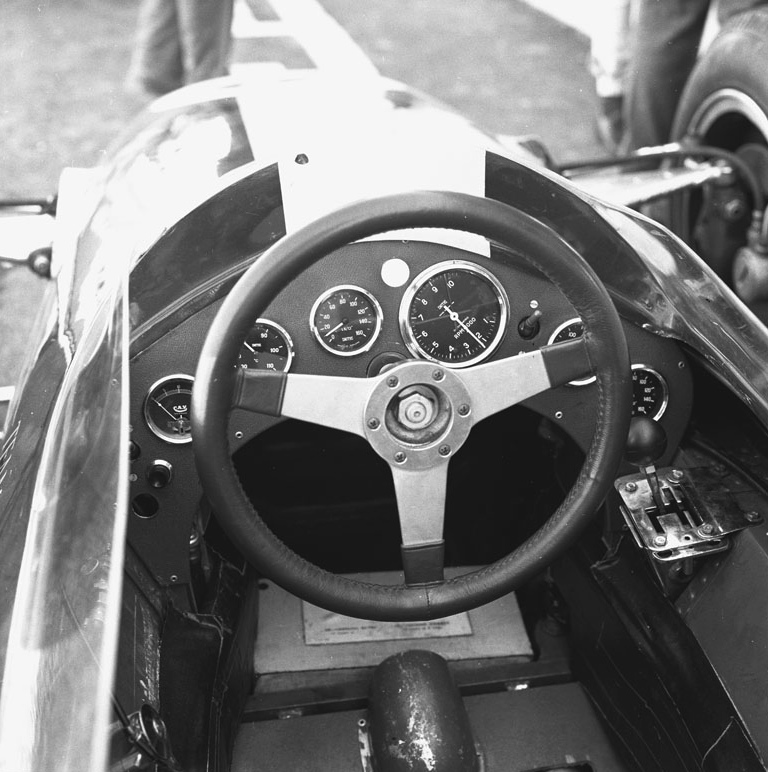
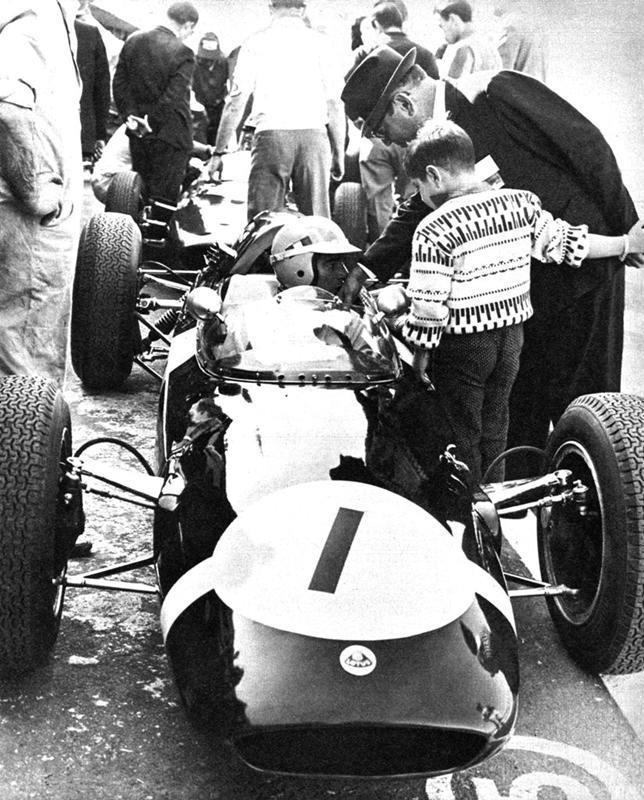
Captions (from top): Although he led the Mexican GP from start to finish, it was by no means an easy weekend for Jim Clark and Team Lotus. Gearbox problems delayed him in practice and in the closing stages of the race the Lotus 25 developed a fuel vaporisation issue.  Here, very relieved, he receives the plaudits; Jim’s 25 looked a little spare in Mexico, lacking, as it did, the plastic Lotus badge normally mounted in the centre of the red-rimmed steering wheel; with Pedro Rodriguez on his right and Jo Siffert just behind him and to the left, Jim listens attentively to the drivers’ briefing. Dan Gurney stands in the background and Jo Bonnier to Jim’s left; Jim accelerates out of the Esses towards the Peraltada. Note the small deflector added to the front of the windscreen for this race ; below – one of the sadest photographs I know.  As we remember 50 years since the first World Championship Mexican GP, here’s Ricardo Rodriguez at the non-championship 1962 race the year before, just prior to his fatal accident.  Unfamiliar in Everoak space-type helmet, Ricardo kisses the hand of his father before setting out for another practice run with Rob Walker’s Lotus 24-Climax.  His youngest brother, Alejandro (who died recently), looks on. Soon afterwards, the right-rear suspension broke on the Lotus, plunging Ricardo head-on into the Armco.  Ricardo and Pedro were Mexican motor racing, and their world stood still when news of the tragedy broke. Pedro, just as gallant, just as brilliant, died in a minor sports car race in 1971. As we look forward to Mexico’s return to the F1 calendar in 2014, we’ll always remember los hermanos Rodriguez Images: LAT Photographic, Diego Merino/Luc GhysRicardo Rodriguez Mexico 1962
“It’s the best circuit in the world…”

That was the verdict of Valtteri Bottas as he looked back at Suzuka, venue of last Sunday’s Japanese Grand Prix.  Williams didn’t have a great weekend (again) but that did nothing to dim Valtteri’s enthusiasm for the circuit and for the F1 disciplines in general.  We tasted a flavour of that at another great circuit last week when Valtteri chauffeured friends and Williams team partners around the Brands Hatch Indy circuit in a hot little Renault Clio.  Mundane the car may be (by F1 standards); perfunctory his lap was not – and I hope we captured a little of its flavour in a short clip within this week’s edition of The Racer’s Edge.  In the Teddington TRE studio I was very pleased to welcome back our friend and regular technical expert, Craig Scarborough.  There have been plenty of rumours recently about Red Bull possibly running some form of KERS-related traction control;  Scarbs tackles this theory head-on as well as providing his own, inimitable, detailed analyses all of the teams’ latest developments.  And I’ve always wanted to chat to Alex Lynn, the very fast young Englishman who won prolifically in Formula Renault before graduating to F3.  Alex has now won three rounds of the ultra-competitive 2013 Euro F3 Championship and I think you’ll find him refreshing in his approach:  he chose to drive for the front-running Italian team, Prema Powersport, (a) because it would leave him with no excuses and (b) because it would take him out of his British comfort zone.  He’s risen to the challenge.  On top of all that, Alex also finds time to race his father’s ex-Bob Jane 1965 Lotus-Cortina, so there’s no doubt that his heart’s in the right place.  It’s been a sad week but I hope you enjoy Episode 33.  It’s about people who love our sport and the passion that they engender.

The Glen ’63: “…he was given to understatement…”

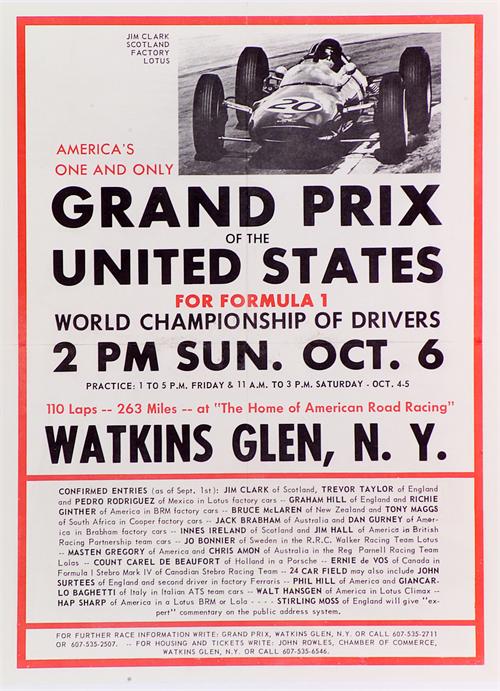
21699.tifFrom Trenton back to London; from London to New York and then on to Elmira, the small airport local to Watkins Glen.  The 1963 US GP would be Jim Clark’s first as World Champion.

Jim loved his days at The Glen;  everyone did.  The leaves had by now turned red and brown; there was a mist in the mornings that lifted only as the sun broke through before noon.  And this was a Grand Prix run by good, racing people – men like Cameron Argetsinger, who had brought motor racing to Watkins Glen in 1948,  Media Director, Mal Currie, and Chief Steward, Bill Milliken.  All had rich racing and automotive histories.  Milliken had been a Boeing test engineer during World War II and had joined the Cornell Aeronautical Laboratory (Calspan) in 1945.  As an avid Sports Car Club of America (SCCA) member and former driver/designer, Bill in 1960s and 1970s became the doyen of US automobile engineering research. He was, in short, the sort of Chief Steward in whose presence you doffed your cap. The drivers and key team people stayed nearby at the Glen Motor Inn, hard by the Seneca Lakes, where their hosts were Jo and Helen Franzese, the second-generation Italian couple who loved their F1.  Legends were born overnight at the Glen Motor Inn – and even at the old Jefferson hotel downtown. Lips, though, were always sealed.  Such was life that October week at The Glen.

Ford made a big splash, too, this year of the Lotus-Ford at Indy.  This was the US GP!  Sixty thousand fans were expected.  Cedric Selzer, hooking up with the Team Lotus “US guys” for this race, remembers the drive up from New York airport on the Tuesday before the race:  “We were given the keys of a saloon, a coupe and a convertible and made our way out of the city, heading for Watkins Glen.  When we stopped at traffic lights, people came over and asked us about the cars.  We told them we’d got them from the Ford Motor Company but it took us three days to realize that we’d all been given 1964 models than no-one had seen before.

“The following afternoon, Jim Endruweit hired a Cessna 180, with a pilot, and we flew over the Finger Lakes. It was autumn, and the seasonal colours were unbelievable.It seemed a shame when it was time to get back to the task of winning a motor race…”

Milliken remembers the pre-race party:  “High point of the festivities were the parties at the Argetsinger’s home in Burdette.  All drivers and officials were there in an atmosphere or pure fun and excitement, bolstered by great conversation, good food and dozens of magnums of champagne from the local vineyards.  The homespun hospitality led to permanent friendships and was never forgotten by the drivers or teams.”Watkins_Glen_Dec_2002_209.1

Practice took place over eight absorbing hours, split between two four-hour sessions on Friday (1pm-5pm) and again on Saturday (11am-3pm).  There was a bit of a fracas when, first, Peter Broeker’s Canadian-built four-cylinder Stebro-Ford began spewing – and continued to spew – oil around the circuit, and, second, when Lorenzo Bandini slowed down after a blind brow to talk to his sidelined Ferrari team-mate, John Surtees.  Richie Ginther and Jack Brabham narrowly missed the Number Two Ferrari, igniting a bit of finger-pointing back in the pits and plenty of  “I no-a speak-a di Eengleesh…”.

The Glen in 1963 featured the brand new Tech Centre on top of the hill behind the pits (which were then sited after today’s Turn One), allowing all the teams (except Ferrari, who continued to use Nick Fraboni’s Glen Chevrolet garage and therefore to truck their cars up from the town each morning), to work on their cars in situ, in communal spirit and to be energized by plenty of lighting and electric sockets. (The F1 teams were obliged to convert to the American standard 110volts. On the face of it, this didn’t seem to be a problem. As it turned out, it was.)  For a small incremental fee, race fans could also walk up and down the Kendall shed, looking at the cars at close hand.  GP2 could learn a thing or two from The Glen, 1963…

Jim, in relaxed mood, qualified second, 0.1 sec behind Graham Hill’s old space-frame BRM. Milliken also recalls in his excellent autobiography (Equations in Motion, with an introduction by Dan Gurney) that the timekeepers “always had problems with Colin Chapman. Colin timed his own entries and claimed his faster figures were correct, so Bill Close, one of our timers and a solid Scotsman, put two clocks on each Lotus…”

Trevor Taylor, whose car caught fire in the paddock on Saturday, qualified seventh; and Pedro Rodriguez, having his first F1 drive, and fresh from a win for Ferrari in the Canadian GP sports car event, was 13th in the carburettor-engined 25. This wasn’t a happy weekend for Trevor:  Chapman chose the US GP to tell him that he wouldn’t be retained for 1964. His place would be taken by Lotus’ FJ king, Peter Arundell.

Bruce McLaren lost most of the Saturday morning session when his Cooper-Climax lost oil pressure; and so – as at the British GP – he used his time to watch, learn and compare.  This from his notes in Autosport the following week:  “Graham Hill finished his braking relatively early and had the power on, and the BRM a bit sideways, well before the apex of the slow corner at which I was watching.  Jim Clark, on the other hand, braked hard right into the apex with the inside front wheel just on the point of locking as he started to turn.”

Jim’s race was defined on the dummy grid.  Due to what was later found to be a faulty fuel pump, his 25 wouldn’t start. And then, very quickly, the battery went flat. Selzer: “The truth is that the battery had not taken a proper charge overnight. We used a dry-cell aircraft battery made by Varley with six, white-capped cells. Somehow, we never got the hang of keeping them fully-charged. America was a special case as we had to borrow a 110 volt charger.  We used a ‘fast’ charger when actually what was required was a ‘trickle’ charger. As Jim was left way behind the grid proper, two of us ran over to him and changed the battery. This meant that Jim had to climb out whilst we removed the tail and nose sections of the car in order to get at the battery, which was under the seat.”

I recently bought an audio CD of the 1963 US GP and Stirling Moss provides an hilarious description of these moves whilst watching the start from the main control tower.

“I can see lots of people gathered around Jim Clark’s car.  Looks as though they’re trying to remove the bonnet…no…what is it that you Americans call it?  The hood? Yes, that’s right. The hood. They’re removing the hood. Meanwhile, I can see Graham Hill getting ready for the off….”

Jim eventually lit up the rear Dunlops just as the last-placed car completed its first flying lap. He would finish a brilliant third behind the two BRMs of Hill and Ginther (after Surtees’ V6 Ferrari broke a piston in the closing stages) – but it could have been even closer.  “That mishap on the grid was what I needed to put me back into a fighting mood,” remembers Clark in Jim Clark at the Wheel, “and so I set off after the field, knowing I was going to enjoy the race. I began to catch up the field, and to thread my way through, until I saw Graham Hill in front of me. I thought I was at least going to have a dice with my old rival, albeit with me being a whole lap behind him. This was not to be, for shortly afterwards the fuel pump started acting up and it became a struggle even to keep him in view. I ploughed on through the race, during which many cars dropped out, and finally finished third.”  Jim didn’t know it at the time but Graham, too, had been in major trouble:  a rear roll-bar mount had broken on the BRM. Even so, it is typical of Clark’s character that he should sum-up his US GP with the phrase “…and finally finished third.”  He was given to understatement; his mechanical sympathy in reality did the talking. 

21700.tifNeither of the other Lotus 25s finished, although Pedro showed the promise of things to come by slicing his way up to sixth before retiring with a major engine failure. Given the financial support the Rodriguez family were giving Team Lotus for The Glen and then the Mexican GP, the mechanics had to work very hard to rebuild that engine within the next few days. A new timing chain and valves were found after long “phone-arounds” and other broken valves were repaired at a local machine shop.  David Lazenby, the lead “American” Team Lotus mechanic, returned to Detroit to begin installation of the four-cam Ford engine in the Lotus 29 – and he would be joined, once the Rodriguez engine rebuild was finished, by the F1 boys.  Chapman was always one for keeping his lads amused…21754.tif

There was no podium at The Glen.  As in other races back in 1963, it was the winner alone who took the plaudits and the laurel wreath (and, in the case of the US GP, the kisses from the Race Queen.) The new World Champion, after yet another astonishing race, would have quietly donned his dark blue, turtle-necked sweater, had a soft drink or two, helped the boys in the garage and then repaired to the Glen Motor Inn for a bath and a good dinner.   The Mexican GP was three weeks away.  On the Monday, Jim would journey back to New York and then fly across the continent to Los Angeles.  Ahead, over the next two weekends, lay two sports car events for Frank and Phil Arciero, the wealthy (construction/wine-growing) enthusiasts from Montebello, California, who had already won many races with Dan Gurney. The first would be the LA Times Grand Prix at Riverside, where Jim’s “team-mate” would be his Indy sparring partner, Parnelli Jones.  Then, the following weekend, he would race in the Pacific Grand Prix at Laguna Seca.  On both occasions he would drive the Arciero’s new 2.7 Climax-engined Lotus 19….assuming it was ready.  On the radio in his room that night at The Glen, with the still, cool air from the Lakes reminding him that the European winter was  but a step away, Jim might have heard the Beach Boys chasing their Surfer Girl, or Peter, Paul and Mary Blowin’ In The Wind.

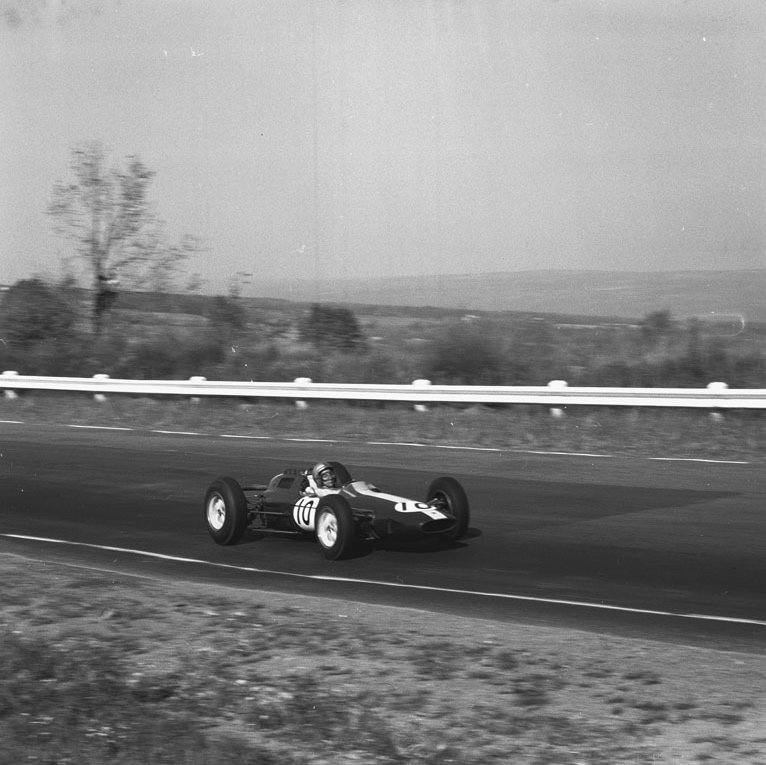
Captions, from top: Jim drifts the Lotus 25-Climax up through the Watkins Glen esses on his way to a fighting third place; less than a year after the loss of his brother, Ricardo, Pedro Rodriguez made his F1 debut at the Glen in a third works Lotus 25-Climax; classic pose: Jim displays the 25’s reclined driving position as he accelerates past an ABC TV tower Images: LAT Photographic 

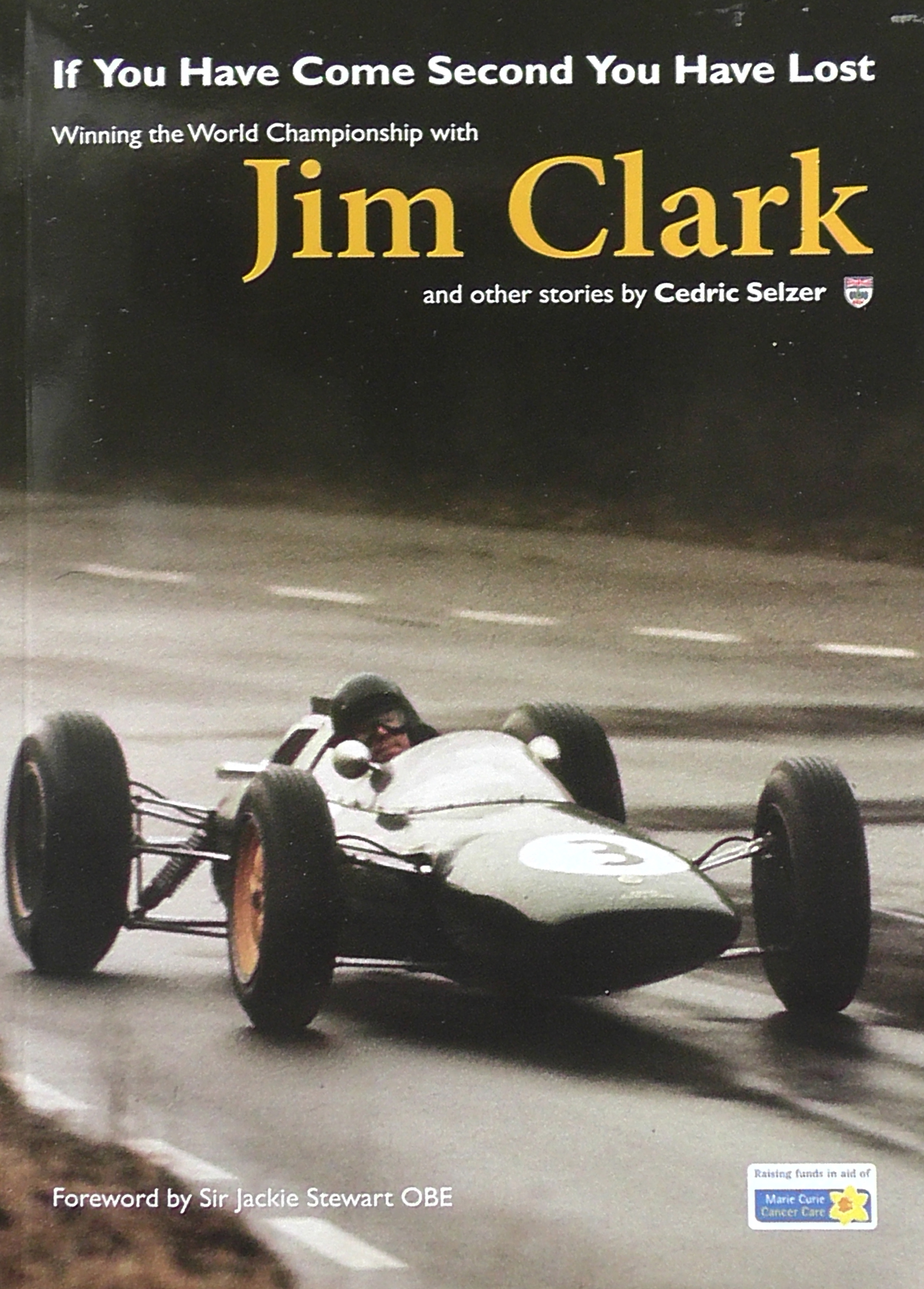
Buy Cedric Selzer’s wonderful new autobiography, published in aid of Marie Curie Cancer CareS2740001

“Where’s Clark…?”

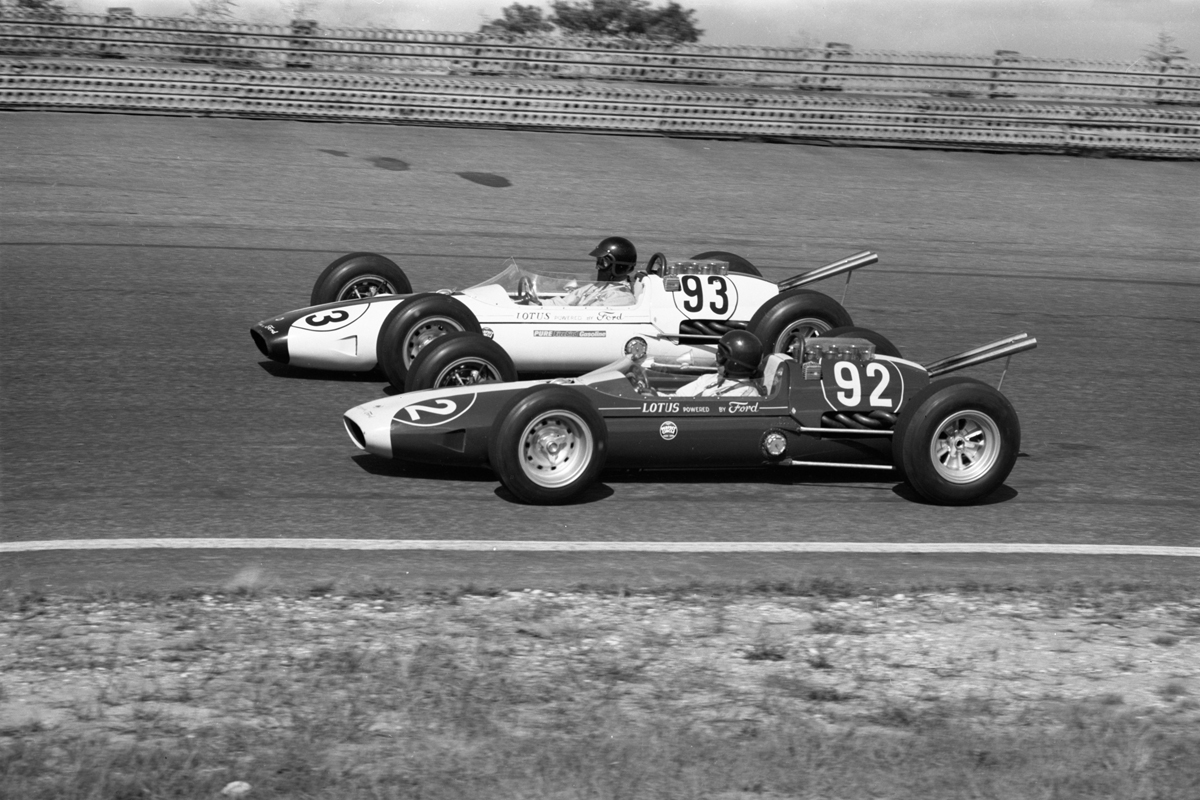
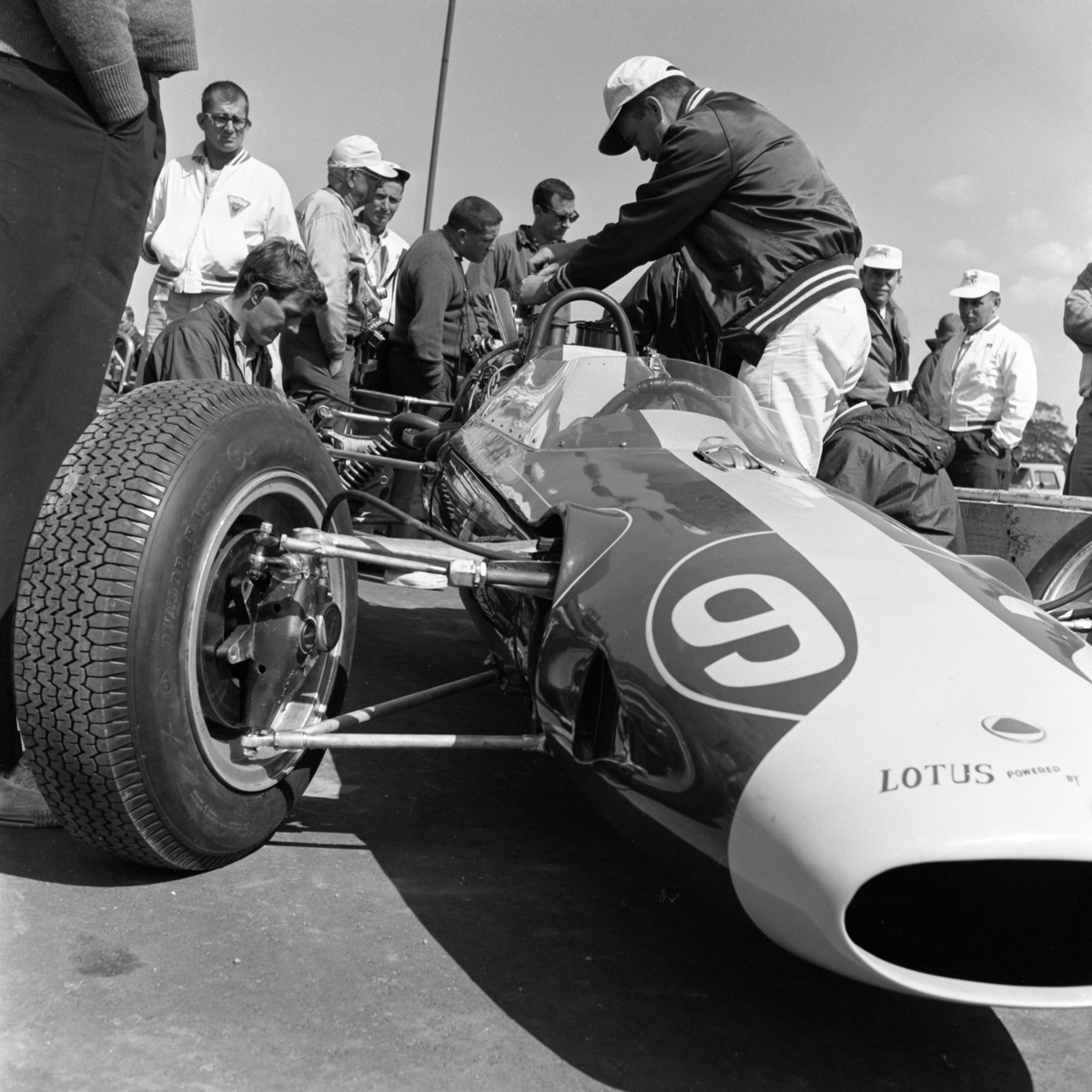
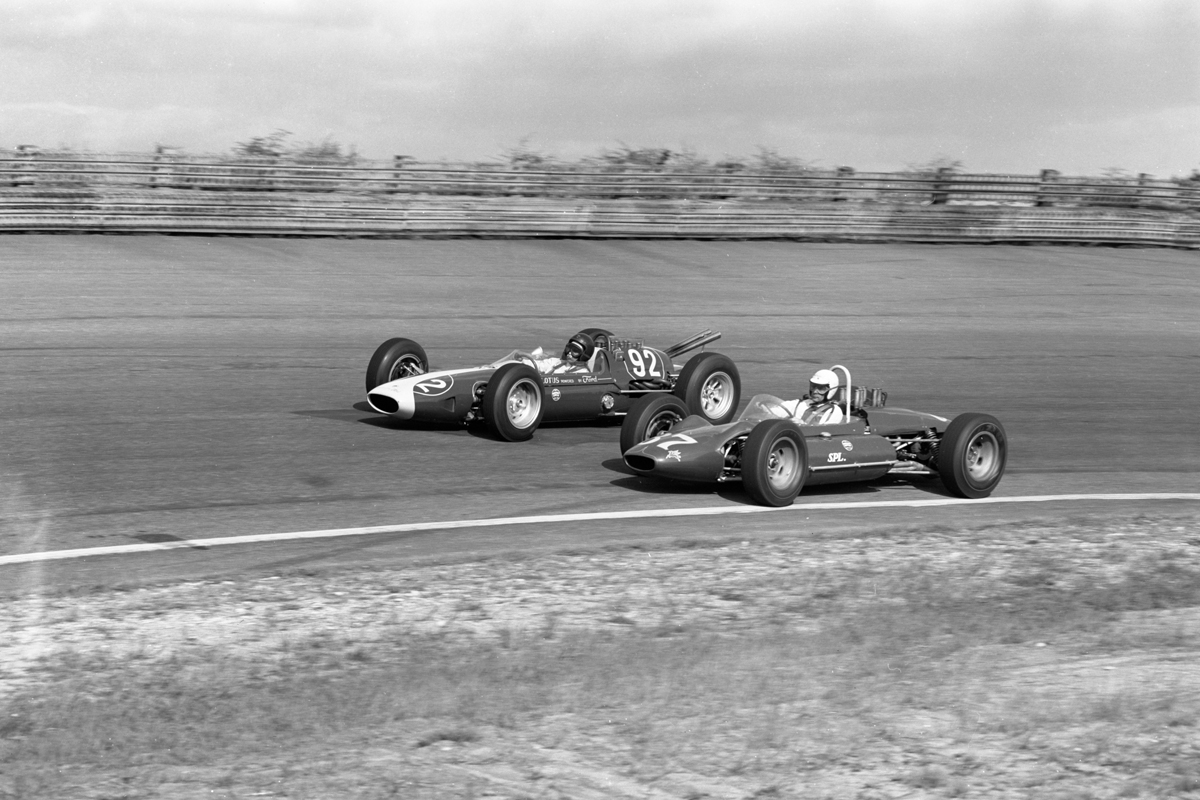
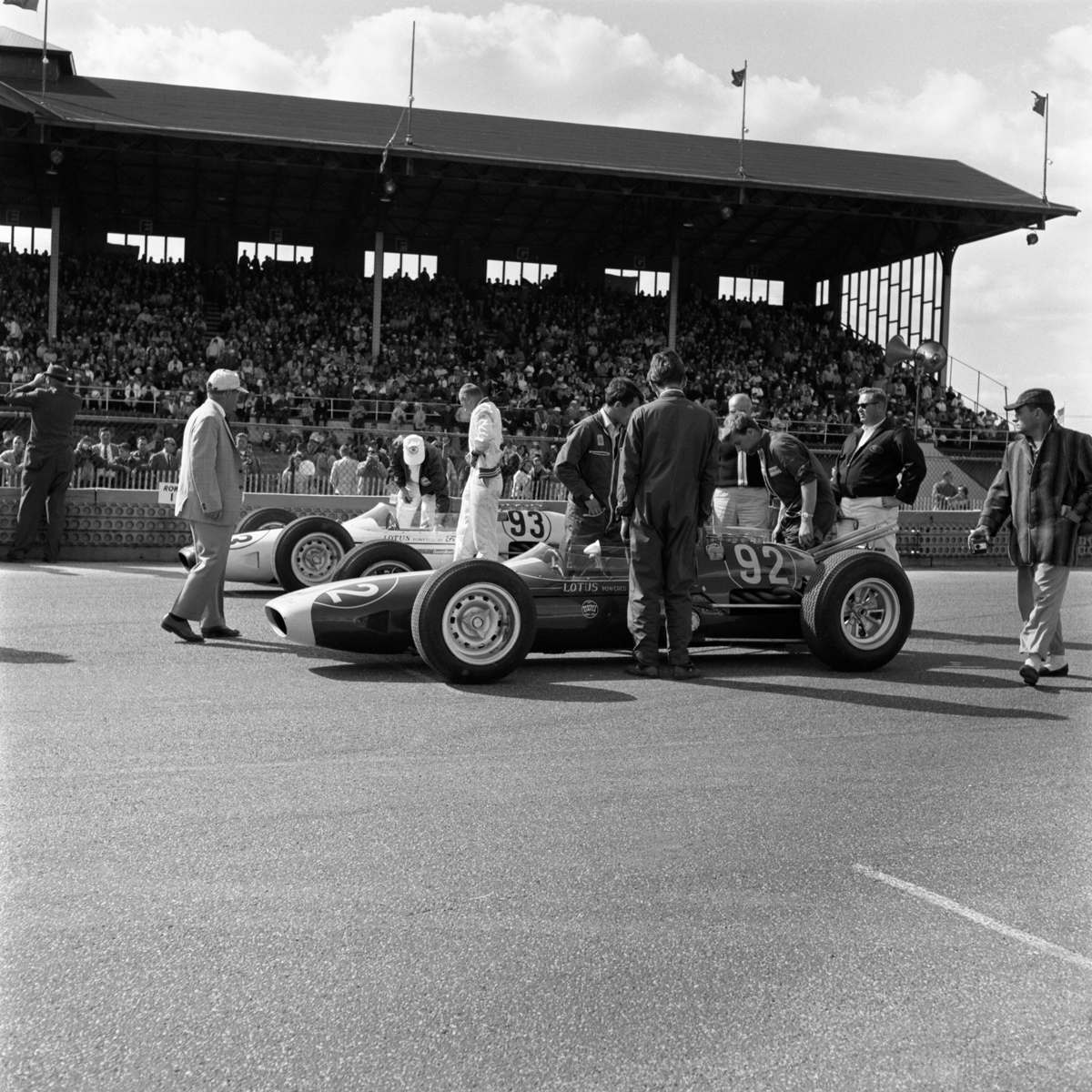
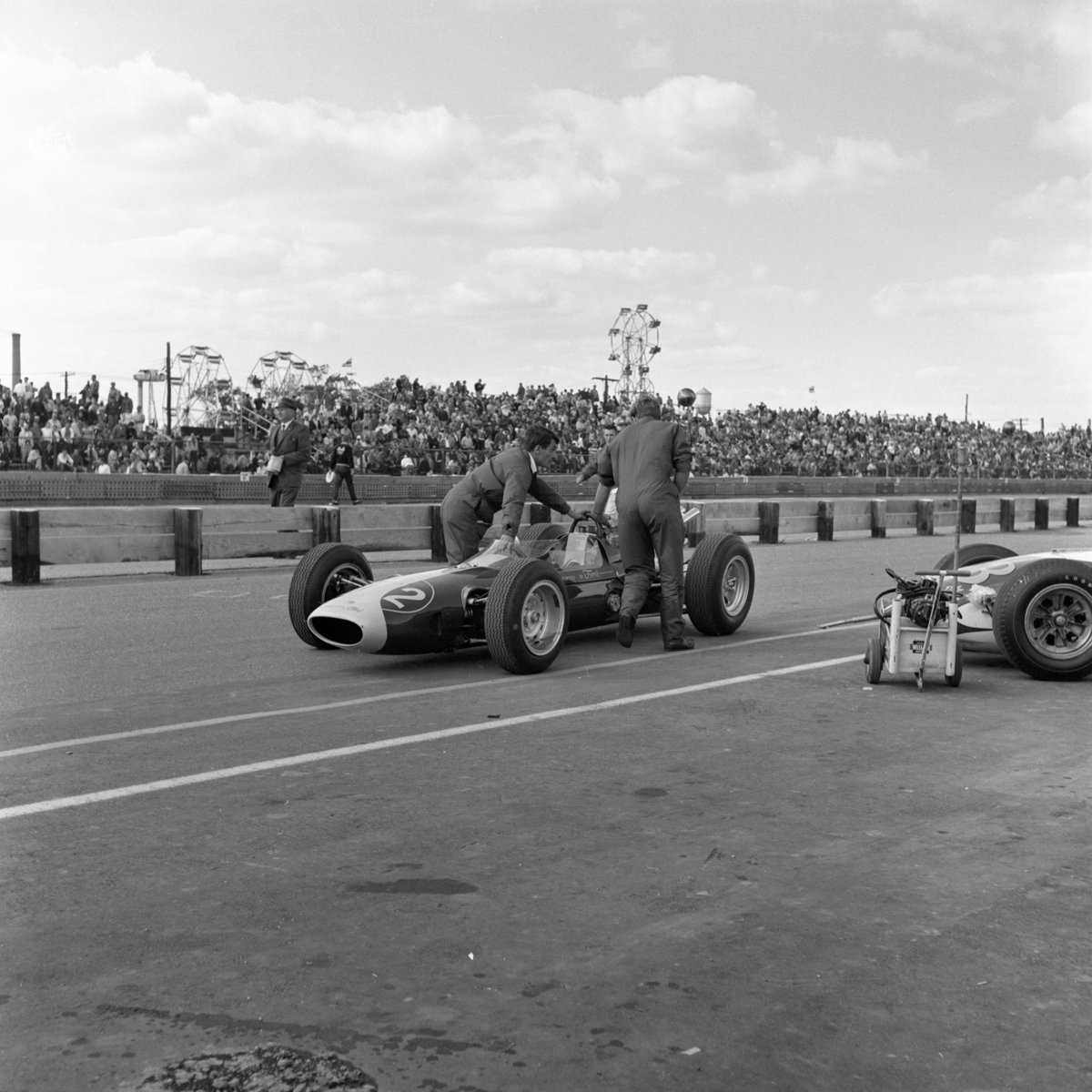
THF110901_JimClark-DanGurney-Trenton200_09-22-1963Incredibly, amazingly, Jim Clark and Dan Gurney arrived at the venerable Trenton State Fairgrounds in New Jersey ready to qualify and to race.  They had slept for but a couple of hours at the nearby team motel;  Oulton Park already seemed an age away.  Both would drive their Indy and Milwaukee Lotus 29-Fords, although on this occasion the exhausts had been angled skywards in physical testimony to the sheer speed of the two rear-engined cars.  At both of the preceding races, the drivers of the higher, front-engined roadsters had complained about the fumes caused by the lower exhaust flows from the two little Lotus.  As it was by now clear that the older cars would inevitably be trailing the 29s, Colin Chapman (and designer Len Terry) agreed to re-angle the exhausts upwards.  The ungainly mod (which also, as it turned out, provided a performance boost!) would thereafter be a reminder of all that was achieved by Team Lotus in America in 1963.

For coverage of the Trenton 200 I can do no better than to hand over to that excellent American writer, John Hearst Jnr, and to (the sadly now defunct) Sports Car Digest:

“The two-lap qualifications proved to be almost as exciting as the race itself,” wrote Hearst. “Knowing voices said that AJ Foyt’s one-lap record of 106.635 mph could not be beaten, for conditions weren’t ‘right’.  Clouds polka-dotted the sky and outnumbered the sun.  The day was cold and brisk, and the long grass in the infield was beaten flat by a gusty wind.  The wind.  That would be the problem.

“And it was…for some.  Indy roasters and ‘spring cars’ made two laps apiece.  Each driver fought to stay in the blacker part of the grey asphalt ribbon: ‘the groove’.  Some were quick and skillfull while others worked with arms flailing and right foot stabbing in a furious exhibition of over/under oversteer.  A couple reached the point of no return as their mounts went into gut-wrenching, rubber-burning slides.

“Dan Gurney’ (whose engine now had the 48mm longitudinal Weber carburettors) “took his turn.  Dressed in plain overalls, with black helmet and leather face mask, first thoughts were, ‘He must have come to the wrong place!’ The little blue-and-white car sang its way around once, and then again.  Accelerating earlier, and backing-off earlier, Dan made it all look so easy as he averaged 109.024 mph.  AJ Foyt, 28 years old and twice USAC Champion, could manage no more than a shrug as his record fell.

“Minutes later, Jim Clark took his turn with a flourish, provided by promoter Sam Nunis.  A local bagpipe band huffed and wheezed at ‘Scotland, the Brave’ as Clark, in his green-and-yellow car, was pushed out before the cheering fans on the grandstand straight.  All work stopped.  Wrenches were laid aside and heads came out from beneath raised hoods.  Everyone knew what was going to happen.

“The crowd became silent.  The only sounds were the skirling pipes and the wind.  Then came the hum of the starter motor, followed by the high-pitched wail of the unmuffled, pushrod Ford V8.  The young Scot was given a shove to engage first, and he was away.

“The air held one sound:  a note that worked itself higher and higher up the scale.  The car seemed to float around the track others had made appear so bumpy.  Green flag, white flag and then the checker.  It was over, and everyone knew – but by how much?

“Clark had just lowered Gurney’s newly-set record by 0.332 mph when he turned the mile over in 33.02 seconds, and was over 3 mph faster than Foyt’s old record.

“A weak smile was all that was offered in return as one roadster owner turned to his driver and cracked, ‘How do you spell ‘For Sale’?’

“Finally, the 26 starters were assembled, started and pushed away on the first of four warm-up laps.  On the pole was Clark and next to him was Gurney.  Both stifled yawns, for both had spent the night flying the Atlantic.  Both had won races at Oulton Park the previous day and Gurney the previous weekend had won at Bridgehampton, where he had been the first to drive an American car, the Shelby Cobra, to victory in a World Manufacturers’ Championship race.

“The green flag was waved furiously and a roar shook the earth as 26 cars accelerated as one.  Yet the sound of the Lotus-Fords was unmistakable, for they were two trumpets in an orchestra of tubas.  Appearing comparatively relaxed, Clark and Gurney, nose to tail, pulled away from the 24 others.  At first only a second, then two, then five, soon to be seven, ten, twelve, and more.

“Meanwhile others were having their problems.  On lap six, Rodger Ward saw his USAC Championship hopes fizzle when a fuel line burst, covering him with the volatile stuff.  Next to quit was Jim Hurtubise, whose fuel-laden car was bottoming through the turns.  When the seat pan started to wear away, Jim started getting a little warm.  Then his gas tank ruptured and Jim wisely gave up.  Speechmaker Eddie Sachs retired, to be joined five laps later by Indy winner Parnelli Jones, whose magneto went sour.

“By now, Clark led Gurney and 12 seconds, who in turn led Foyt by 10 seconds.  Clark had lapped every car in the field except Foyt.  That was lap 49.  On lap 50 everyone looked at everyone else and finally someone said it:  ‘Where’s Clark?’

“The young Scot had pulled into the pits.  A glance at his oil pressure gauge brought him in, and an ever-growing puddle of black under his car kept him in.  Through for the day, the primrose-yellow-overalled driver” (the Hinchmans!) “climbed atop a nearby truck and joined Rodger Ward as a spectator.  Englishman Colin Chapman, builder of the Lotus-Fords, stood by as the crew removed the engine cover, revealing a ruptured four-inch hose, used to join the chassis oil tube to the cast-aluminium ‘Fairlane’ engine.  Unceremoniously, the car was shoved into its van.

“Gurney calmly kept his mount in first place.  Foyt, however, closed the gap to seven seconds as three Offy types put Dan in a neat little box for some five laps. When they became committed to a line in a turn, he changed his, and eventually picked them off, one at a time.  The Lotus held the upper hand.

“Mounting elation suddenly turned to depression for on lap 147 Gurney was followed down the main straight by a large cloud of white smoke.  Dan backed off and cars he had just lapped, some for the fifth and sixth time, came streaming by him.  Silently, with engine cut, he pulled into pit lane as Foyt, with a quick glance to the left, accepted the lead.  Gurney’s acute disappointment was mirrored in the faces of his crew.  And for many of the fans, the race was over, for they had come to ‘…See the Fabulous Lotus-Fords!  See Jim Clark! See Dan Gurney!’

“An oil seal on an accessory drive on the front of the block had let go, causing Dan’s retirement.  This was the reason given by one Ford representative (of almost 50 present) after almost an hour of searching by Chapman and crew.

“Foyt led for the remaining 53 laps.  He not only won the race but the USAC Championship for the third time in his career.  Over a lap behind, and finishing second and third, were Bud Tinglestad and Troy Ruttman, who brought the remaining crowd to their fee with some hearty dicing.  It was a good race and an exciting race but for many it was over back on lap 147.

“Only ten cars finished.  Foyt’s share of the $42,210 purse was nearly $12,000, which might just b e enough for a down-payment on a Lotus-Ford.  Chapman said (and a Ford PR man verified it) that he will build cars for private owners after he fulfils his primary commitment to Ford.   He refused, at present to state a price.  And, according to a Dunlop tyre man who was present, the R6s the cars were shod with showed very little wear at Trenton and ‘…may be the answer to a no-change Indy’.

“When a Ford man was asked if these cars would run again next year at Indy, the answer was ‘No!’. When asked why, he answered, ‘…’cause we’re going to build new ones.’  The 1963 cars will be used for display and research and development.

“The capper of the day came when one railbird remarked that he didn’t think the Lotus-Ford were really that amazing after all.  ‘Hell,’ he explained, ‘a guy in track shoes can beat a guy in combat boots any day of the week.”

Thanks again to Sports Car Digest for John’s reporting in the way of the classic, 1960s US sportswriter.

Additional notes:  Dan would have at least been cheered by Troy Ruttman’s third place because he still rates Troy as one of the great, hidden-away American talents.  (Ruttman won the 1952 Indy 500 at the age of 22 and showed his versatility with a strong Maserati 250F drive in the 1958 French GP at Reims.)  With Jim’s hectic schedule precluding any sort of consistent commitment to a 1963-64 US test programme, young Bobby Marshman was duly hired by Team Lotus (financed by Lindsey Hopkins) to carry out development work on the new double overhead-cam engines. There was also talk after Trenton that the two Lotus failures had been indirectly caused by incidents during the shipping of parts.  This was later rescinded when it was discovered that on Dan’s car a piston had fractured and thus damaged the oil line – but this does give a flavour of the sort of differences that quickly grew between Ford and Lotus (and between the Americans and the British).  Hearst’s report, indeed, is remarkable for its objectivity. In most contemporary American publications, and particularly over at Car and Driver, the emphasis was very much on the Ford-Lotus cars, with Lotus, in the main, considered to be lucky, and slightly unworthy, partners.  Sports Car Digest, by contrast, was a brilliant mix of Americana and Bernard Cahier. Need I say more.

So ended Jim’s 1963 American oval racing season.  A win and a second.  He would return to Trenton – and Indy, of course – in 1964.

“It had been hard work and a great deal of travelling for just three races,” he would write later in Jim Clark at the Wheel, “but it was worth it in the results we gained and the impact we made.  I now have an ambition to drive the Lotus 29 on a road circuit but I suppose that dream will have to wait.”

Jim would, of course, drive the 1965 Lotus 38 Indy car up the Ste Ursanne hill-climb, as we have described elsewhere on these pages, but in 1963, after the US and Mexican GPs, there were American sports car races still to pursue.  From New Jersey, meanwhile, the new World Champion took a 707 back to England for a different kind of race:  the Snetterton Three Hours with the Normand Racing Lotus 23B.

Personal trainer?  Gym?  Nutritionist?  “Racing keeps me fit,” said Jim.  “Racing and getting to races.  There’s no time for anything else.”22259.tif

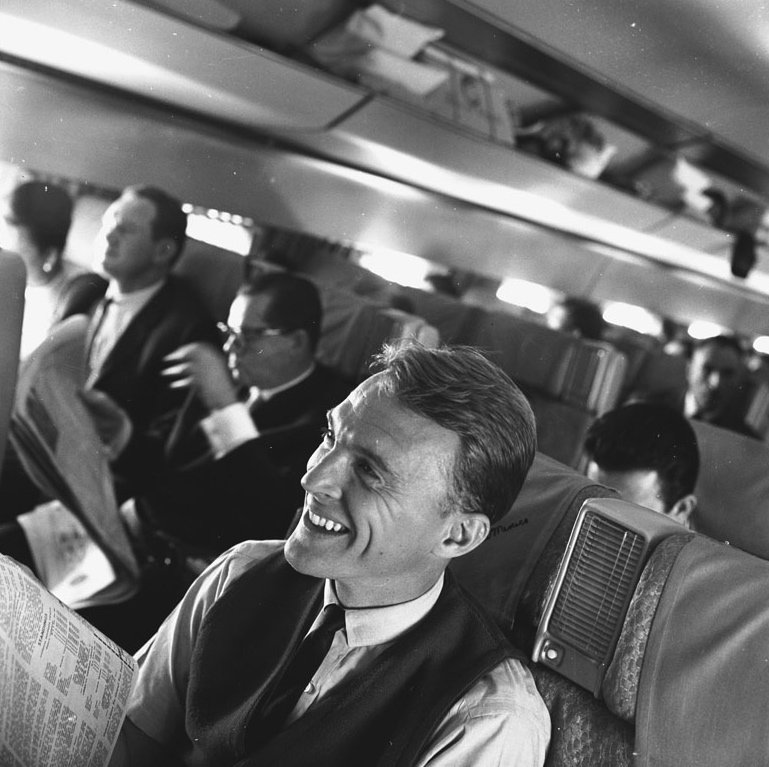
Captions (from top):  looking slightly less elegant thanks to its angled exhausts, the Lotus 29-Fords nonetheless set the pace at Trenton.  Jim, wearing his regular, peakless Bell Magnum but on this occasion (as per the USAC regularions) a shoulder harness, was leading easily before an oil leak forced his retirement; Dan then took over in the blue-and-white car – but retired with a broken piston.  Note that they are running the same Dunlop-Halibrand wheel combination as Milwaukee; Dan Gurney, on board a 707, gives some idea of what it was like in 1963, when trans-Atlantic crossings were for drivers like Dan and Jim Clark as frequent as trips to the local market.  Economy class was a little more spacious back then; the seat backs included a serious reading light; and everyone dressed for the occasion, regardless of the route or the timings Photographs: Ford Motor Company and LAT Photographic

It was initially difficult to find images from the 1963 Trenton 200.  I wrote to most of the leading US journalists for leads;  I contacted local, New Jersey, newspapers and agencies.  No luck.  Then, the day after the above report was published, I received this bundle (below) from the Ford Motor Company.  To say I’m delighted is massively to under-state.  Finally, we can gain a picture of what it was like back then on the track that is no longer.  Look at the old grandstand; look at Jim Endruweit and the Lotus mechanics, all neat in green.  Look at the sandy infield;  look at the Fairground in the background.  Look at the 29s out there in the groove.  That’s the rear-engined Kurtis-Offy of the  Canadian, Ed Kostenuk, that Jim is lapping.  That looks like the nose of Parnelli’s Watson on the right as Jim’s 29 is pushed backwards down the pit lane – and that’s Roger McCluskey’s Vita Fresh Orange Juice Special behind Jim’s car at bottom.  Again, many thanks to FoMoCo.

THF110896_JimClark-Trenton200_09-22-1963THF110898_JimClark-ChuckRogee-Trenton200_09-22-1963THF110899_JimClark-DanGurney-Trenton200_09-22-1963THF110900_JimClark-Trenton200_09-22-1963THF110902_JimClark-Trenton200_09-22-1963

Clark’s Gold Cup

21594.tifJim’s hectic schedule was a blessing:  he had little time to dwell upon the post-Monza traumas.  After the Chapman party, Jim returned to Edington Mains for a couple of days, there at last to savour the feeling of securing the World Championship. There were interviews to handle; and the concept of an autobiography was quickly gathering strength. Too quickly, though, it was time to drive down to Tarporley in his new, prototype Lotus Elan for the Daily Express-sponsored Gold Cup meeting at Oulton Park. Although this was a two-day meeting, with practice on Friday and racing on Saturday, Jim was additionally required to drive the 25 in a filming session for Esso. Unusually, movie cameras were mounted on a specially-made, triangulated section behind the driver and in the footwell area.  Everyone remembered Graham Hill’s scare at the Nurburgring the year before, when he had clouted a camera that had fallen off another car, but this session, at least, would take place with no other cars on the circuit.

Cedric Selzer recalls Colin Chapman’s reaction to the filming in his superb new autobiography, “Jim Clark”:  “The camera on top was operated by a battery pack – basically a wooden box containing a number of batteries.  No-one had thought of how this box was going to be mounted.  It was too big to go on the driver’s lap.  While we were dithering over what to do, Colin Chapman came over, slightly irate, as he wanted to get away as soon as filming was over.

“He put the box on top of the two rear tailpipes and bound it on with tank tape.  We all looked at each other, knowing what the outcome would be.  Jim went out in the car and on the second lap he came in with the battery box missing. We were not surprised. The camera crew went around the circuit to collect it. They came back with the battery pack completely wrecked. Fortunately for them, they had a spare. Chapman played no further part in remounting the battery box.   The mechanics took over, did it their way, and there was no further trouble! Jim never went over 7,000rpm as he was worried about the battery box going missing again but he drove as if he was driving at full speed.”

Many of you will have seen this on-board lap already on YouTube – but I am pleased to show here the entire film made by Esso, beginning with the Esso caravan’s departure (with Joe and Lofty!) from the Fulham oil dump by Wandsworth Bridge, London. It also includes some nice shots from the British GP and the Oulton Park Gold Cup. Watch for Cedric Selzer in the closing sequence, fingering the Cup itself!

Jim was scheduled to drive three different cars at Oulton – the 25 in the F1 Gold Cup; the Normand Lotus 23B; and, finally, now that it had been homologated, the brand new Lotus-Cortina.  He indeed raced the 25, and won with ease from the pole.  His new lap record established him as the first driver officially to lap Oulton at over 100mph; and top speeds in the F1 race, recorded for the first time over one-tenth of a mile on the back straight, underlined Jim’s feelings about the superior power of the BRMs.  Richie Ginther broke the trap at 139mph, Innes Ireland at 138.4 mph and Graham Hill 137.8 mph. Jim was the quickest Climax runner at 136 mph.  After this race, Selzer also wrote: “There have been many stories about the tyres on Jim Clark’s car lasting four races.  This is true, but also the brake pads lasted three times longer than those any other driver.  Derek Wild used to say that you could put all the gearboxes on the bench in front of him in random order and he could tell which gearbox came out of Jim’s car as it showed less signs of wear.   The point is that the standard of preparation was no different between Jim’s car and the number two car.  It was just that the man was very ‘soft’ on his car and so he tended to last the race distance as a result.”1963 International Gold Cup.1963 International Gold Cup.

The remainder of Jim’s Oulton racecard was more complicated.  Having taken the lead from the front row of the sports car race – the first event of the day – Jim amazingly spun on the opening lap and dropped to eighth.  Frank Gardner, who had driven beautifully in practice to take the pole with the little works Brabham, crashed heavily in avoidance and was very lucky to escape serious injury. Despite all this, Jim sliced his way back through the field to win his class and to finish second overall behind Roy Salvadori’s venerable Tommy Atkins Cooper Monaco. 21580.tifJim practised the Lotus Cortina but stood aside to let Jack Sears race it: Ford of America enjoyed a relationship with Willment that extended far beyond motor racing and specially requested that Jack be allowed to debut the car officially. (Without in any way detracting either from Jack or Willment, it seems odd that Ford considered this to be more significant than having Jim Clark, Indy-Ford driver and new World Champion, in the car.  Such, though, were the times.) Jim watched happily with Colin as Trevor Taylor, now recovered from his Enna shunt, jumped straight into the other Cortina to qualify only a shade slower than Jack. 21605.tifTrevor sat on Jack’s bumper for the duration of the race – and in addition qualified fourth for the Gold Cup, in the 25, 0.6 slower than Jim.  Again, though, he DNF’d with more transmission problems.  Mike Beckwith, Jim’s Normand team-mate, made his F1 debut in the Gold Cup, driving Jim Hall’s BRP Lotus 24-BRM, but Mike remembers it as an unhappy time:  “We never got the thing sorted and it all ended when the gearbox seized going into Old Hall.  I hit the bank hard.”  Mike, like Frank Gardner, was fortunately able to return to the pits on foot.

Also in the Oulton saloon car event:  Dan Gurney, driving “Jim’s” Alan Brown Ford Galaxie.  Dan, who had retired from the Gold Cup with a blown engine in his Brabham, arrived very late on the grid amidst frantic PA-calls for his presence.  He then calmly peeled open a packet of chewing gum, climbed into the car…and won from the pole.21611.tif  Graham Hill replaced Sears in the Willment Galaxy and duly finished second – and Phil Middlehurst, father of Andy, was again right in the midst of it with his Cooper S.  About the first thing Andy remembers, as a baby in a pram at Oulton, is staring at the rear light cluster of a factory Lotus–Cortina.  Last weekend, at Goodwood, Andy, still obsessed with mid-1960s Lotus, debuted his stunning rebuild of Jim’s 1966 US GP-winning Lotus 43-BRM.

60,000 people watched the racing at Oulton:  it was another of those classic, brilliant, British motor racing days at one of the all-time great circuits. Old Hall, crammed with spectators, was cambered, quick and very conducive to four-wheel-drifts. Or you watched from further down the hill, on the approach to Cascades, where you could see the cars plunge into the left-hander – or accelerate away over in the background, down the straight, noses dipping as they flicked through the gears. The mist rose in the early mornings at Oulton; the light flecked through the trees. The aroma of high-octane fuel mixed perfectly with the gentle flavour of English parkland. The drivers gathered around the Esso caravan in the paddock for cups of tea and a sandwich. The team transporters were parked in natural but logical random. Flags flew.  And, In a field nearby, the makeshift runway ran diagonally, giving maximum length for take-off.

Jim, Colin and Dan flew from it in Colin’s Piper Aztec, narrowly missing the trees as the engine thrashed away.  From Heathrow, they flew on to Toronto, where they transferred to a Ford company plane for the ongoing flight to Newark.  The following day, Sunday, despite the full programme of Oulton, despite the trans-Atlantic flight and all the connections, Jim and Dan would be racing Lotus 29-Fords in the Trenton 200.

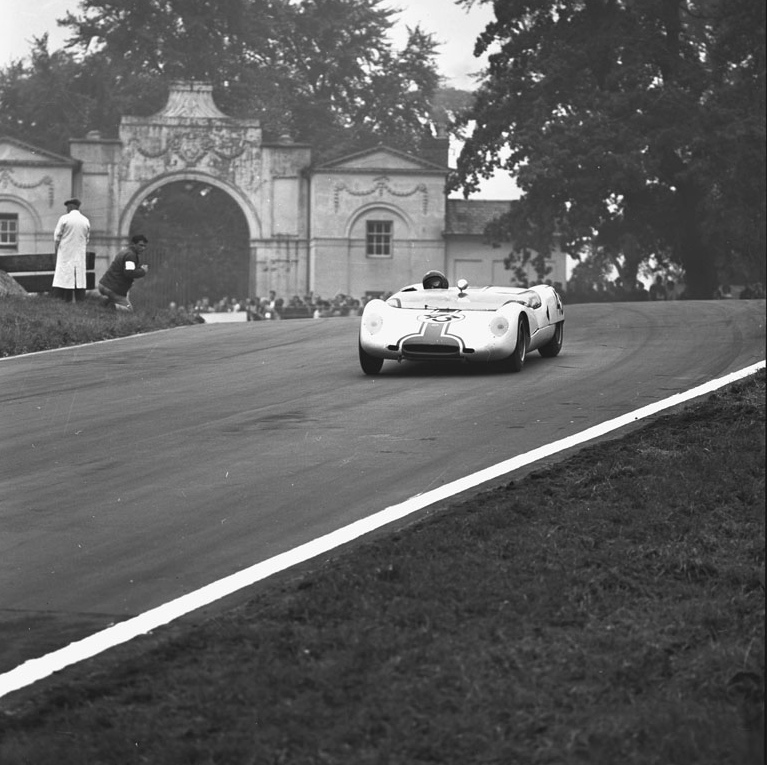
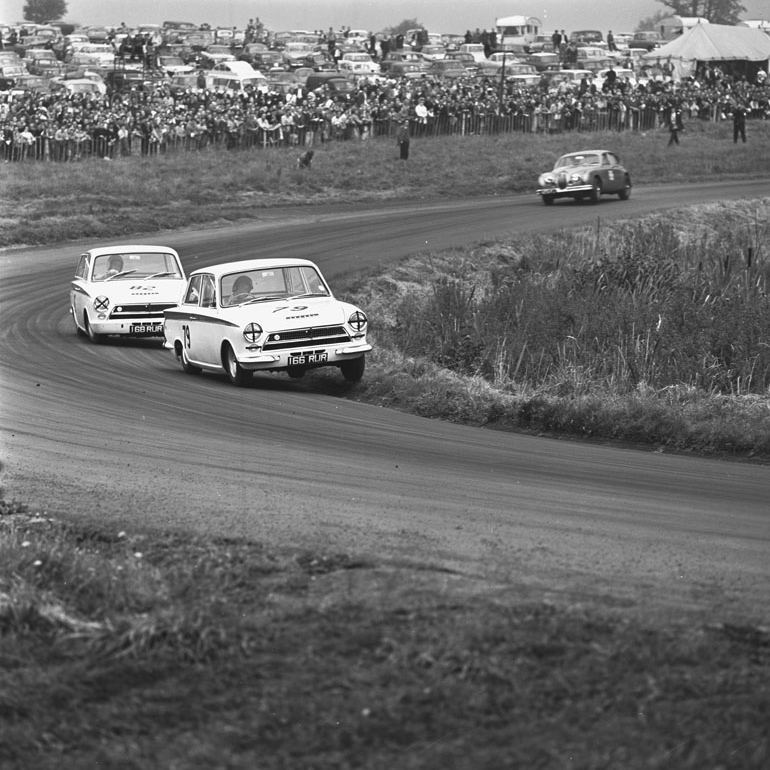
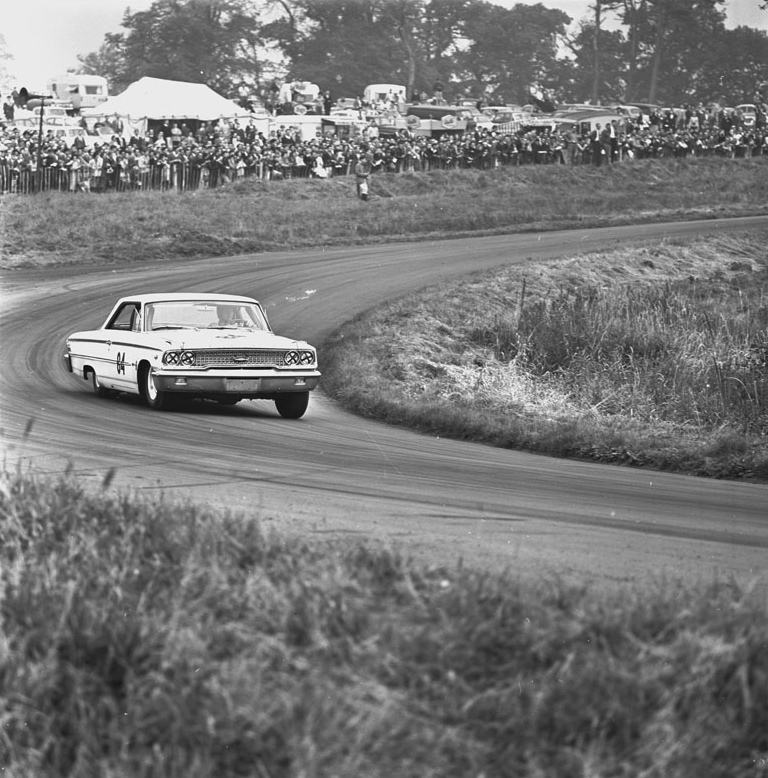
Captions, from top:  Jim glides the 25 through the Esso Hairpin at Oulton Park.  He won the Gold Cup with impunity; the full version of the Esso film made before, and during, the Gold Cup meeting;  photographer Max Le Grand peers down at Jim as the Lotus 25 prepares to exit the Esso Hairpin; the nose dips as Jim squeezes the brakes between the autumn leaves; Jim exits Lodge Corner in the Normand Lotus 23B.  On this occasion he wore his Bell Magnum, creating a very different look from the April meeting at Oulton; Jack Sears and Trevor Taylor stunned the crowd with their new Ford Lotus-Cortinas; Dan Gurney won the saloon car race overall with “Jim’s” Alan Brown’s Ford Galaxie Photographs: LAT Photographic, Peter Windsor Collection

With grateful thanks to Cedric Selzer, whose new autobiography contains many Jim Clark gems. Cedric has published the book himself, with proceeds going to the Marie Cure Cancer Care Charity. It can be ordered on-line or via good bookshopsS2740001

The Jim Clark Victory Parade…at Brands

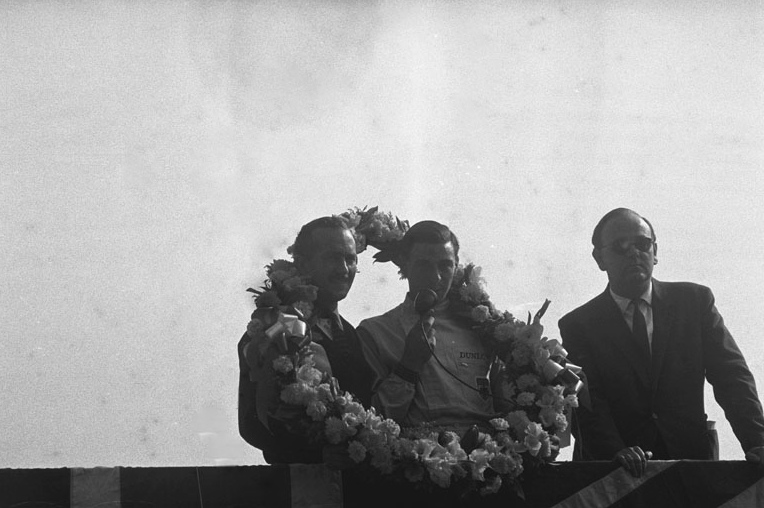
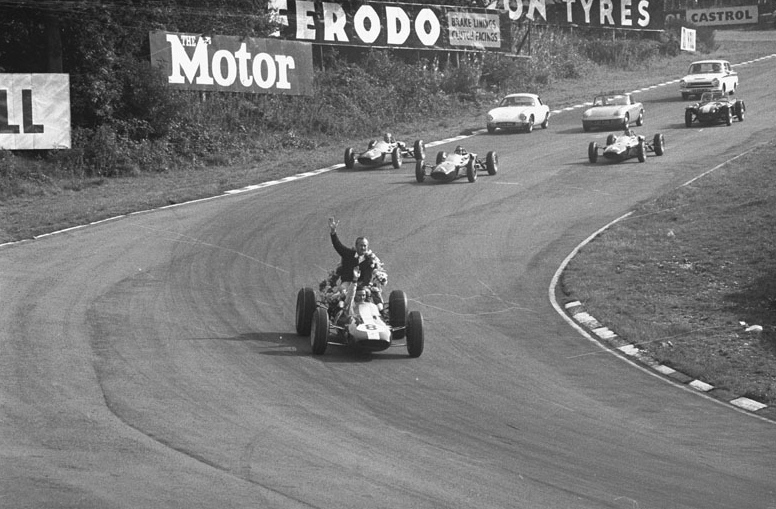
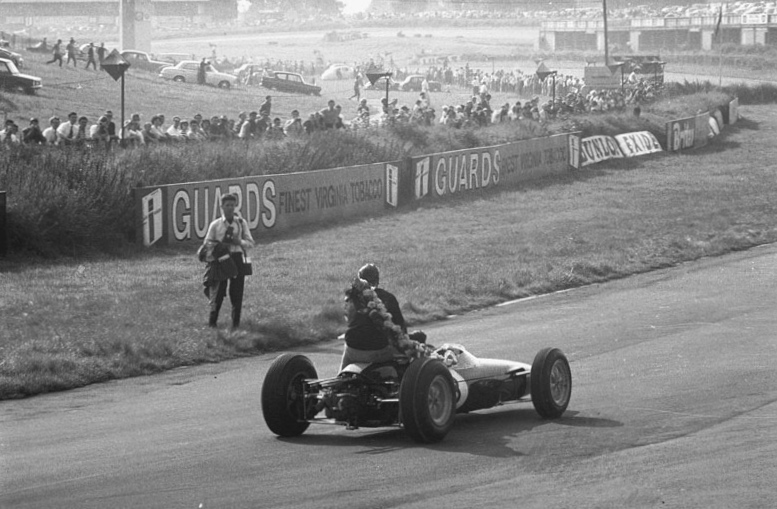
831_41.tifAt Goodwood over the weekend we celebrated the 50th anniversary of Jim Clark’s first World Championship with probably the greatest collection of Clark cars ever seen on one patch of motor racing turf. On Saturday, September 14, 1963, there was a similar, if slightly more muted, Jim Clark parade to toast the same championship win. Jim, Colin Chapman and the Team Lotus mechanics were the impromptu toast of a relatively small crowd at Brands Hatch, where a BRSCC international meeting had the week before been billed only as the Anglo-European Trophy for Formula Juniors.  Jim changed into his Dunlop overalls in order to drive the Lotus 25 around the Grand Prix circuit, waving to the crowd and carrying Colin Chapman piggy-back behind the rollover bar;  and all the Team Lotus mechanics were present, sharing the fun and chatting to the crowds. Behind the 25 ran the Ron Harris Lotus 27s of Peter Arundell and Mike Spence (who were racing that day and would finish one-four in the final) plus the spare 27, an Elite, an Elan, a Seven and a Cortina.  831_43.tifJim would have enjoyed watching the two FJ heats early in the afternoon (won by Timmy Mayer and Denny Hulme) and would have been delighted by Sir John Whitmore’s class win with the factory Austin Cooper S. Bob Olthoff would have revived recent happy memories by winning overall with his Galaxie; and Jack Sears would also have brought a smile to Jim’s face with his class win with his Willment Cortina GT. (The Cortina-Lotus would soon be homologated but not for this weekend). That done, Jim then donned his Bell Magnum and string-backed Leston gloves to set about some serious lappery with the 25.  Despite running the wrong dampers for Brands, and nursing a slight mis-fire, he completed four flying laps, smashing Bruce McLaren’s 2.5 litre record by 0.6sec. (The first Championship F1 race at Brands, the British and European GP, was scheduled for July, 1964.)831_44.tifThat night, with the less pleasant aspects of Monza now beginning to fade, Colin Chapman hosted a huge party in his house in Hadley Wood, near Elstree aerodrome in north London.  Most of Jim’s peers were present, in addition to many key motoring and motor racing figures.  I asked Sally (Stokes) if she remembered much about it.  “I think it was the first time I saw Jim in a kilt,” she replied.  “There were lots of ‘do they/don’t they?’ jokes which Jim thought were very funny.  Apart from that I don’t remember too much about it. Probably we were having too good a time!”

Captions, from top: Jim talks to the Brands crowd. Colin listens and the excellent Anthony Marsh oversees; Jim’s 25 leads the Brands victory parade; rear view of the same.  Images: LAT Photographic  

Post Navigation