I hope the show we’ve put together this week gives a little bit of a taste of what we’ve been up to over the past few days on our Italian roadtrip. I’d like to say a very big thankyou to Jonathan Giacobazzi, who achieved the almost-impossible with his laps of Brisighella in the Ferrari 312T4; to the organizers of the Trofeo Bandini; to Alpinestars, who are celebrating their 50th birthday this weekend; to Renault, for building the amazing Captur (the perfect family touring wagon even for the likes of Jack Windsor); to Cory Pesaturo, who wrote music and then performed it, especially for this show; and to Diego Merino and Rodrigo Camacho, both of whom helped with the photography.
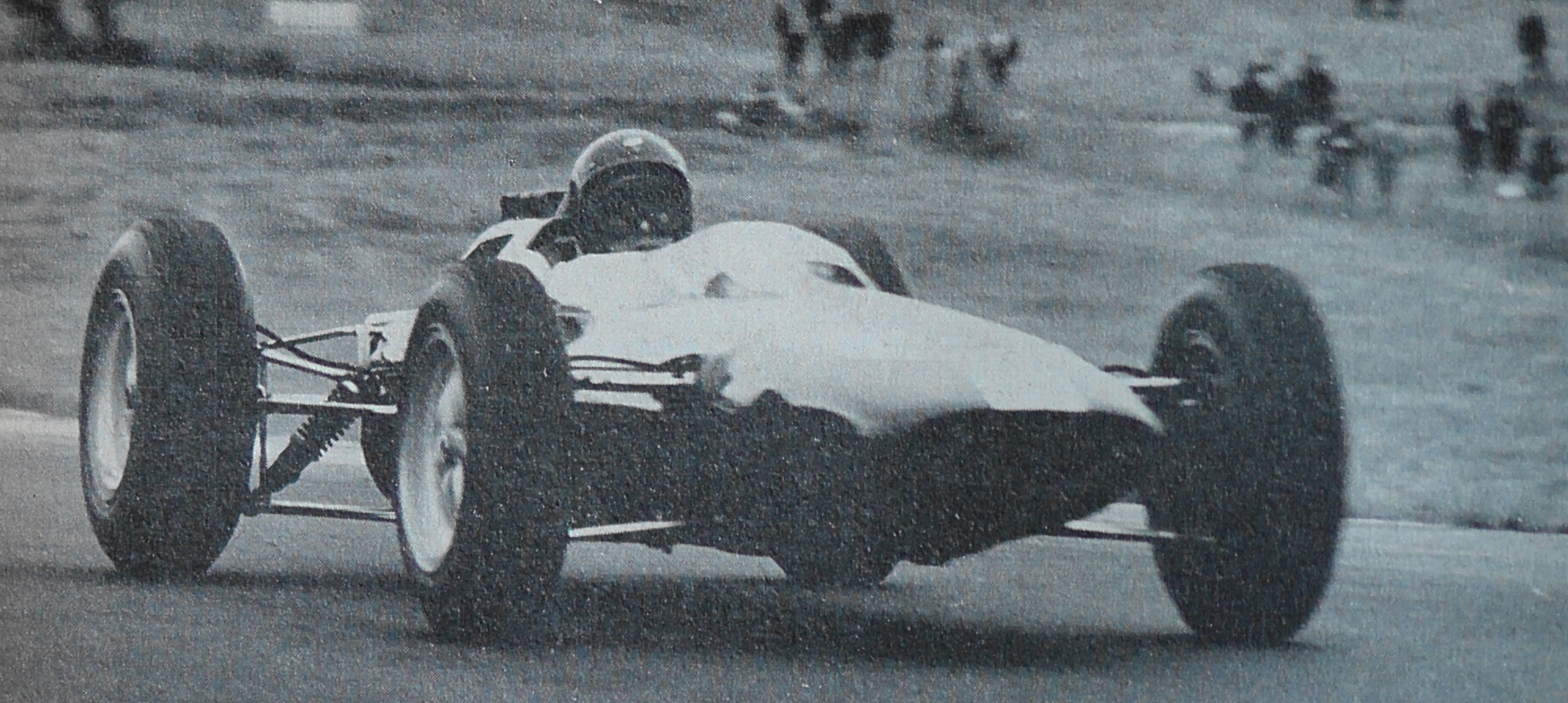
To Sweden, for the Kanonloppet – to a non-championship F1 race with a bit of history, given that Stirling Moss (Rob Walker Lotus 18/21) won it in 1961 (from the back of the grid, after Jim Clark’s retirement) and Maston Gregory followed that with victory in 1962 at the wheel of a UDT-Laystall Lotus 24-BRM. (It should also be remembered that Graham Hill, fresh from his momentous victory for BRM in the 1962 German GP, drove Rob Walker’s Lotus 24-Climax the following week in the downbeat Kanonloppet. He qualified on the second row at Karlskoga but retired early.) The Swedish race was bracketed with with Danish GP (Roskildering) in ’61 and ’62 but it stood alone in ’63. As the former factory Lotus and BRM driver, Reine Wisell, recalls in the adjoining interview, Karlskoga was, and is, best-known for the Bofors armament factory. Thus the name of the race: Kanon (gun), Loppet (trophy).
Jim Clark won the two-part race (the results of which were based on points awarded for finishing positions, with total times deciding the ties) but – as at Solitude – it was Black Jack Brabham who again set the “non-championship” pace. Jim experimented with the spare, carburettored, Lotus 25, leaving the fuel-injected car for Trevor Taylor – but couldn’t live with Jack’s BT7 out of the slow corners (of which there were about five at Karlskoga, including the banked hairpin). Jack, who took the pole from Jim by half-a-second, was heading towards a sure victory in Heat One when his engine suddenly cut-out (as per Dan Gurney’s chronically at the Nurburgring). Jim thus won easily from Trevor.
Jim calculated during the lunch break that he could finish third in Heat Two and still win overall (providing he crossed the line no more than 1min 35.2sec behind Brabham) and so, on a wet afternoon, he did exactly that: Jack duly won the second heat; Jim let Trevor finish second – and thus the Kanonloppet was Jim’s. As it happened, he finished that second heat exactly 35 sec behind Jack and right on Trevor’s gearbox. Denny Hulme, having his first F1 drive in the 1.5 litre formula, finished fourth in the other works Brabham.
As I say, Reine Wisell paints a nice picture for us of the 1963 Kanonloppet in the video interview below. I caught him last week on a day similar to that of August 11, 1963, dragging him out of a restaurant on a wet day Motala. His chat is best watched in conjunction with the “Kanonloppet 1963” video (also embedded here) which has become something of a YouTube cult hit. Think a very early Swedish Woodstock and you have some picture of what that Karlskoga meeting, on August 9-10-11, 1963, was all about. You get a feel for ’63 Karlskoga (the town) and for what it was like for the fans there. I kind of like the Swedish commentary, too! Reine also mentions a video of the 1967 Kanonloppet but I couldn’t find it on a quick, initial search. Let me know if you have more luck.
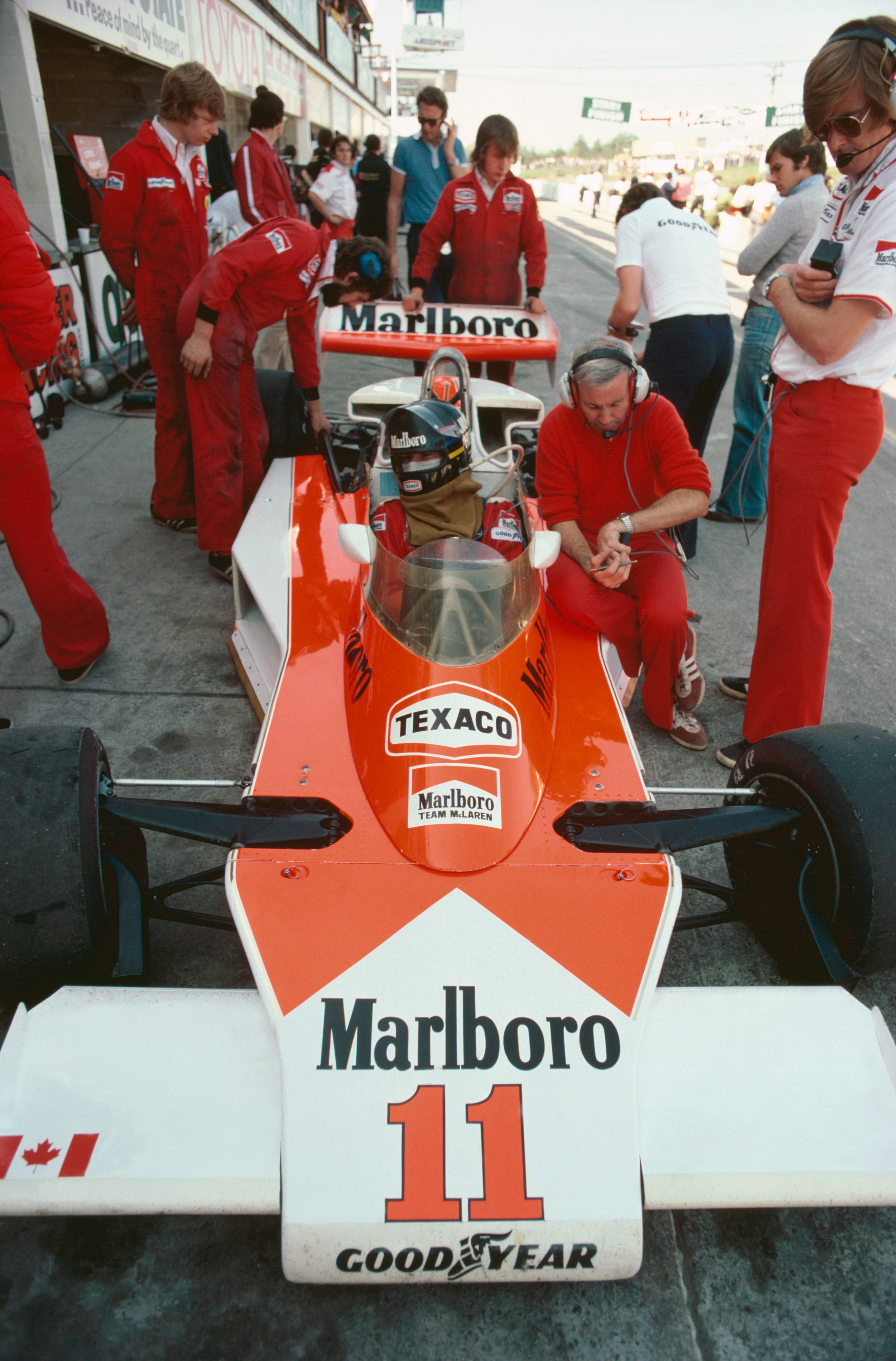
Alastair Caldwell (right, with headset, talking to James Hunt at Mosport, in 1976) is our guest this week on The Racer’s Edge – which means that at last we can sit him down and talk to him in outrageous detail about those early days at McLaren, about Bruce winning his first race in a car bearing his own name – and about the tricks they used to play back in 1976, when James Hunt fought Niki Lauda all the way to the Drivers’ World Championship. We also catch up with Charlie Kimball, the son of the former McLaren and Ferrari Design Engineer, Gordon Kimball. Last Sunday, Charlie won his first IndyCar race (with Chip Ganassi Racing) Images: LAT Photographic; TRE Production: Knockout TV in association with F1 Racing
As Jim Clark’s 1963 season continues, we head to the Nurburgring
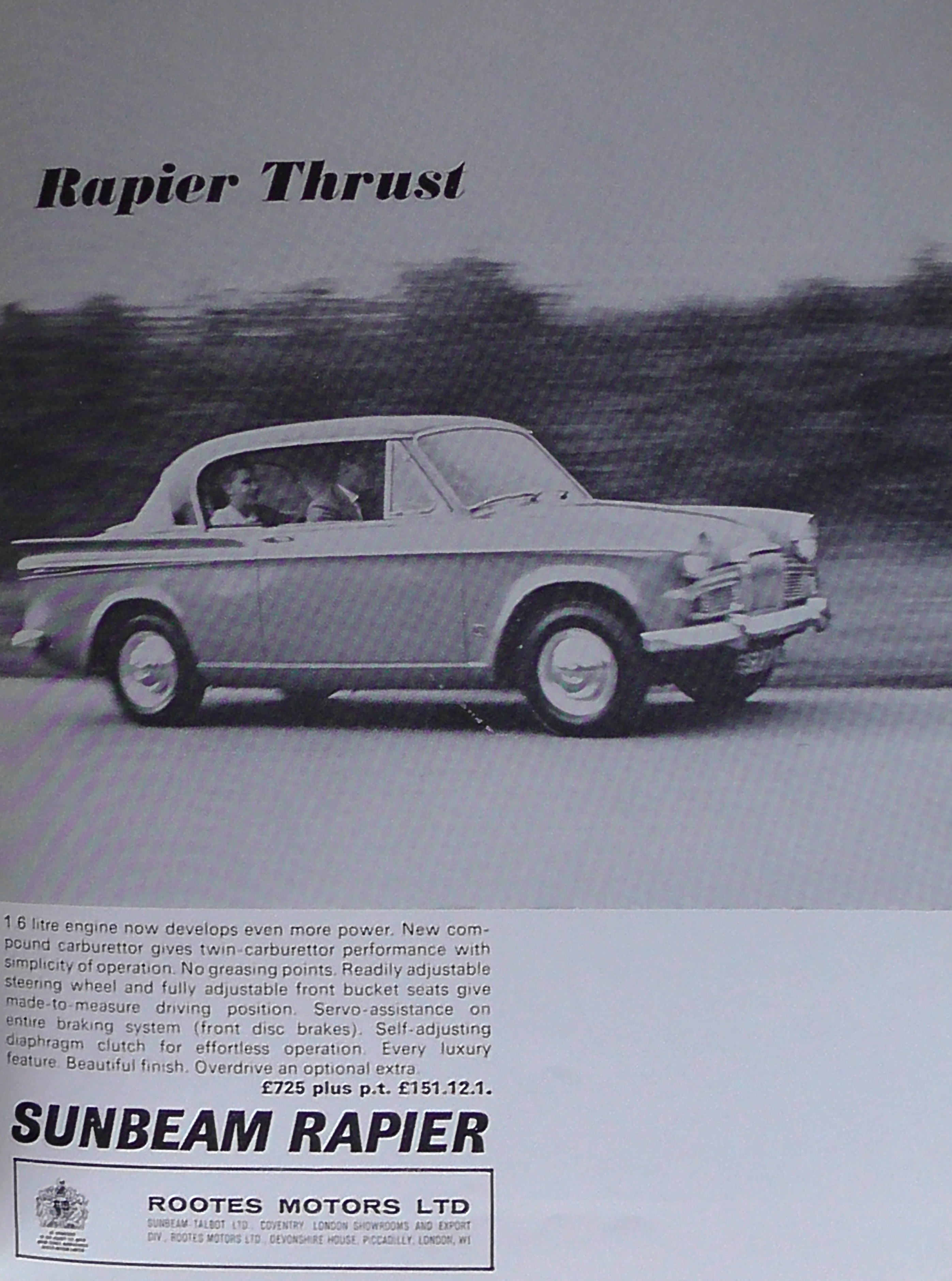
Bruce McLaren journeyed to the Nurburgring, for the German GP, in a Sunbeam Rapier road test car (arranged and co-driven by his secretary, Eoin Young). In the days when standards, and tastes, were more in tune with real life, Bruce described the Rapier as “surprisingly fast” and “very comfortable”. He would have cause to repeat his descriptions, post-race, in ways that he could never have imagined.
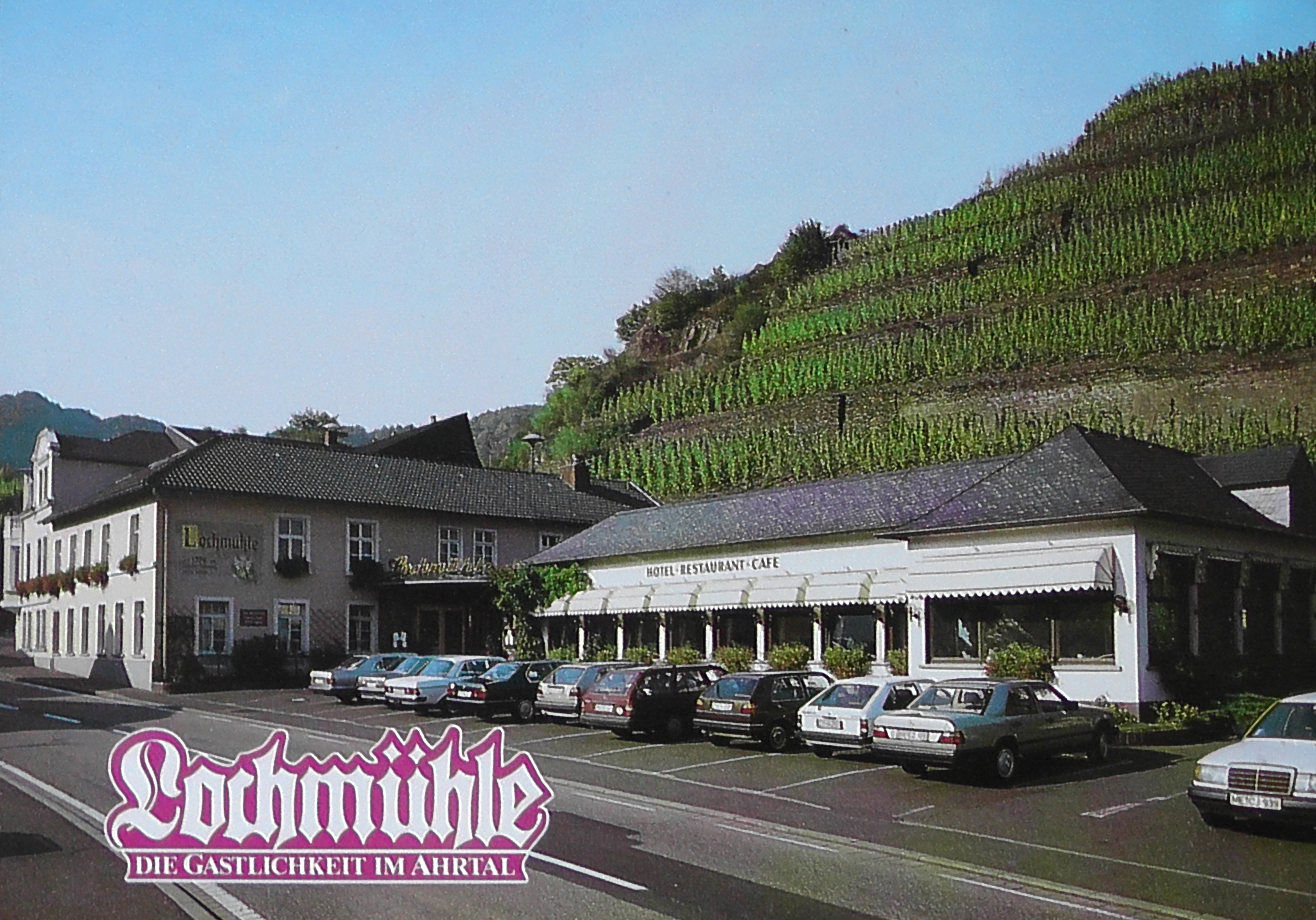
As in 1961 and 1962, when they had raced as team-mates in John Ogier’s Essex Racing Team, Bruce McLaren and Jim Clark stayed at the Lochmuhle hotel in Altenahr for the 1963 F1 race. There’s no record of exactly what they specifically ate that weekend, but Bruce had said this about their stay the previous year: “They serve some of the best food in Europe at the Lochmuhle and, as Essex were paying the bill, most of us stuck to four large courses, such as lobster or that delicious oxtail soup, followed by a quick chicken and mushroom entrée or pate, then an exotic steak, grilled with oranges and tomatoes or a wine sauce. Jim generally managed to fit in a grilled trout, probably caught an hour earlier in the river by the hotel. For a small man, it was amazing how much he could stow away!”
Jim, Peter Arundell and Trevor Taylor attended Huschke’s Sunday night party in Solitude and thus Jim and Trevor left at a leisurely hour for the autobahn thrash up to the Eifel hills on Monday. Jim was thirsty for a win on the circuit that for him represented the greatest of all tests of drivers’ skill. He had first raced there in 1961, in that Essex Aston with Bruce, and had quickly learned the circuit in Bruce’s 3.8 Jag. Then, two months later, he had finished fourth in the German GP in the Lotus 21. That race will forever be remembered as one of the finest hours (or two and a half hours!) in the career of Stirling Moss – but Jim’s fourth place, in his first full season, nursing a brake problem in the spare car (after a big practice accident), should never be under-rated. From then on, Jim had a Monaco-like relationship with the 15-mile circuit: he was always quick, always its master – but the circuit, in turn, always found a way of throwing him a joker. Whilst leading the 1962 1000km race easily in the Lotus 23, Jim became nauseated by an exhaust gas leak from a loose manifold. And at the ’62 German GP, whilst focussed on de-misting his goggles, he forgot to switch on the fuel pump just before the start. He recovered to finish a brilliant fourth.
Now, with four World Championship victories behind him, and that new lap record at Solitude, Jim was returning to the Ring with the Lotus 25 in its latest, delectable, form. Of course he could be worried about suspension failures and the like over the switchbacks of the ‘Ring; he knew that Cedric Selzer and the boys were, too. He trusted them, though; and, ultimately, he had to trust Colin Chapman.
Jim began Friday practice with his race Climax engine from Solitude; and, continuing that Solitude connection, a driveshaft broke (again) as Jim was preparing for a quick lap. He thus finished the session third-quickest behind John Surtees in the works Ferrari and Lorenzo Bandini’s old Centro Sud BRM. Cedric Selzer and the boys fitted new driveshafts during the lunch break in the Team Lotus lock-up garage in the paddock quadrangle. Bratworst anyone?
Then, in the afternoon, it rained on the main part of the circuit (but not in the pit area). In a nice counterpoint to 2013, all the drivers nonetheless ventured out. Jim was quickest, slicing his 25 through the mist and standing water in 9m 44.0sec. Surtees was second and Ritchie Ginther third in the factory BRM. Overnight, Jim asked for an engine and gearbox change. Oh yes, and how about leaving reverse out of the ZF ‘box on this occasion, just as a safeguard against any further selection issues? It’s one thing to hold the car in gear through the Masta kink; it’s another to do so over a blind brow at the Nurburgring…
It was dry, but overcast, on Saturday, which meant that now was the moment for The Lap. The 25 felt taut on exploratory looks around the North and South Curve loops; the new engine, mated to the new ZF, seemed strong. Jim lowered himself in.Peakless Bell, Dunlop blue overalls, Leston string-backed gloves, Westover shoes. No seat belts.
The new engine faltered. It coughed, irritatingly, as Jim left Pflantzgarten for the long roller-coaster straight at the finish. And it wasn’t just a question of losing a second or two: the baulk killed his acceleration run through third, fourth and fifth gears. There was no telling how much time he had lost.
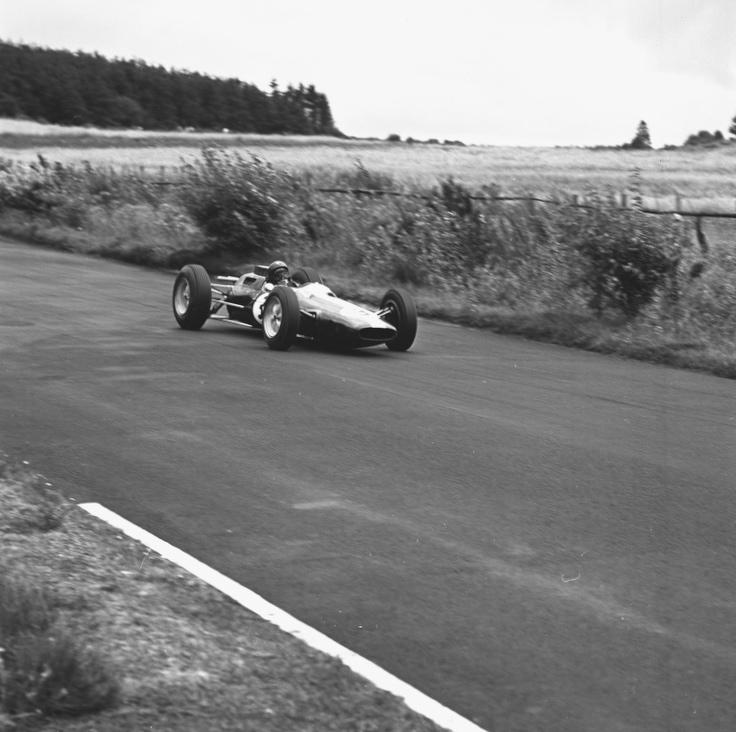
Still, though, he was on the pole: that was the quality of the lap. 8min 46.7sec – the fastest ever recorded at the Nurburgring. Without that mis-fire (or whatever it was), he could easily have been in the 43s. Surtees, looking consistently quick, was second-fastest; and third – amazingly – was Lorenzo in the old BRM. It was at about this time that Jim’s long-lasting friendship with Lorenzo was born. Graham Hill, always a threat at the ‘Ring, rounded out the four-car front row; and Bruce was on the inside of the second row in the Cooper, ahead of Ritchie and Jack Brabham. Dan, again wearing a white, Clark-like, peak on his Bell for this race, had nothing but engine trouble with his Brabham. Was Solitude but a dream, he must have been asking?
Wally Hassan, of Coventry Climax, was present at the ‘Ring (on the third anniversary of the V8’s appearance) and suggested the usual remedies: plug changes, fuel injection clean-outs. In the quadrangle, as they all sat and stood around, and as the mechanics worked flat out, Jim’s engine sounded perfect. Fingers were crossed for tomorrow.
The start I encourage you to watch on the German TV video below. Drivers shuffle in their cockpits; officials wave hands and twitch flags. Some of the slower cars begin to creep. Not Clark. The 25 stays rock-solid still. And then – bang! Jim releases the clutch against revs, the rear tyres smoke and he is gone, soaring into an immediate lead…
His start, indeed, was exactly as he planned it: “I decided that a fast start was absolutely vital,” he would say later to Graham Gauld, “because, with all its twists and turns, the ‘Ring can be tricky for anyone trying to overtake, particularly in a Grand Prix car. So when the flag dropped I departed as quickly as possible…”
It wasn’t to last. As Jim selected third gear – and this can just be seen on the video – his engine hesitates again, just as it had on his pole lap. “Surely I haven’t oiled a plug on the line?” he thought, fearing the worst. Jim had specifically started the engine only a few minutes before the off to prevent just such a problem. Now, as he focused on the first left- and right-handers and then on the run down back behind the pits, he could see the pack surging nearer in his mirrors. All around the lap he lived with the problem. Ritchie Ginther went past in the BRM – then Surtees. The engine would feel as if it was on seven cylinders – and then suddenly it would go onto eight, mid-corner.
In time, of course, Jim began to maximise what he had – “but my progress was erratic, to say the least,” he would say later. “I developed a whole new system for going around the Nurburgring on seven cylinders. This was completely spoiled on occasion because I would arrive at a corner I knew was flat-out on seven cylinders and set the car up. Then the eighth cylinder would come in with a bang and there would follow an exciting second or two as I sorted the car out. What a difference that one cylinder makes when you have committed yourself to a line with what you thought was a seven-cylinder motor car!”
For the most part of the race Jim was able to keep the Ferrari of John Surtees in sight; indeed, as can be seen in the videos, he was on some parts of the circuit able to re-take the lead – for John, too, was fighting a mis-fire of his own. Usually the Ferrari ran on six clear cylinders; occasionally it ran on five. Surtees was up there with Clark, allowing for the intrusions, fighting with the car.
And, towards the end, he was able to pull away, for Jim began to feel his gearbox tighten. On this occasion Jim would settle for second place – the first and only second place he would ever record in a World Championship Grand Prix. It wasn’t a question of “driving for points” because of “the championship”. It was simply a question of “bringing the car to the finish”. He did so – 1min 20sec behind John. Afterwards, the engine problem was traced to yet another dud spark plug.
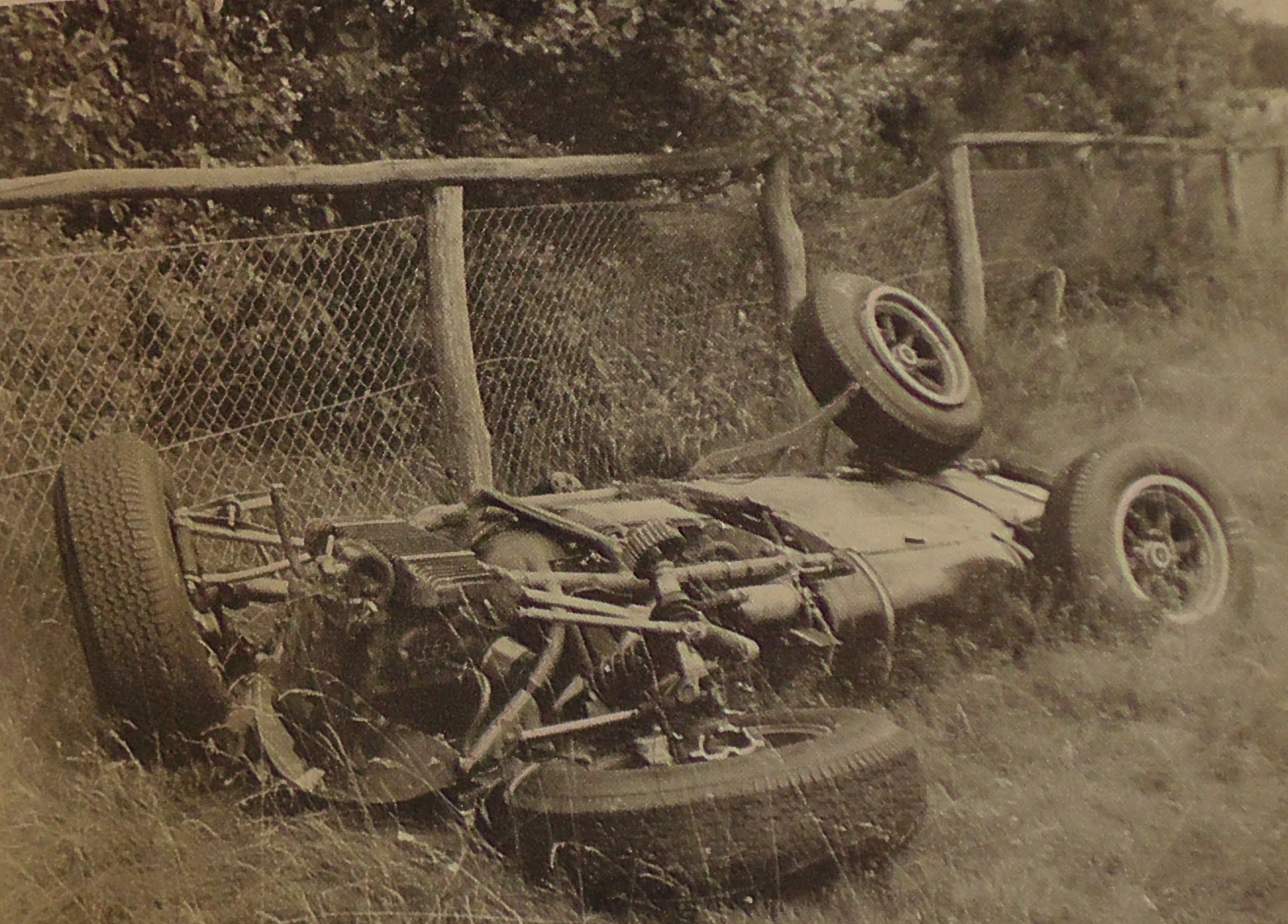
It was in many ways a momentous race, marked for eternity by highs and lows. John Surtees, the former mult-World Motor Cycle Champion, had now won his first Grand Prix; for their part, Ferrari had scored their first victory since that dark day at Monza, in 1961. Ferrari’s other driver, Willy Mairesse, had meanwhile been seriously injured when he lost his car at Flugplatz; Bruce McLaren had crashed heavily when his Cooper broke a rear wishbone (as distinct from the front suspension that had cracked in practice!); Bruce had been thrown out and knocked unconscious but further, serious, head injuries had been prevented by his new Bell Magnum. Chris Amon had broken a couple of ribs when the suspension also failed on his Parnell Lola. Lorenzo was out early after a shunt with Innes Ireland’s BRP but had still done enough to earn himself a works Ferrari drive at Monza (in place of Mairesse). Amon, Jo Siffert and Jo Bonnier could all have finished fourth but for mechanical dramas. (Dan Gurney, who also retired his Brabham, can be seen briefly in the German TV feed, standing by the Rob Walker Cooper after it retired with a “broken chassis”); at the end, fourth position had been taken by a German (Gerhard Mitter) and his old Porsche (shown on the video near the podium); Jim Hall had again driven extremely well to finish fifth; and third, after leading and spending most of the race holding his BRM in gear, was another American, Ritchie Ginther. Over 350,000 paying spectators attended this German GP – even though a Gerhard Mitter-type result was about their greatest expectation; for these were the days when people watched because it was their national Grand Prix and because these were the best drivers in the world, regardless of nationality.
All the drivers – or those who weren’t in hospital – attended the Sunday night celebrations at the Sport Hotel. Jim visited Bruce in Adenau, where he was relieved to find him in reasonably good spirits, and left the victory proceedings early, for he was racing at Brands Hatch the following day in Alan Brown’s Ford Galaxie. Bruce regained consciousness in his hospital bed, completely unaware of how he had got there. “I was a bit shocked at first,” he said later, “because all around me in the same ward there seemed to be people with bashed heads and banged-up legs. I had this awful suspicion that I had caused all the carnage…” He hadn’t – but he had been very lucky. While Bruce’s wife, Pat, drove back to the UK with the Australian driver, Frank Matich (who was staying with the McLarens in Surbiton whilst building up his new Brabham for the 1964 Tasman series) Bruce, resting comfortably in the rear seat of the Rapier, his leg in a precautionary plaster, was chauffeured back to the coast by Eoin Young. It was then but a short hop across the channel in a BUA (British United Airways) Bristol Freighter, with Bruce staying on board the Rapier while Eoin re-fuelled in the cabin. Eoin then drove Bruce all the way to Kingston hospital, where his plaster was quickly removed. “After that crash at the Nurburgring I thought hard about my future,” Bruce would later say. “I had once promised myself to give up racing after my first big shunt. I realize now that that would have been the worst possible thing I could have done. If you are ever going to look yourself in the eye again, it’s essential to go straight out again and have a go…”
Even though Bruce would lose his life in another accident, at Goodwood, in 1970, I think these words would have been fully-endorsed by his friend, Jim Clark.
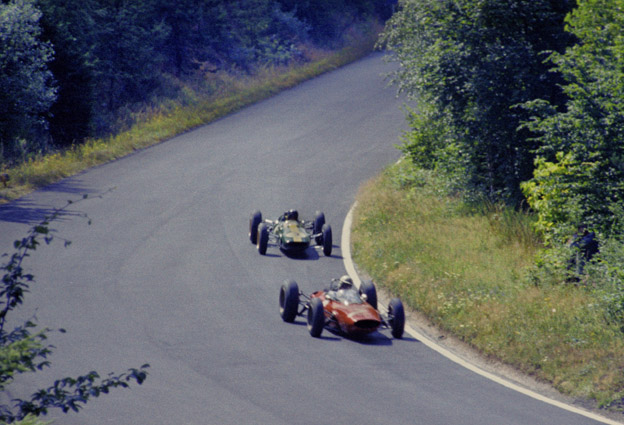
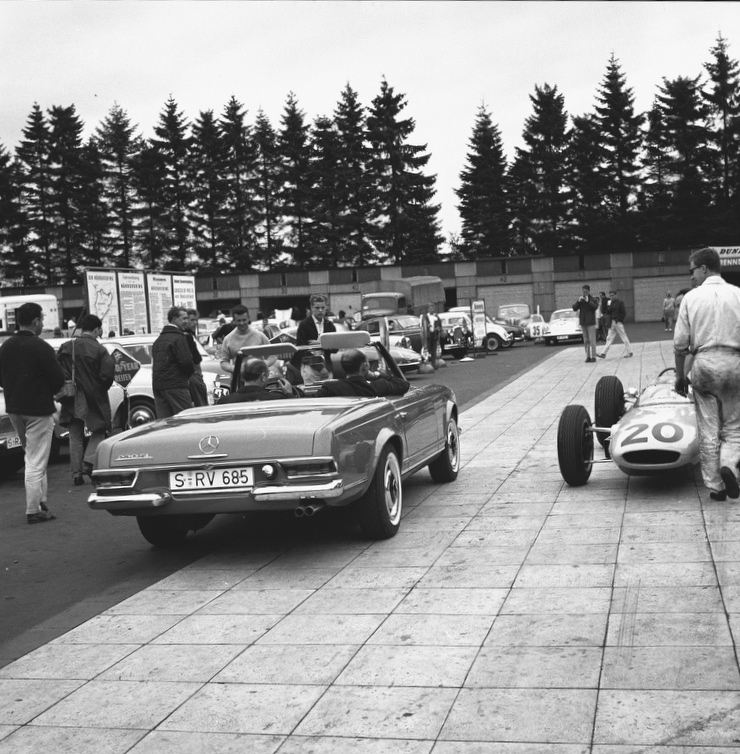
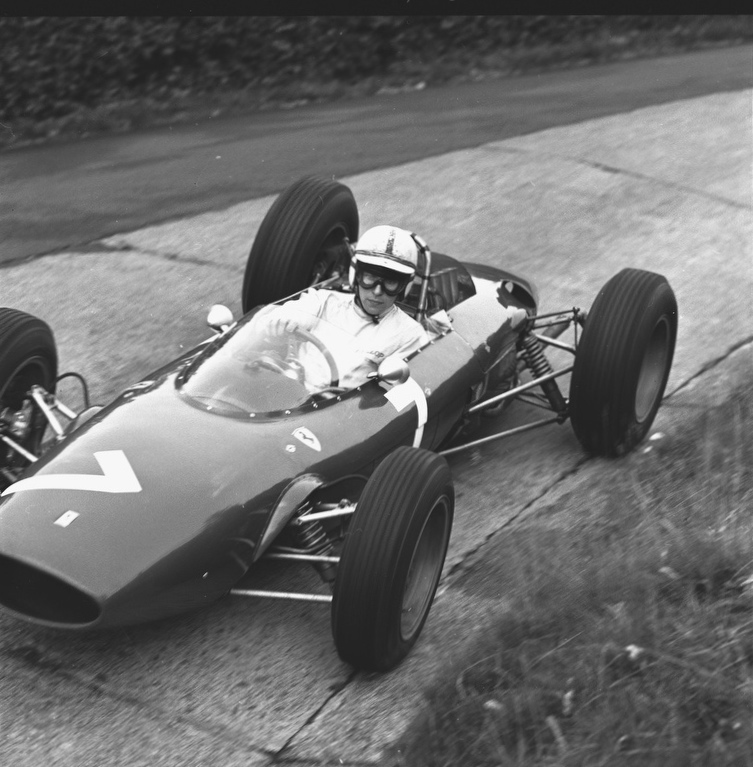
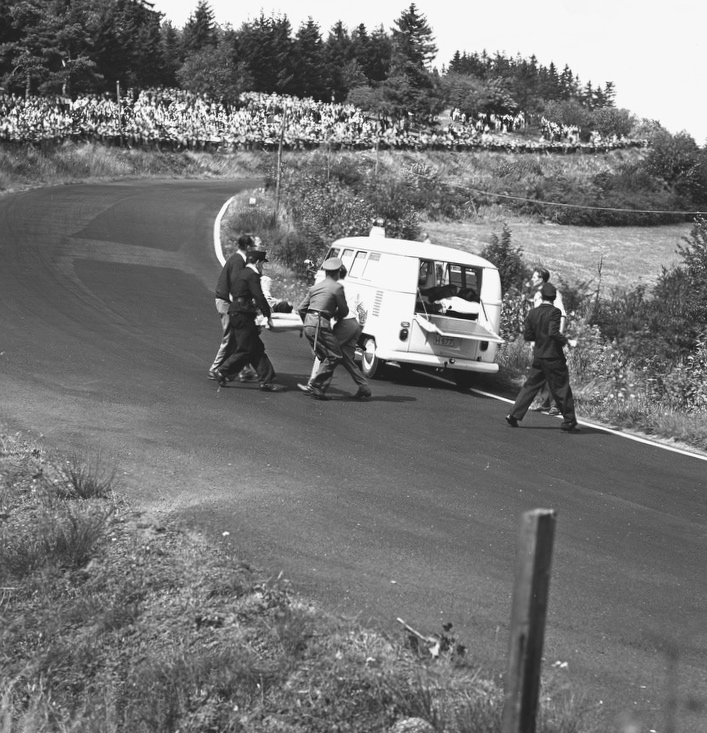
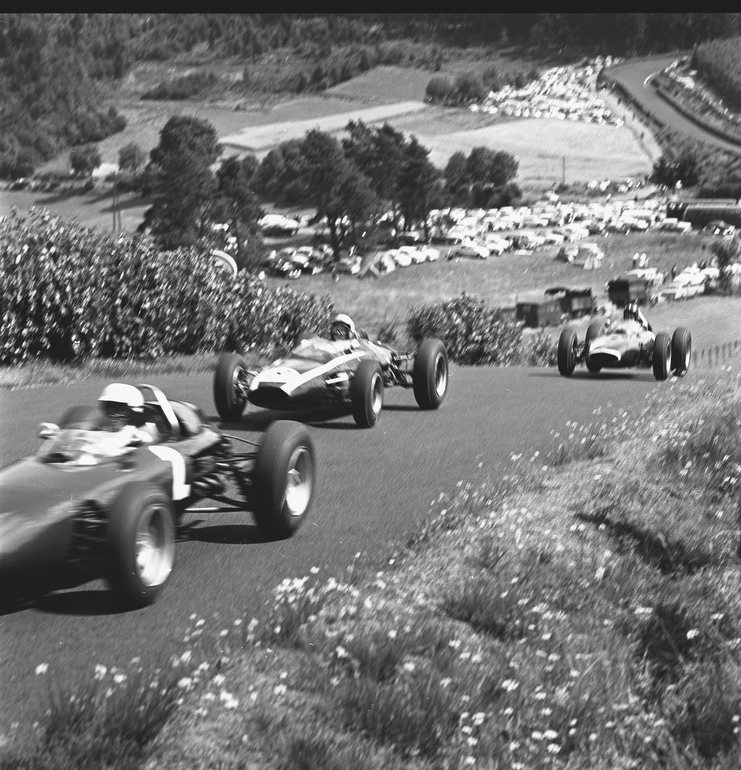
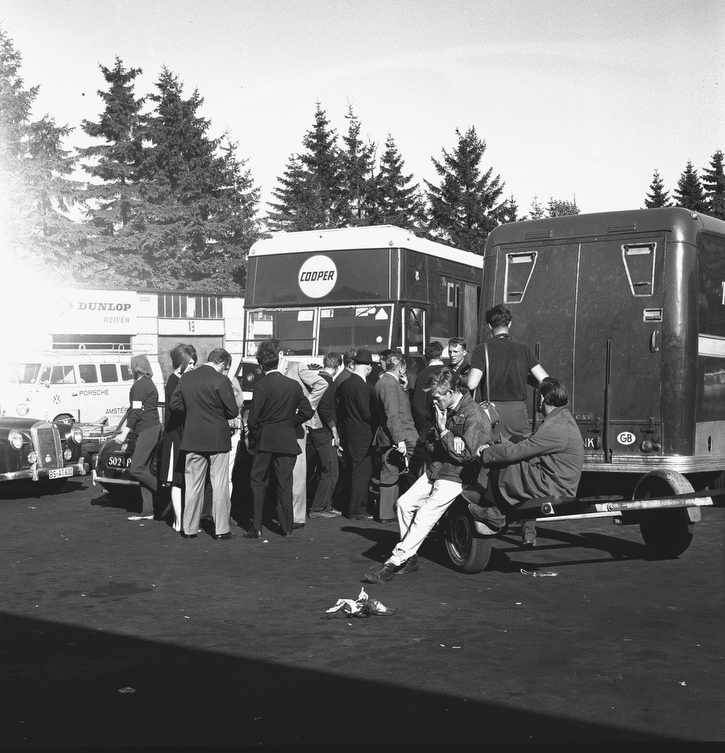
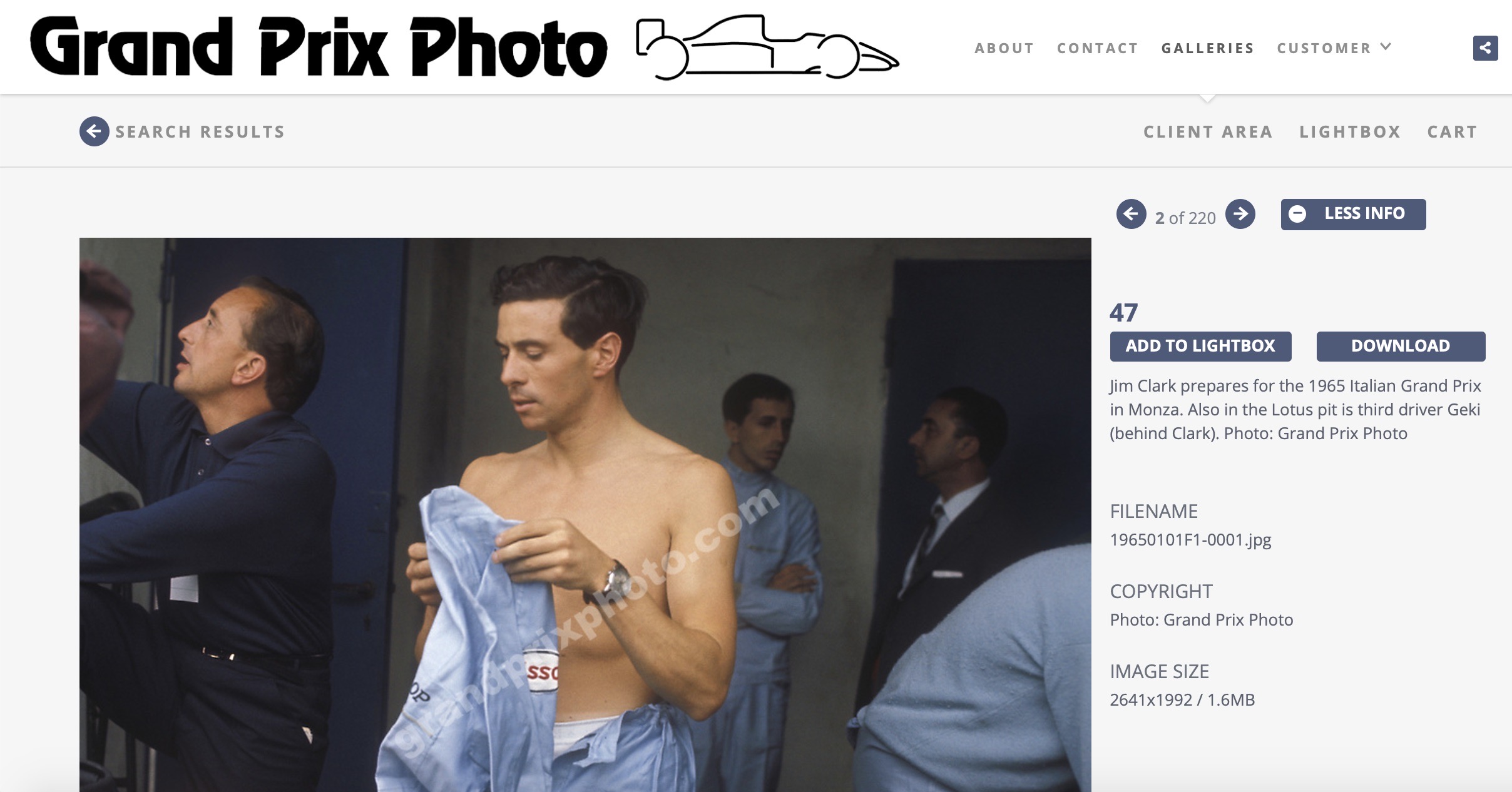
Captions, from top: John Surtees in the “V5” Ferrari leads Jim’s “V7” Lotus 25 around the Nurburgring; Sunbeam Rapiers were all the rage in ’63!; the Lochmuhle Hotel – still there today and still trout-worthy; despite yet another engine mis-fire, Jim Clark took the pole with a brilliant lap in the Lotus 25; in the days when former champions were regularly welcomed at races, former Mercedes F1 team-mates, Stirling Moss and Juan Fangio, had fun in a 230SL convertible. That’s Jim Hall’s fifth-placed BRP Lotus 24 on the right of the paddock quadrangle; Surtees glides the Ferrari around the Karussel; Willy Mairesse is stretchered to an ambulance after his Flugplatz shunt. This sort of scene was all-too-regular at the Nurburgring; Bruce McLaren was running his Cooper right up with the leaders before his big accident. And then there was that awful moment: Bruce’s team-mate, Tony Maggs, draws on a cigarette while journalists and team people hover nervously around the Cooper transporter, awaiting post-race news on Bruce’s condition. Note the Team Lotus truck on the right. Images: Grand Prix Photo; LAT Photographic; Peter Windsor Collection
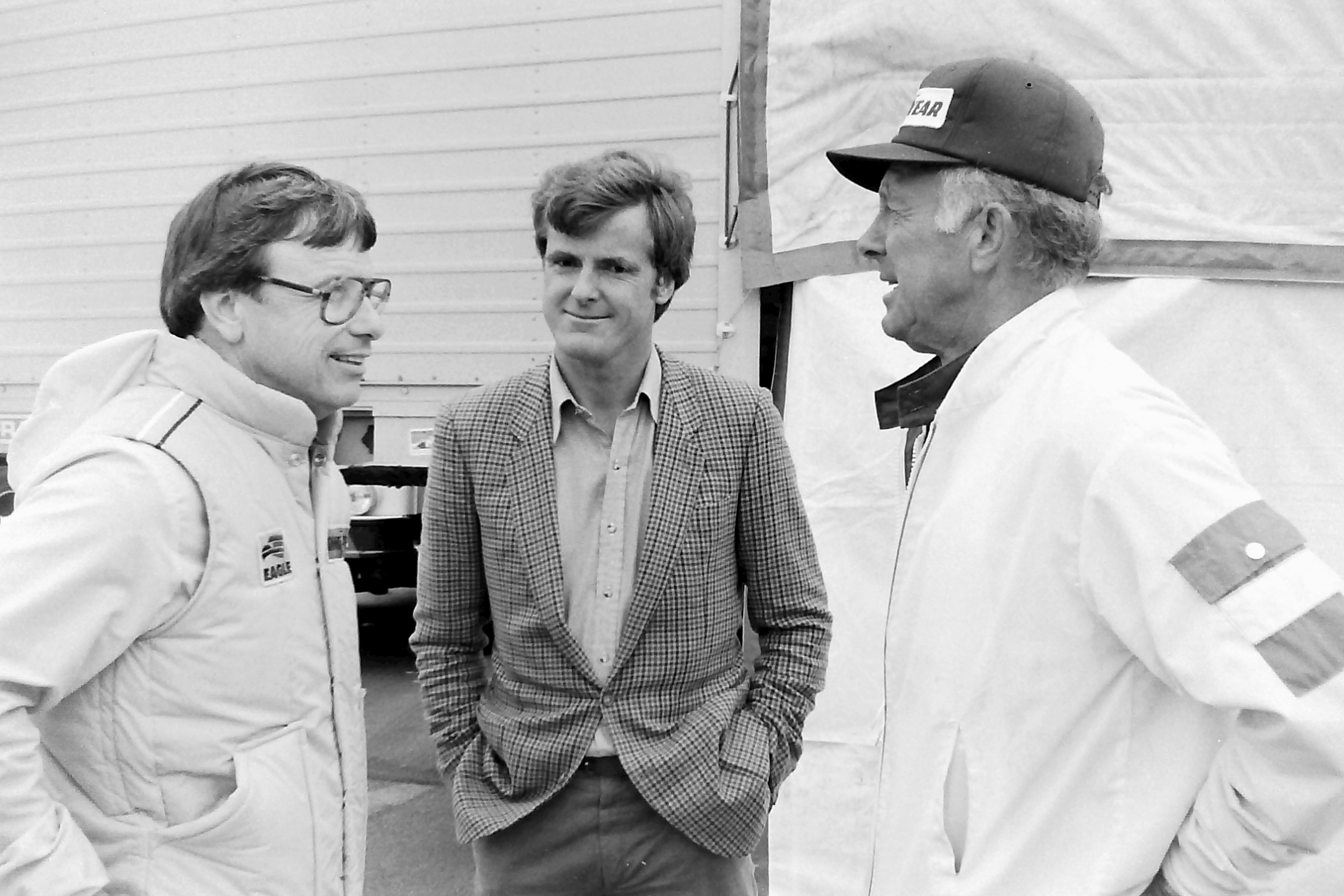
As we’re going to be hosting the ebullient Alastair Caldwell on next week’s edition of The Racer’s Edge, I thought I’d include this neg scan of AC in conference with the Goodyear brass (specifically Leo Mehl, left) and Lee Gaug (right). Leo always made me smile; he had this knack of always being able to mix racing politics with a true grasp of real life. And, through Leo, I discovered one of my favourite authors – Herman Wouk. “What’s that tome you’re reading?” I asked Leo once, at some airport. “War and Remembrance,” he replied. “It’s got just enough fiction to make it sizzle and more than enough history to be real. Can’t put it down.” How right he was. Lee was also a player. A pipe-smoker and an ex-marine who flew Brewster Buffalos from flat-tops, Lee always used to joke about his wives: “They’re all homekeepers. They’ve kept every one I ever owned…” Alastair, meanwhile…well…you can find out for yourselves what makes Mr Caldwell tick on next week’s show. I don’t think you’ll be disappointed.
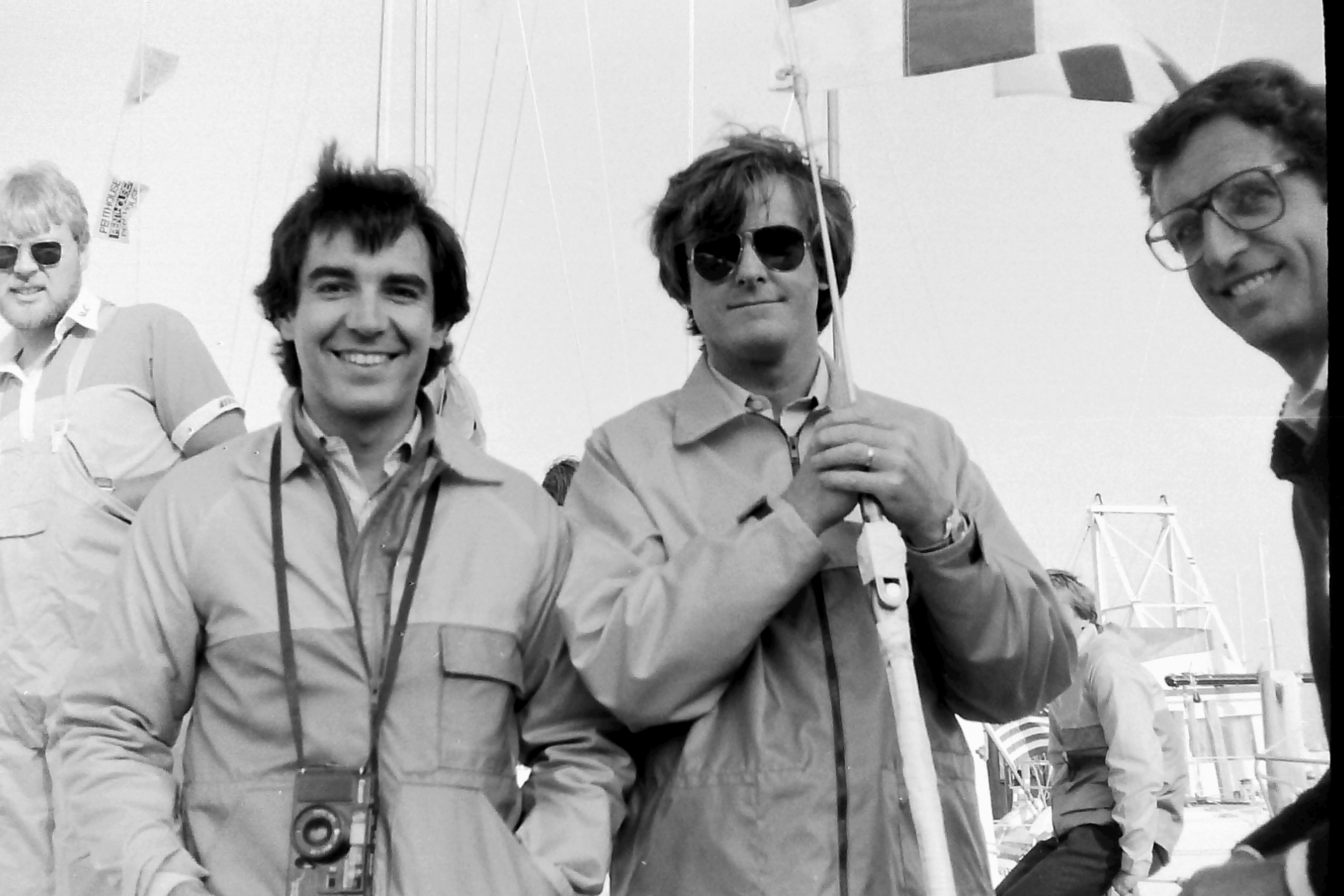
For good measure, here’s another AC shot. This time we’re taking part in the annual Grosse Pointe sailing regatta that preceded the Detroit Grand Prix every year. That’s the largely under-rated and multi-talented (F1, Indy, WRC) Chilean driver, Eliseo Salazar, on Al’s right and on his left is Dieter Stappert, who for many years wrote for the magazine with the greatest of all titles – Powerslide. Dieter was always impressive, I think: small note book in his hip pocket, nice pen, astute questions. He later worked for BMW.
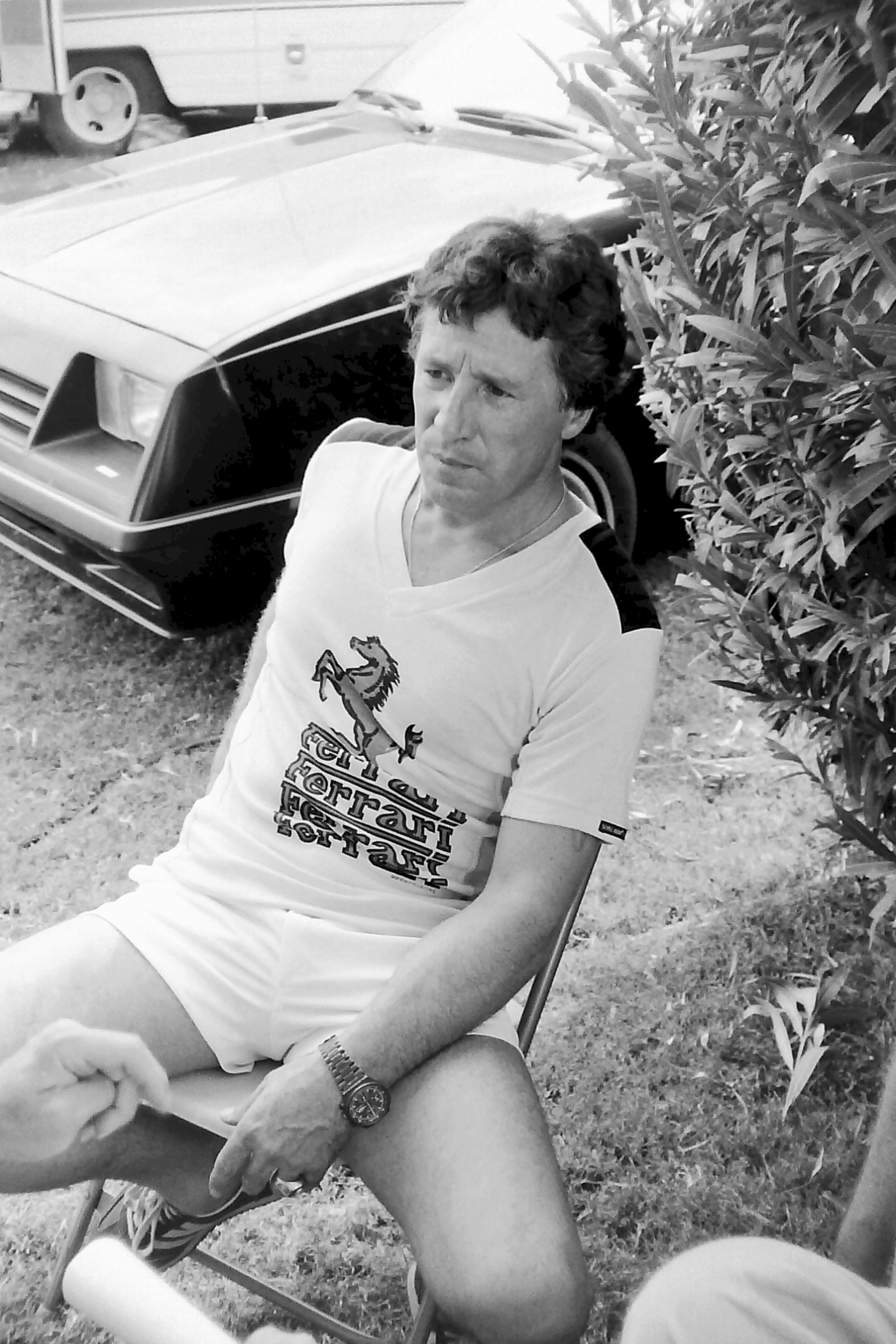
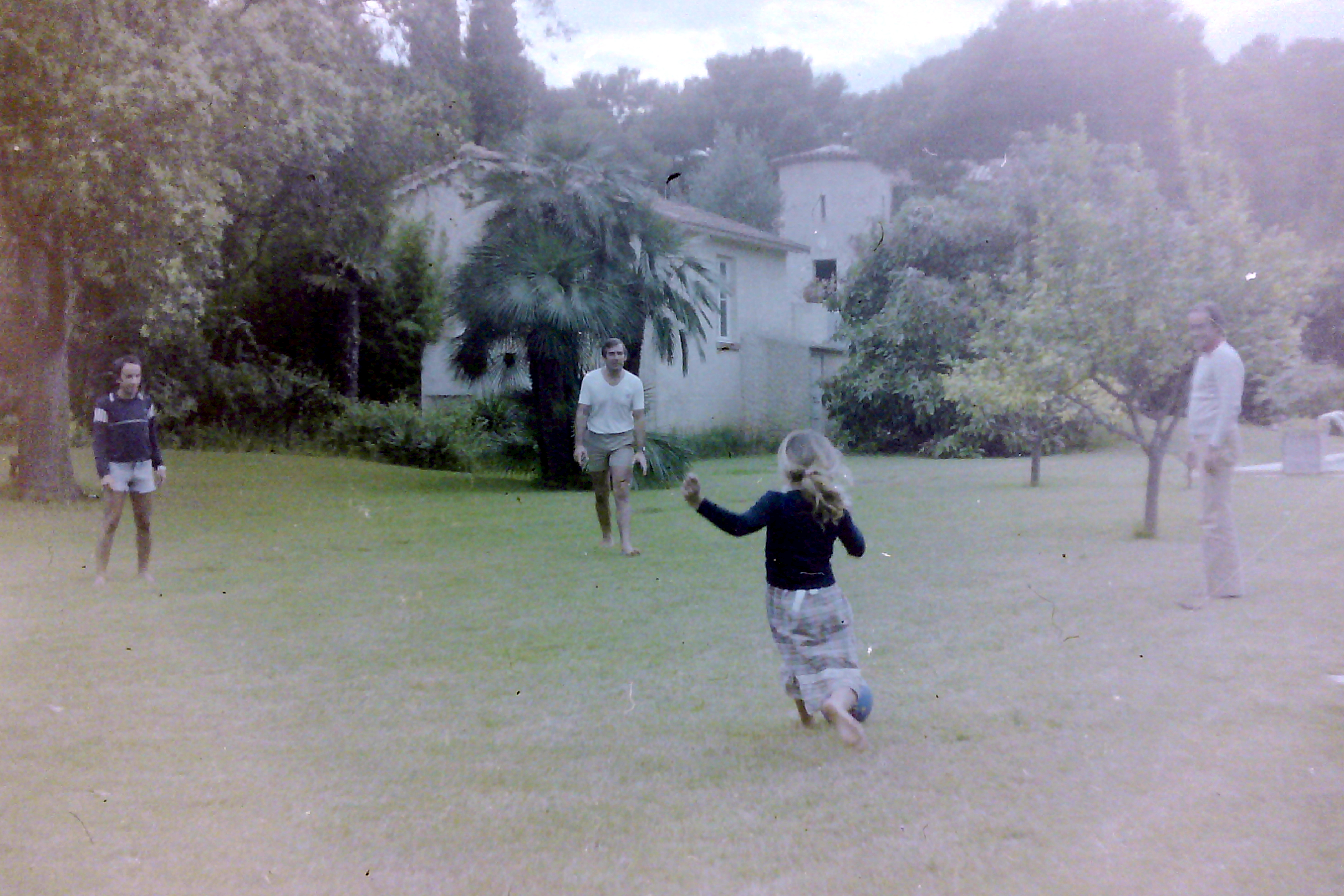
Now let’s drop in on Mario Andretti, wearing one of his favourite t-shirts as he talks set-up and engine revs, and, below, on the Reutemann family and friends, seen here enjoying an early-evening game of soccer in the back yard of Carlos’ home on the Circuit Cap Ferrat, South of France. That’s Cora Reutemann, who would in time become a first-rate photographer, looking as though she’s about to score a goal. Jose-Maria Candiotti, one of Carlos’ mates – and tennis doubles partner – from Carlos’ home town of Santa Fe, is on the right. I used to stay at Carlos’ place before the Monaco GP – and sometimes before the French GP, too.
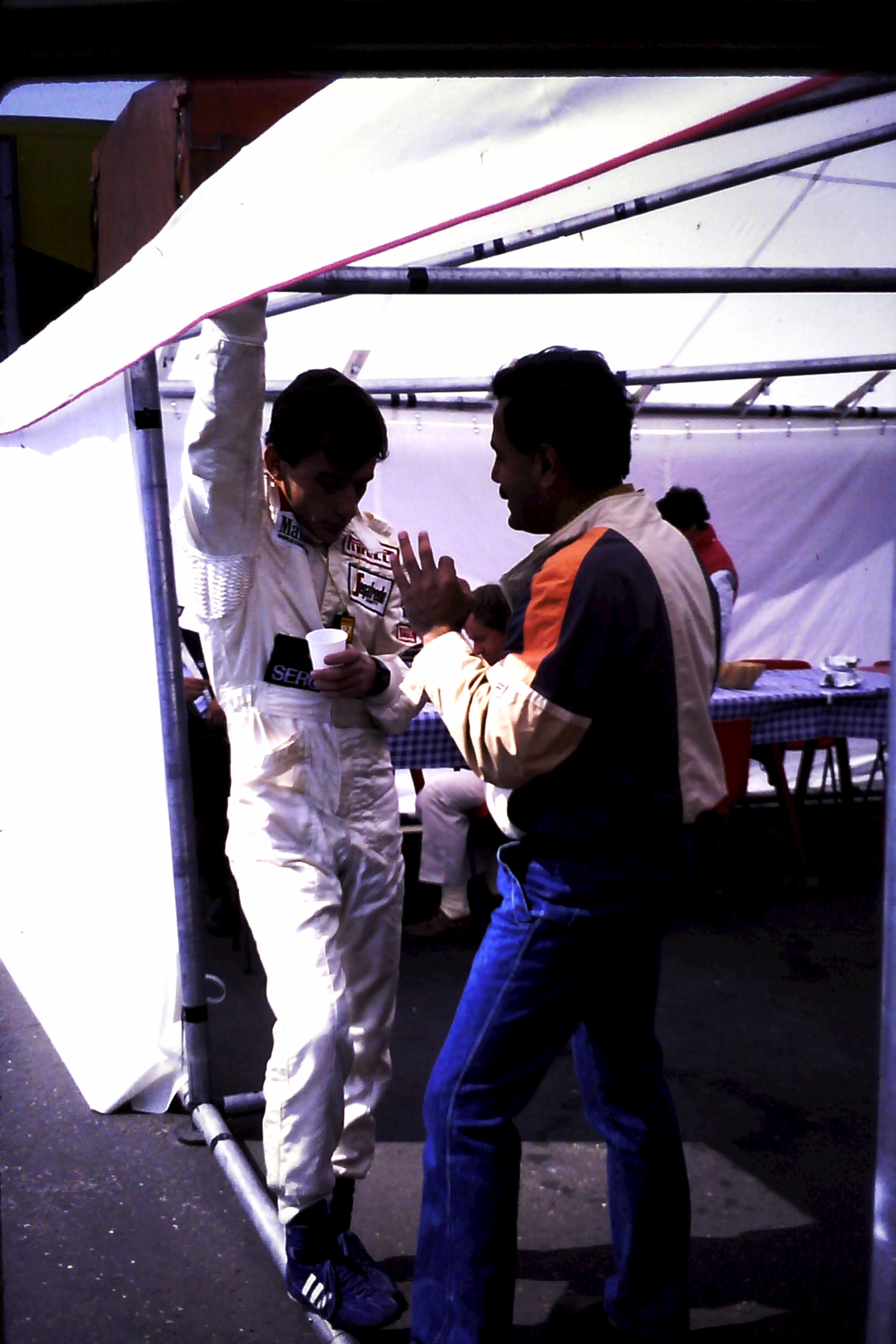
Finally, below, here’s Ayrton Senna, sipping a Segafredo coffee while he talks safety with Rafael Grajales-Robles, the very talented Panamanian heart surgeon. Rafael was a personal F1 doctor to drivers like Emerson Fittipaldi, Carlos Reutemann and Nelson Piquet long before Syd Watkins arrived on the scene and was the first medic of importance to ensure that helicopters were in place before practice sessions began, or that marshals’ posts were properly equipped with medical equipment at regular intervals. As such, he wasn ‘t flavour-of-the-month amongst the F1 power brokers for very long, as you can imagine. As the politics of the 1980s grew in intensity, Rafael – and his stringent safety demands – were inevitably shuffled sideways. He nonetheless remained close to drivers like Ayrton, and Nigel Mansell, for several years thereafter.
As the Hunt vs Lauda documentary has now been withdrawn from YouTube we are sadly unable to show it on these pages. It is available, though, on the BBC iPlayer and it will be screened again on BBC2 in the UK in near future. We will publish dates of those screenings via Twitter @peterdwindsor. Richard Wiseman, the archivist responsible for the video sourcing of the documentary, will also be our guest on The Racer’s Edge on August 22.











 peterwindsor.com