peterwindsor.com

…chance doesn't exist; there's always a cause and a reason for everything – Elahi

The Racer’s Edge

For those of you who haven’t yet watched our free, weekly, in-depth, on-line F1 chat show, remember that you can enjoy The Racer’s Edge every week on YouTube (Thursday, 7:00pm and thereafter on-demand) or you can download it from iTunes, where we have a high-speed facility for both the audio and video files.  Just enter “The Racer’s Edge” in the iTunes search engine and you’ll see a list of all the episodes.  (Although we also process the show for iTunes on the Thursday of each week we have no precise control of the actual release date. Usually it is within 24 hours of posting.)  Please “subscribe” to our YouTube Channel (as per the widget on the right).  This costs nothing but it allows you to receive regular email updates of all the new content we’re producing – and there will be more and more as the year develops.  Remember, too, that we often produce video not featured on The Racer’s Edge, ranging from interviews with wonderful racing people from the past (for example Mike Beckwith) to young up-and-comers on the way to Formula One (like Stoffel Vandoorne).  I also invite you to leave comments on our YouTube page.  We will read them, reply to them where appropriate – and your thoughts will also help to guide the way we move forwards.

If you are a regular viewer – thanks for watching.  We had just over 121,000 hits in the month of June – and over 80 per cent of you were watching the 60/65min show for 80 per cent of its length or longer.  We were also consistently in the top ten urls on iTunes in all aspects – hits, visits and downloads.  Interestingly, I think, about 50 per cent of you were watching from the USA, which just goes to show what I’ve always suspected:  the American F1 fan is amongst the best-informed in the business!

This week’s show is bursting with interesting people and comment:  as well as chatting away with Rob Wilson in the studio, we talk to Daniel Ricciardo, Sam Bird, Derek Daly and Craig Scarborough.  A lot of fun, a lot of laughs – and lots of detail about the sport we love.

In the meantime – again, in case you haven’t seen it – have a look at the episode below.  We filmed it on the Wednesday before Silverstone at LotusF1’s headquarters in Oxfordshire with the support of Avanade, the IT systems company.   This is a good example, I think, of an F1 partner company using digital media to tell a story that you wouldn’t necessarily see or hear on the conventional platforms.  I enjoyed, too, the chat with Alan Permayne.  Which reminds me:  if you haven’t yet joined the F1 Racing magazine Global Fan Community, then you should do so now.   GFC members will be given exclusive opportunities to ask questions of our featured guests – and to be in the running for some great prizes.  The winner from this interview was Mr Colin Bowett, from the UK.  His question to Alan:  “Do you think it’s odd that Kimi doesn’t do a track walk on Thursdays?”   Some excellent LotusF1 merchandise will now be coming Colin’s way.  You can join the GFC by going to the appropriate link published in the latest edition of F1 Racing.

OK.  Enough.  Enjoy.

Pirelli responds…

I like Pirelli’s response not only to the FIA statement of yesterday but also to the specific tyre problems we saw at Silverstone.

Milan, July 2, 2013 – After exhaustive analysis of the tyres used at Silverstone, Pirelli has concluded that the causes of the failures were principally down to a combination of the following factors:

1) Rear tyres that were mounted the wrong way round: in other words, the right hand tyre being placed where the left hand one should be and vice versa, on the cars that suffered failures. The tyres supplied this year have an asymmetric structure, which means that they are not designed to be interchangeable. The sidewalls are designed in such a way to deal with specific loads on the internal and external sides of the tyre. So swapping the tyres round has an effect on how they work in certain conditions. In particular, the external part is designed to cope with the very high loads that are generated while cornering at a circuit as demanding as Silverstone, with its rapid left-hand bends and some kerbs that are particularly aggressive.

2) The use of tyre pressures that were excessively low or in any case lower than those indicated by Pirelli. Under-inflating the tyres means that the tyre is subjected to more stressful working conditions.

3) The use of extreme camber angles.

4) Kerbing that was particularly aggressive on fast corners, such as that on turn four at Silverstone, which was the scene of most of the failures. Consequently it was the left-rear tyres that were affected.

The only problems that had come to light before Silverstone were to do with delamination, which was a completely different phenomenon. To stop these delaminations Pirelli found a solution by suggesting that the teams use the tyres that were tried out in Canada from Silverstone onwards. When this proposal was not accepted, Pirelli found another solution through laboratory testing, with a different bonding process to attach the tread to the carcass. So the problem of delamination has nothing at all to do with what was seen in Great Britain.

Following the conclusions of this analysis, Pirelli would like to underline that:

1) Mounting the tyres the wrong way round is a practice that was nonetheless underestimated by everybody: above all Pirelli, which did not forbid this.

2) In the same way, under-inflation of the tyres and extreme camber settings, over which Pirelli has no control, are choices that can be dangerous under certain circumstances. Because of this, Pirelli has asked the FIA for these parameters will be a topic of accurate and future examinations. Pirelli has also asked for compliance with these rules to be checked by a dedicated delegate.

3) Pirelli would also like to underline that the 2013 tyre range does not compromise driver safety in any way if used in the correct manner, and that it meets all the safety standards requested by the FIA.

The logical conclusion is that it is essential for tyres with the performance and technical sophistication of the 2013 range to be regulated and carefully controlled by Pirelli itself. In order to ensure the optimal functioning of the tyres, the Italian firm would need real-time data from the teams regarding fundamental parameters such as pressure, temperature and camber angles. While waiting for new regulations that would permit Pirelli access to this data, vital for the development and management of these state-of-the-art tyres, the following measures are proposed for the forthcoming grands prix, in agreement with the FIA, FOM, the teams and the drivers:

1) The use of the evolution of the current tyre that was tested in Canada (and proved to be completely reliable) for the German Grand Prix this weekend. This represents the best match for the technical characteristics of the Nurburgring circuit. In particular, the rear tyres that will be used at the German Grand Prix, which takes place on July 7, have a Kevlar construction that replaces the current steel structure and the re-introduction of the 2012 belt, to ensure maximum stability and roadholding. Given that these tyres are asymmetric as well, it will be strictly forbidden to swap them round. The front tyres, by contrast, will remain unaltered.

2) From the Hungarian Grand Prix onwards, the introduction of a new range of tyres. The new tyres will have a symmetrical structure, designed to guarantee maximum safety even without access to tyre data – which however is essential for the optimal function of the more sophisticated 2013 tyres. The tyres that will be used for the Hungarian Grand Prix onwards will combine the characteristics of the 2012 tyres with the performance of the 2013 compounds. Essentially, the new tyres will have a structure, construction and belt identical to that of 2012, which ensured maximum performance and safety. The compounds will be the same as those used throughout 2013, which guaranteed faster lap times and a wider working range. This new specification, as agreed with the FIA, will be tested on-track together with the teams and their 2013 cars at Silverstone from 17-19 July in a session with the race drivers during the young driver test. These tests will contribute to the definitive development of the new range of tyres, giving teams the opportunity to carry out the appropriate set-up work on their cars.

Paul Hembery, Pirelli’s motorsport director, said: “What happened at Silverstone was completely unexpected and it was the first time that anything like this has ever occurred in more than a century of Pirelli in motorsport. These incidents, which have upset us greatly, have stressed the urgency of the changes that we already suggested – which will be introduced during for free practice in Germany on Friday. We would like to acknowledge the willingness of the FIA, FOM teams, and drivers to act quickly to find an immediate solution to the problem. In particular, the adoption of winter tests, arranged with the FIA, that are more suitable for tyre development and the possibility of carrying out in-season testing will contribute to the realisation of tyres with increasingly improved standards of safety and performance. I’d like to re-emphasise the fact that the 2013 range of tyres, used in the correct way, is completely safe. What happened at Silverstone though has led us to ask for full access to real time tyre data to ensure the correct usage and development of tyres that have the sophistication we were asked to provide and extremely high performance that has lowered lap times by more than two seconds on average. While we wait for a change in the rules, we will introduce tyres that are easier to manage.”

Low pressures and high camber angles have been standard practice up and down the pit lane – and it’s interesting that Pirelli condoned the swapping of tyres, left to right. The kerbs are the kerbs, though, as the BRDC’s Derek Warwick said recently. The  early-race on-boards of Lewis Hamilton, which I have seen, show that he uses only a tiny amount of apex kerb at T4. Fernando Alonso uses more – maybe a foot more – but conversely had no problems. It could be, of course, that the “safe” line at T4 was Fernando’s but it’s also interesting to note that Daniel Ricciardo, for instance, never touched the T4 apex on any of the on-boards I viewed. 

On Pirelli and glass houses…

The FIA today announced that the  Young Drivers’ Test at Silverstone on July 17-19 would be opened up to regular F1 drivers “to allow teams to use drivers they deem fit to carry out tyre development work in a bid to solve the problems we saw at the British GP”.  Even more significantly, the FIA says it will seek approval to “change the Technical Regulations to allow modifications to the specification of the tyres during the season without the unanimous agreement of all competing teams”.  This, I think, is to be applauded, bearing in mind that Pirelli wanted to revert to Kevlar constructions after the first Bahrain incident and were forbidden for doing so by the teams, who could not come to a unanimous agreement.  (Lotus and Ferrari were going well at the time and understandably did not want to see any major construction changes at that point.)  It also seems likely that the ridiculous (current) requirement for Pirelli to define its 2014 tyre specification by September 1, 2013, will be re-written.  Less comforting is the closing threat in the FIA statement today: “the FIA has asked Pirelli for an assurance that there will be no repetition of the tyre problems at this weekend’s German GP or at subsequent grand prix (sic).”  I may be reading too much into it, but that to me sounds like a governing body potentially wanting to discipline a tyre supplier – the only tyre supplier that would step into the void left by Bridgestone – for making future mistakes.  What would happen, for example, if Sebastian Vettel in Germany this weekend suffered exactly the same sort of tyre failure that took him out at the first corner at Abu Dhabi in 2011? Does anyone outside Red Bull Racing and Pirelli know exactly what happened on that occasion?  Judging by the number of different opinions in the pit lane to this day, I think not.  Surely the role of the FIA at this time – when Pirelli have been subjected to massive criticism from all quarters – is to re-assure the F1 tyre supplier that it has the support of the people who matter.  Pirelli have made mistakes – and will continue to make mistakes – because that is the nature of the F1 business.  Indeed, it is the nature of life.  I make mistakes – plenty of them.  The F1 teams make mistakes. The drivers make mistakes. And so, come to think of it, does the FIA.  I seem to recall some FIA fuel rigs under-performing a few seasons back – and who ratified the regulations that are now being changed mid-season?  Of course Pirelli have had a bunch of problems – but then so did Michelin back in 2005, at Indianapolis.  I think it’s interesting that a number of F1 people who now dream of a Michelin return were the same people who refused to race at Indianapolis that year (when some sort of race could have been put together to save Michelin’s face in its biggest market) and who in 2006, at Monza, openly accused Michelin of cheating.  Pirelli spend several hundred millions of Euros per year supplying tyres for F1;  they don’t have to do it – and I’m sure that at present they wish they weren’t doing it.  In the absence of Goodyear, Bridgestone and Michelin, though, the alternative three years ago was for the F1 industry to produce its own tyres, with the vague hope of a sponsor branding the sidewalls.  Instead, Pirelli stepped up to the plate and everyone breathed a huge sigh of relief. In my view, it now behoves the F1 industry to stand squarely behind Pirelli, to give them the scope they need to do the job and not to threaten them with some sort of discipline if/when something again goes wrong.

The Battle of Reims

20172.tifJim Clark makes it three-in-a-row

The drive down to Reims was the usual cavalcade.  They left Zandvoort, after a celebratory dinner/cabaret at the Bouwes Hotel, early on Monday morning.  First practice for the French GP would commence on Wednesday afternoon (or just one clear working day from the Dutch GP.  As with Monaco now, there was a “free” day within the French GP schedule back then.  At Reims, this was on the Saturday, following three successive afternoons of official practice.  No thought, apparently, was given to the ‘double-header’ pressures facing the mechanics.)  At some point in the road trip Ian Scott-Watson joined Jim and Colin in their rental car and allowed Trevor Taylor behind the wheel of his yellow Elan.   Ian would thereafter spend much time telling the French police that, no, it wasn’t he who had been driving the English sports car at the time in question and that his friend, the culprit, had since flown to Canada…or anywhere…

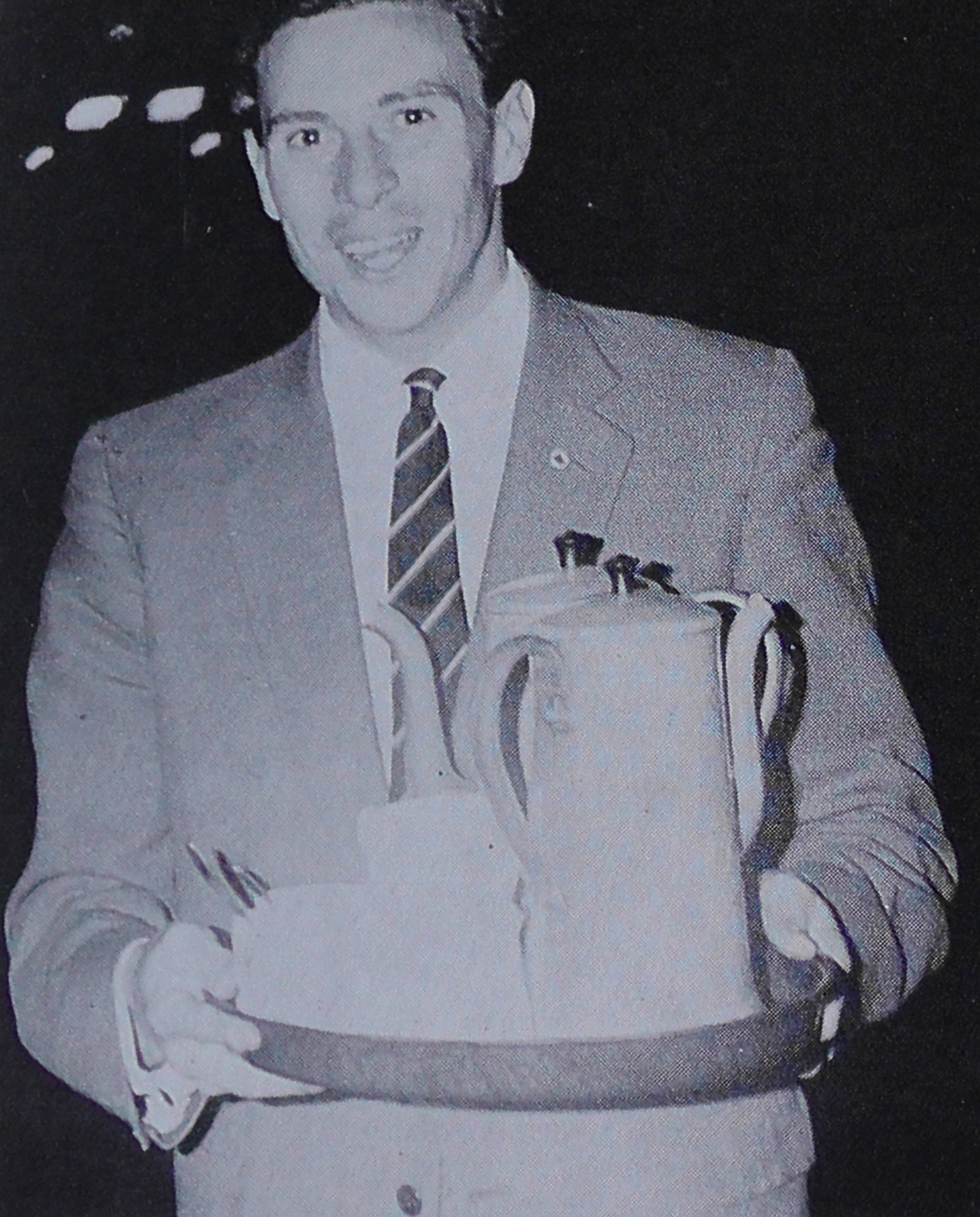
This wasn’t the usual sun-baked French Grand Prix.  Showers muddied the paddock on Thursday, leaving the Wednesday and Friday sessions for grid-shaping;  Taylor, indeed, set his fastest lap on that Wednesday – and on Thursday, in the rain, neither Lotus driver completed a lap.  (One significant casualty that day was Ludovico Scarfiotti, who crashed heavily in the works Ferrari.  He was for the most part uninjured but shortly afterwards would announce his retirement from racing.  Rescinding this a few months later, he went on to win the 1966 Italian GP for Ferrari at Monza.  He would sadly lose his life in 1968, in a hill-climbing accident.  He was a good friend of Jim’s.)

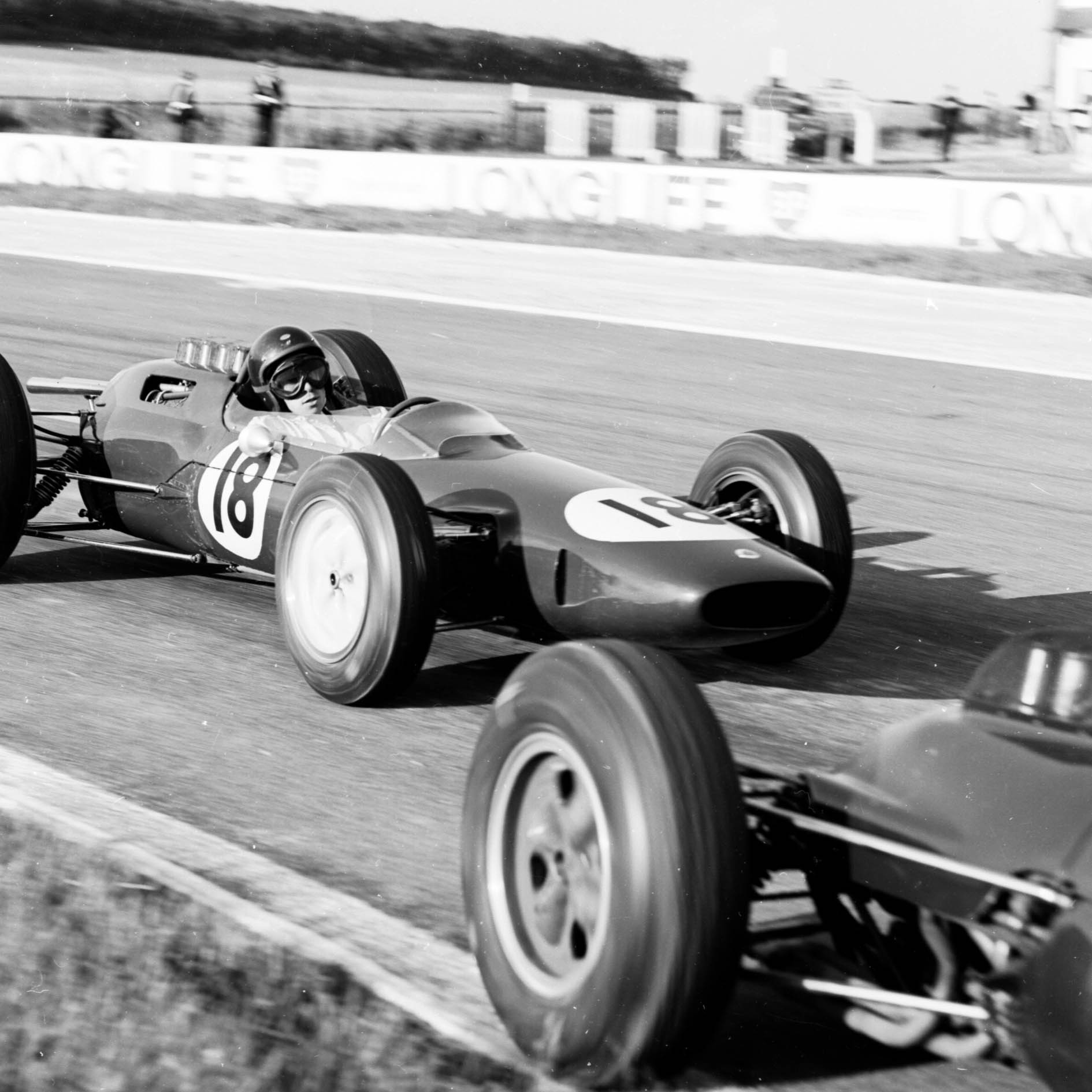
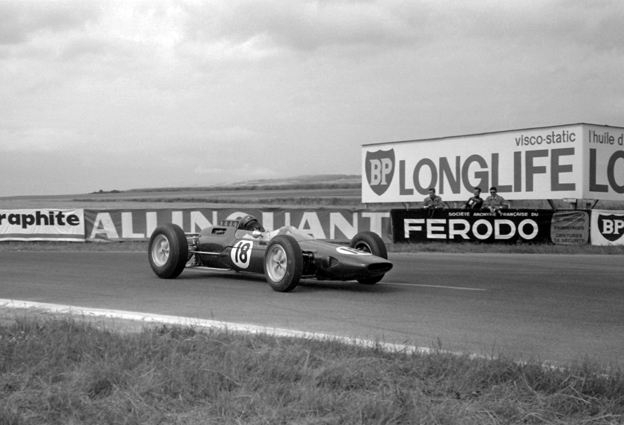
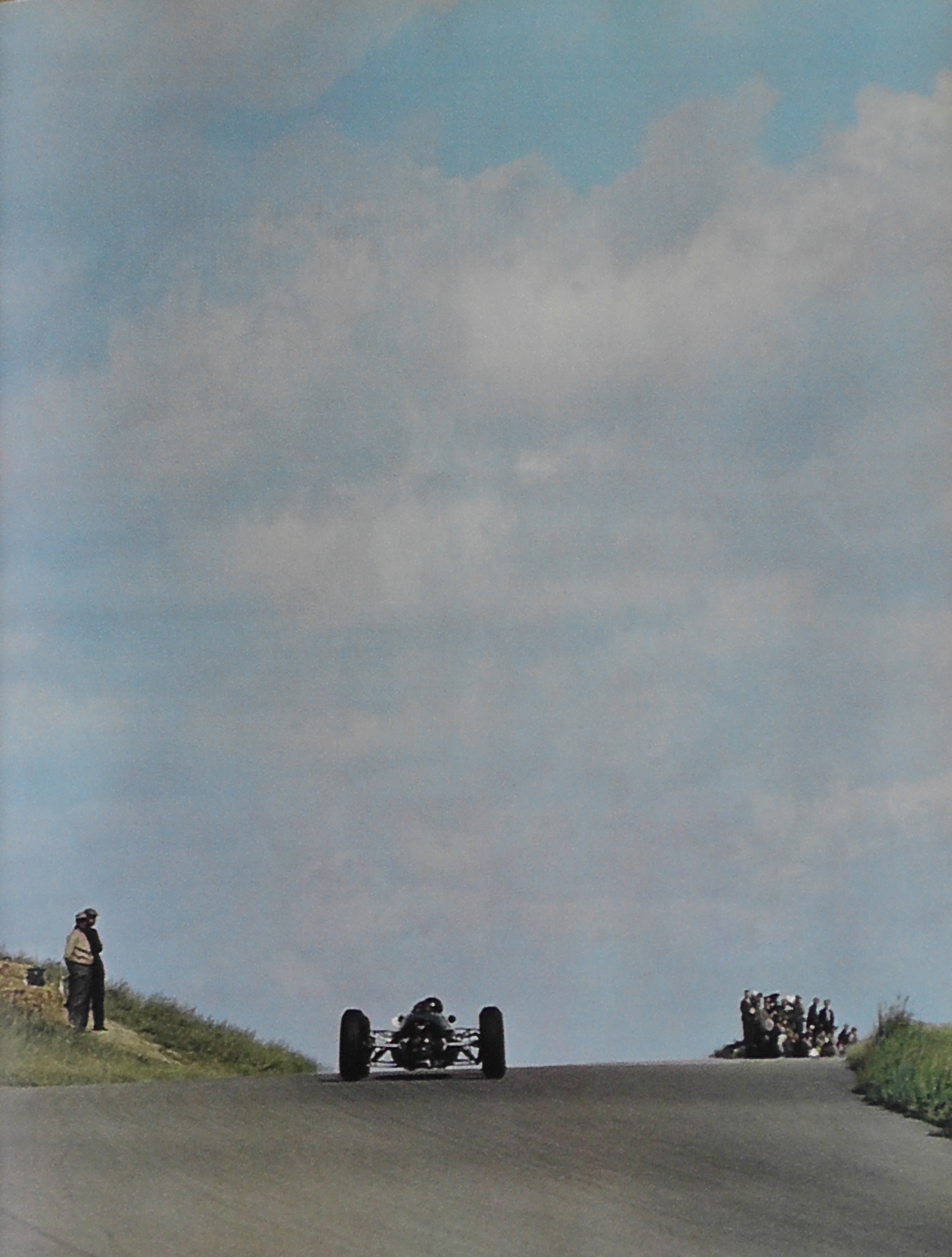
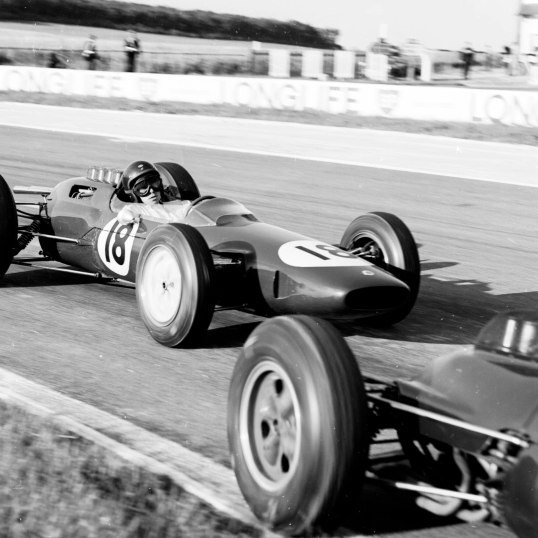
Wet or dry, flying stones were always an issue at Reims, inducing Lotus to revert to standard windscreens for this race.  With the aeroscreen, it was thought, there was always a risk of debris finding its way into the “jet”.  Slipstreaming on the long, ultra-fast (160mph) French public roads could gain you seconds per lap;  the trick in practice, if you were searching for the pole, was to keep your mirrors free.  Despite a considerable straight-line speed deficiency to the BRMs (including Innes Ireland’s BRP-BRM) and also to the Ferraris, Jim took the pole – and the local champagne that came with it.   In the 25, running the same set of Dunlop R6s he had raced at Monaco, Spa and Zandvoort, Jim found a sweetness in the balance on high-speed corners that he had not felt before – or would feel again in 1963.  “I could set the car up in a whacking great drift around the back, keep my foot it it and achieve cornering speeds that I wouldn’t have thought possible,” he would say later.  Very few photographers – if any – seemed to venture out to these corners in those days (they focussed on the “long” shots on the pit straight and the 90 deg right hander leading on to it) so we are left only to imagine what Jim describes as that “whacking great drift”.  To my mind, given the understeer with which he lived at the International Trophy race at May, the 25 at Reims was now far more neutral – neutral leading to oversteer.  I think it’s also probably significant that by this race Team Lotus seemed to have found some sort of fix for their gearbox drams.  Jim, at last, was able to drive the 25 with both hands on his red leather-rimmed wheel.1963 French Grand Prix. Ref-20133. World © LAT Photographic
Saturday was support-race day, which meant big sports cars and Formula Junior.  Jim was at the track, of course, primarily supporting the Normand Lotus 23Bs (Mike Beckwith and Tony Hegbourne) and Peter Arundell in the FJ race.  There had even been talk of Peter racing the third (spare) 25 in the Grand Prix but ultimately it was felt (when balancing prize money against running expenses!) that Peter should race the works (“mini-25”) 27 FJ.  Denny Hulme again won the FJ battle in the works Brabham, pulling away definitively from the second-place slipstreaming group and finally finishing ahead of Peter, Richard Attwood (MRP Lola), fellow Lotus drivers, Mike Spence and John Fenning, and David Hobbs (MRP Lola).  (As the 50th anniversary of the formation of Bruce McLaren Motor Racing Ltd approaches, it’s also worth noting that the talented American, Tim Mayer, finished eighth in this Reims FJ race in one of Ken Tyrrell’s Cooper-BMWs.  Tim and his brother, Teddy, would in the months that follow become an integral part of the new McLaren team.)

Tall and talented Mike Parkes should have won the sports car event with his formidable 4-litre Ferrari but a clutch problem early in the one-hour event effectively handed victory to Carlo Abate (also of powerboat fame) and his 3-litre Ferrari.  Lucien Bianchi (great uncle of Jules) placed third behind Dick Protheroe – and the tough Australian, Paul Hawkins, finished fifth overall with his Ian Walker Lotus 23.  Mike Beckwith had been right up there in third place in the early phase, when Jo Schlesser was leading with his 4-litre Aston, but he fell back a little after a slight “off”.  The small-car class was won by Jose Rosinski, who would go on to become one of the greatest of all French motor racing journalists.

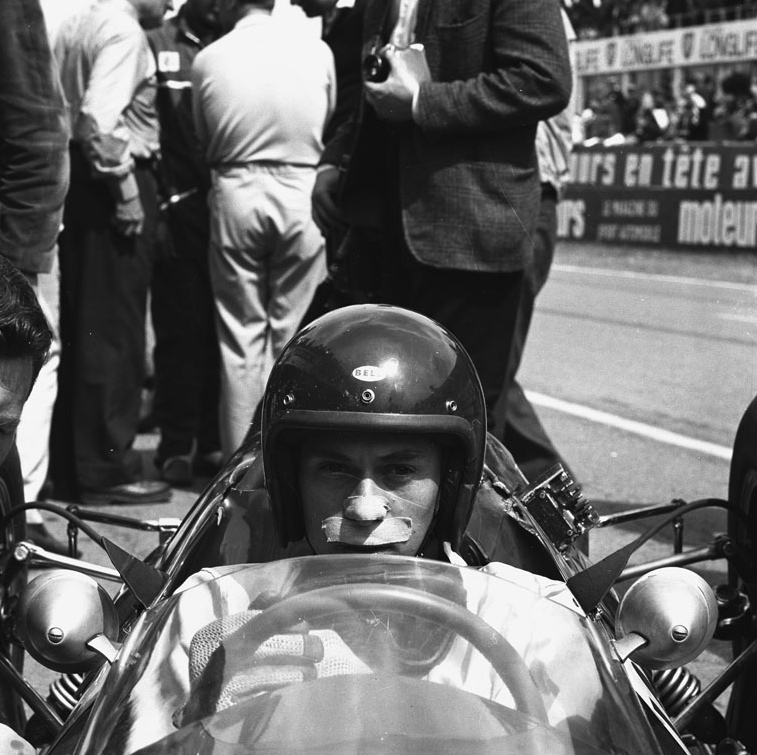
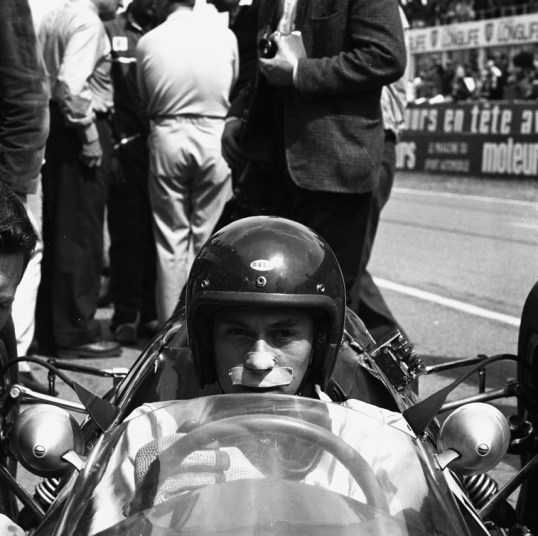
On Sunday – another overcast day – Jim prepared for a torrid French GP as a fighter prepares for a bout, applying white masking tape across his face for extra protection.  Even in the dry, this race would run for well over two hours.

The start, as they say, was the usual shambles.  A fuel vapour lock killed the engine in Graham Hill’s BRM.  Push-starts were forbidden by the regulations…but “Toto Roche”, the autocratic leader of French motor sport and official starter, instructed the BRM mechanics to push Hill’s car nonetheless.  The V8 now revving purely, Roche then quickly stepped away and dropped the flag – except that he dropped a red flag rather than the French national tricolor.   No-one was exactly sure what to do – but they went for it nonetheless.

Jim Clark accelerated hard through the gears to 9,600 (with a max set at 9,800) and then focused on driving the perfect lap:  “Before the race,” he would say later, “I had said to Colin that if I could make the fast corners in front I felt I could open a gap and break the tow.  If I wasn’t in front we agreed that it would be better if I just sat back for a while and let them get on with it…”

Jim was in the lead by the time he reached the first, quick right-hander.  And the second.  And the third.  Full tanks or not, he four-wheel-drifted the 25 with fluid inputs and pin-sharp judgement.  By the time he reached Muizon, the right-hand hairpin, he had free air behind him.  He could forget about his mirrors.ACT
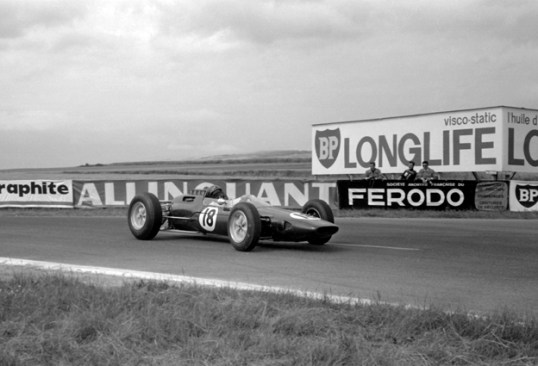
Jim’s standing lap was completed in 2min 31.0sec;  his Indy team-mate and friend, Dan Gurney, lay second a full 2.7sec behind.  Richie Ginther, powered by probably the best engine on the circuit that day, catapulted his BRM up to second place on lap two.  Even so, Jim was leading by nearly four seconds as he passed the Team Lotus signalling board, the 25 sitting on 9,600rpm.

And so it went on.  John Surtees (Ferrari), Dan and Jack (working together in the Brabhams), Bruce McLaren (Cooper), Trevor and Graham Hill scrapped over second place, swapping track space either in top gear, in the tow – or under braking.  At the front, Jim continued to pull away.   By lap 12 of the 53-lap race, he was 19 seconds ahead of Brabham.

Then, for Jim, it all seemed to go wrong.  His Climax engine began to mis-fire at 9,600rpm.  Jim immediately throttled back to 8,000 rpm, where he found a “sweet spot” around which the engine seemed to be half-ok.   He then concentrated even harder on those fast corners but was forced to sit back helplessly on the straights, waiting for the engine to blow – and/or for the next round of bad news on the pit board, for  Brabham was now catching him.  All around the circuit, what’s more, Jim could see parked cars.  Reims was forever tough on all mechanical components – so why was this circuit, on this day, going to be any different for him?

Because on this day – as it had been all week – it would rain.  Jim felt the grease on the track even before his goggles went smeary, for the grooves of the R6s were now worn virtually to slicks.  He was dancing on ice – focussing once again on those fast, very drifty corners where still the 25 felt perfect.  His lap times climbed by ten, 15 seconds;  Graham Hill’s ballooned by 20 seconds.  Maximum revs became irrelevant;  it was all about delicacy.

And so, maintaining that lead, Jim Clark crossed the line, acknowledging Toto Roche’s chequered flag with a raised left arm.  In the grandstands, umbrellas dominated the visage.  On the rev-counter of Jim’s 25, the tell-tale needle sat resolutely at 9,600rpm.  On the work bench later, back in Coventry, Jim’s engine was found to have two broken valve springs.  Trevor (who for this high-speed race, like Jim, raced without a peak on his helmet) might well have finished second had the crown-wheel-and-pinion not failed.  As it was, Graham Hill’s second place was subsequently disallowed due to that push start (subsequently, as in “by the time they got to Monza”.)  Tony Maggs therefore finished an excellent second for Cooper, catching and passing Hill in the closing stages when the monocoque BRM ran into both clutch and brake issues.  Jack took Graham’s third place, with Dan finishing fourth.

Post-race, there was more pandemonium:  a policeman suffered an epileptic fit as he was attempted to clear the crowds from the pit area.  Through the melee, though, Jim and Colin found their way opposite to “the press box”, where they chatted to journalists like Gregor Grant (Autosport), Philip Turner (Motor), Peter Garnier (Autocar) and several of the Fleet Street types.

Thus it was done.  A new era had begun.  Jim Clark and Team Lotus had won three in a row – Spa, Zandvoort and Reims – and had changed the face of Formula One.  The driver lay low in his monocoque car.  The speed, and the suppleness of that speed, was extraordinary.

Next:  the British Grand Prix at Silverstone.FH000006
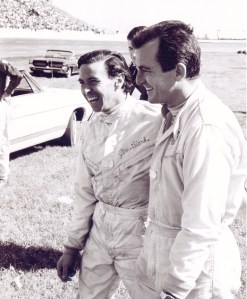
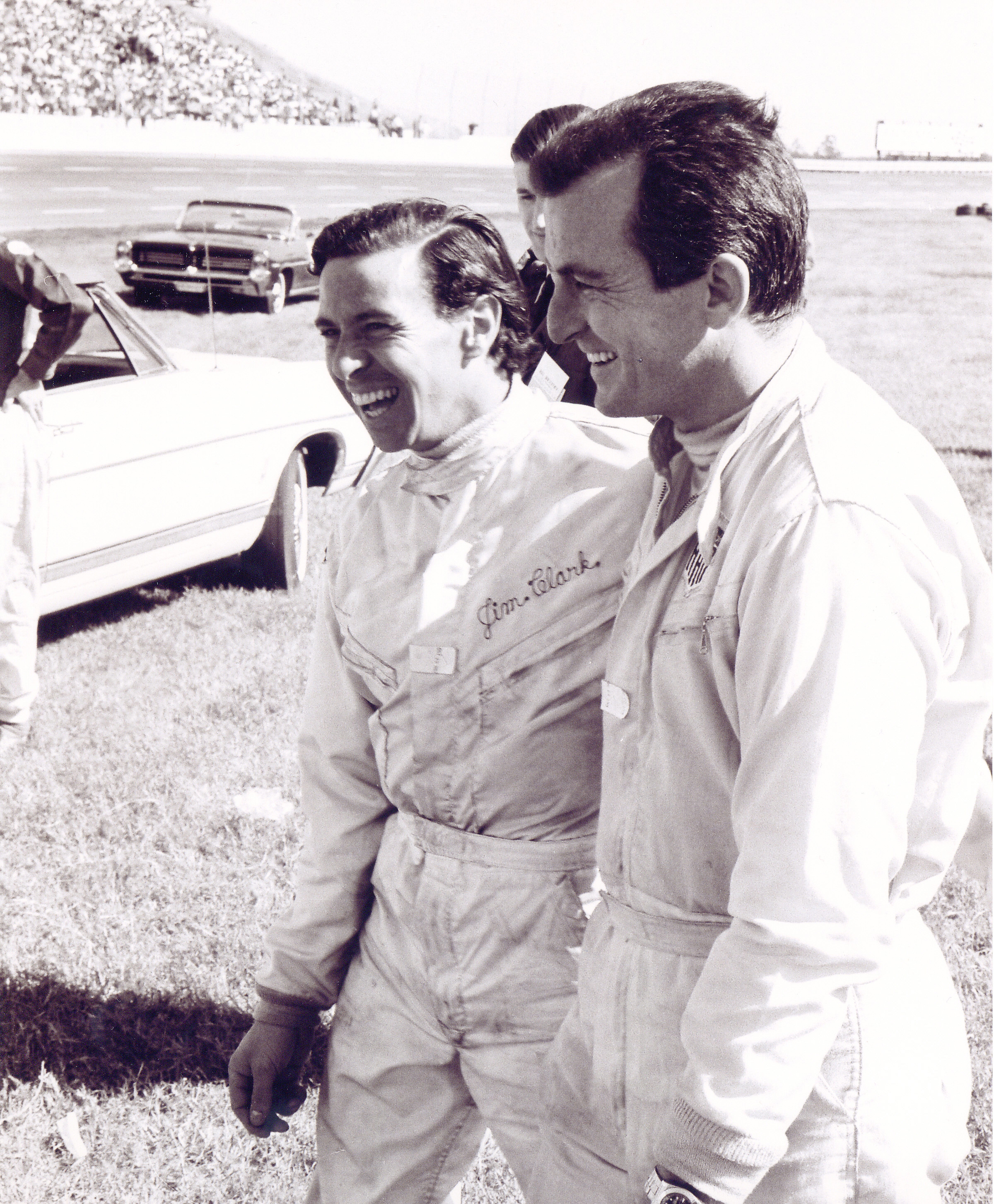
Captions from top: face taped to provide at least some protection from flying stones, Jim Clark readies for battle at Reims;  Reims practice shot of Jim in the aeroscreened 25; for the race, the conventional screen was used.  This was also the last race for a 25 sans yellow stripe; Jim and his friend, Ludovico Scarfiotti, photographed at the Rockingham NASCAR race in 1967  Images: LAT Photographic; Peter Nygaard Collection; Peter Windsor Collection

Artist at work: Jim Clark wins Dutch GP

19618.tifJim’s whirlwind 1963 season continued unabated – even when he wasn’t driving a racing car.  The Belgian Grand Prix had been a relief;  it had been tough and dangerous;  it had been nothing less than the usual forces of Spa.  At last, though, he had scored another F1 Championship win with the Lotus 25 (his last, prior to that, had been at Watkins Glen, the previous October).  At Spa the car had again been excessively temperamental – difficult to set-up and fragile (with the persistent gearbox problems still no nearer to being remedied).  Still, though, he had won with enough margin to be able to back away in the closing stages and to crawl around in the torrential rain.

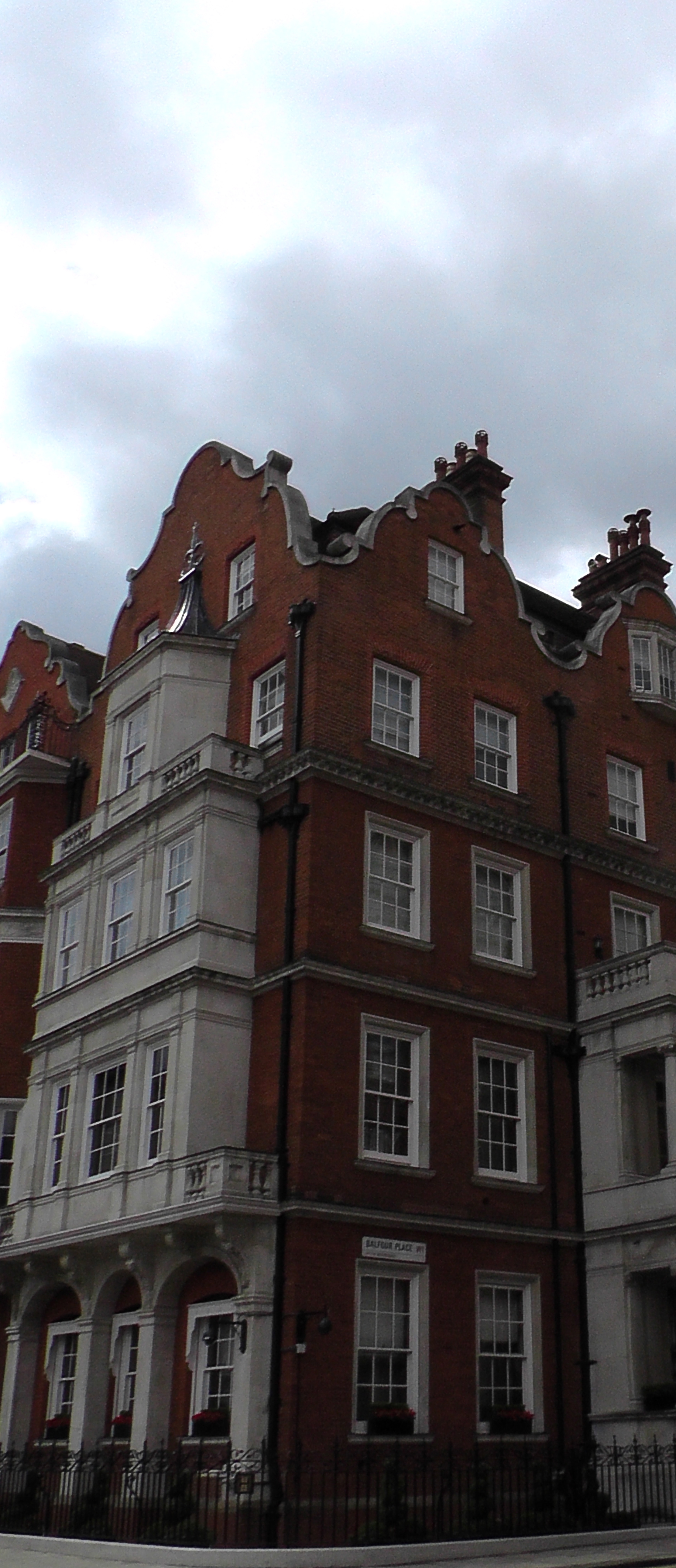
Then came a nice, two-week break.  Jim returned first to London, to Balfour Place, where there was plenty to celebrate with Sir John Whitmore and his new wife, Gunilla, and also with the boys over at Cheshunt.S2600019  There were expense accounts to present to the ever-scrupulous Andrew Ferguson and there was Indy prize money to reconcile.   There was also a new, convertible, Lotus Elan S2 to collect and try.   Painstakingly assembled at the factory, this Elan would be Jim’s transport through to October, 1963.

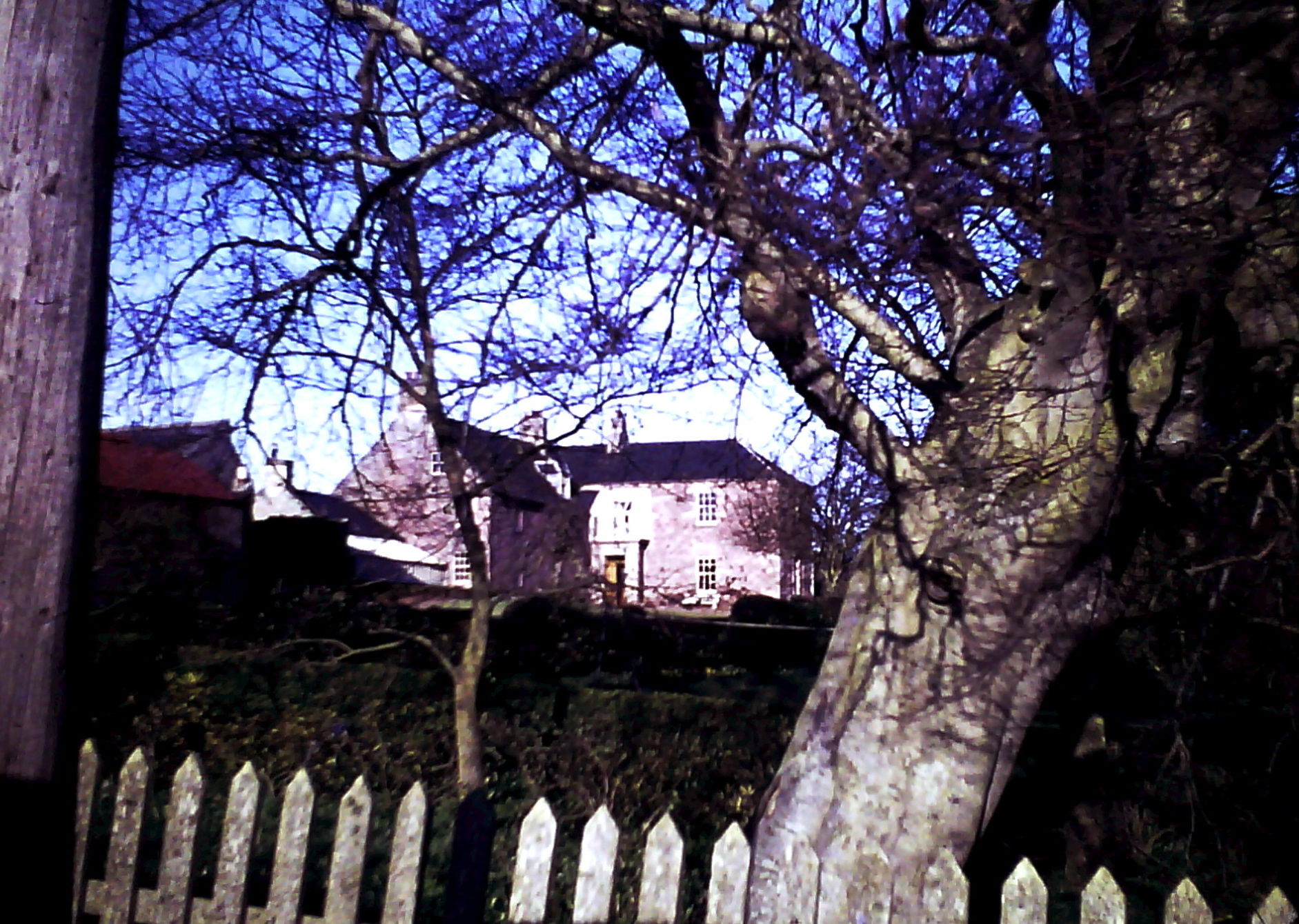
Jim had appointed Bill Campbell to manage Edington Mains but now it was time for Jim to return to the Borders to catch up on the events – farm-related and otherwise – of the past six weeks or so.  More and more, there were additional interviews to be scheduled with local TV, radio, newspaper and magazine journalists.  Ian Scott-Watson, who had already invested £40,000 of his own money in Jim’s career – and was paying his own way to several European events in 1963 – was still very much in charge of Jim’s racing administration.  Graham Gauld, a local motoring journalist whom Jim had respected from the early Border Reiver days, was also in position to start preliminary work on Jim’s autobiography.  And then there were the farm matters.  The lamb sales were looming.  Cast ewes were to be bought.  Silage was in the first cut. Most days, with an interview or Lotus-related meeting scheduled at some point, Jim wore a shirt, tie, sports jacket, flat cap and Wellington boots as he strode around the farm.  Sometimes, if he could relax, he’d leave out the tie.  In short, Jim switched off for a while, although the inevitable Autosport and Motoring News were never far from his desk.  He would have smiled that week at the picture in Autosport of the USAC race official pointing to the oil leaking from Parnelli Jones’ car during his last pit stop and he would have spent a little time, too, reading about the Rover-BRM turbine car that Graham Hill and Richie Ginther would be racing at Le Mans the following weekend.  And, of course, he would have devoured the details of the previous week’s Scottish Rally (won by his fellow-Border farmer, Andrew Cowan).   Andrew and Jim – who were 27 and 26 at that point – had much to celebrate in Duns in the free weekend that followed.08-26-2010_45

All too soon, though, it was over:  ahead lay a Dutch and French Grand Prix double, followed two weeks later by the British Grand Prix.  With Ian driving his own, yellow Elan demonstrator to Zandvoort and then Reims, Jim drove south to travel to Holland with Colin by private aircraft from Panshanger Aerodrome in Essex.8-24-2010 16-55-24_095

A year on from their official race debut, the cars weren’t ready for first practice at Zandvoort – which, from Jim’s perspective, was no bad thing:  as much time as was needed to fix the gearbox problems, Cedric Selzer and the lads could have it.  As it was, Team Lotus brought a mixed bag to Holland:  Trevor Taylor would use a six-speed Colotti gearbox and Jim a modified five-speed ZF. The cars were also fitted with revised versions of the aeroscreen tried at Spa – this time with a larger opening and a steeper flare ahead of the dash.  Jim quickly found that, with the new design, buffeting had all but disappeared;  white helmet peak now confined to his bag (or lent to Dan Gurney!), he could lie even lower in the car.  So Jim raced it.  The 25’s Ultimate Look was almost complete.S2600001

For this race, thinking about the potential for dust and sand, Jim fitted an orange lens to his Panorama goggles, taping the top half, as usual.   He stayed with the team in a small bed-and-breakfast in the little holiday town of Zandvoort and went trampolining with Bruce McLaren on the beach after practice.  The Dutch Grand Prix was being staged later than normal.  The weather was warmer.  The crowds were huge.

Jim tried the Colotti in practice, then switched to the ZF.  He was unsettled to find that it was now jumping out of second gear rather than top.

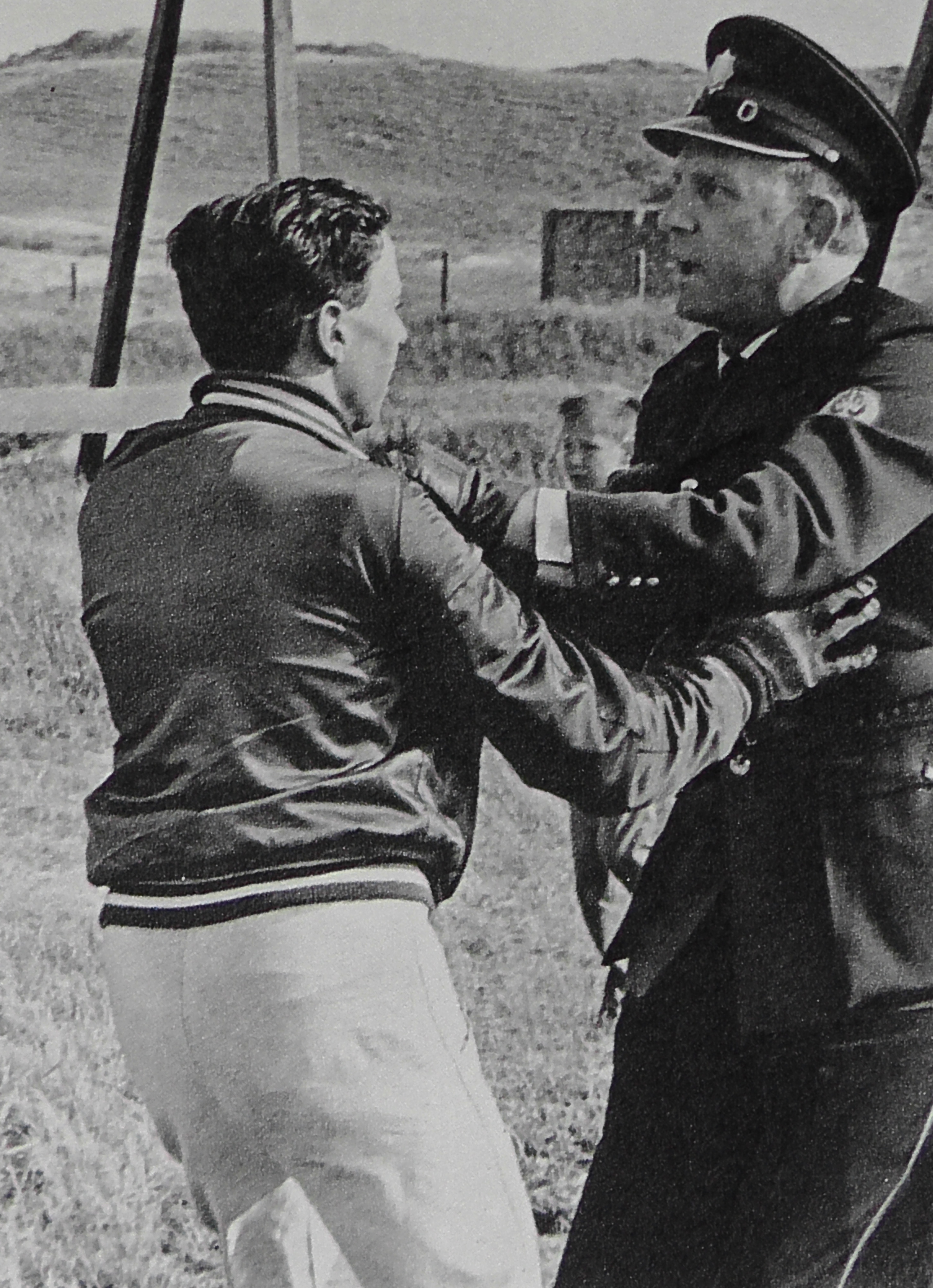
While waiting for his car to be adjusted during Saturday practice, Jim strolled out the back of the pits to watch the action.  Against a chill North Sea breeze, he wore his now-customary Pure jacket over his Dunlop blues and his regular string-backed driving gloves.  There he found his mate, Bruce McLaren, who was also in gearbox trouble with the Cooper-Climax (in this, a “comeback” race for John Cooper, who had been seriously injured in early April when he had crashed an experimental twin-engined Mini-Cooper on the Kingston by-pass).   The two were having a laugh, and comparing notes, when suddenly Bruce was grabbed by a policeman and dragged backwards towards the paddock.  Jim spun around in horror – only to see another policeman heading towards him with about the same step.  The issue at hand:  Bruce McLaren, without his Driver’s pass, was standing where only photographers could tread.  Jim was about to protest Bruce’s innocence when two big hands grabbed him by the Pure jacket and attempted to drag him too towards the shrubbery.  Jim’s Dunlop overalls were torn;  and a large crowd swarmed around, all shouting at the policemen to stop. S2600002 Jim had the correct pass! It was there, visible inside his jacket!  In time, there was little the police could do.  It took a reminder that Zandvoort was about to receive the GPDA’s “Best Organized” award, however (as voted by the members at Monaco), for Bruce to be released.

Although the story of Jim Clark’s Dutch GP weekend is thereafter a story of complete domination, of total command, there was, of course, another side to it: Jim felt that the revised Dunlop R6s brought to Zandvoort were an improvement but still he couldn’t persuade the 25 to handle well on both fast corners and slow:  although he headed every practice session and took the pole by 0.6 sec, he had to nurse understeer at Tarzan and – more importantly, at Hunze Rug, where the slow, downhill left-hander was followed by a long acceleration run through the sweepers.  Even so, he led the race from start to finish, lapping even Dan Gurney, who finished second for Brabham.  The sun shone, sand swirled – and still Jim drew quickly away from the pack.   His was a race of supreme concentration, for there was no-one around for him to race.  It was two hours, nine minutes of lone, artistic brilliance.S2600004

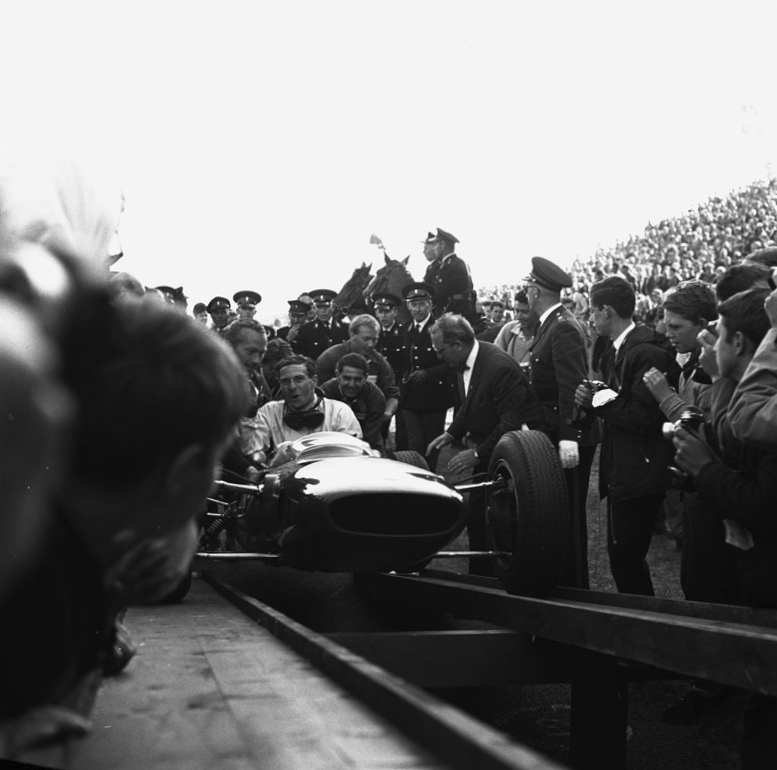
Justifying that GPDA Award, the Dutch organizers did a nice job with the post-race celebrations, ushering Jim and the 25 up between the crowds onto a trailer, where the new Championship points leader could be acknowledged by the fans opposite in the packed, signature grandstand.   Jim’s policeman friend from Friday reluctantly helped with the crowd control – but then had the last word when by preventing both Jim and Colin Chapman from entering a studio for post-race radio interviews. No-one dared ask why.

In another part of Europe, meanwhile, on this day in June, 1963 – on Hockenheim’s OstCurve, in Germany  – Heinz Schreiber was killed when his BMW slid into the trees.  In the aftermath, no-one even thought about the erection of guard-rails or of any sort of protective fencing.S2600003

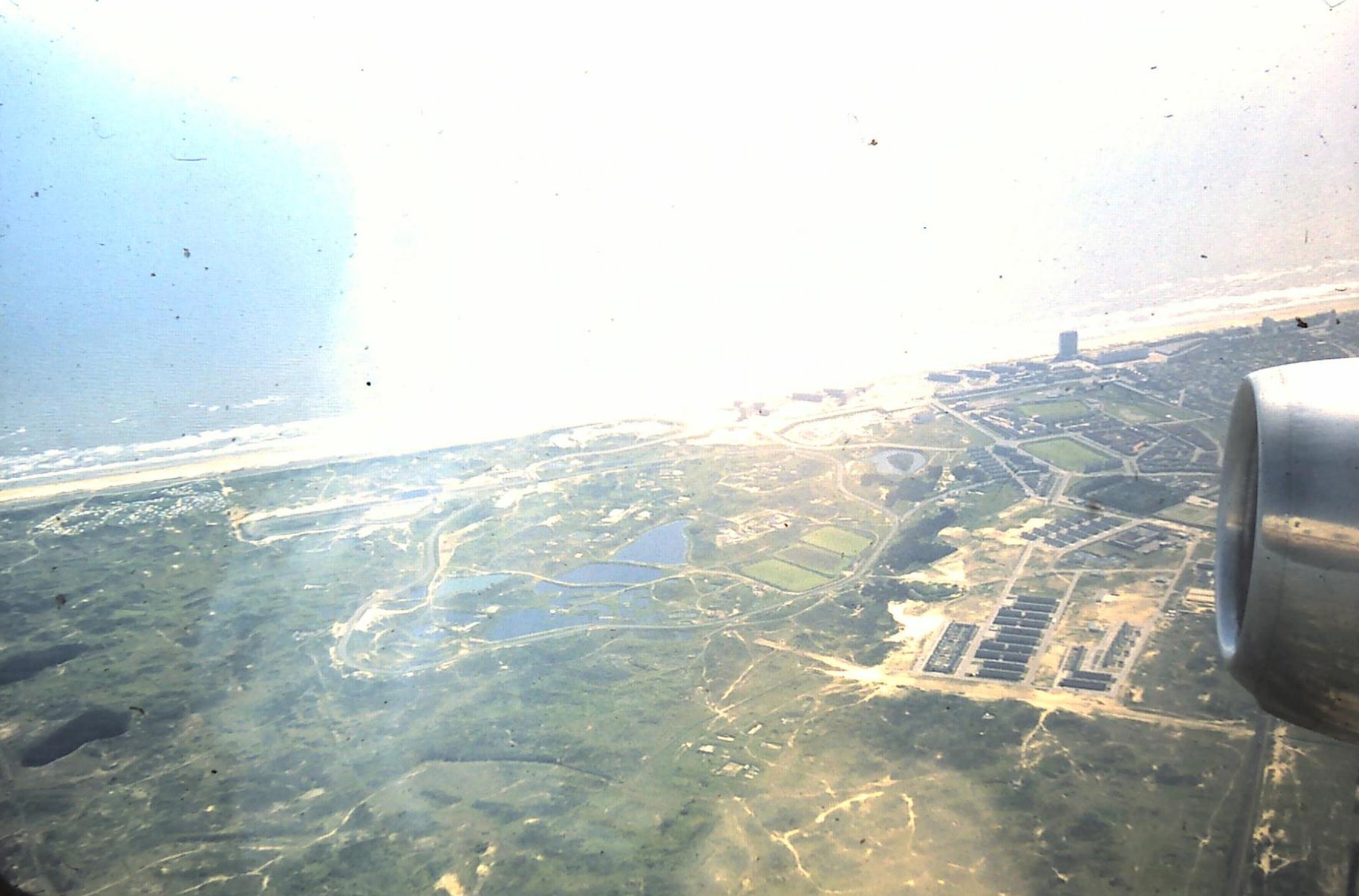
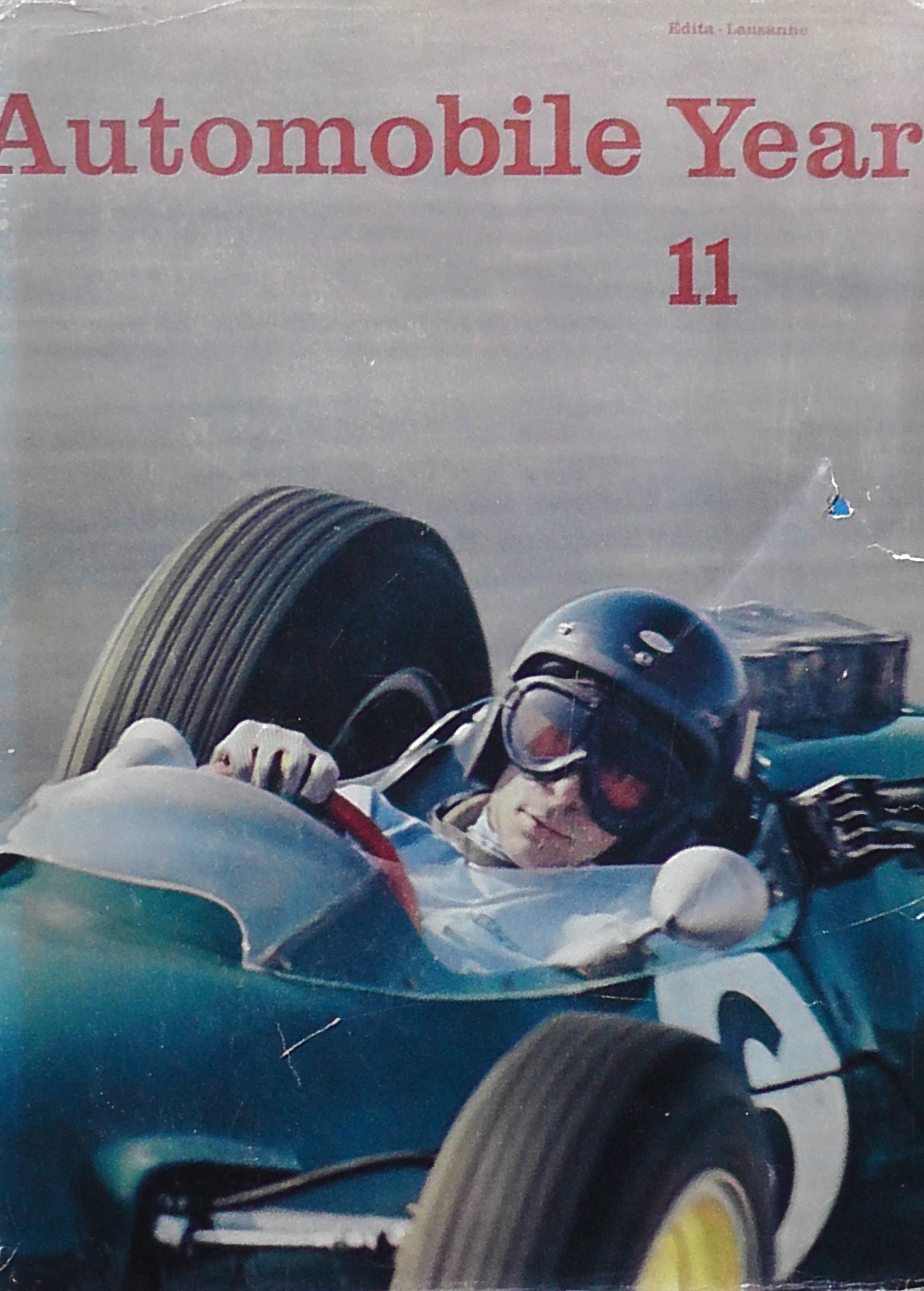
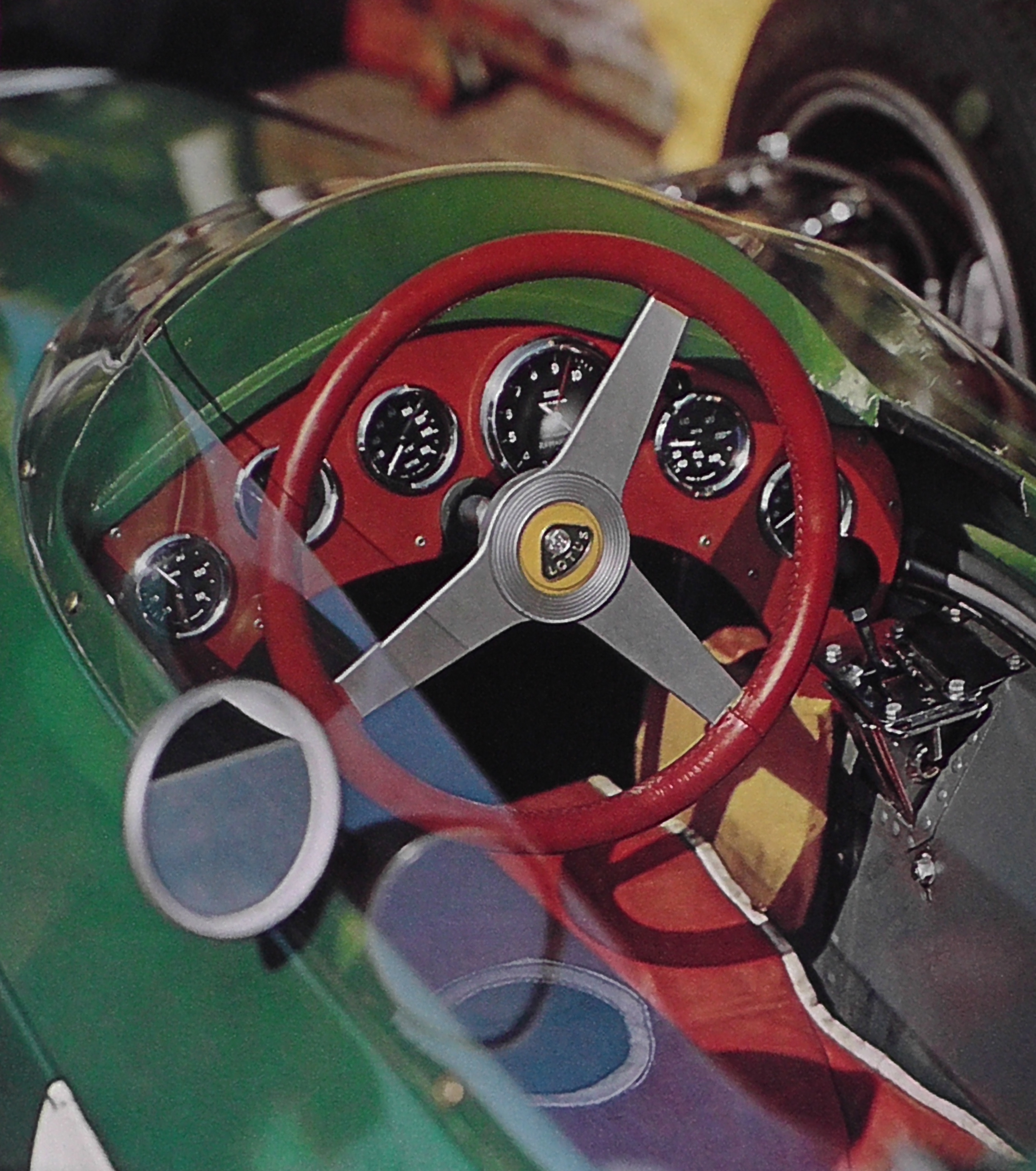
Captions (from top): Jim glides the 25 up the ramp for victory celebrations.  Note Cedric Selzer by left-rear Dunlop;  top-floor flat, 8 Balfour Place – Sir John Whitmore’s London pad, as frequented by Jim Clark.  Rob Slotemaker, the Dutch trickster, once completed a perfect 360 within the confines of this narrow road, much to the amusement of  Sirs Whitmore and Clark; Edington Mains as I photographed it in 1967; Zandvoort in 1967, as I saw it from a Boeing 707; Jim’s Dutch GP win, with all its aesthetic perfection, was perfectly-captured on the cover of the 1963 edition of Automobile Year; Jim and that famous scuffle; the 25’s cockpit also set timeless artistic standards; in a world of his own – Clark at Zandvoort, 1963; below – Saturday night, and Jim returns to the track after dining in Zandvoort.  The boys needed some coffee! Images: LAT Photographic, Peter Windsor CollectionS2620007

Alain Prost – racing driver

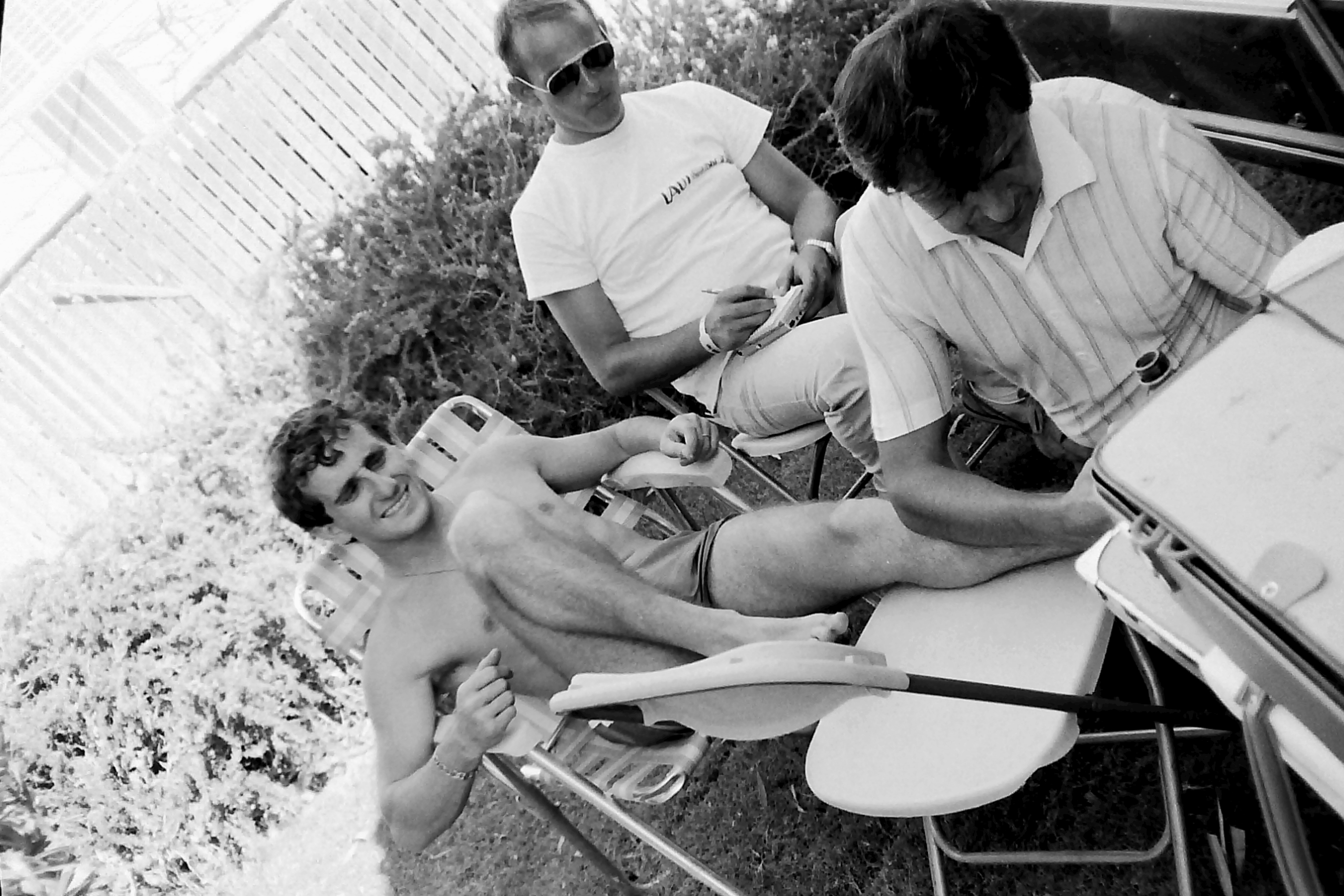
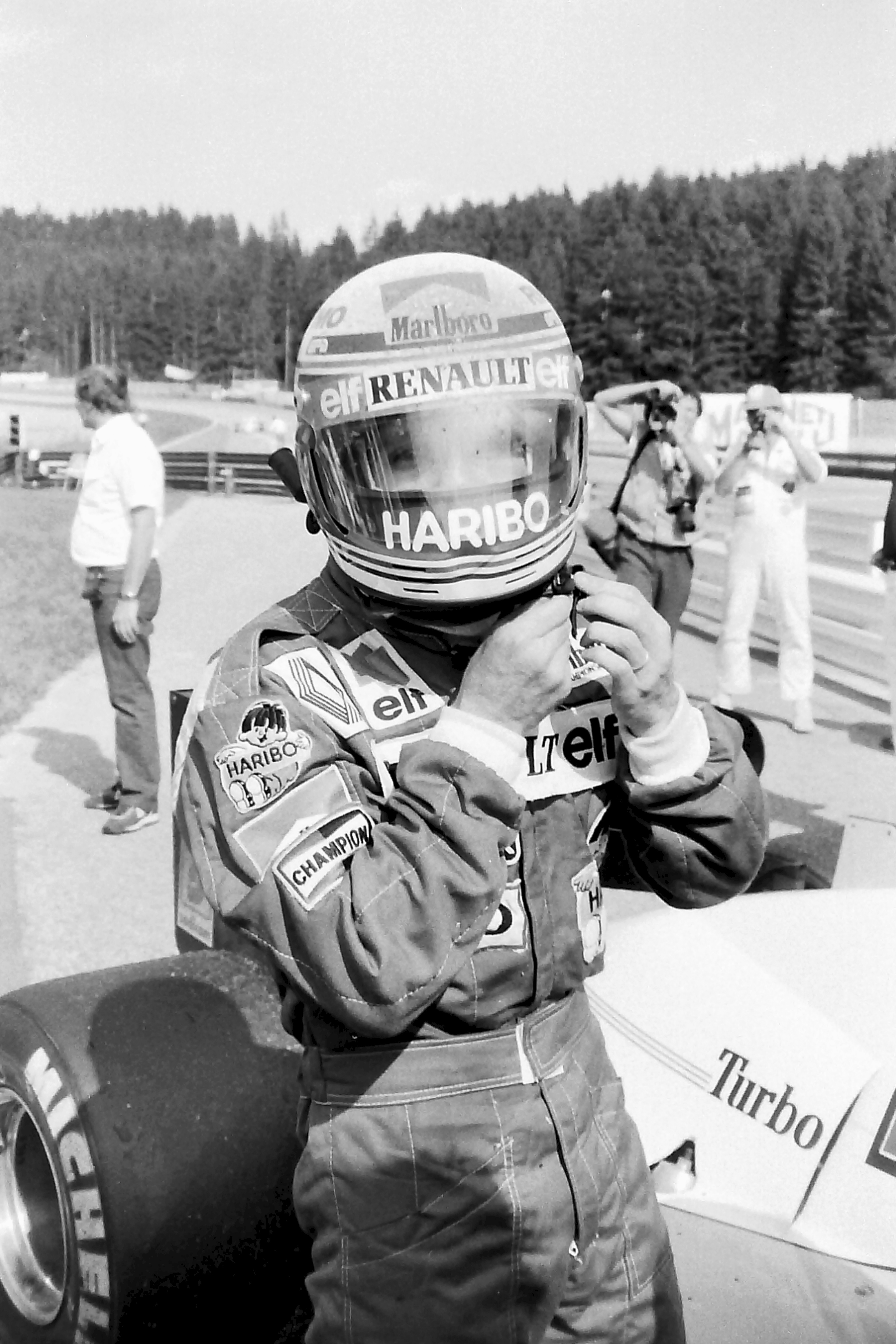
06-15-2013_10On our YouTube Channel (http://youtube.com/peterwindsor) you will find a short conversation I had today with Anthony Rowlinson, Editor of F1Racing magazine.  We speak about The Verdict (enough said!), about the gentleness of Murray Walker – and about Renault’s new F1 engine (correction: “Energy Power Unit”) for 2014.  Fresh from the creative RenaultF1 press conference at Le Bourget, at the Paris Air show, Anthony reported that Alain Prost believes that efficient cornering is going to be even more important from next year onwards, which prompted me to suggest that some teams could do a lot worse than to employ Alain again as a driver.  I joke, of course, but the topic is a vivid reminder of how good Alain used to look in Renault turbos in the early 1980s;  and this, in turn, induced me to scan another neg or two.  The first is of Alain receiving some routine physio after a practice run at Imola in 1983.  There were no closed doors or darkened windows back then;  on the contrary:  here was a chance to do a bit of sun-bathing.  I particularly like this photograph because there in the background, interviewing Alain, is one of my favourite F1 writers – the French journalist, Gerard Flocon.  Gerard used to write for the fabulously thick and glossy L’Automobile and was both astonishingly productive and studious in the way he went about his business.  It was daunting, indeed, for someone like me to see just how much work was involved if ever I was to have a hope of becoming someone like him.  The other shot is one I took of Alain unfastening his GPA helmet a few seconds after winning the 1983 Austrian GP for Renault Elf.  I was a huge Prost fan, I have to confess – right from the days when he dominated the European F3 Championship.  I got to know him well during his first McLaren years and we spoke a lot, back then, about the ins and outs of his switching to Renault.  I don’t know for sure if Alain is smiling right at me in this photograph, but I like to think he is.06-15-2013_40 

Post Navigation