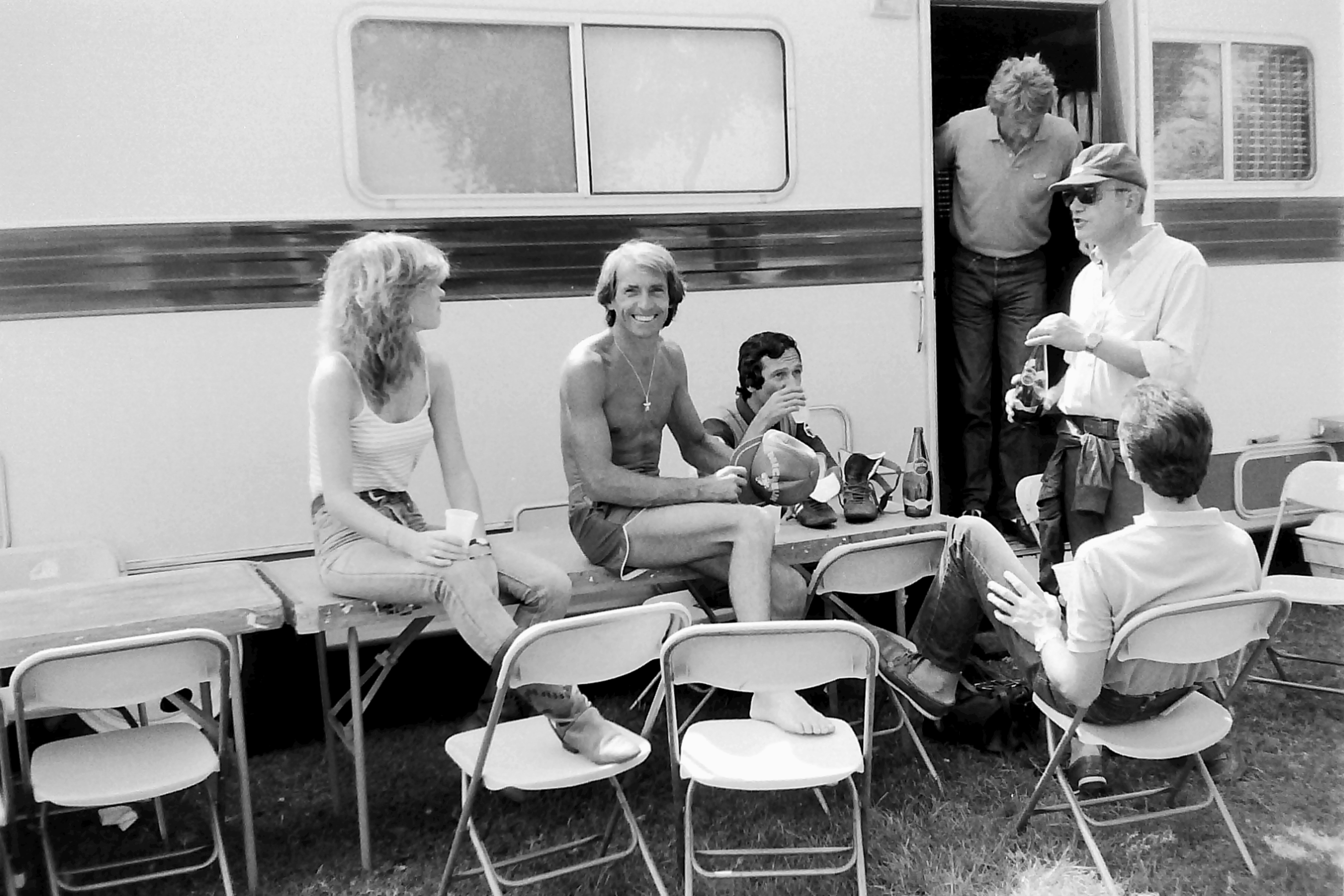
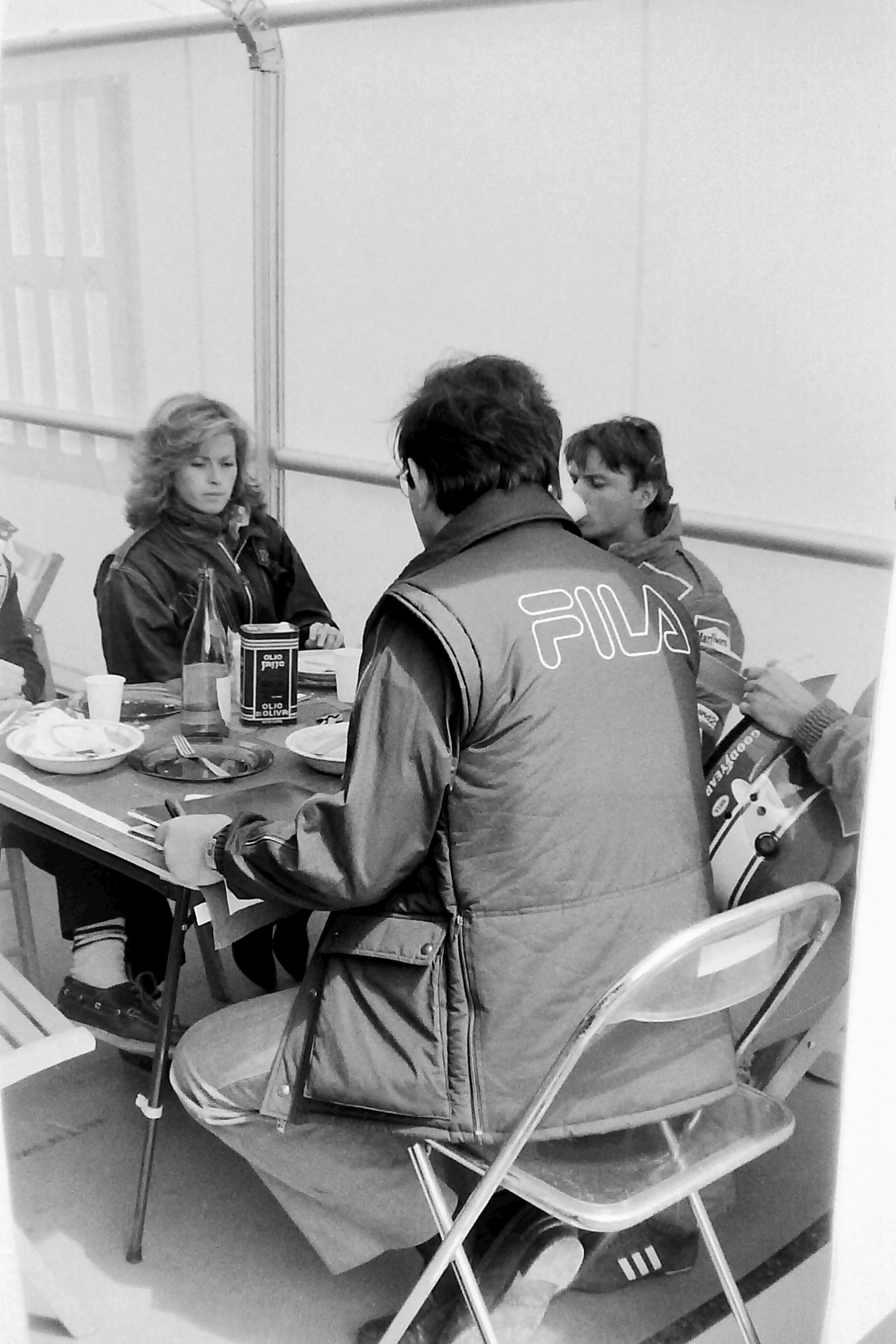
Here’s the Gitanes Ligier team de-brief at Imola in 1981. The excellent Jacques-Henri Laffite is having a laugh, as ever, and that’s his team-mate and brother-in-law, Jean-Pierre Jabouille, stepping out of the “motorhome”. Jean-Pierre was very into Supertramp, as I recall. And I think that’s the team’s sponsorship/PR manager, Danny Hindenock, with his feet up on the chair. Danny I believe was the first guy to wear Timberland deck shoes in F1. Quite a breakthrough in the style department. That may be the F3 comingman, Philippe Alliot, having a drink, and the gorgeous item on the left is Rene Arnoux’s girl-friend, Pascale. Not sure what she was doing there with the wrong team, but I’m sure Jacques Laffite had everything under control. Just for good measure, here’s another picture (lower, below) of Pascale, this time (1983) where she should be – having lunch with Rene and Mauro Forghieri under the Ferrari truck awning. Note Patrick Tambay’s helmet on the right of the picture and the Timberland sneaker on the left…
It was Spa – the old Spa. And it was wet. Atrociously wet. Thus Jim Clark scored his first World Championship win of 1963
And so they went to Spa. Jim traditionally stayed at the Val d’Ambleve near Stavelot and did so in 1963: the 25s would be towed to and from the paddock area every day. Jim flew with Colin Chapman and Trevor Taylor on D-Day, June 6. The Ardennes forest had nineteen years before been ablaze with the Battle of the Bulge. Practice at Spa would begin on Friday.
In the Clark track bag: his new, dark blue Bell Magnum helmet and rounded bubble visor Bell had given to him at Indy. All previous visors used by Jim had been attached to his Herbert Johnson or Everoak helmets by a crude strap and a single stud. After last year (1962), when the rush of air down the Masta straight had actually loosened Jim’s regular white helmet peak, obliging him to rip it off one-handed whilst winning the race, Jim was delighted to see that the new Bell visor was fastened by three big pop-on studs. With rain always on the agenda at Spa, this would be the perfect try-out. Left in the bag, therefore, was the white Bell peak he had used at Indy, Mosport and Crystal Palace (ready for Dan Gurney to borrow!). If it was dry, he would just run the helmet without the peak. If it was wet, and providing he liked it in practice, he would try the bubble visor.
Lotus had another airflow development, too: Colin’s latest idea involved a a large opening at the front of the screen and a lip on the cockpit surround. This would channel air up and over the driver, reducing buffeting and allowing the windscreen to be cut lower, thereby improving visibility. Again, the high-speed Spa circuit was the obvious venue on which to try the new device. In the dry, in 1962, Jim had won at an average of 133.98 mph – this on a lap that included a 40mph mid-corner speed at La Source hairpin. With more power from the flat-crank Climax, more grip from the Dunlop R6s and some significant re-surfacing, lap speeds – and top speeds – would be higher still in 1963.
It is hard to imagine today what it was actually like at Spa back then – out there on the old circuit, on a thin ribbon of public road bordered by such routine items as telegraph poles, phone boxes, concrete marker posts, sheer drops, clusters of trees and stone-walled houses. The drivers didn’t wear seat belts; the cars rattled and shook; and Jim, in the monocoque Lotus 25, was lying at about 25 deg to horizontal, his rear-vision mirrors right back near his helmet line so that he had some sort of angle of view. To see clearly in them, however, he had to turn his head consciously from side to side. This was another reason he avoided the helmet peak for Spa.
The right foot was held flat, hard down on the throttle, for minutes on end, even though the road was in reality only straight into and out of La Source, down the hill past the pits and on the sections of road immediately before and after the famous Masta kink (which was also taken flat in fifth – or sixth if you were a Ferrari or Richie Ginther trying BRM’s new six-speeder). The rest of the time, the drivers were threading their F1 cars through the needle, using all the road, accelerator against the stops. The lap length was 8.76 miles and the lap time was just under four minutes – or just over it, if you were Phil Hill in the new, disastrous, ATS, or Tony Settember in the new American F1 entry – the Scirocco-BRM.
After the simplicity of of the 23 at Crystal Palace, the 25 around Spa initially felt appalling. The high-speed oversteer was frightening…and still the dreaded ZF transmission kept jumping out of gear. Mid-corner.
Adding to the feeling of foreboding on the circuit that Jim had hated since his first appearance there, in 1958, when Archie Scott-Brown had lost his life, and then 1960, when both Alan Stacey and Chris Bristow had been killed in Jim’s second F1 race, Trevor Taylor was also in trouble in the second 25. After finally discovering that his car had been running only on two-thirds throttle at Monaco and then in first practice at Spa, Trevor would be dispatched from the pit lane on Saturday with a rear suspension bolt still lose. Unsurprisingly, he crashed heavily when the rear wheel suddenly canted inwards. A stone marshals’ post took the impact; Trevor, amazingly, was able to step free with a badly torn thigh muscle. Hero that he was, Trevor still started the race on Sunday in the spare 25.
Jim’s car felt little better on Saturday. I think this was one of the first examples of Jim not giving 100 per cent until he really needed to do so: Spa was dangerous enough as it was without having to stretch the limit in practice. He would always give his maximum in the race but in practice, until he was comfortable, particularly at Spa, he would leave some margin. As a last resort, as it turned out, Cedric Selzer and the boys fitted to Jim’s car the gearbox from Trevor’s crashed 25.
In between times, Jim tried the new aeroscreen (which he liked) and the bubble visor (which he didn’t); it’s convex shaped distorted his peripheral vision. He would revert, wet or dry, to his regular Panorama goggles and he would try the aeroscreen again at Zandvoort, at the Dutch GP.
Jim qualified only seventh at Spa after those two days of practice. Graham Hill was on the pole for BRM, with Dan Gurney alongside him in his new Brabham. Then, third quickest, came the fiery Belgian, Willy Mairesse, playing the number two role to John Surtees at Ferrari. They formed up on a wet track.
As at Indy, I can do no better now that to hand over to Jim himself, this time as told to Graham Gauld in Jim Clark at the Wheel:
“I was right behind Willy on the grid. This set me thinking that he was inclined to be exuberant, to say the least, and that in his home race he would be rather anxious. I reasoned that a combination of an anxious Willy trying to take a Ferrari off the line in the wet at Spa was going to be exciting and that he might not take too good a job of it. I knew that if I got a good start I would have to take him on the pits side even if it meant going across the yellow baulk line. All this ran through my mind, sitting there, so that by the time the starter had raised his flag I had the Lotus on right lock and the clutch ready to bite. The flickered and came down, I let in the clutch with a bang, scooted forward and to the right of Willy, who, as I thought, was standing still with spray being sent up in the air by his spinning wheels. He just stood there without moving an inch. Mine was a legitimate start, but I didn’t expect, in my enthusiasm, to lead everyone away from the start from the front row but this is exactly what happened. As I went into Eau Rouge I glanced in the mirror and saw Graham Hill grimly on my tail and just pressed on. As I said earlier, it was wet and I enjoy driving in the wet, but, after all, this was Spa, and I kept well within my limits.
“At the end of the opening lap Graham was still on my tail but I didn’t know until later that we had both left everyone else behind and we had a ten-second lead. We stayed this way for quite a while and then I began to get the old gearbox trouble again. It started dropping out of top and on Spa this is not funny. You wind the car up to, say, 9,500rpm on the straight when suddenly all hell is let loose and you make a grab at the lever and pull it back into gear before you put the revs right off the clock. Once this happens you start waiting for it to happen again. By now, the problem was becoming acute. Here I was, with Graham Hill still on my tail, with a gearbox which threatened to do something nasty at any moment. I decided to drop 300rpm through the Masta kink for safety’s sake but I was still doing about 150mph. This meant that, as I approached the kink, I would be holding the gear lever in place with my right hand and moving my left hand down to the bottom of the steering wheel. I did this because the car has a nasty tendency on this kink to move from one side of the road to the other and I often needed correction. By keeping my hand low on the wheel I could twirl the steering wheel round with one hand and hold the slide – but doing this for lap after lap was not funny.”
Jim still retained the lead. Graham Hill faded and then retired. As another precaution, Jim began to take fifth gear corners in fourth, luxuriating in the feel of being to hold the wheel with both hands.
Then, in true John Frankenheimer fashion, the rain grew more intense. Visibility disappeared. Standing water drowned the valley. Jim added a full three minutes to his lap times..but still pulled away.
This is how Bruce McLaren described the downpour in Autosport the following week:
“The rain was bouncing two or three feet off the road. We were crawling around in the spray – and, for once, it was just as bad in the pit area, so the crews could appreciate how bad it was on the rest of the circuit. The mechanics were sheltering under their signal boards but, with two laps to go, I saw mine pointing excitedly down the road in a fashion that said ‘you’re catching someone. Get with it!’
“So I got with it, and, in another half lap, I could make out two huge palls of spray – two racing cars ploughing along in front of me. There was so much spray that it was hard to tell how far they were ahead, but I knew that one would be Jim, who had lapped me earlier, and I guessed that the other would be the second-place man, Dan in the Brabham. As I got passed the first conglomeration of steam and spray I was that indeed it was Dan. I passed Jim further up the hill, just in case that it was him that my pit had been referring to, but by now he had backed off considerably, so I guessed that it wasn’t. By passing Jim I gave myself an extra lap to do and he received the chequered flag behind me as I went on to complete the lap and take second place.” (This result actually put Bruce into the lead of the 1963 Drivers’ Championship and Cooper on top of the Constructors’ table.)
Bruce began that column thus:
“Relaxing on one of those after-race mornings with a cup of coffee on the patio of our hotel at Stavelot” (Jim’s hotel) “with the sun shining brilliantly and the birds feeling like Jim Clark and consequently singing…it was difficult to imagine that the previous afternoon we had driven though the worst thunderstorms I’d ever seen, let alone raced in.”
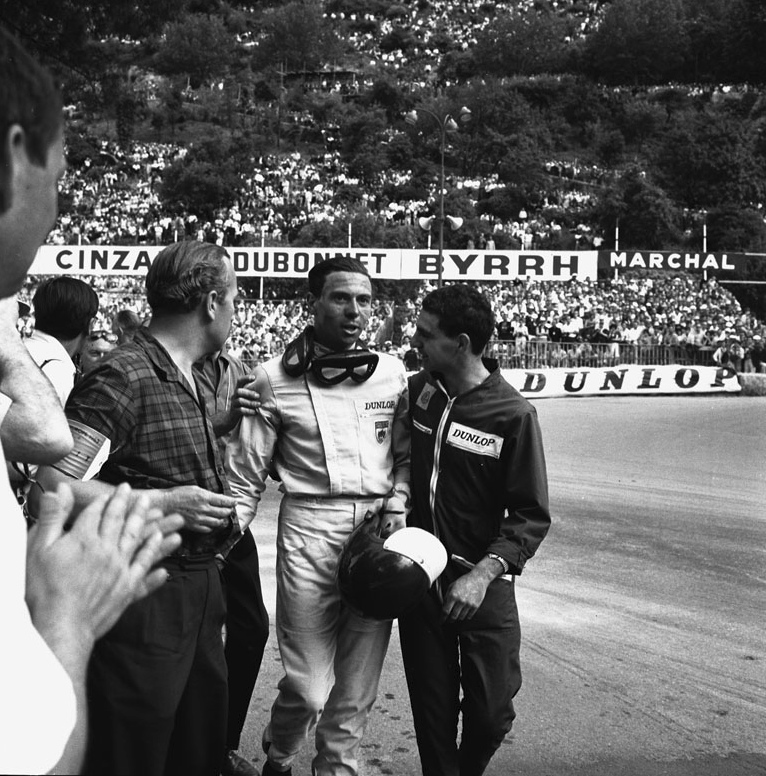
Jim was relieved to win – relieved to have survived. Both Tony Rudd (BRM) and Chapman (of course) had pleaded with the organizers to stop the race; Rudd had even sprinted across the track in order to speak to the Clerk of the Course face-to-face. Their requests had been denied. Jim stepped from the 25 smeared in oil, his blue Dunlops sodden. He quickly changed into dark chinos, a polo shirt and his Pure jacket (never mind the Esso sponsorship!). On the podium, up above the old pits, by the control tower, his wet hair slicked backwards, he cradled the traditional Spa bouquet. This was the first Grand Prix he had won more than once. A cup of tea – in the Esso caravan, of course! – was very much in order.
Zandvoort, two weeks later, was next on Jim’s agenda. There was at last time to return to London for a couple of days of fun – and then to see what was happening up on the farm.
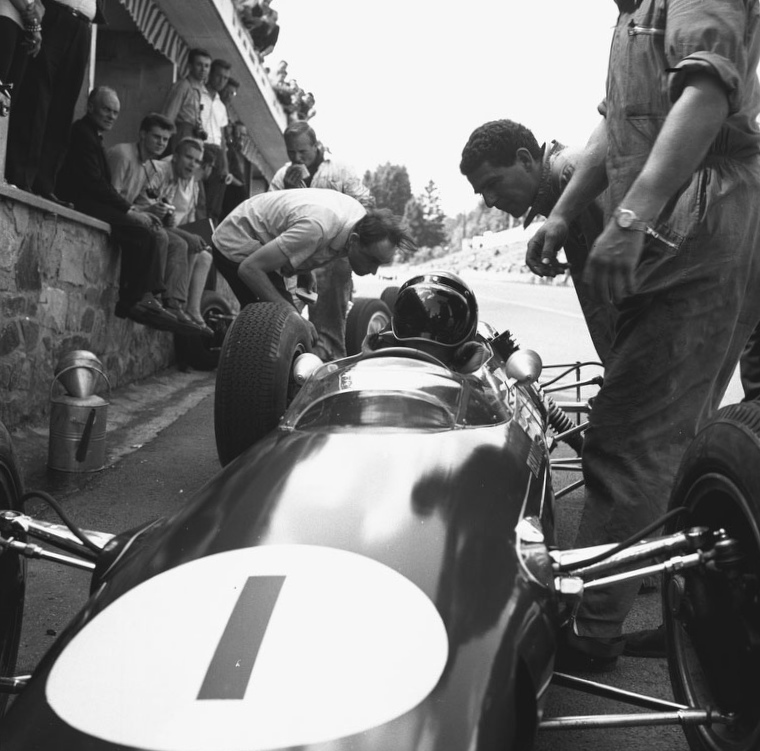
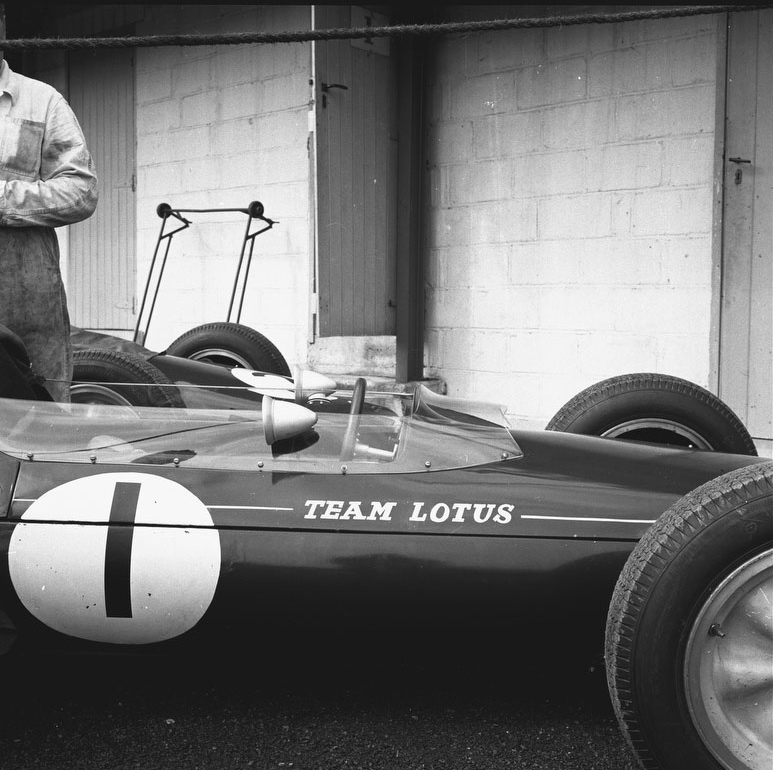
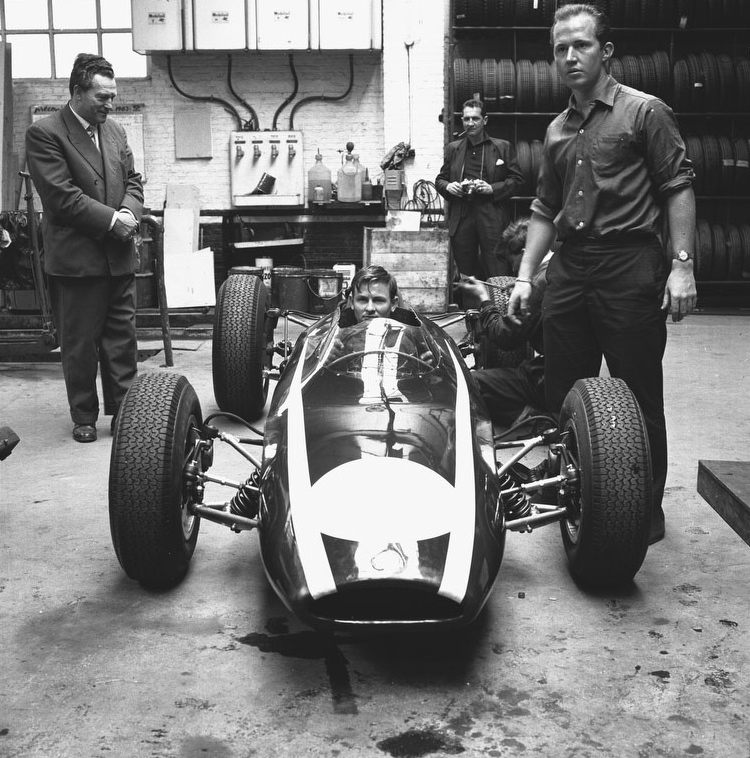
Images: LAT Photographic; Peter Windsor Collection Captions from top: Jim streams past the pits in the late-race deluge; the Val d’Ambleve as it is today – little changed but for a very nice-looking timber extension out the back; Jim tried the Bell Bubble and the new aeroscreen during dry practice; another shot of the new visor/windscreen – note the carburettored spare 25 in the background. Trevor Taylor would race this after his practice shunt; side view of the new aeroscreen – note thicker, rather odd-looking “Team Lotus” signwriting, probably a result of this entire new top section being prepared in a rush at the factory; while Jim Clark began a long streak of peakless races at Spa, Dan Gurney used a standard Bell white peak in this race instead of his regular black; the exit of the Masta kink as it is today; modern F1 drivers, if they do see the old circuit, cannot imagine that this was a part of it all; Bruce McLaren and the Cooper team in their Stavelot garage on a practice night. That’s Eoin Young on the right: Eoin was Bruce’s right-hand-man and Autosport ghost-writer. Now retired in his native New Zealand, he became one of the world’s pre-eminent motoring journalists
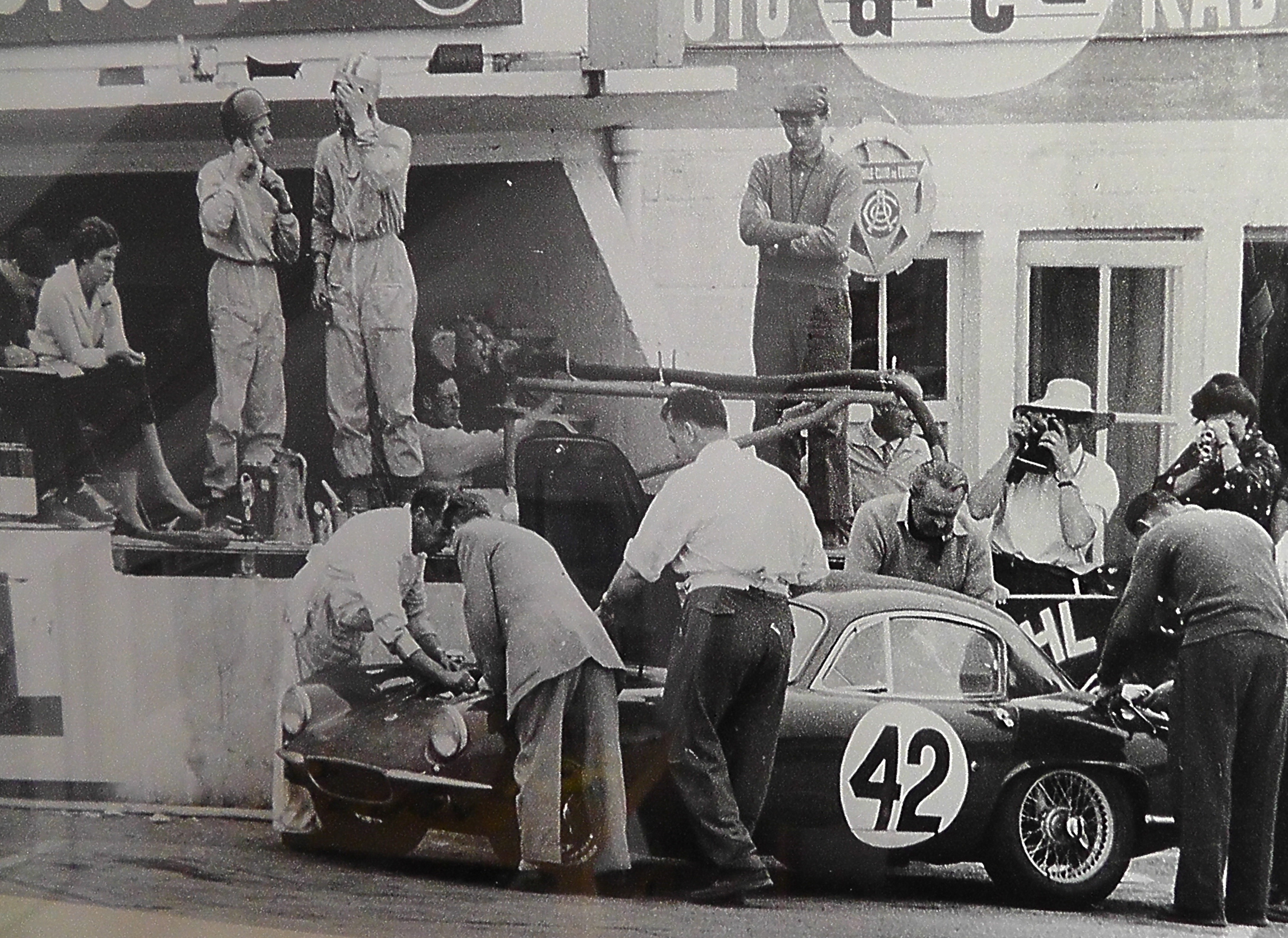
From Indy Qualifying, Jim flew to Nice from London, where he had been staying on Monday and Tuesday in the apartment of his friend, Sir John Whitmore. They had first met in 1959, when they had shared Ian Scott-Watson’s Lotus Elite at Le Mans, and they had stayed in touch ever since. Their bond, ironically, had been their shared despair after Alan Stacey’s death. A farmer like John and Jim, Alan had been hugely helpful to Whitmore in the early years. At Le Mans in ‘59, with Alan now on the verge of a full F1 career and driving at Le Mans a factory Lotus 17 with Keith Greene, the three of them had had a ball, with Alan very much playing the role of the mentor. Early in that Le Mans week, over dinner at the Team Lotus hotel in a little village away from the main town, John had read aloud a report in L’Equipe about one of the drivers having an artificial leg. Jim, still very new to motor racing, was both appalled and disbelieving. “Disgusting,” he said, making it unclear whether he was talking about the lies in the article or the concept itself.
Jim was up bright and early the following morning, in his usual way, and knocked on the door of the room being shared by John and Alan.
“Come on. Wake up. Rise and shine. Time to get going.” Then silence. Jim had seen Alan’s prosthetic leg lying on the floor by the bed. The next sound was of Jim’s feet, running as far away as possible.
A few days later, John and Alan were still laughing at Jim’s embarrassment…
Alan was killed at Spa the following year in a Team Lotus 18 – in the second Grand Prix of Jim’s career – when, it is said, he hit a bird at high speed. (Some people close to Team Lotus are convinced that the steering column broke on Alan’s car and that the “bird” story was merely a cover.) Jim was of course devastated – but thought instantly of John, who had been even closer to Alan. Thus the mateship.
John’s small two-bedroom, two-bathroom flat was in Balfour Place, Mayfair – an ideal location for racing drivers on the move. The Lotus factory at Cheshunt was half an hour away. And London was great for Heathrow and Gatwick airports, Crystal Palace, Brands Hatch and of course the A1 – the road to Scotland. After days – weeks – of non-stop travel, these two days in Mayfair for Jim offered a welcome break. John’s wife, Ghinsella, caught up with Jim’s washing – including his blue Dunlop overalls – and Jim finalized the detail arrangements of his travel over the next few weeks. He would return immediately to Indianapolis after Sunday’s Monaco Grand Prix; then he would race at Mosport; then, two days later, he would race at Crystal Palace. He’d return to Balfour Place at that point before leaving for Spa, for the Belgian GP.
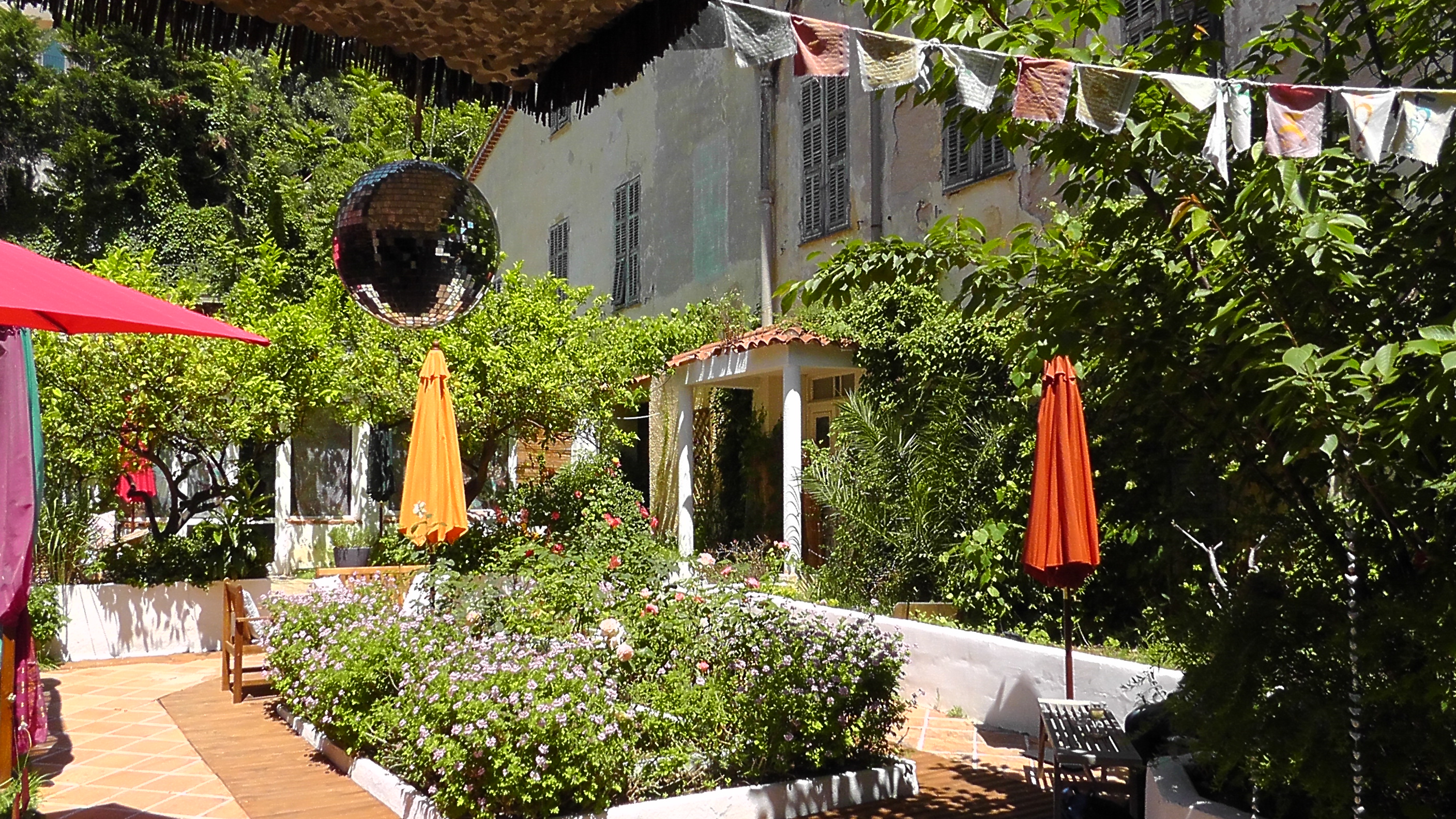
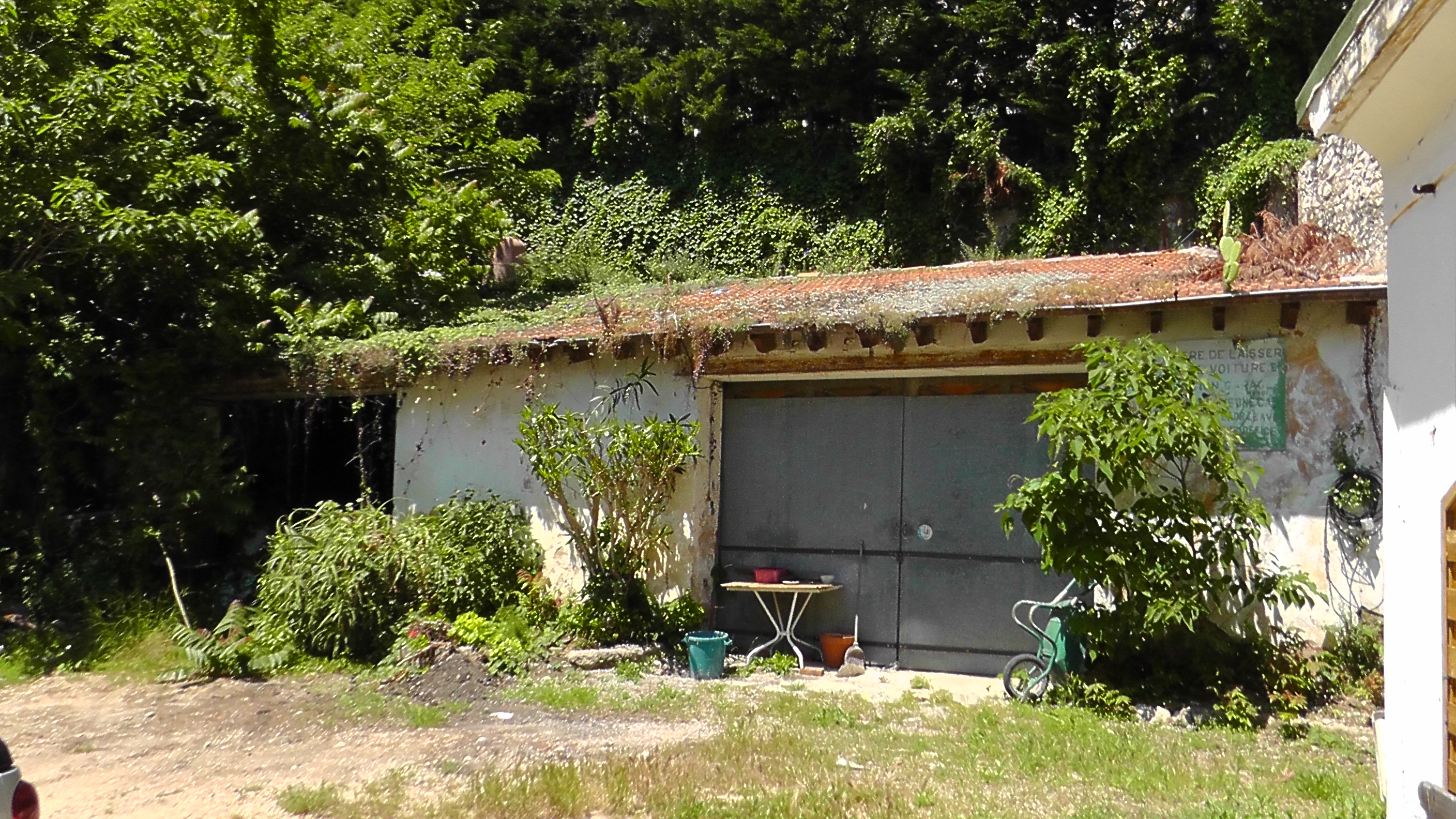
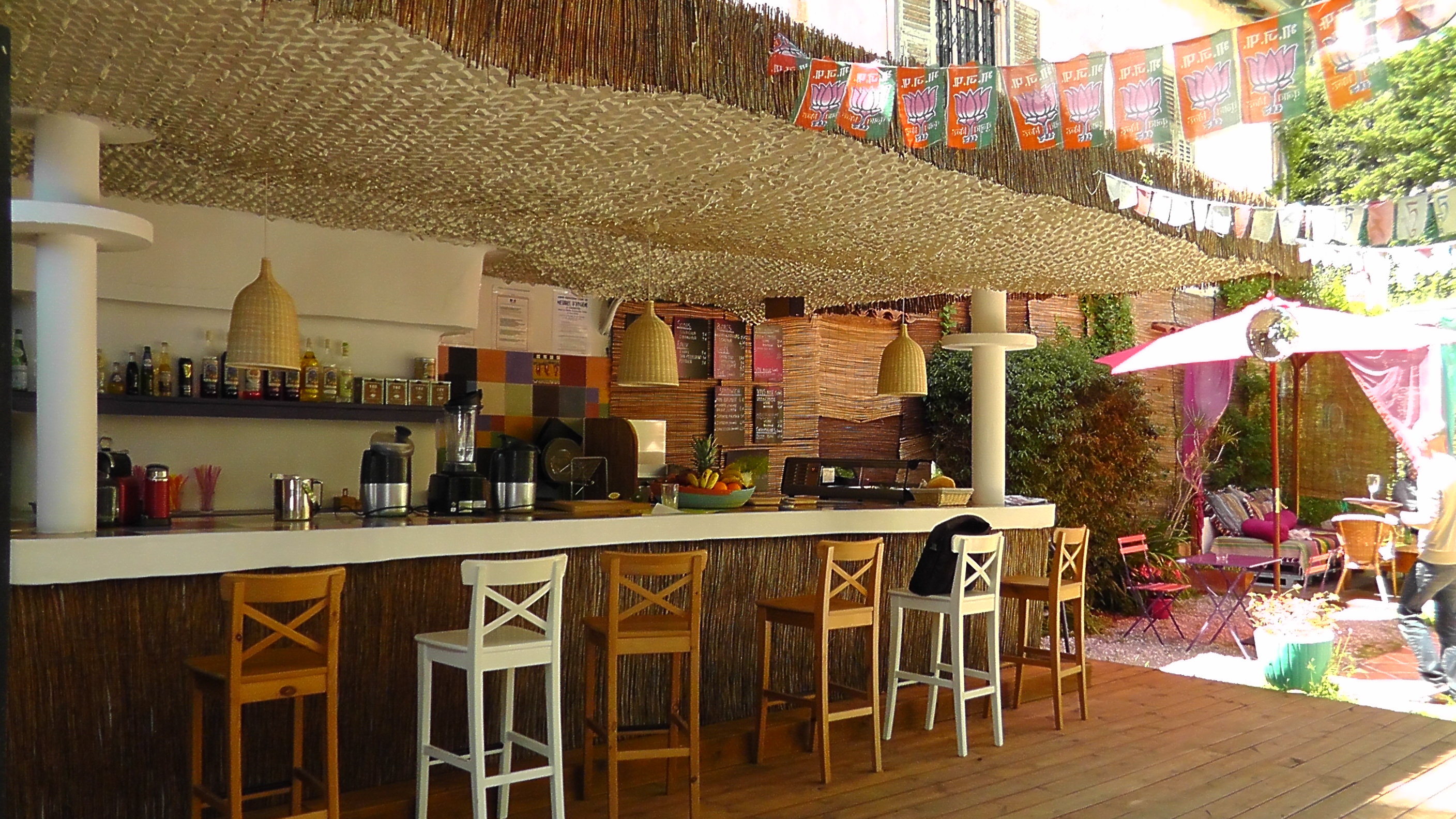
Nice was bright and sunny when Jim and Colin arrived on Wednesday, May 22. They drove out to Monaco by the coast road, stopping on the way to check in to their regular hotel in Eze sur Mere. Little more than a railway station and a small café today, Eze in 1963 was somewhat more prosperous, boasting a couple of good restaurants, a garage and a small market. The Team Lotus hotel, LaBananeraie, was perfect for the group’s needs, boasting a spacious, secure, three-car garage out the back in which the Lotus 25s could be housed. Towing race cars to circuits on public roads was not only normal back then; it was a part of the show. Spectators would line the streets, awaiting their favourites – and sometimes, if the travel distances was short, the cars would be driven under their own power. Nothing clears a crowd faster than a quick blast of Ferrari V12…
Jim had brought with him to Europe his newly-painted Bell Magnum helmet and wore it for the first time at Monaco on Thursday, when he was fastest. The overall look was completely different: it was as if the slightly thicker Bell had been specifically designed for the gorgeous, slow-slung lines of the Lotus 25. And Jim again wore a white peak! It was as if the ’63 season was entering a new phase, and the Jim Clark era was now upon us.
Jim was unnerved for a second or two on Thursday when he spied a black cat running across the track by the pits. He wasn’t about to label himself “superstitious” but, in that world, back then, he wasn’t going to go out of his way to walk under ladders or spill salt on the table. He was delighted, then, to see the car suddenly freeze and scamper back the way it had came. Nor was he reluctant to tell a few of his friends about it, either!
Practice over – and the temporary pole secured – Jim then joined his fellow drivers in a GPDA meeting at the Hotel Metropole. These gatherings had been a regular fixtures at F1 races ever since the drivers had first got together in a formal way at Monaco, in 1960. As a group, they were now respected by the team owners and by the circuit organizers – something that couldn’t be said about the drivers’ group of the 1950s, the UPPI (Union of Professional Pilotes International). Jo Bonner presided over the GPDA meetings; Autocar’s Sports Editor, Peter Garnier, recorded the minutes for posterity. As well as discussing important safety and organizational issues, the drivers also took time to talk to one another. In Jim’s case, he was keen to learn about Dan Gurney’s first drive in the new Brabham (Dan had been eighth quickest on a troublesome day) and to discuss the growing shortage of Coventry Climax Mk 111 engines. Just as Dan had been obliged to miss Silverstone, now Jack Brabham himself was flying straight back to England to pick up a replacement for the engine that had failed that morning. There was also general chit-chat about the new, sticker Dunlop R6s, now re-designed around the 1962-spec 28 deg cord angle. In theory, this greatly improved the tyre’s breakaway without detracting from its better adhesion. A bit like Pirelli reverting to Kevlar casing in 2013!
Problem was, the new Dunlops were also in short supply. The bulk of them would only reach Monaco, by truck, late on Thursday night.
Matters of Moment in that GPDA meeting: the prize for the best-run Grand Prix would go to Zandvoort. The Taffy von Trips trophy for the best private entrant would go to Count Carel de Beaufort; and Graham Hill would receive a Roy Nockolds painting for winning the 1962 World Championship.
F1 practice was also held on Friday back then – but at the absurdly early hour of 7:30am, by which time two Formula Junior sessions had also been staged. The idea was to have everything over by 9:00am, thus allowing the town to go about its usual business. The track was cold but Jim was faster still. Then, with the day still ahead, it was all over. Jim joined other drivers on Carribee, the yacht hired by Ken Gregory (Stirling Moss’s manager) and the former driver, Mike McKee. After a few hours in the sun, enjoying life with his mates Bruce McLaren, Dan Gurney and Lorenzo Bandini, it was back to Eze for a look at the cars and an early dinner at La Bananeraie. It turned out that Cedric Selzer and the boys had had a relatively easy day with the 25s – particularly as a nice blonde seemed to have joined the team as wheel-polisher and go-fer. Jack Brabham, meanwhile, had flown his own single-engined Cessna 180 back to England to pick up a replacement Climax engine. He planned to be back in Monaco by late afternoon but was held up by bad weather in France. He didn’t make it until about 5:00pm on Saturday – by which time the Climax in Dan’s car had also burned a piston.
Jim was again quick on Saturday afternoon, when the session was run from 2:00pm – 3:15pm. Perenniel gearbox worries aside, the 25 was running perfectly – so much so that Jim was happy to run full tanks for most of the afternoon while he pushed the R6s to the limit. (With more grip on line, he was only a second slower than his Thursday, empty-tank, pole time.) Jim also completed a few laps in the spare car (fitted with the old carburettored Climax engine), lapping as quickly as the Ferraris and fourth-fastest overall. The Brabham engine issues remined dire but everyone was deeply moved when Jack stood aside to let Dan have the only spare Climax for the race on Sunday. Drawn to Jack because of his decision to run a Lotus 24 for the first half of the previous season (while he was working on his own car) – and also because of the Indy ties with Dan – Colin Chapman then offered the spare Team Lotus 25 for Jack to race on Sunday. The 1959-60 World Champion readily agreed, even though he would be unable to put in a single lap with it before the flag dropped.
Serious work over for the day – Jim was on the pole from Graham Hill, John Surtees, Innes Ireland and Dan Gurney – everyone settled back to watch the Formula Junior race. An electrical problem had ruined his day when he was leading the FJ race by a mile in 1960, so he was not really surprised when Peter Arundell, who had won his heat in the Team Lotus 27, retired from the final early with a blown engine. Richard Attwood went on to win in the MRP Lola from an excellent Frank Gardner (Brabham).
Sunday, May 26, 1963 was a gorgeous day – much like May 26, 2013. There were no support races; instead, great F1 drivers from the past were paraded in open sports cars. Prince Rainier drove a few laps of the circuit in his Porsche Super 90. The drivers, staring at 100 laps of Monaco, gathered in the pits beneath the trees.
Louis Chiron, Clerk of the Course, presided over a shambolic drivers’ briefing on the grid. Photographers pushed and shoved; some drivers listened, others joked with friends. “Remember it is a sport,” said Chiron. “Good racing, good driving, good amusement and God bless you.” As Bruce McLaren later, “We knew how hot it was going to be and we knew that it wasn’t exactly going to be very amusing…”
Jim was instantly in trouble. In total contrast to his full-tanks run on Saturday, his engine coughed badly under acceleration. He couldn’t believe it. Perhaps it was a plug or something. Perhaps it would clear itself over the opening lap.
It did not. The mis-fire persisted. Graham had unsurprisingly out-dragged him into Ste Devote and down out of Casino Square, and into Mirabeau and the Station Hairpin, he was all over the BRM. Out on the seafront, however, and on the fast run through Tabac and towards the Gasworks Hairpin, the BRM pulled away as it was a 2-litre car.
Jim couldn’t understand what was happening. And so he just drove with the problem, trying to apply the power in different throttle loads – and trying, of course, to find ways of braking so late that he could sustain an attack.
It’s interesting to note, I think, that very, very few reports of the day mention Clark’s problems in this early phase of the race. Observers and spectators were enthralled, instead, by Jim’s attempts to outbrake Graham and his BRM team-mate, Ritchie Ginther, into the Gasworks Hairpin – and by the BRM drivers always regaining the initiative under acceleration. It never occurred to reporters that Clark was adjusting his driving in order to compensate for a problem. They saw Jim hit the cement dust bags protecting a fire hydrant with the left rear wheel on about lap 15 and they put it down to “Clark under pressure”. They saw Jim throwing the 25 around with armfulls of opposite lock and they just assumed he was having fun…
It was when the engine problem began to go away that Jim worked out for himself what had been happening: “The trouble stemmed from the two little pipes which stuck up behind my head and above the engine. These were fuel tank breathers and at the start, with full tanks, they tended to blow excess fuel out of the top whenever I accelerated hard. This would blow fuel straight back down the injector pipes and thus richen the mixture. The engine would bang and splutter. It was murder. Whenever I was out on my own with no-one around I could scramble through the corners and have the car running properly before anyone noticed but when, in the early phase of the race, I was fighting both Graham and Ritchie, I kept losing places. I’d pass Ritchie into a corner and then there would be this bubble, bubble, snort, bang and while I was trying to clear the system Richie would pass me again. Eventually, though, I managed to get with it, pass Ritchie and pull away. Of course, as the race progressed, less and less fuel came up the breathers and the trouble gradually disappeared.”
Jim was leading easily – just as he had led the FJ race in 1960 and then again the Grand Prix in 1962 – when it all went suddenly, finally, wrong. Wary of the gear selection trouble that had coloured the early-season races, he was now changing gear nice and precisely, easing the lever into the next slot without any strain. Suddenly, into Tabac, changing from fourth to third, the gearbox jammed. He still had drive – in fourth gear – but the gear lever was in “neutral”. He tried the lever again – and suddenly the car was in second, spinning itself to a standstill in the middle of the Gasworks Hairpin. Declutching did nothing. The car was locked in second. Jim’s first reaction was to jump from the 25 and thus to warn a fast-approaching Graham Hill, who at that point was ten seconds behind. Then, drained, he walked quickly back to the pits.
Thus ended Jim’s first Championship Grand Prix of 1963. The gearbox problems would continue (both Trevor Taylor and Jack had transmission problems in the race) but Cedric Selzer was not slow in coming up with solution to the fuel mixture issue: he fitted a motorcycle tap to the cockpit for Spa and gave Jim an instruction he would never forget: “It’s like a factory. It opens up and it closes down!”
They had an early night at La Bananeraie: on Monday, May 27, Colin, Jim and Dan flew from Nice to London on the 6:00am BOAC Comet. From there, via New York and Chicago, they would fly again to Indianapolis. The 500 would take place on Thursday, May 30.
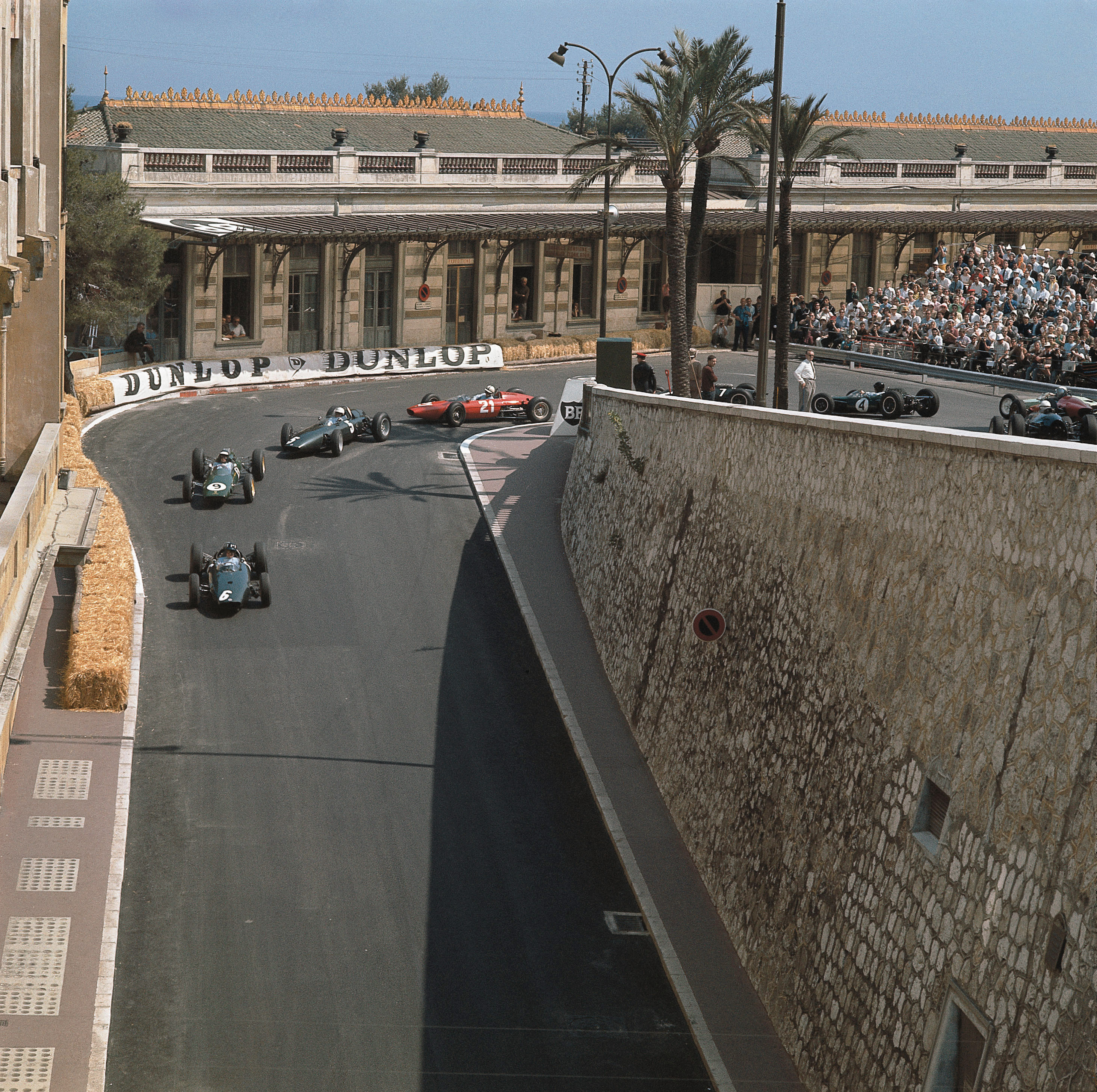
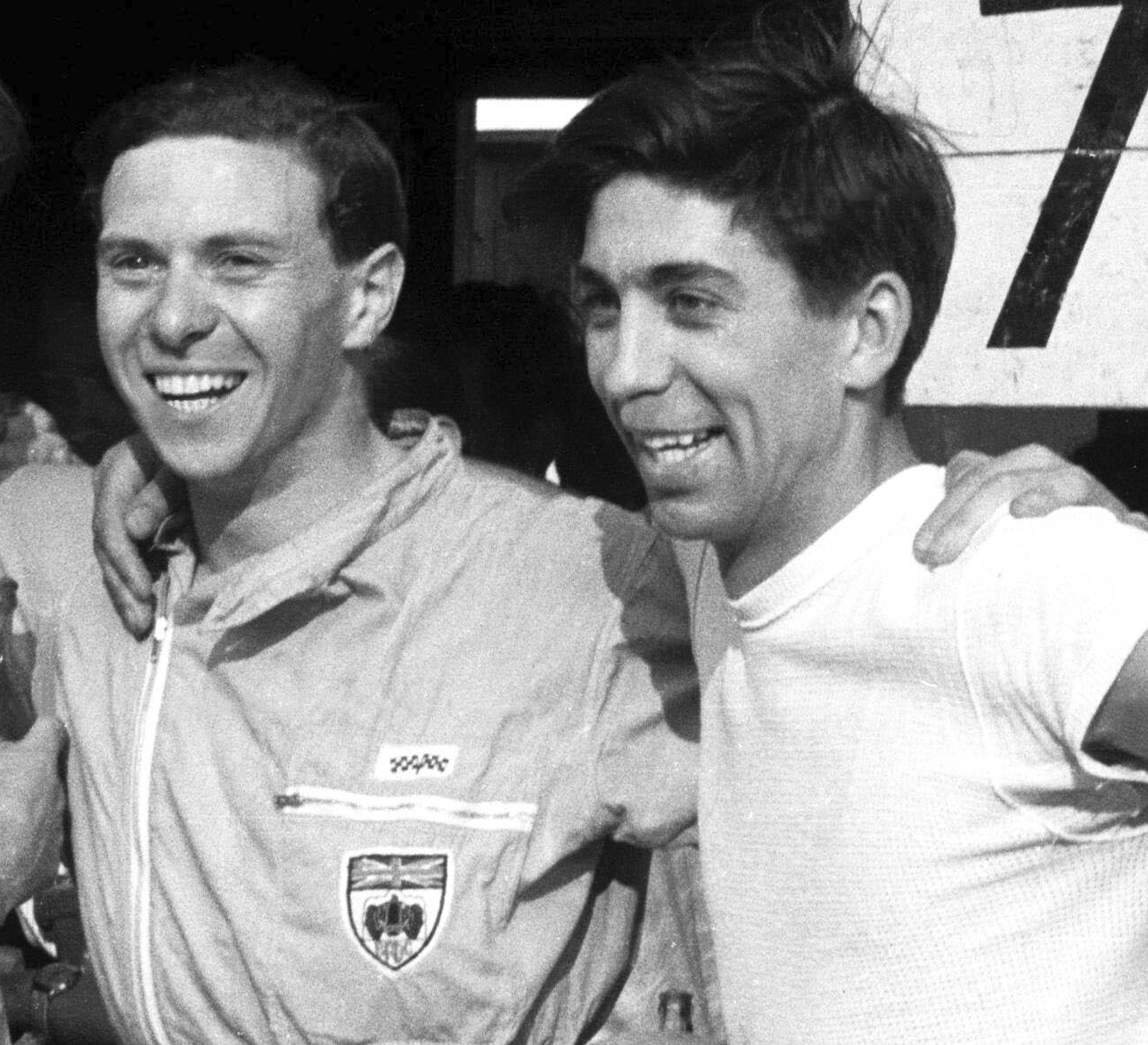
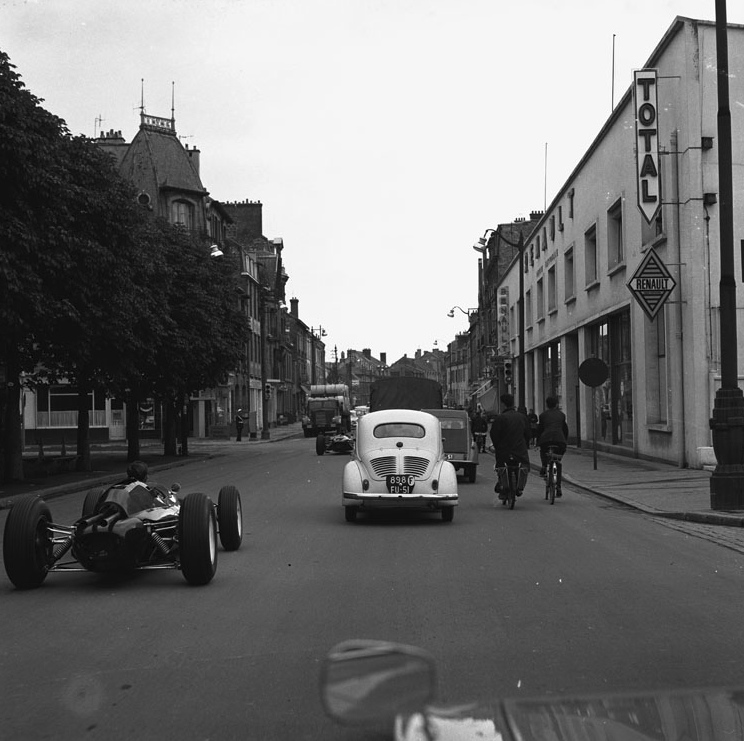
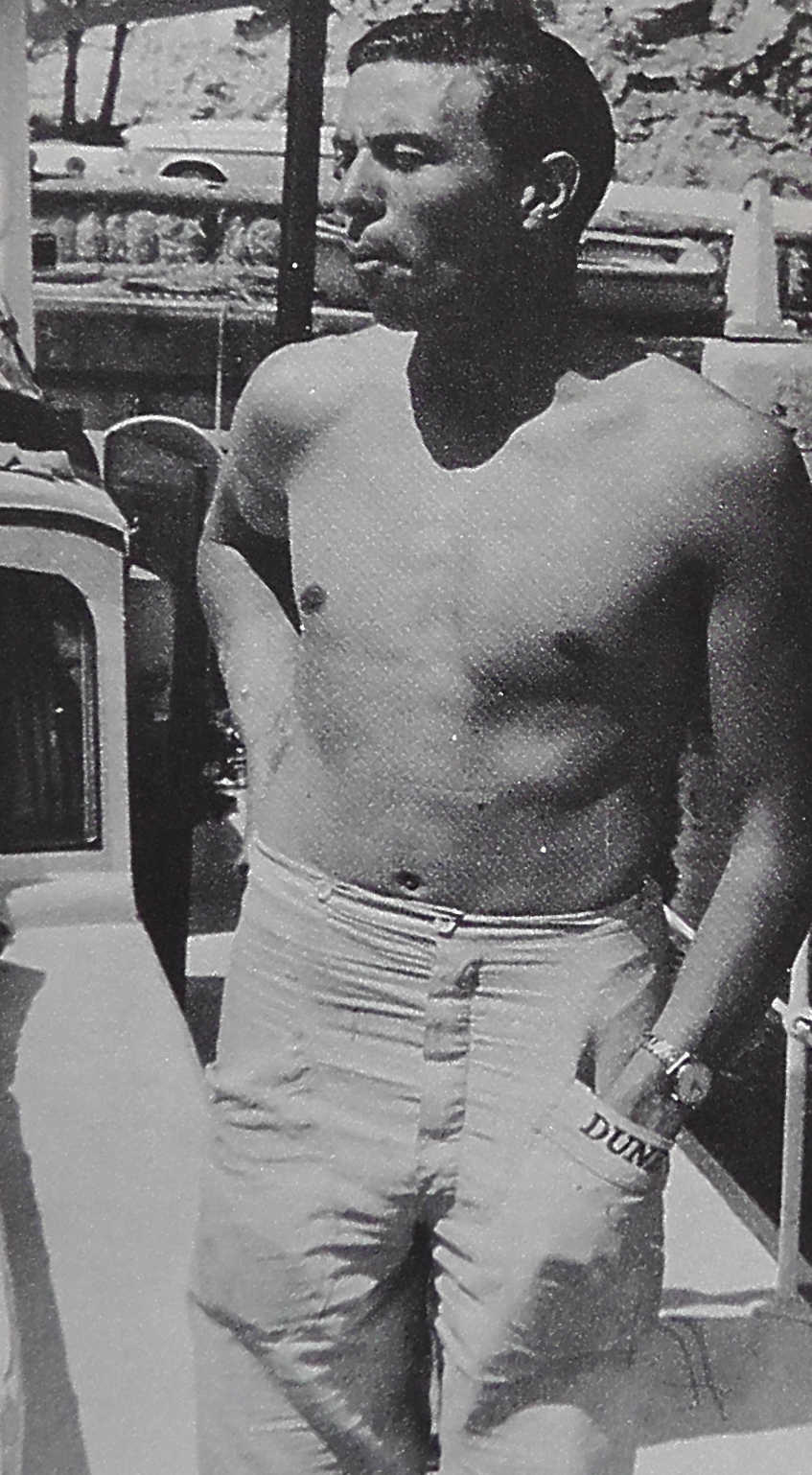
Captions, from top: Lap one, Monaco, 1963. Graham Hill leads for BRM, with Jim lying second in the mis-firing Lotus 25-Climax. Then come Ritchie Ginther (BRM) and John Surtees (Ferrari); Jim Clark and Sir John Whitmore compare notes at Le Mans in 1959 while Ian Scott-Watson’s Lotus Elite is given unscheduled attention. Ian can be seen to the right of Sir John’s legs – and that’s Jabby Crombac with arms folded; Jim shares a laugh with the very excellent Alan Stacey; La Bananeraie as it is today, now run by the grandson of the of the original owners. It’s overgrown but Bohemian: the bulk of the hotel is now an artist’s studio but the bar is still pretty much as it was; F1 cars often split the everyday traffic en route to the track. This is (I think) Bernard Collomb’s Lotus 24; Louis T Stanley’s shot of Jim aboard the good ship Carribbee after early practice on Friday. Note the Dunlop race trousers!; the garages around the back of La Bananarie; the bar/restaurant where Team Lotus refreshed in May, 1963; Cedric Selzer (right) and Colin Chapman (checked shirt) shepherd Jim back to the Lotus pit after his retirement. Photos: Sir John Whitmore, Louis T Stanley, LAT Photographic, Peter Windsor Collection
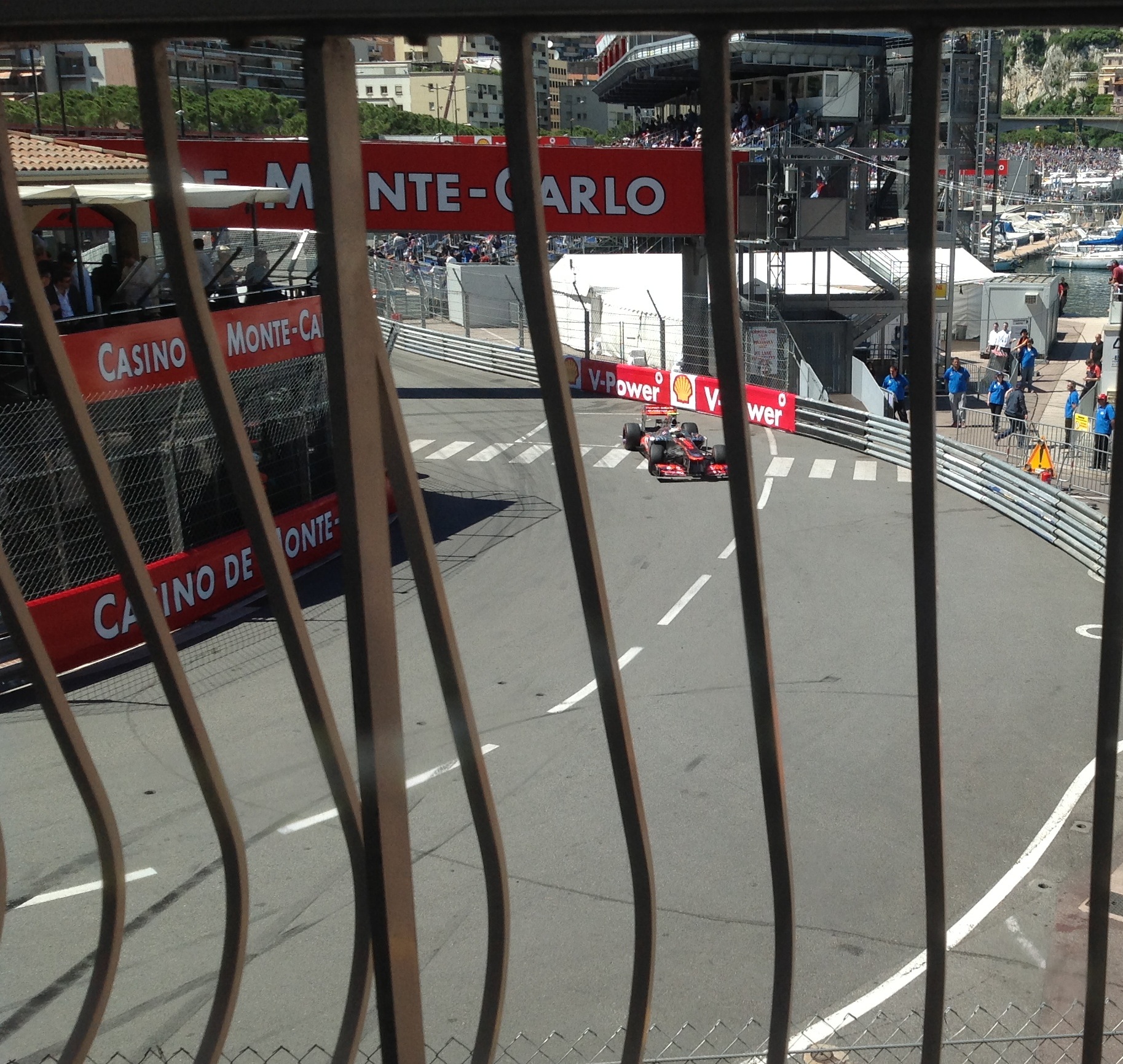
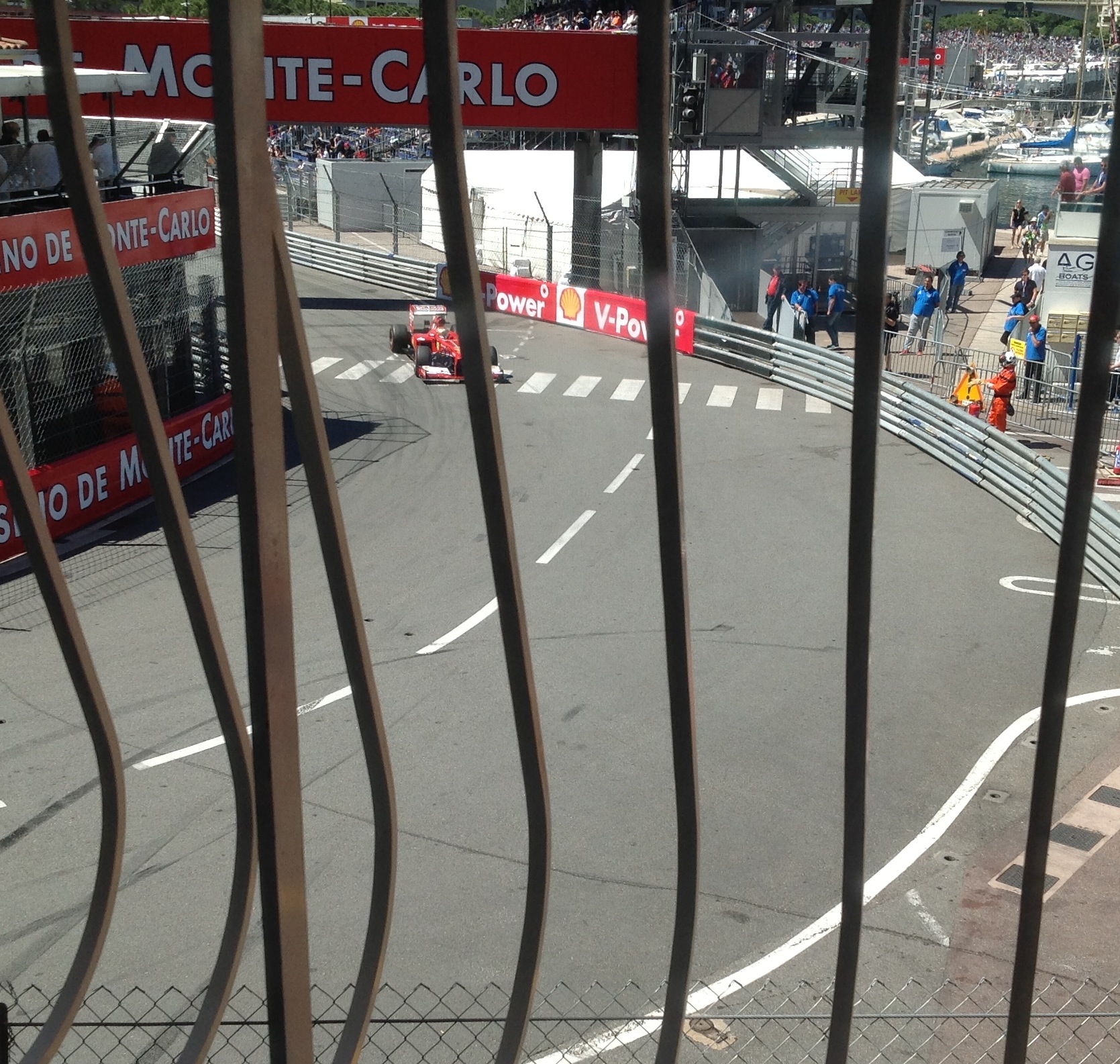
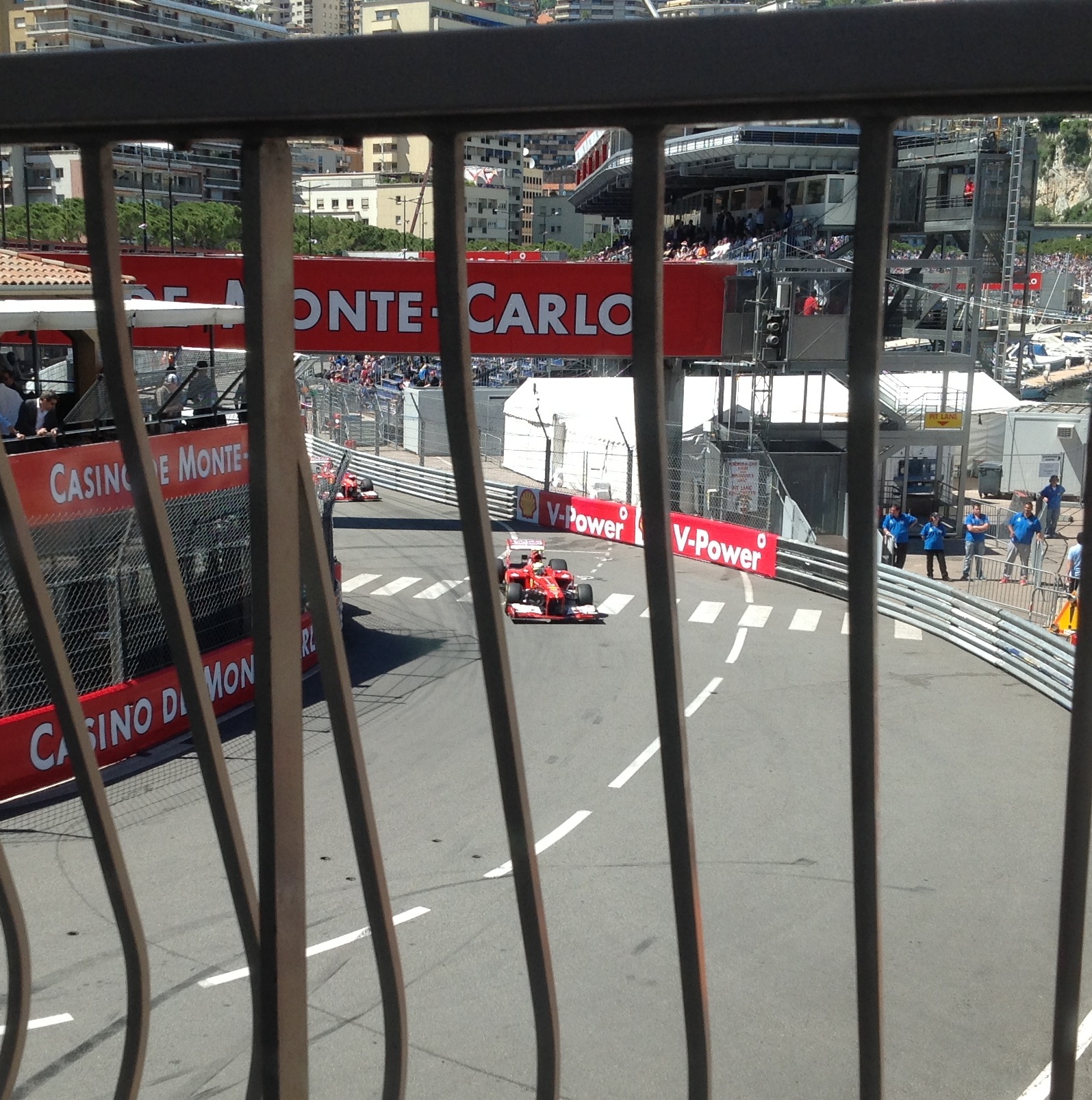
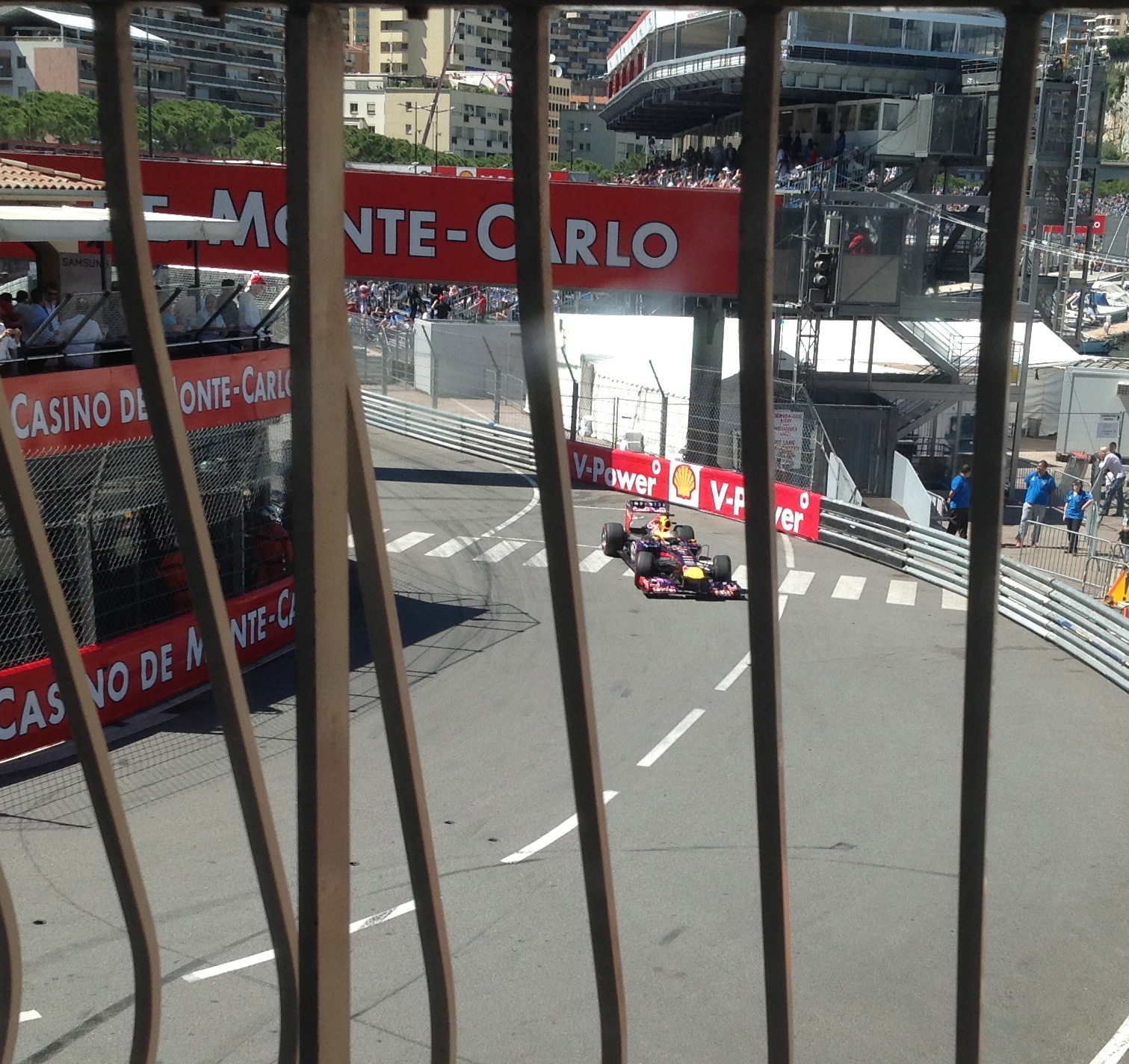
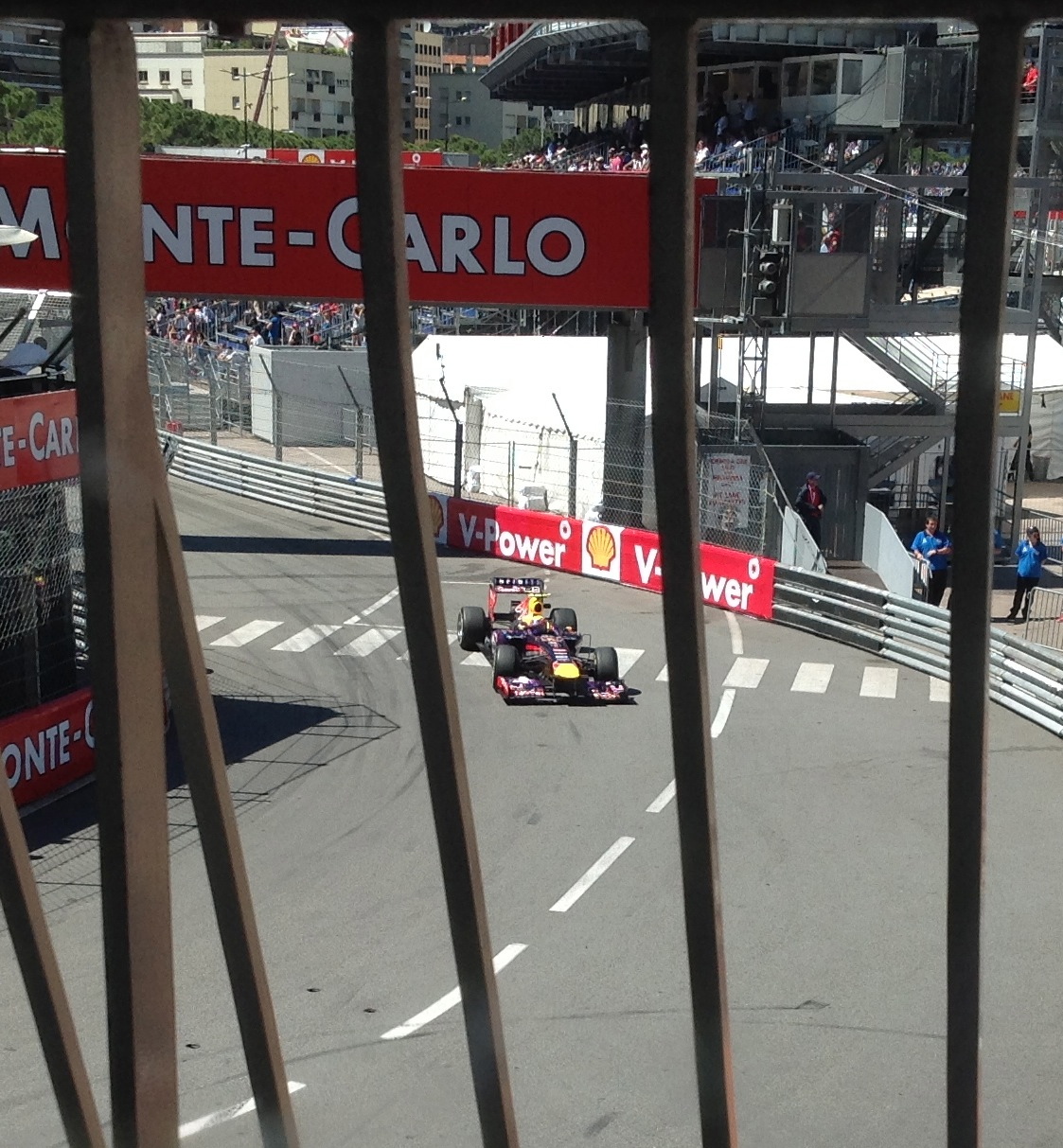
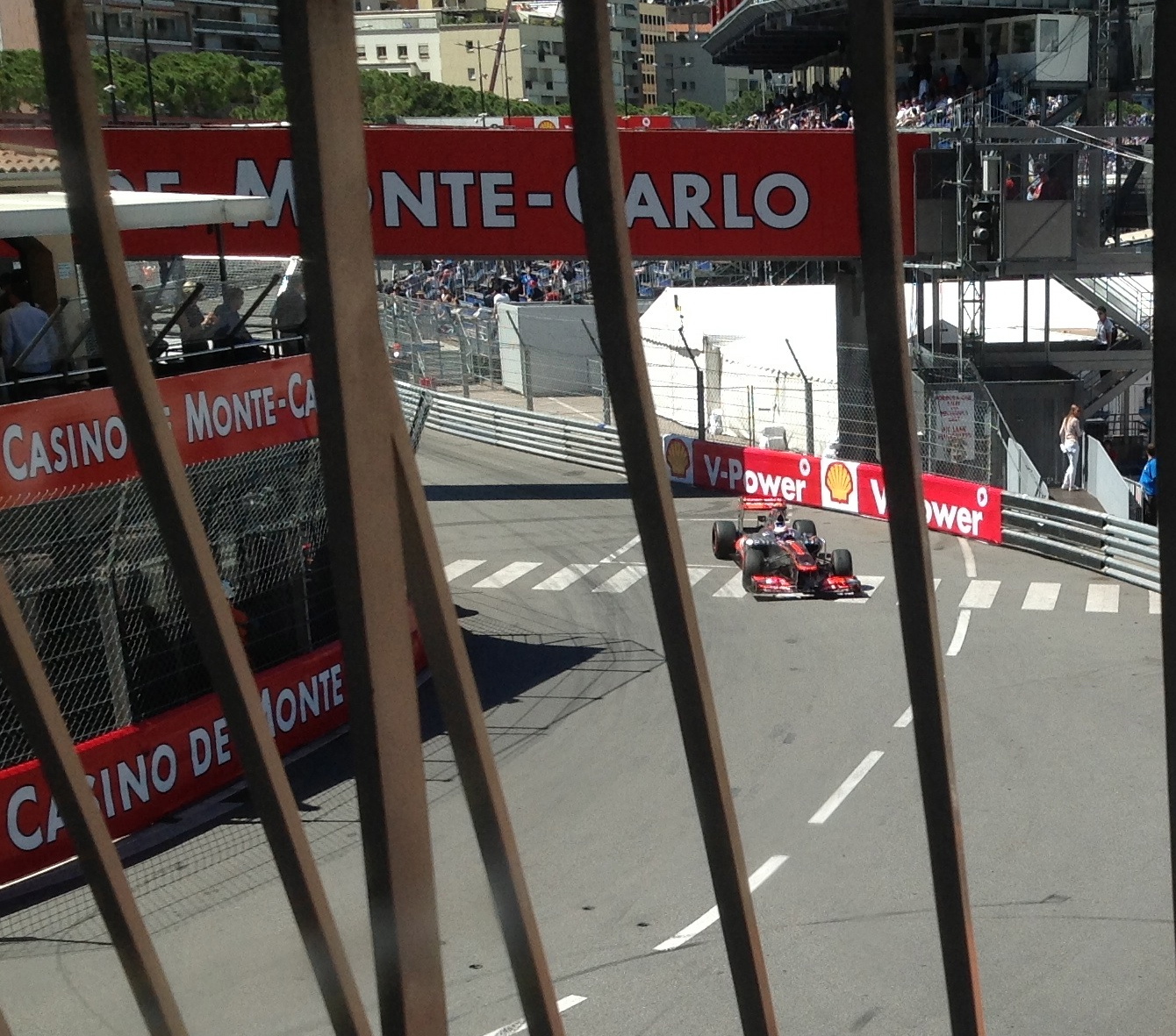
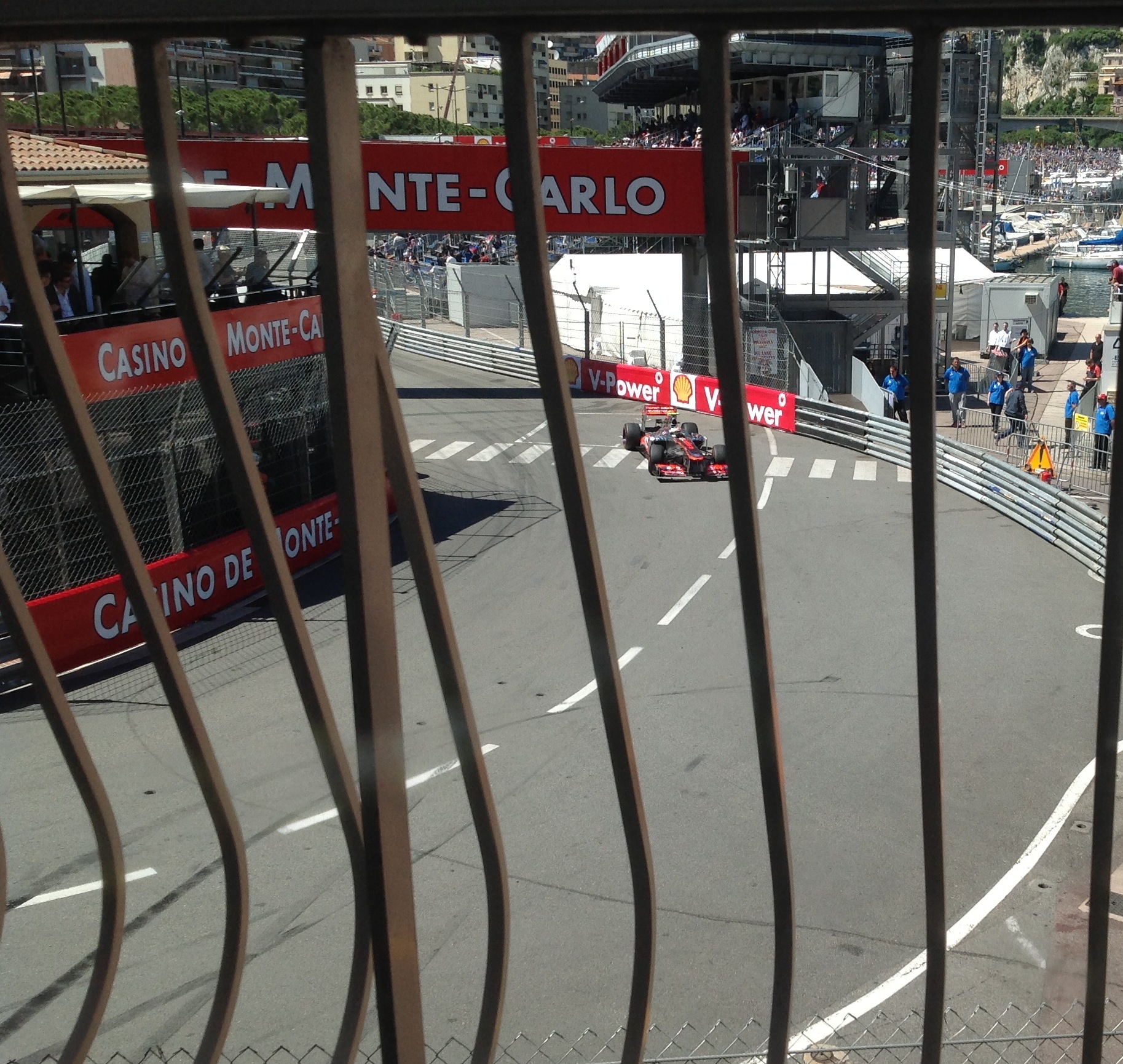
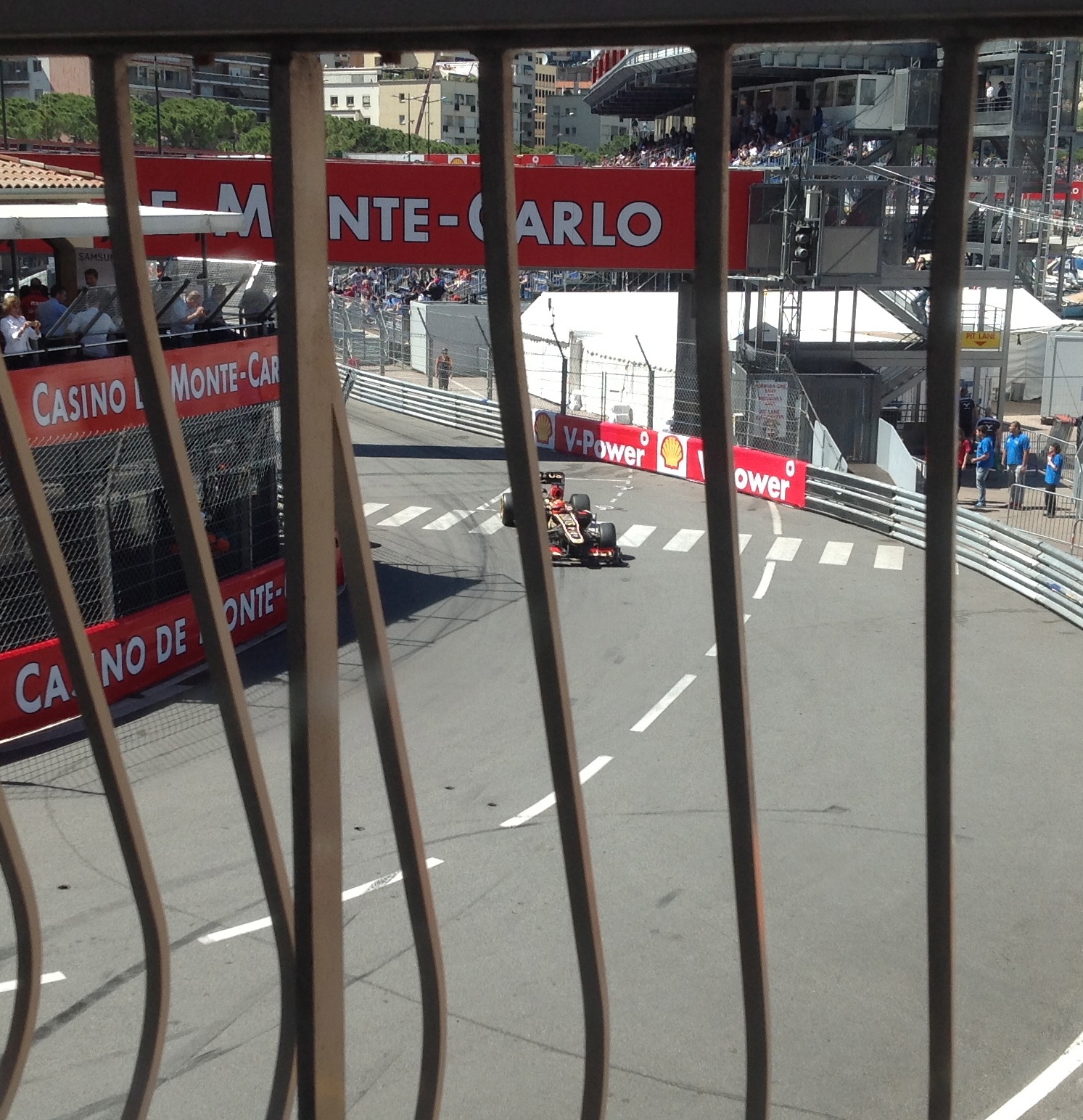
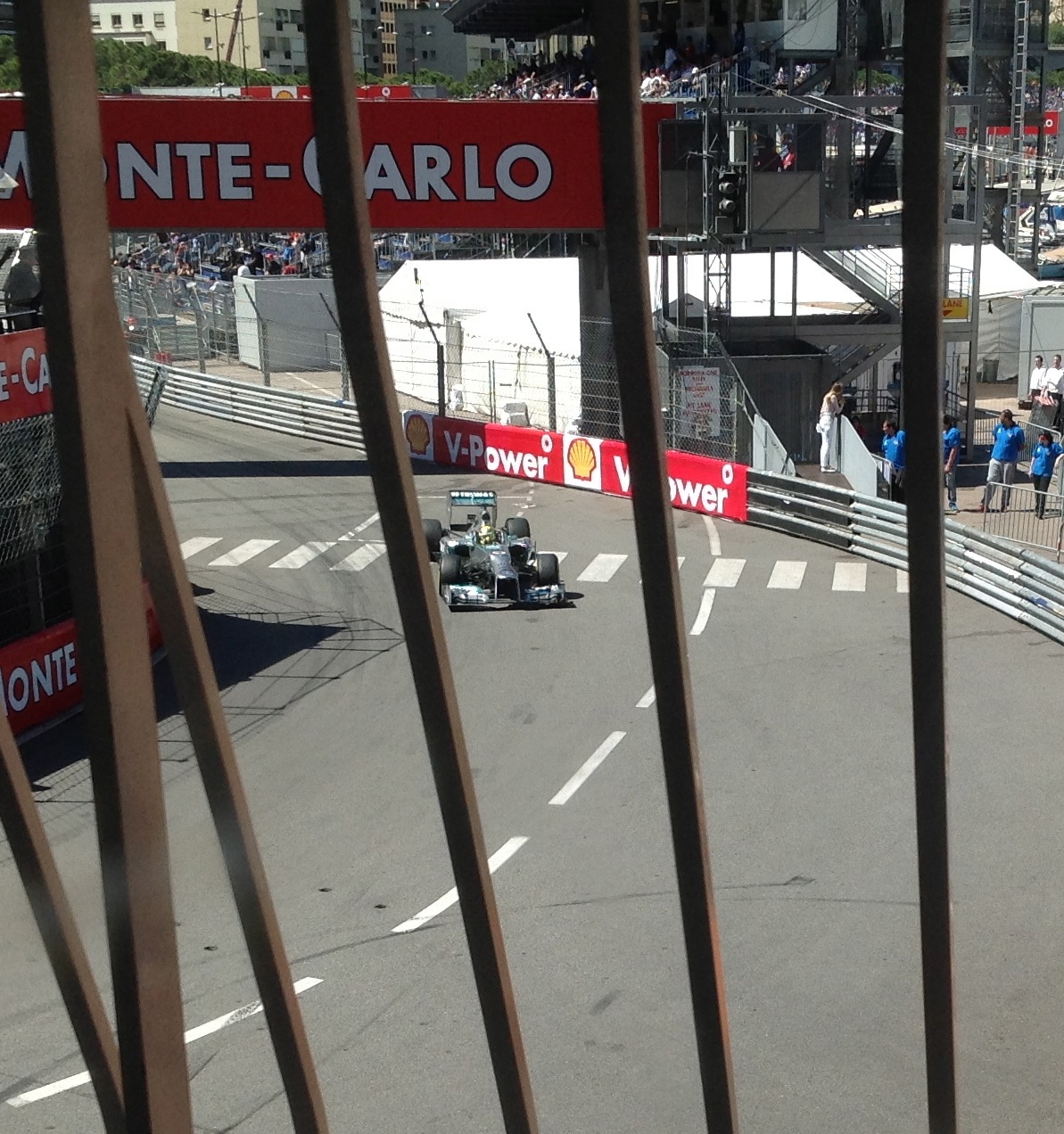
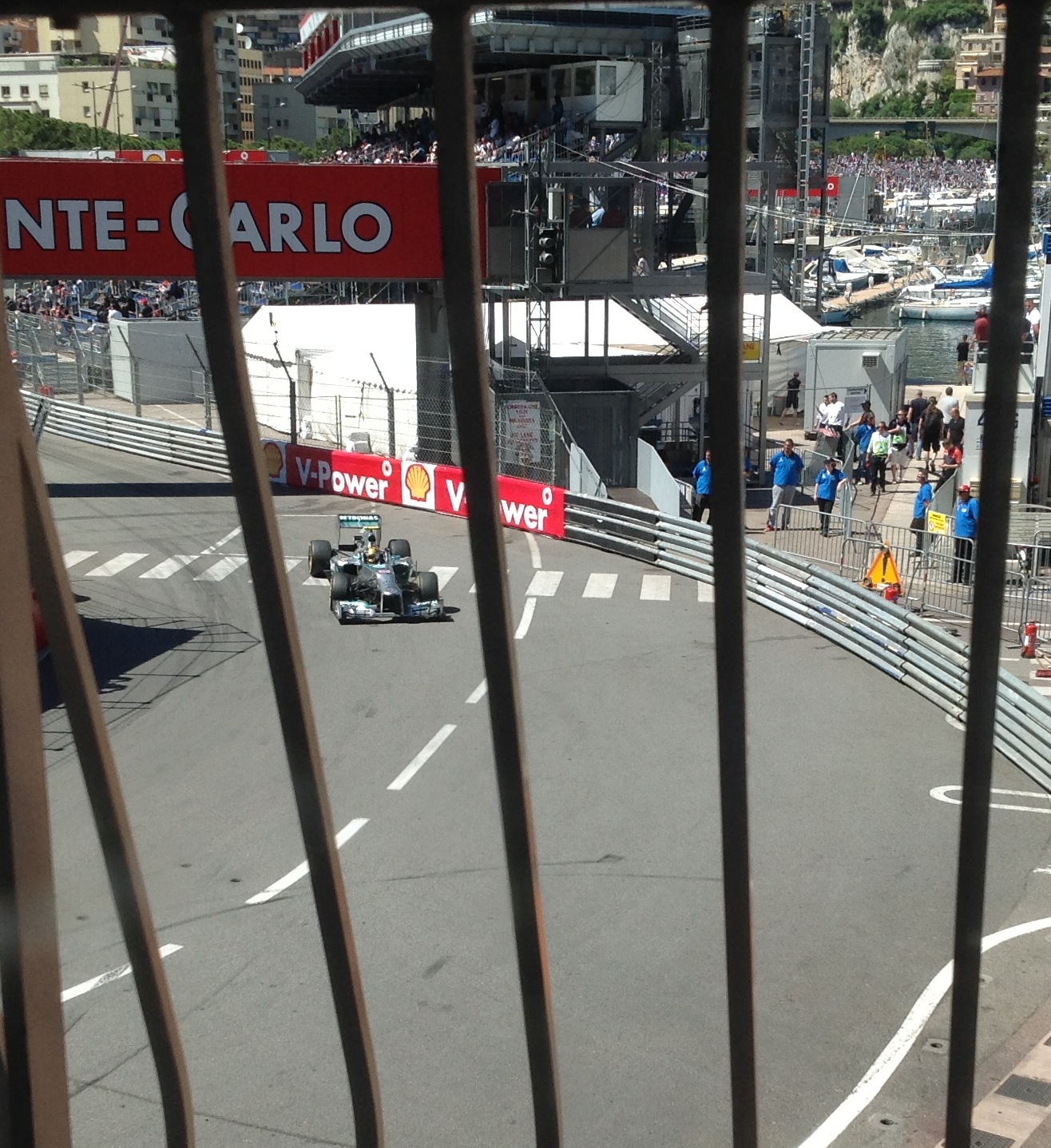
What you see here does not come under the heading of “good photography”. It is, though, my attempt to try to illustrate some of the principles about which we talk on The Racer’s Edge and occasionally on these pages. All the pictures were taken at La Rascasse on Thursday afternoon at Monaco (after Romain Grosjean had hit the barrier at Ste Devote!). I wanted to try to keep the frame of the shot as near-identical as I could for every car so that we could identify some of the differences between the drivers. I also ensured that each driver was on a quick lap or was not backing-off prior to peeling into the pit lane. The pose they strike as they reach the pedestrian crossing stripes is pretty much their signature – and those stripes on the road of course provide some sort of useful visual reference. Some drivers, you will see, are already asking quite a lot from the car – as can be seen by the steering angles as they reach the road stripes. Others are asking less. Some are “softening” the entry by curving into the apex from about the middle fo the road; others are well to the right of centre and are “extending the straight” into a relatively low minimum speed rotation-point. I should stress that La Rascasse is far from being the most important corner on the circuit: it is followed by a very short, sharp blast before braking into a negative-camber right-hander. It is, though, what it is – and I can confirm that I have never seen a great Monaco driver (Stewart, Reutemann, Prost, Mansell, Senna, Raikkonen) who was not clean, methodical and super-quick into La Rascasse. Despite the implications of these quiet, motionless images, each snapshot-in-time is in reality a compendium of the initial brake pedal pressure that was applied about a second or so before (when the cars were in fifth gear on the curving straight between the swimming pool and Rascasse), the rate of release of the brake pedal pressure (taking place as these pictures were captured), the initial steering movements (also taking place) and, yes, the positioning of the car. In each case, in summary, the “static” cars shown here are actually a mass of dynamic forces being harnessed by the drivers. All are different; some are better than others.
Fernando Alonso (left) was (with Pastor Maldonado) the driver who turned-in earliest to Rascasse. He refrained from applying any soft of substantial steering lock until he was right at the apex (out of the photograph to the bottom left), and this he did with increasing power. He looked superb, I thought. The back of the Ferrari would always skip slightly as he rotated the car, which probably meant that his minimum speed was relatively low – but there is no doubt that from the pedestrian crossing to that minimum speed point he was quicker than anyone on the circuit.
Felipe Massa (right) wasn’t a lot different from Fernando… but was different nonetheless. He braked more to the centre of the road and thus approached the corner with a slightly “softer” line. This gave him a slightly “longer” corner – ie, he had to cover more road and, thus, he put more initial lateral energy through the tyres for longer. Felipe was very finessey with his steering inputs and, like Fernando, always honed-in to a lowish minimum speed, the better to rotate the car.
I was surprised by the massive differences between the Red Bull drivers, Sebastian Vettel and Mark Webber. Although the positioning of the two cars looks fairly similar in these two pictures, look closely at the amount of steering lock Seb has applied (relative to Mark). This was absolutely typical of what we saw all afternoon. Seb (right) would approach from a relatively wide angle and crank on a massive amount of lock as he was releasing the brakes. The result was understeer – driver-induced (very graphic) understeer. Could it be that Seb was working on protecting the rears? Perhaps. Mark, by contrast, was Alonso-like with the steering applications, even if he was leaving himself a slightly more open approach. I’d say Mark’s Rascasse (right) leaves him slightly more margin for error (or for the unexpected) than does Fernando’s but that their inputs were about equal. Again, brilliant to watch.
Both McLaren drivers created very “long” corners from wide entries. Jenson’s inputs (below) were more svelte that Sergio’s but Sergio began the corner with slightly less initial steering input, in turn enabling him to ask slightly less from the front tyres. Equally, Sergio (below right) had a more substantial final rotation. When you see these two drivers alongside one another like this, you wonder how good it is for a team to be running drivers of such similar style. It would be interesting, for example, to see how the MP4-28 would perform at the other end of the spectrum – the Alonso/Webber/Raikkonen end – or perhaps at the Vettel/understeer end.
I didn’t get to see Romain, as I say, but I can tell you (from Thursday morning) that he was about half-a-car’s length to the left of Kimi as he crossed the painted lines and was using about a Webber-dose of steering at that point. Unlike Mark, who would deliberately await the moment of final rotation before accelerating flat and clean, Romain teased the throttle a little, like Alonso and thus ran right out there on the ragged edge, leaving no room for error. The Ste Devote shunt, I think, was no surprise. Kimi was of course just beautiful to watch, even if he was locking up the front brakes more than we usually see. He wasn’t quite as far to the right as Alonso and Maldonado (or Di Resta, as it happens) but his initial steering movements were very slight and very small – a mile away from Vettel’s. Then, in one clean movement, he would tuck in the front for the major rotation and accelerate without fuss towards the exit of the corner. Totally repeatable and extremely efficient (left).
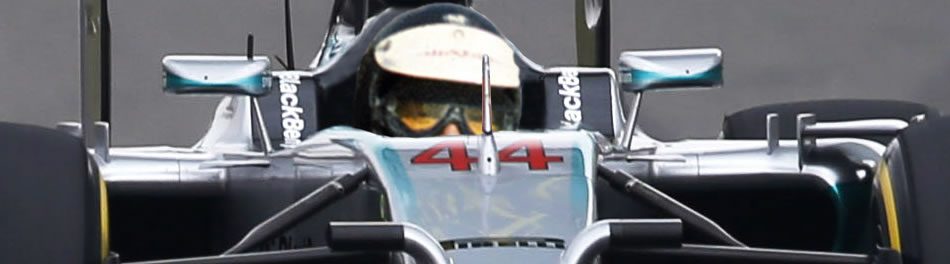
The differences between Nico Rosberg and Lewis Hamilton were small but significant. Both drivers turned-in early, like Kimi and Fernando, with delicately-small initial steering inputs, but Nico (below) did so from about half a metre further to the right, giving him a slightly shorter corner. This he managed in Prost-like fashion, never looking unruffled or out of synch. Lewis (below) was thus a tad less impressive than Nico through this section of road – which, for me, was a surprise, I have to admit.
Part 2 of our views from Rascasse, featuring the remaining cars on the grid, will follow shortly.
Modified the Pirelli hard tyre may have been in Barcelona; still, though, F1’s monopoly tyre supplier is planning further changes from the Canadian GP onwards. How Monaco will work out in the interim, with the soft and super-soft in use, remains an unanswered question. This was the statement issued today by Pirelli. Note that the thrust of the piece reflects Fernando Alonso’s four-stop strategy. LotusF1, and Kimi Raikkonen, who managed to split the Ferraris with a nice three-stop run, do not get a mention…
Milan, May 14, 2013 – This year’s Pirelli P Zero Formula One tyre range will change from the Canadian Grand Prix onwards, using a revised construction.
The move follows the Spanish Grand Prix, which had four pit stops per driver. The new range will combine elements from the 2012 and 2013 tyres to have both durability and performance.
Pirelli’s motorsport director Paul Hembery said: “Our aim is to provide the teams with a new range which mixes the stability of the 2012 tyres and the performance of the current ones. As a company, we have always moved quickly to make improvements where we see them to be necessary. After evaluating data from the first few races this year, we’ve decided to introduce a further evolution as it became clear at the Spanish Grand Prix that the number of pit stops was too high. The Spanish Grand Prix was won with four pit stops, which has only happened once before in our history. These changes will also mean that the tyres are not worked quite as hard, reducing the number of pit stops.”
With limited testing time, it’s clear now that our original 2013 tyre range was probably too performance-orientated for the current regulations. However, having identified this issue, we’re determined to rapidly resolve it. It’s worth underlining that the current regulations for winter tests limit the opportunity to test the tyres under the same conditions as the race season because of the lower temperature and restricted time. The Teams are of the same opinion as we are in wanting longer testing times and different locations for the next tests. We developed the 2013 tyres on the basis of careful simulations that were, however, not sufficient, taking into account the improved speed of cars (up to 3 seconds per lap).
We’ve also taken this step to avoid the delaminations that were caused by track debris. It’s important to point out that these delaminations, which occur when the tread comes off, do not compromise the safety of the tyres as the core structure of the tyre is not affected in any way, helping drivers to complete the lap and to change the damaged tyres safely. These delaminations were due to damage from debris that overheated the tread. We’d like to thank all the teams for their continued and extremely valued support as we worked with them to identify the correct compromise between the pure speed that makes us the world leader in the Ultra High Performance sector and a global spectacle that is easy for Formula One fans to follow.”
First, though, the build-up to that May 11, 1963, 15th International Trophy Race:
Indianapolis became a steep learning-curve as the month of May gathered pace. As well as embracing the ways of the idiosyncratic Speedway, and all that comes with it, Team Lotus faced the additional problems of being newcomers amongst the old guard, of initiating the winds of profound technical change and of trying many all-new components thus related. Like big, aluminium, 4.2 litre Ford Fairlane V8 engines. And Firestone tyres. And Halibrand wheels. And asymmetric suspension. And seat belts. And, yes, Bell Magnum helmets.
For most of the month of May, Jim, Colin Chapman and David Phipps, the talented photo-journalist, stayed in the house of Rodger Ward, the 1959 and 1962 Indy winner. The days were relaxed by European racing standards, beginning with early morning tests, lunch work, more afternoon laps and then late-ish nights with the mechanics after early evening meals. The issues were many: the Dunlop D12s were quicker (Dan Gurney had lapped his Lotus 29 at 150mph while Jim was racing in Europe) but the Firestones were more durable. With one pit stop to the roadsters’ two or three, Lotus could enjoy a big advantage even before the race was underway. To achieve that, however, they needed to run the less grippy Firestones.
This, in turn, caused a furore. Firestone built special tyres for Lotus around 15in wheels but then quickly found themselves under pressure from the Americans, who also expected the same, larger, footprint tyres for their roadsters (which normally ran 18in wheels). AJ Foyt in particular took umbrage. Expecting Firestone to be swamped, he approached Goodyear about using their stock car (NASCAR) tyres. They agreed. And, with that, the great Akron company began its single-seater racing history.
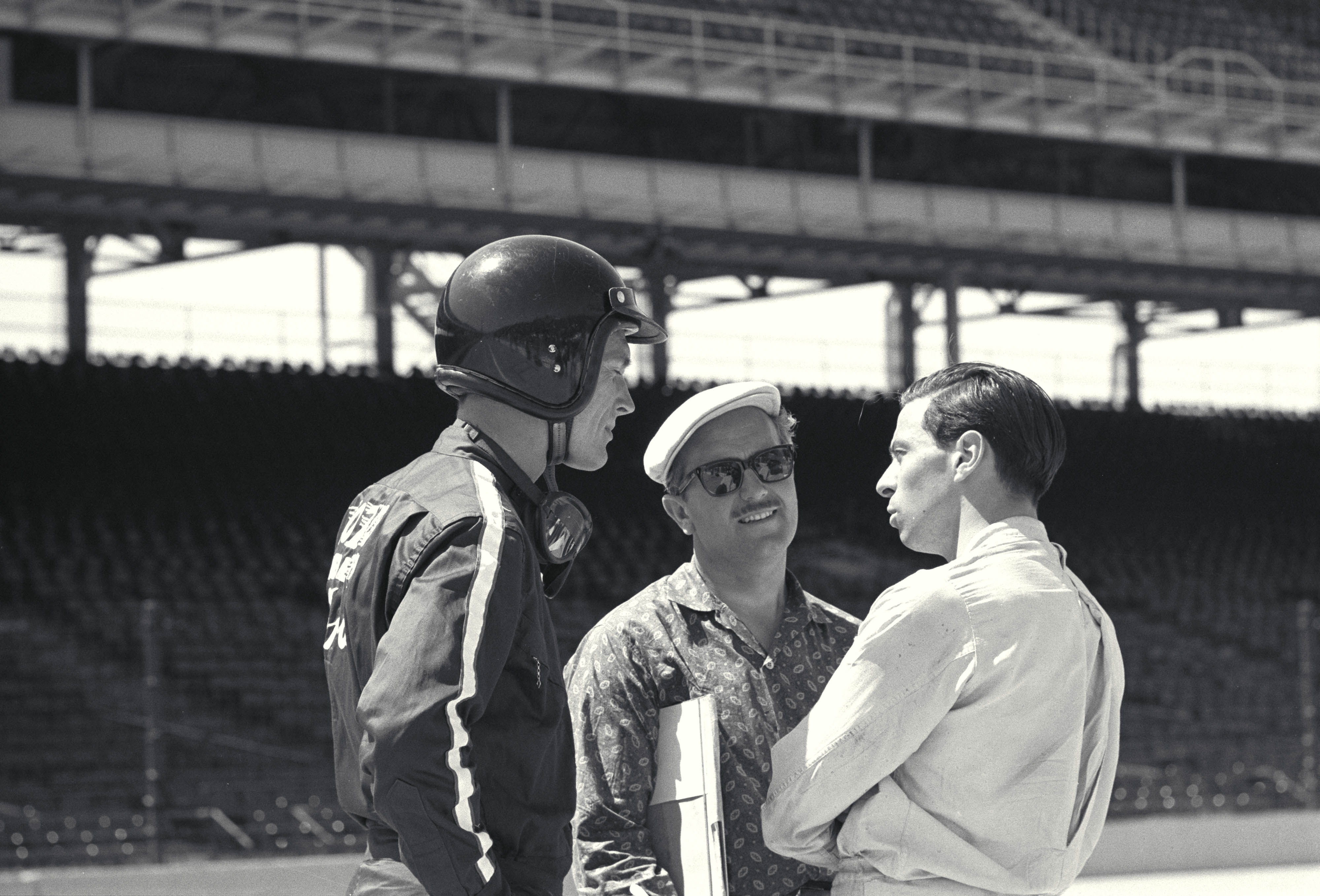
The switch to Firestones had additional implications for Jim. Until now, he had worn at Indy his regular, light blue, two-piece Dunlop overalls, complete with Esso and BRDC badges. With Ford’s engine supply now requiring the Lotus 29s to use Pure fuel and lubricants, those overalls were obviously redundant. What to do? Dan introduced Jim to Lew Hinchman, the local owner of a large garment and uniform factory. Lew, whose father, JB, built fire-retardant overalls for many of the American drivers, was in the process of making a dark blue, Ford-logo’d one-piece suit for Dan. Why not make one for Jim, too? Jim was measured up in the sweaty Team Lotus garage one lunch break (air-conditioning units were forbidden by the Speedway Safety Police due to the WWII-spec wiring in the garages!) and Jim was told that the overalls would be ready for the first week of qualifying. Dan also pointed Jim in the direction of the Bell Helmets race rep. Dan had been using a leather-edged McHal for a couple of years, and loved it. Even so, he was impressed with the new Magnum. And so here was a chance for Jim to put his trusty Everoak out to pasture. Jim examined the new silver helmet and decided to try it in the build-up to qualifying. For Silverstone, next weekend, he would nonetheless race with the Everoak – for the last time, as it turned out.
Between runs in this leisurely week at Indy, Jim also had time to shape-up his travel schedule for the following weeks. It would go something like this:
Tue, May 7: return to England (via Chicago). Pick up Lotus-Cortina at Heathrow. Drive to Silverstone. Check in to Green Man hotel. Thur-Fri-Sat: International Trophy F1 race, Silverstone. Sat, May 11: immediately after the race, fly with Colin and Dan Gurney to Heathrow in Colin’s Miles Messenger. Take flight to Chicago via New York. Change at Chicago for Indy. Check in to Speedway Motel. Begin testing Monday morning. Sat, May 18: Indy qualifying. Leave Sunday, May 19, for London. Stay with Sir John Whitmore in Belgravia. Two days at the factory at Cheshunt. Wed, May 22 : fly to Nice from Heathrow. Check in to La Bananerie at Eze sur Mer. Thur, May 23-Sun May 26: Monaco GP. Mon, May 27: leave at 4:00am for London. Take flight to Chicago and then on to Indy. Thur, May 30: Indy 500. Fri, May 31: fly to Toronto and then drive on to Mosport. Sat, June 1: Players’ 200 sports car race (with Al Pease’s Lotus 23). Drive afterwards to Toronto. Take evening flight to London. Mon, June 3: Whitmonday Crystal Palace sports car race (Normand Lotus 23B). Wed, June 5: Leave London with Colin for Spa (Belgian GP).
In other words: phew! There was of course no internet back then; transatlantic phone calls were both a novelty and expensive. Communications with the UK were via telexes and telegrams. Flight bookings were handled by Andrew Ferguson’s office in Cheshunt but re-arranged in the US by David Phipps. And the tickets, of course, were big, carbon-copied wads of coupons. Jim’s black leather briefcase was literally jammed to the hilt.
There was little time, though, as one Indy issue followed another, to wonder if it would all be feasible. If Jim didn’t qualify on the first weekend, for example – what would happen? Would he miss Monaco or would he foresake Indy? Given the powers behind the Indy effort – Ford, Firestone, etc – probably it would be Monaco. For now, though, it was heads-down: there was not a moment to spare – or even to think about the bigger problem.
In the midst of all this, Silverstone turned out to be a golden Saturday to be forever savoured. Thursday and Friday, by contrast, were best forgotten. Dunlop were pushing R6 development to new frontiers; Jim, as at Snetterton, found the Lotus 25 to be all over the place on the new tyres. On a cold and windy Thursday, jet lag or no, he couldn’t find anything approaching a sweet spot with the car – and this was with exactly the chassis (R5) in which he’d been so quick at Aintree (on R5s). He was only fifth that Thursday, focusing as he was on trying to make the car work just through Stowe and Club. If he could find a balance there, he reasoned, then he could probably make up for deficiencies over the rest of the lap.
The mechanics – Jim Endruweit, Cedric Selzer Dick Scammell, Derek Wilde and the boys – worked through to six o’clock on Friday morning, rebuilding Jim’s car with yet another set-up change. Perhaps, in addition, the rebuild might uncover a more fundamental chassis fault…
To no avail. Saturday was cold and wet; as all-weather as the new Dunlops undoubtedly were, little could be learned about a dry-weather balance. The grid therefore being defined by Thursday’s times, Jim tried team-mate Trevor Taylor’s car for a few laps. A spin at Copse capped an unremarkable day. Innes Ireland, what’s more, would start from the pole in the BRP Lotus 24-BRM – a chassis that Jim had always liked. Graham Hill was second in his trusty 1961/62 BRM, Bruce McLaren third in the new works Cooper and Jack Brabham fourth in his BT3, his engine down on power after a rushed rebuild. Poor Dan Gurney had flown over with Jim from Indy but for him there would be no F1 debut with Brabham: there was a dire shortage of Climax engines in this build up to the season proper, highlighted by Jack’s frequent runs up and down to Coventry. Jack was more than ready to let Dan race the one and only BT3 at Silverstone but a short test at Goodwood confirmed that Dan was much too tall for Jack’s cockpit. He would have to wait until Monaco to drive his tailor-made car.
This race was also notable for the appearance of the new 1963 Ferraris driven by John Surtees and Willy Mairesse. Powered by regular V6 engines (with V8s rumoured to be on the way), the new cars showed glimpses of promise amidst predictable teething troubles. This would be Surtees’ first F1 race for the Scuderia (and his first F1 race of the season; the beautiful Lola GT, a forerunner of the 1964 Ford GT and a car with which Surtees had been closely involved form the outset, also had its maiden appearance this Silverstone weekend. In a portent of the drama that was to explode three years later, Big John practiced the Lola on Thursday but was then forbidden by Ferrari from racing it on Saturday, even though the Sports Car Race was the last event of the day. John appointed Tony Maggs in his place; the South African started from the back of the grid and finished an excellent ninth.)
After Thursday’s all-nighter, and given the slight repairs that needed to be made to Trevor’s car after Jim’s spin, Colin decreed late on Friday afternoon that the boys should not overdo it. “Just put everything back to standard on both cars. Try to finish by nine. Get an early night.”
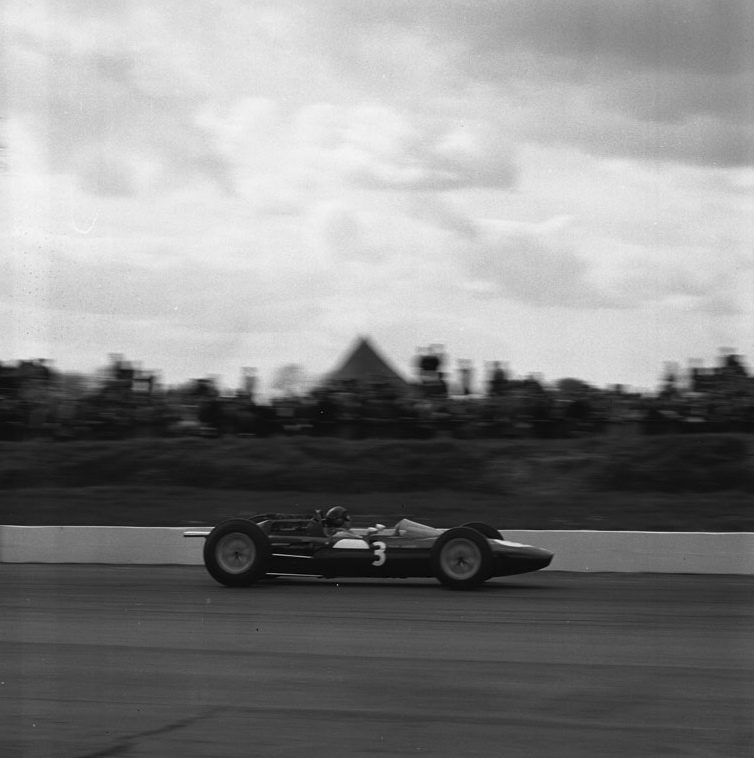
This they attempted. After packing the 25s back into the transporter and driving it to their regular garage on the outskirts of Towcester, they race-prepared the cars to standard spec before repairing to their hotel, the Brave Old Oak, in time for a half-past-nine drink at the bar. A “quick drink” then evolved into an all-nighter of a different kind – the liquid kind. Come Saturday morning, as the bleary-eyed Team Lotus crew hustled their transporter through the early-race traffic, all the talk was of the blonde girl who worked behind the bar…Princess Margaret and Lord Snowden attended the 1963 International Trophy; and the weather doffed its cap. A warm spring sun quickly replaced early cloud. One hundred thousand spectators poured through Silverstone’s gates, filling the grandstands and the grass banks right around the circuit. The British Grand Prix may have been but a couple of months in the future – here, at Silverstone – but the fans could not get enough. A clear example of how less is definitely not more – providing the product is right. In the Team Lotus transporter, between laughs, Jim Clark reflected on the good news: today they would forget the R6s. They’d race R5s. Dunlop wouldn’t like it but there you go. A race is a race.A masterpiece of a race. Jim started on the second row but was quickly up to second place, trailing his friend Bruce McLaren for a couple of laps before slicing past and pulling away. Suddenly he had a Lotus 25 around him. Suddenly he had balance and feel when on Thursday he been obliged to drive mainly on reflex, dumbing the understeer with induced flick oversteer. Now he was four-wheel-drifting the 25 through Copse, Becketts, Stowe and Club. Now he was using every inch of road through Woodcote and again past the pits, making the art of ten-tenths driving look sublimely simple.
He won it – and he won it with ease. It was a Clark Classic on the old R5s in Lotus 25/R5. Bruce finished second and Trevor drove well to make it a Team Lotus one-three. Innes, quick all weekend, finished fourth – but not before recovering from a big spin at Woodcote, the thick tyre smoke of which effectively ushered-in a new era – the era of the soft-compound Dunlop R6. Never before had rubber been so burnable – or so sticky. Innes revolved the 24 at high speed – probably on oil dropped by the Surtees Ferrari, which eventually retired – but kept the car on the Ireland. A few years before, the odds of that happening would have been too small even to contemplate. Now, if we can combine those new grip levels with more compliant sidewalls, thought Jim and Colin, then we’ll definitely have a race tyre…
It was a fun day, too. Sir John Whitmore was again magnificent in the Cooper S; Mike Beckwith won his class with the Normand Lotus 23B; Jack Sears scored the first of his many wins with the big Ford Galaxie – a car that Jim had driven over at Indy, when he was filling in some time one quiet day at the Speedway; Graham Hill won the GT race in John Coombs’ lightweight E-Type; and Denny Hulme again won the Formula Junior race in the factory Brabham, just beating David Hobbs and Paul Hawkins. Earlier that week, Jack himself had driven the FJ car, helping Denny with set-up and with a few circuit pointers. Then there was the business with the Miles Messenger. Racing over, Jim and Dan piled into the cramped four-seat cockpit; bags were stuffed into the small luggage compartment (no room for the trophy!); Colin fired up the DeHaviland Gipsy engine, opened the throttle…and nothing happened. The old four-seater remained bogged in the Stowe mud, its wheels intransigent. Out jumped an amused Silverstone winner and his buddy, Dan – and off, in a lighter Miles, set Colin. Even as the little aeroplane was gathering speed, Jim and Dan were scambling aboard.
Four connections and 4,000 miles later, the two Team Lotus friends were at Indy, ready to test on a warm Monday morning.
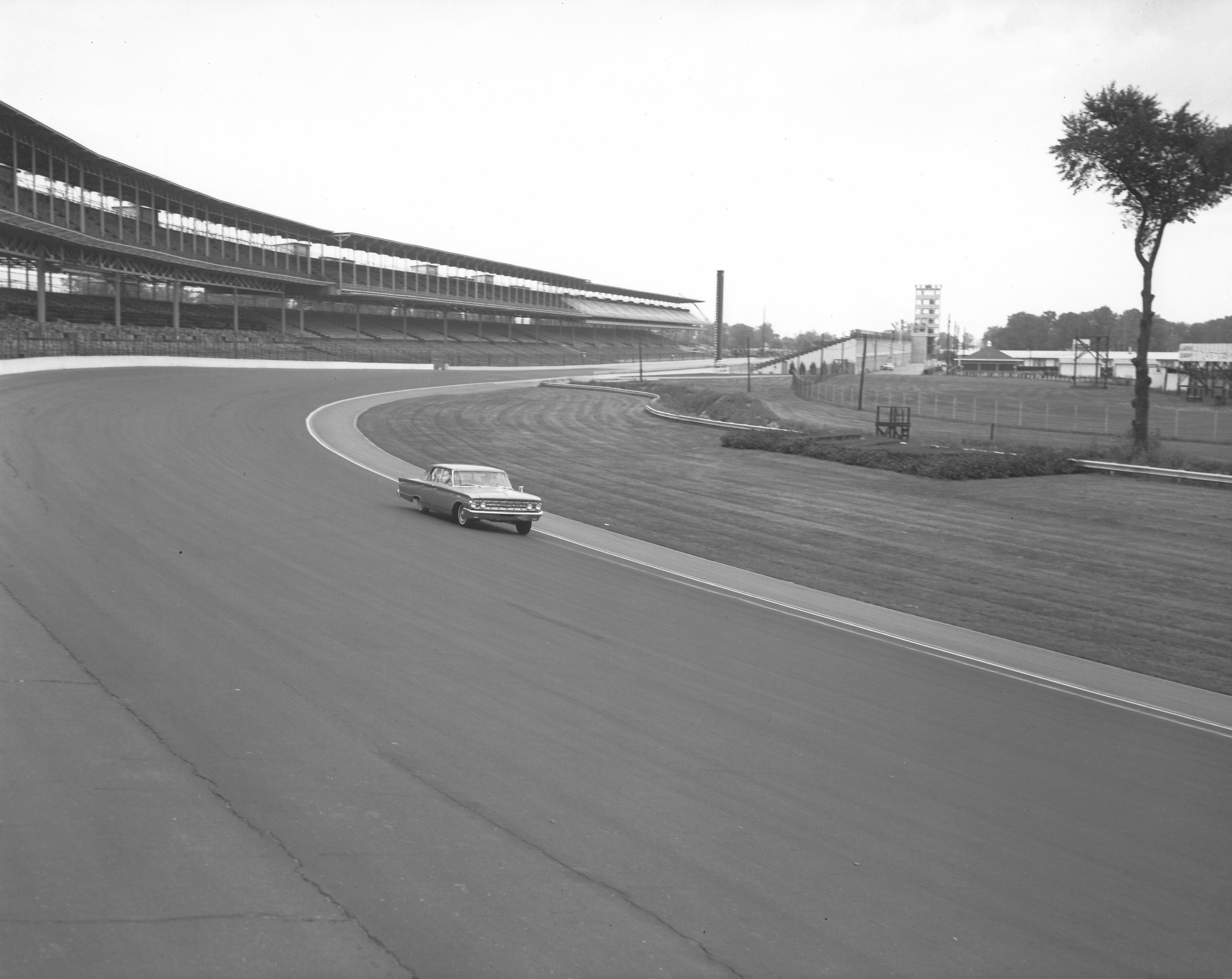
Captions from top: Dan Gurney, in new Hinchmans, Colin Chapman and Jim Clark, still in Dunlop blues, talk wheels and tyres early in the Indy month of May; Jim fingertips 25/R5 out of Becketts en route to victory; late in ’62 Jim had fun at the Speedway with a road-going Mercury Monterey. Images: LAT Photographic, Indianapolis Motor Speedway. For more on Hinchman overalls: http://hinchmanracewear.com
















 peterwindsor.com