In this week’s post-Singapore episode of The Racer’s Edge, we talk to Derek Warwick about those reprimands; to GP2 winner and Mercedes F1 Third Driver, Sam Bird, about his success this year and the styles of Nico and Lewis; and Rob Wilson, our favourite driver coach, analyses Sebastian Vettel’s approach to those most boring of corners – the slow chicanes. Hope you like it.
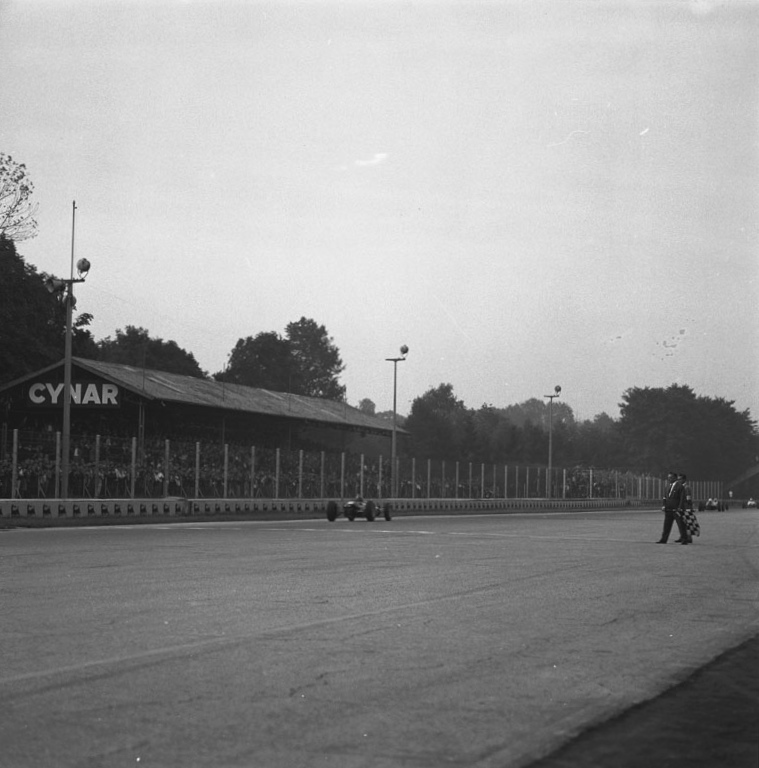
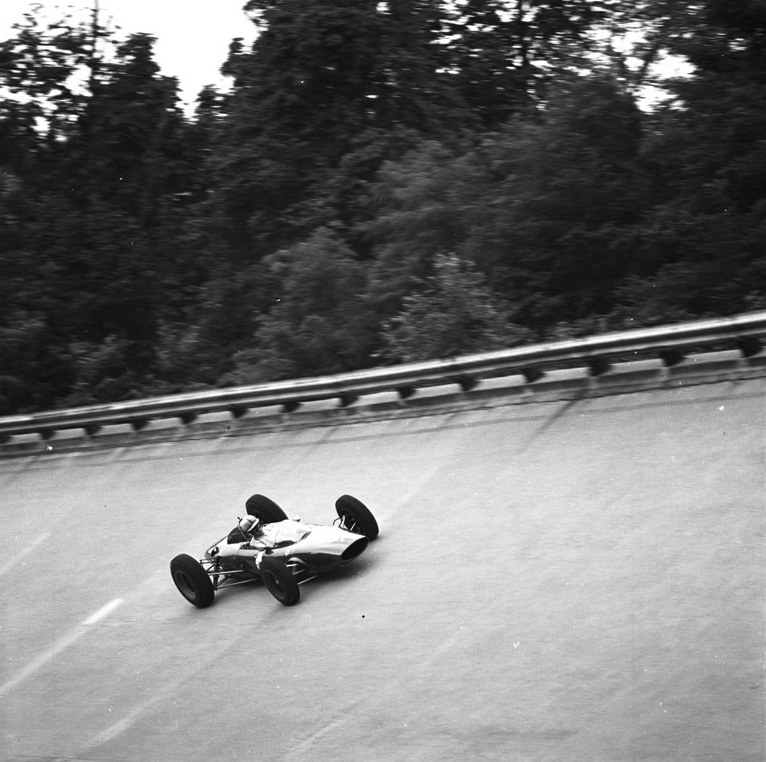
They drove, despite their misgivings, on the Friday. The steep Monza banking had long since established itself as the fastest race track in the world – some 30 mph faster even than Indianapolis. The British teams, wary of the damage caused by the bumps, had boycotted the Italian GP in 1960. Phil Hill had that day won for Ferrari, thus becoming the last driver ever to secure a World Championship victory in a front-engined Grand Prix car. Seat belts had appeared for the first time in Europe at the Races of Two Worlds in 1957-58 but not for the usual reasons – not because the drivers believed in not being thrown from their cars in the case of accident. They were worn just to keep the drivers in the cars while they were running… (That combined Indy-F1 race, incidentally, was run in heat form for the simple reason that the teams needed time to rebuild their cars after each segment. Had the race been run non-stop it is unlikely there would have been any finishers.) Ferrari’s Luigi Musso took the pole for the 1958 race at an average speed of nearly 170mph (281kph).
No surprise, then, that Jack Brabham led the tentative, pre-Italian GP boycott in 1963. The banking had not been used in 1962, so why revert to it now? When push came to shove, however, Black Jack and Dan were out there on Friday morning, nosing around.
Jim Clark and Colin Chapman, already wary of Italian politics (following the Von Trips accident of 1961) stayed relatively neutral. Jim had a World Championship to clinch. Ferrari had new cars and engines to beat. They settled into the Hotel de la Ville, opposite Monza’s Villa Real, with some trepidation. Monza – Italy – is never easy.
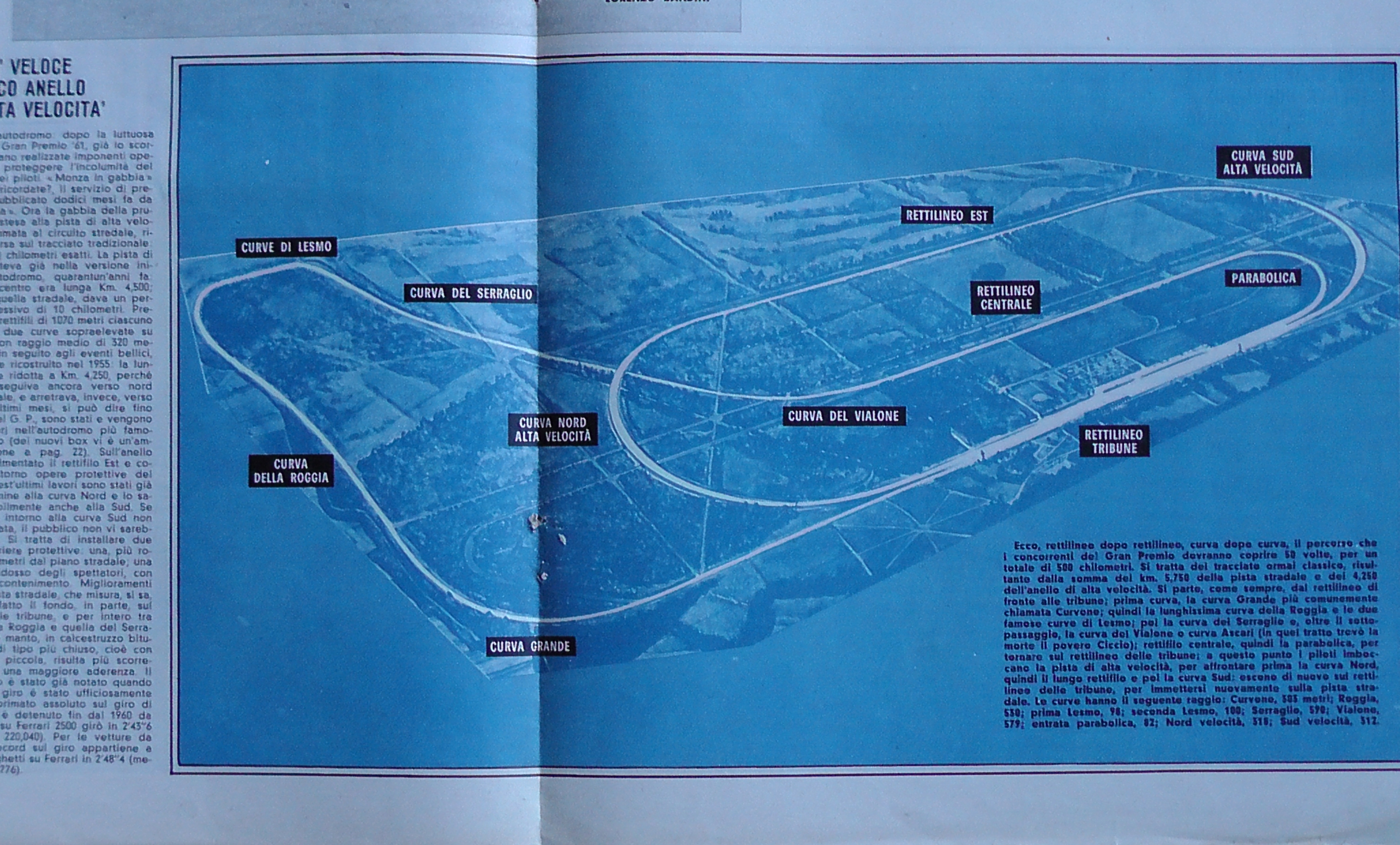
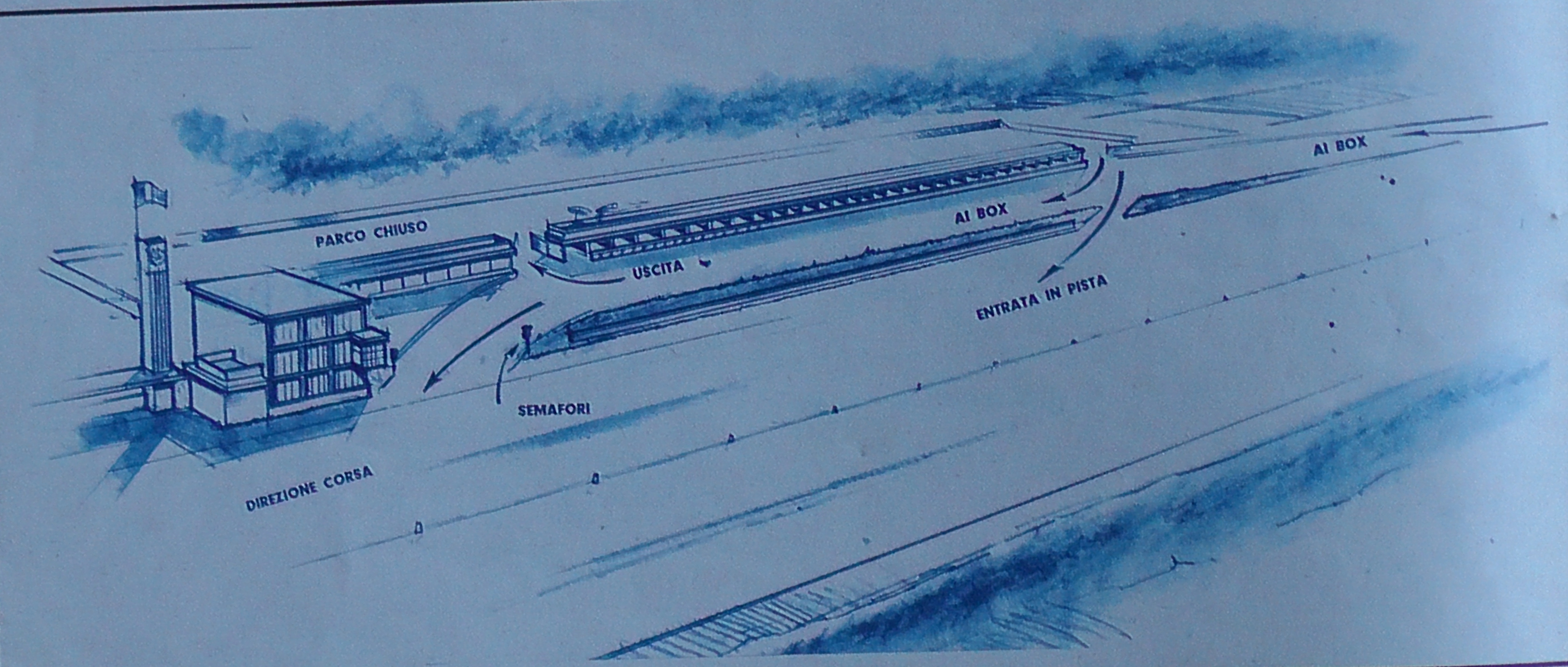
And so onto the banking they ventured that Friday morning, ride heights raised, suspension stiffened…pick-up points stressed. The combined road-course/oval shared the same pit straight, divided only by cones (the oval’s straight nearest the pits). The oval was flat-out in top gear; the road course was pretty much as we know it today, minus the first, second and Ascari chicanes. Team Lotus initially sent out Mike Spence (in the carburettored car, standing-in for the injured Trevor Taylor). His 2min 48.1 was beaten only by the BRMs of Richie Ginther and Graham Hill and Masten Gregory in his Parnell Lotus 24-BRM. Brave stuff.
Then Bob Anderson crashed when his privately-entered Lola-Climax lost a wheel on the banking; luckily he was uninjured. The teams suddenly became adamant: unless they raced only on the road course there would be no Italian Grand Prix. The Automobile Club of Milan acquiesced only moments before the GPDA handed in its petition. The banking was shut off. Although it would be used by sports cars through to 1969 (slowed by entrance chicanes from 1966 onwards), the Monza banking never again played host to F1.
Somewhat disrupted, therefore, but much happier, the teams set about their new challenge – an Italian GP on the familiar, 1962, layout. For Jim, problems quickly arose. He was hoping to race the new Hewland gearbox tried in Austria but quickly it failed. Reverting to his regular ZF gearbox, Jim qualified only third, 1.7 sec slower than John Surtees in the new monocoque Ferrari V6. Lorenzo Bandini, making his debut with the older, space-frame Ferrari, was behind Jim and alongside Dan Gurney on the third row. With the monocoque BRM also performing well in the hands of Graham Hill, who qualified second, Monza was looking as though it was going to be very different from the season’s previous high-speed race, at Reims.
In the end, it was the usual, nail-biting slipstreamer. The lead changed no fewer than 25 times before it was finally settled in favour of Jim Clark. For Jim, though, his forehead protected by white masking tape, the better to stop his Bell Magnum from creeping up in the slipstream, the day was bittersweet, as he recounted in Jim Clark at the Wheel: “Being so much slower than John in practice really sapped my confidence, and I felt dismal on Friday and Saturday. It got so bad that, before the race started, I had fitted a new engine, gearbox, gear ratios, reverted to the standard windscreen and changed the tyre sizes. This meant starting the race not fully knowing what the car would be like when it arrived at the first corner. From the start, though, the car was better. In Surtees’ tow I could gain an extra 500rpm and by the third lap I could relax a little and still maintain my position behind him while, behind me, Graham and Dan were having their own private battle. On about the 17th lap I noticed a puff of smoke from the tailpipes of John’s Ferrari. It was no surprise when he dived into the pits the following lap.
“This left me in the lead but with a problem on my hands. It was not worthwhile stretching myself or the car so long as Graham and Dan were behind me, towing one another around. I was basically a sitting duck and when they passed me I remember they whisked by so quickly that they almost caught me on the hop. I then managed to get into their slipstream. The three of us had a grand race of it before Graham retired. Dan and I then had a great set-to, for our cars were fairly equal in performance. I remember at one stage coming up to lap Innes Ireland in the BRP-BRM. He was much quicker than both Dan or I down the straights but we had him on the corners. I first tried on one bend to get past on the inside but Innes blocked me off. Then I tried again and the same thing happened.
“The next time around I thought I would play it crafty, so I waited until Dan had come up close behind me and I made a pass at Innes. I eased off slightly and let Dan go through. Innes thought that Dan was me and moved over again – but no-one does this sort of thing to Dan. In the ensuing battle of wits Dan eased Innes out, and while he was doing that I passed both of them.” (Ireland, whose relationship with Jim had been strained ever since he had been dropped from Team Lotus at the end of 1961, would have finished third at Monza but for an engine failure on the last lap; as it was he came home P4). “Dan had to retire shortly afterwards with fuel starvation and I was able to settle down at last to win the Italian Grand Prix and assure myself of the World Championship.
“I couldn’t believe it when I arrived at the pits after my slowing-down lap. The place was crowded with photographers and Colin had a bit of a fight getting through to me. However, he managed it and he climbed on the back of the Lotus with the silver trophy and we covered a lap of honour, picking up Mike Spence, who had broken down on the back of the circuit while heading for sixth place.
“Colin and our wonderful team of mechanics were ecstatic. It gave me great pleasure to share this victory with them. To escape the mob afterwards we dived into the Dunlop enclosure, where someone came up and informed me that the Italian police wanted to see me immediately in race control. When I got there, I discovered they wanted me to sign a document written in Italian relating to the Von Trips accident of 1961. I naturally refused to sign it. Coming as it did on what should have been a night of celebration, this affair depressed me so much that all I wanted to do was get out of Italy. I didn’t care if I never returned to the place. Consequently, it was a very subdued victory party at the de la Ville, enlivened only by a bun fight between the Lotus and Cooper teams.”
Jim flew home early on Monday with Jack Brabham in the latter’s Cessna 180. He headed straight for Balfour Place – and then to a press conference in Fleet Street, home of the British daily press. Most of the questions, sadly, related to 1961, not 1963.
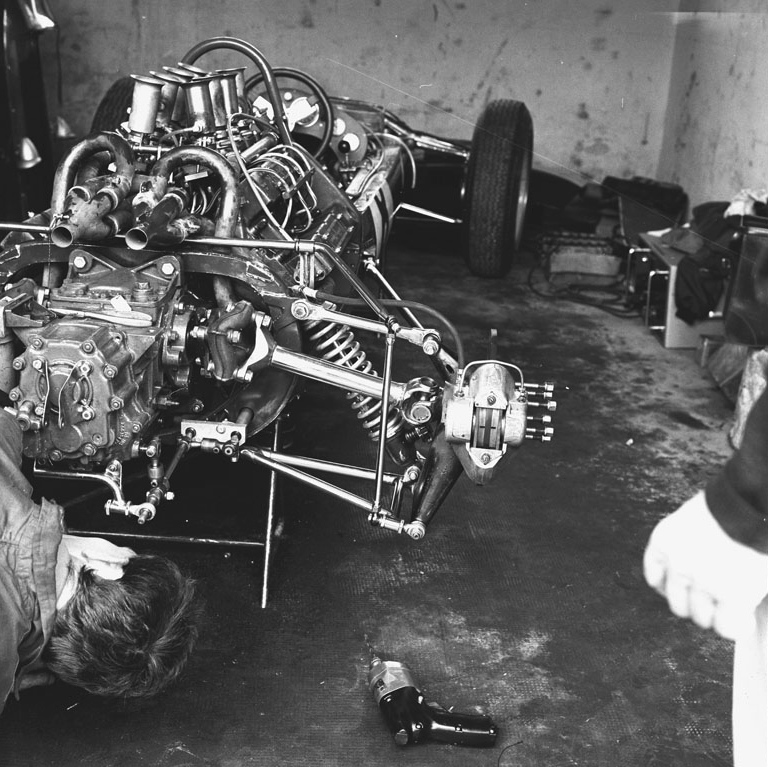
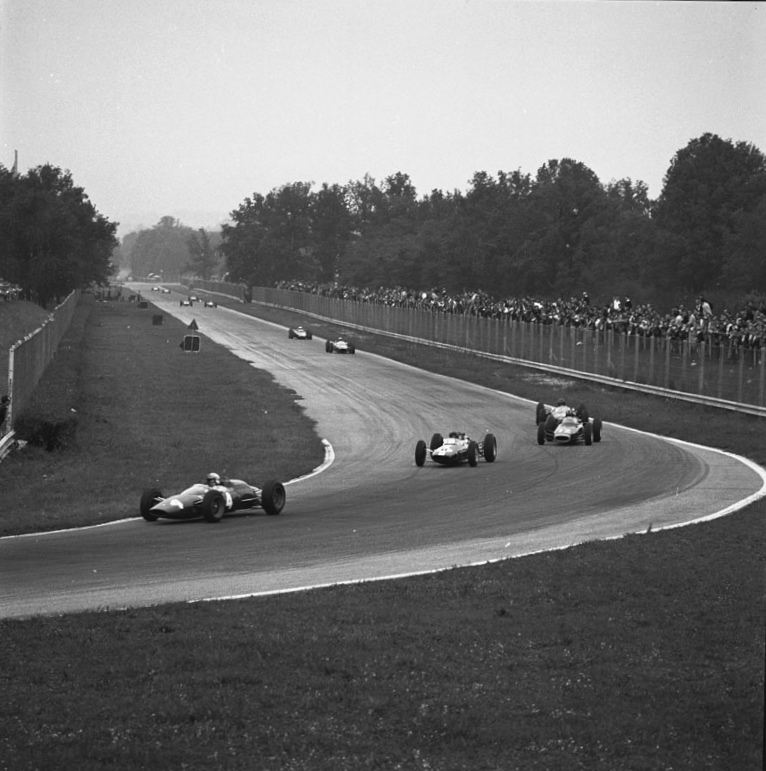
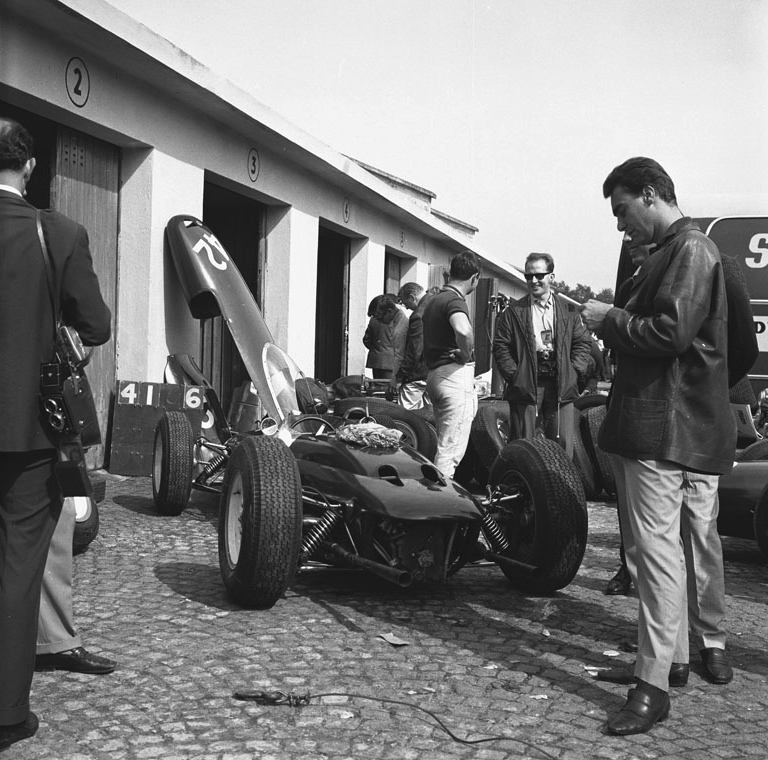
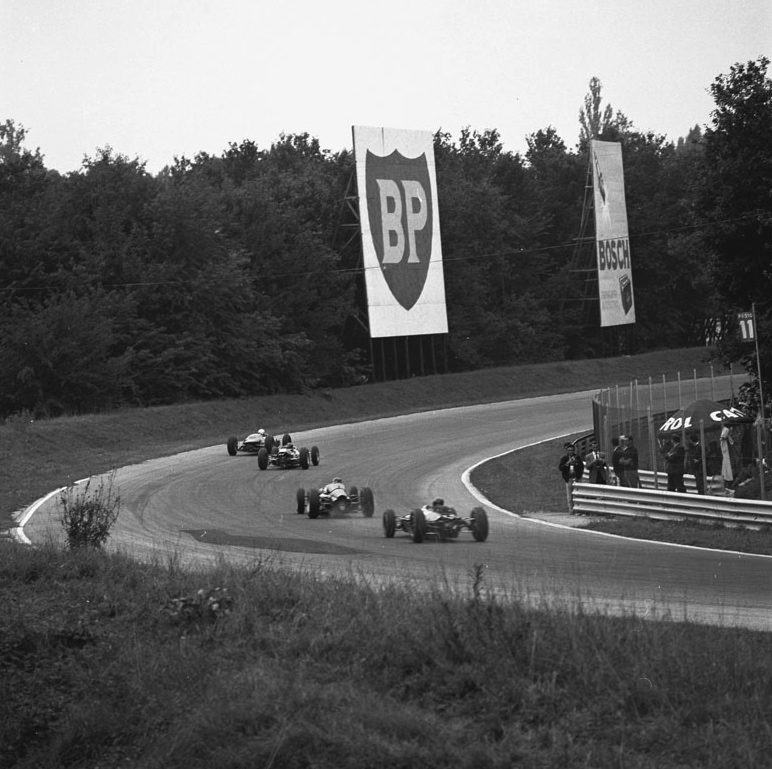
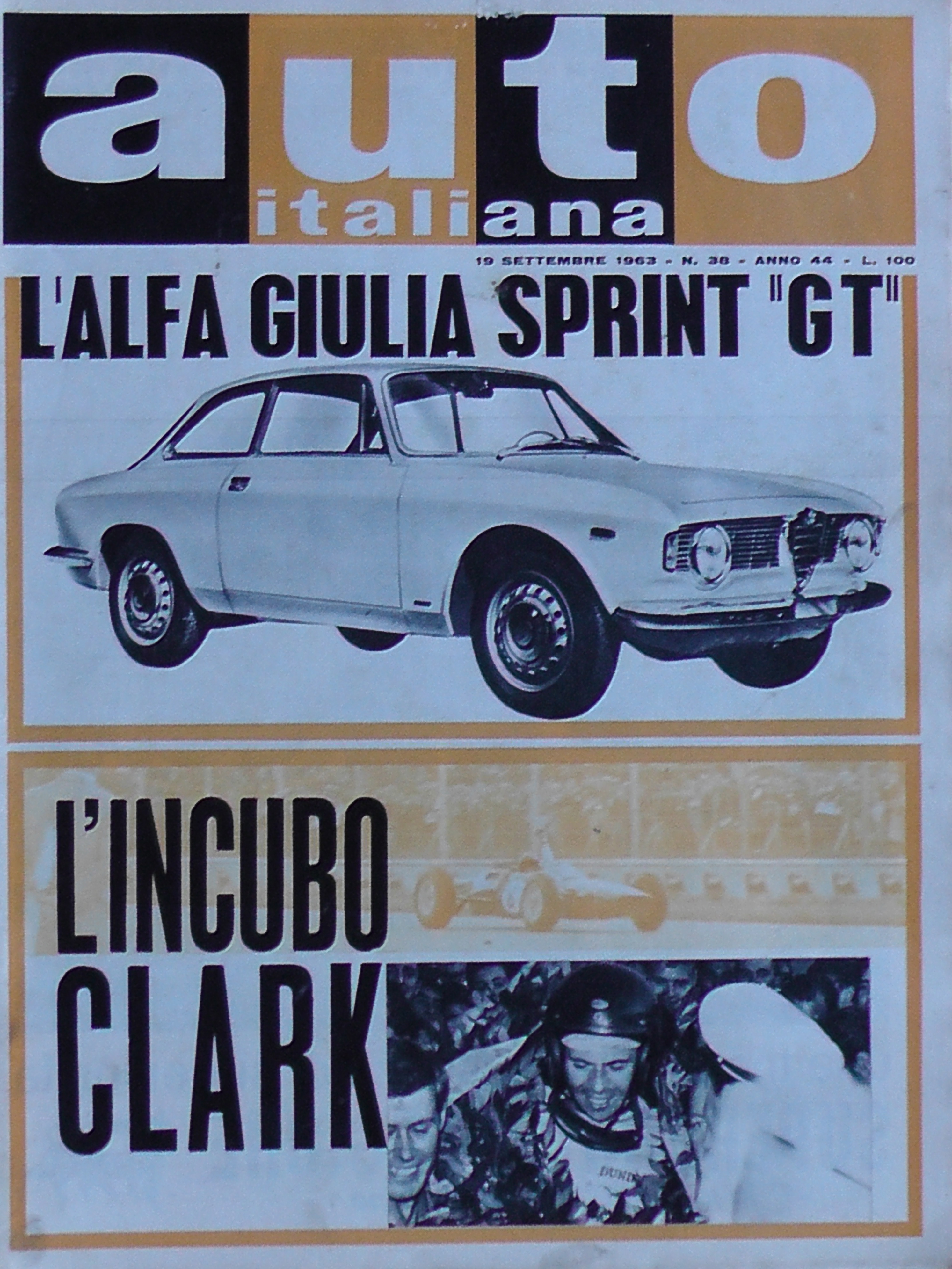
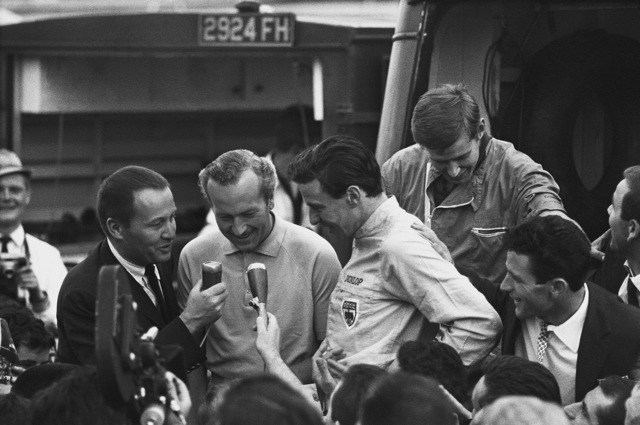
Captions (from top): although he feared the worst, Jim eventually won convincingly. With five wins and a second place to his credit from seven starts, he clinches the 1963 World Championship; early on Friday morning, John Surtees tries both the Monza banking and the new Ferrari V6. He was easily quickest in qualifying but retired with engine failure (broken tappet). Team Lotus, then, won the race of reliability!; the combined road course/banking layout as drawn by the excellent (but sadly now defunt) Italian weekly, Auto Italiana, in its preview to the 1963 Italian GP; Auto Italiana‘s explanation of how the complex Monza pit straight/pit lane system was going to work (with banking in use) for 1963, a new, higher pit wall was built; Jim’s 25 was extensively re-fitted and revised before the race; Surtees leads Jim and then Graham Hill and Dan Gurney into the Parabolica in the early laps; Chris Amon (pictured here talking early on Friday to Eoin Young (probably about the new Bruce McLaren Cooper team that would contest the 1964 Tasman Series!) was lucky to escape a big practice accident at the Lesmos with broken ribs; rearward view of the aforementioned lead group; front cover of Auto Italiana in the week after the race. Two artists here – Jim Clark and Giovanni Bertone; below – to the backdrop of the Lotus truck, and before the drama with the Italian authorities, Jim McKay interviews Colin and Jim for ABC’s Wide World of Sports. Images: LAT Photographic, Peter Windsor Collection
I hope the show we’ve put together this week gives a little bit of a taste of what we’ve been up to over the past few days on our Italian roadtrip. I’d like to say a very big thankyou to Jonathan Giacobazzi, who achieved the almost-impossible with his laps of Brisighella in the Ferrari 312T4; to the organizers of the Trofeo Bandini; to Alpinestars, who are celebrating their 50th birthday this weekend; to Renault, for building the amazing Captur (the perfect family touring wagon even for the likes of Jack Windsor); to Cory Pesaturo, who wrote music and then performed it, especially for this show; and to Diego Merino and Rodrigo Camacho, both of whom helped with the photography.
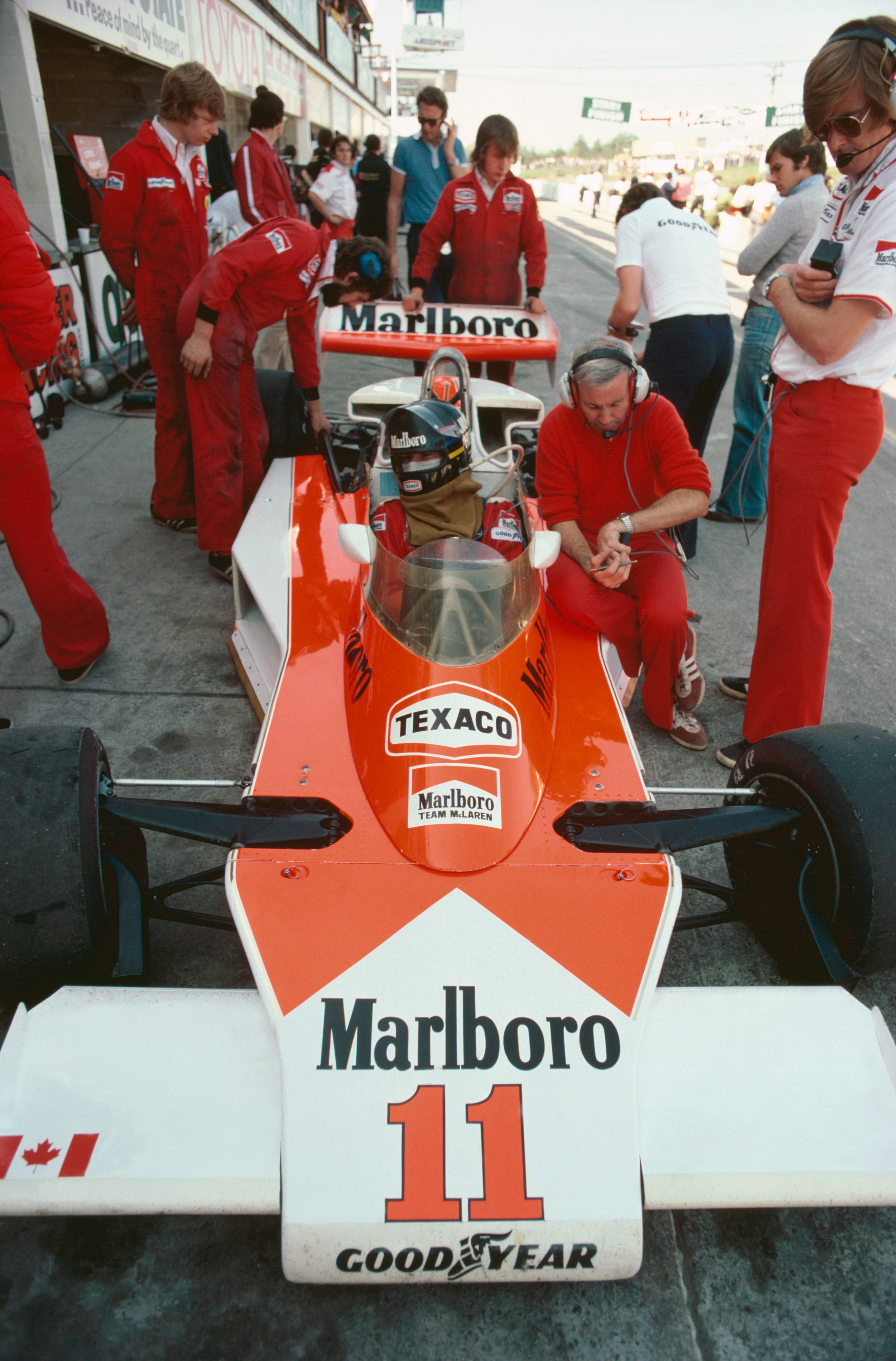
Alastair Caldwell (right, with headset, talking to James Hunt at Mosport, in 1976) is our guest this week on The Racer’s Edge – which means that at last we can sit him down and talk to him in outrageous detail about those early days at McLaren, about Bruce winning his first race in a car bearing his own name – and about the tricks they used to play back in 1976, when James Hunt fought Niki Lauda all the way to the Drivers’ World Championship. We also catch up with Charlie Kimball, the son of the former McLaren and Ferrari Design Engineer, Gordon Kimball. Last Sunday, Charlie won his first IndyCar race (with Chip Ganassi Racing) Images: LAT Photographic; TRE Production: Knockout TV in association with F1 Racing
Monday, August 5, was a holiday in the UK in 1963, which meant that all eyes turned towards Brands Hatch for the Guards Trophy (as in Carreras Guards filter cigarettes). This was a classic British international race meeting run by the British Racing and Sports Car Club (BRSCC) in front of a classically-large crowd. The feature race was for sports cars over 50 laps; support events were for saloon cars, smaller sports-racing cars and GT cars. Consider that this meeting was staged exactly 24 hours after the German GP, and that the line-up of drivers at Brands included F1 stars like Jim Clark, Graham Hill, Lorenzo Bandini, Trevor Taylor, Innes Ireland and Tony Maggs, plus other names like Roy Salvadori Roger Penske, Jack Sears, Timmy Mayer, Paddy Hopkirk, Sir John Whitmore, Frank Gardner, Mike Salmon, David Piper, Lucien Bianchi, John Miles (the future Lotus F1 driver) and Ray Parsons, (Jim Clark’s part-time mechanic) and you have a picture of what motor racing in the 1960s was all about: it was about the drivers – about star names having one-off races in interesting cars, regardless of their chances of winning. Trevor Taylor, for instance, jumped from an F1 Lotus 25 at the Nurburgring into a Lotus Elite at Brands. The World Champion, Graham Hill, swapped his works BRM for a Jaguar 3.8. Le Mans winner, Lorenzo Bandini, went from his Centro Sud BRM to a big Ferrari 330LM.
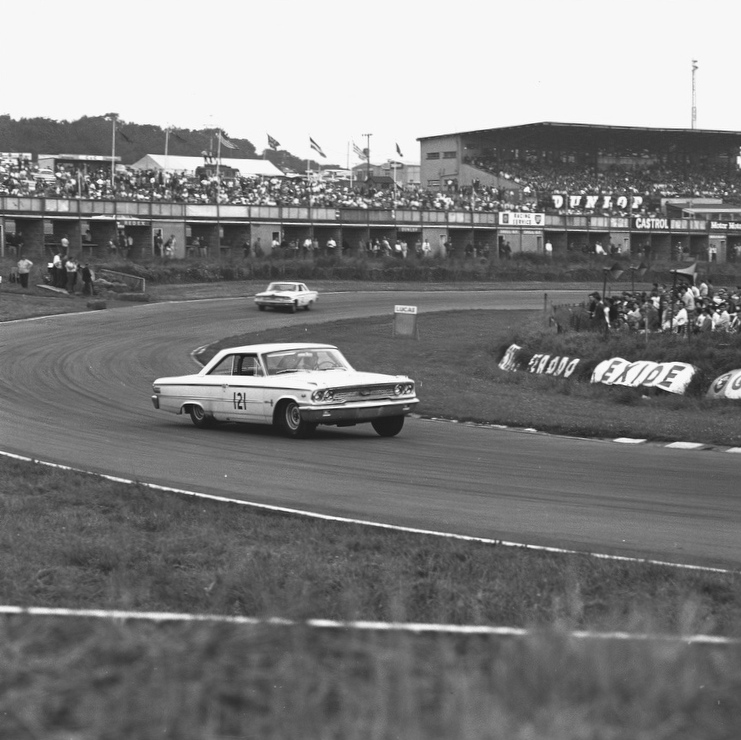
And Jim Clark, if you please, stepped from his Lotus 25 into…a Holman-Moody-prepared, Alan Brown-run, 7-litre Ford Galaxie. Featuring lightweight panels, blueprinted V8 and stripped interior, this two-door “fastback” Galaxie was one of three Ford-commissioned, Holman and Moody-prepared cars to colour the British touring car scene in 1963. One Galaxie, owned by John Willment (who knew Holman and Moody well from his interests in marine engines) immediately won races in the skilful hands of Jack Sears; the Alan Brown car was effectively a “guest” Galaxie, driven by Dan Gurney, Jack Brabham and, at Brands, Jim Clark; and Sir Gawaine Bailey, the very rapid baronet, owned and drove the third car. Lee Holman, son of John, was 18 when, in early 1963, he was asked to drive the Alan Brown Galaxie from the H-M headquarters in Charlotte, North Carolina, to the port of New York. “We put some Brillo pads up the exhaust to try to dampen the sound,” remembers Lee, “but the biggest help were the $100 bills I took with me to pay off the traffic cops! One of them stopped me somewhere in Virginia so I showed him the paperwork about the car being owned by the Ford Motor Company and being shipped to the UK for racing and he was so impressed that he let me go…”
It’s hard to picture it, now – Jim, Graham, Trevor, Tony Maggs, Lorenzo and Innes all rushing back to England to race their widely-different cars at this Brands International. Jim wasn’t even in the big race! Instead, he could relax down at the lower end of the paddock with Alan Brown and the mechanics, settle himself into the Galaxie’s spacious, padded “bucket” seat and apply some of the intel he’d been given by Dan. The left-hand-drive Galaxie had a “four-speed, on-the-floor (L-shaped) shifter”, a lap seat belt only, a deeply-dished plastic steering wheel and a lateral (ie, not longitudinally-braced) roll-bar. Driving it was all about taming the power – ie, minimising the wheelspin and the oversteer….and allowing for brake fade.
Why was Jim racing that Monday in a car he’d never even tested? As much as Jim loved to drive nimble sports cars on the road like the Lotus Elite, Lotus Elan and Porsche 356 he was also amused by the concept of big, comfortable American “slushmobiles” like the Galaxie. And controlling the Galaxie on a race track appealed to Jim’s sense of curiosity. Ask one of the current F1 drivers to compete in a Porsche Supercup race and their initial response – even before they considered the complication of contracts – would be to ensure that their image was not dented by the likes of a Sean Edwards; Jim had no such qualms. He was intrigued by the concept of racing the Galaxie; he liked the Ford connection, in view of his plans to race more extensively in the US; he liked the Holman and Moody people, who were at that point doing great things with the Falcon Sprint rally cars in Europe; and he wasn’t afraid of being beaten by an ace like Jack Sears: this was but a part of motor racing.
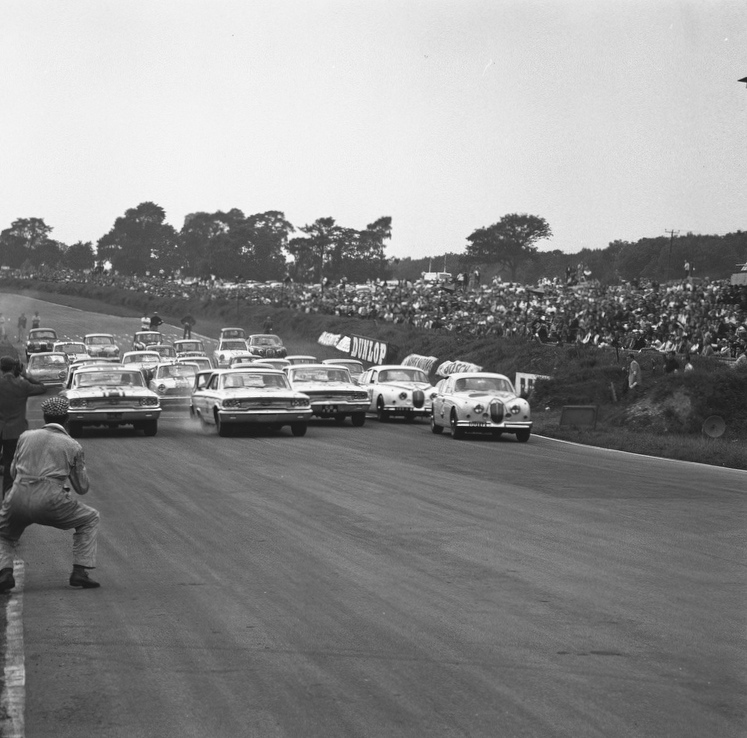
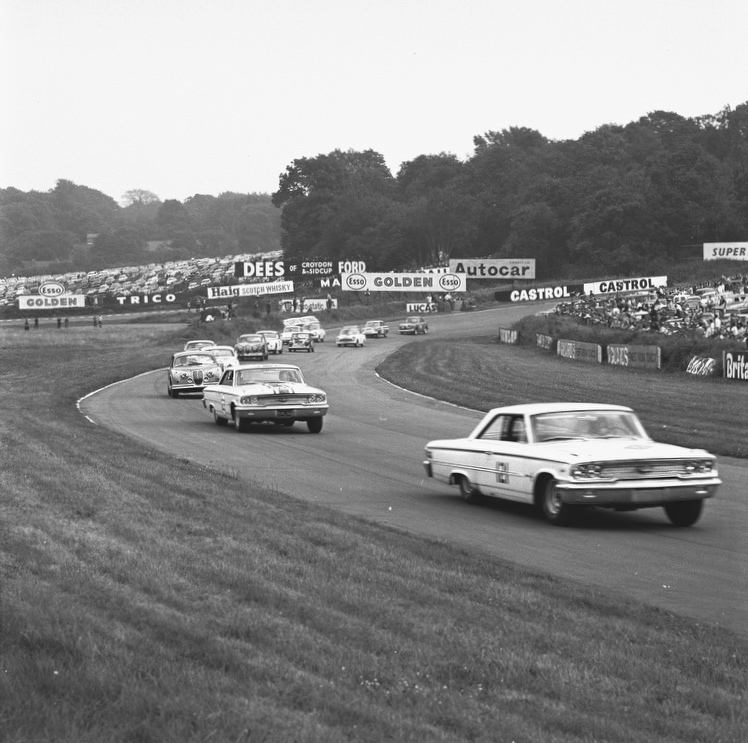
As it happened, Jim qualified second to Jack but seized the lead into Paddock Bend: Jack’s start, on the lower side of the track, had suffered from the usual Brands Hatch wheelspin. Jim held the inside line up the hill into Druids, won the mid-corner barging match at the hairpin and headed the field into Bottom Bend, his right rear Firestone picking up the dirt as he power-slid the big Galaxie onto Bottom Straight. Jack Sears had won on all types of circuit (from Silverstone to Crystal Palace) with the Willment Galaxie and was not about to fall away; it was Jim Clark, though, who emerged from the back of the circuit still in the lead. One can hear the voice of Anthony Marsh now, as the lumbering V8s teetered into Clearways:
“And it’s Jim Clark in front! Clark leads from Sears and then come the three Jaguars – Graham Hill in the Coombs car, Roy Salvadori, Mike Salmon, who banged into Sir Gawaine Baillie’s slow-starting Galaxie off the line…”
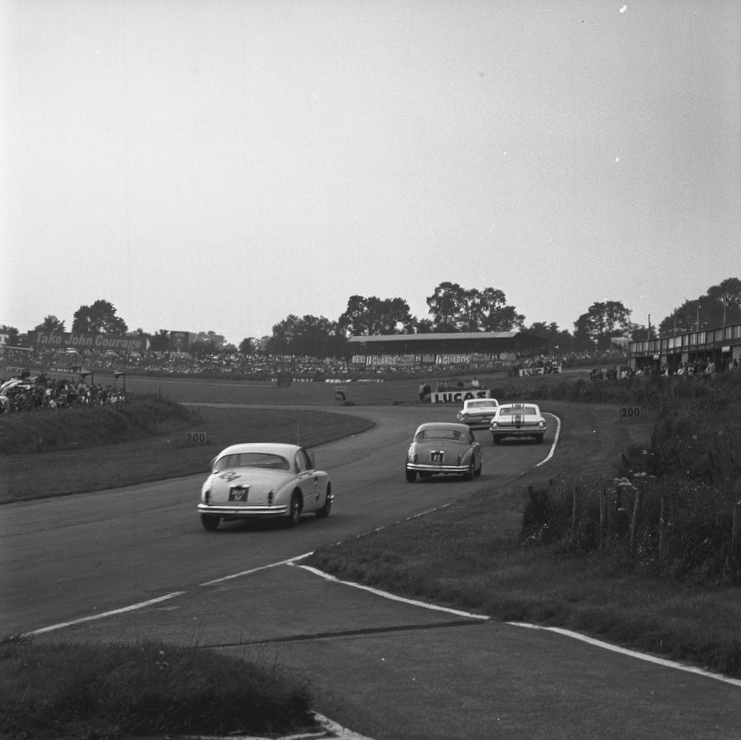
Jack, for once, ran into trouble – a punctured Firestone, to be precise. Jim was left to win from F1 arch-rival Hill – but not without incident. David Haynes demolished his Cortina GT on Bottom Straight right in front of Paddy Hopkirk’s Mini. Paddy took major avoiding action on the grass – but Jim, too, was forced to put two wheels out there on the turf to miss the melee. Fortunately, Haynes escaped uninjured.
So Jim won the 20-lap Slip Molyslip Trophy for B-class Group 2 saloon cars. The race was considered at the time to be so minor that no pictures at all were published in Autosport of the F1 Championship leader in the Galaxie. Instead, the headlines went to Roger Penske, who won the Guards Trophy with his Zerex Special (basically a Cooper-Climax F1 car with bodywork). Frank Gardner’s Brabham beat the Lotus 23s in the sports car event; Bob Olthoff, who on August 18 would, with Jack Sears, win a 12-hour race in Washington, USA, in a Willment Cortina GT, took the up-to-3-litre class of Jim’s race; and Sir John Whitmore again reigned supreme in his Mini-Cooper. (Sir John would also win the GT race with his Stirling Moss special-bodied Elan.) Balfour Place was thus heaving that Monday night – particularly as Cleopatra was on the agenda for Jim and Sally. Jim would head over to Cheshunt on Tuesday to see Andrew Ferguson (to sort out some accounts!) – and they would leave on Wednesday for Sweden, where Jim was due to race in the non-championship F1 event at Karlskoga, near Orebro, west of Stockholm. Jim had had the pole there in 1961 but had retired from the race with that old Lotus foible – broken front suspension. Here was a chance to redress the balance.
Also eagerly awaiting the appearance of F1 stars on his home track was an Orebro 19-year-old who had over the past 18 months been winning a string of kart races. His name was Ronnie Peterson.
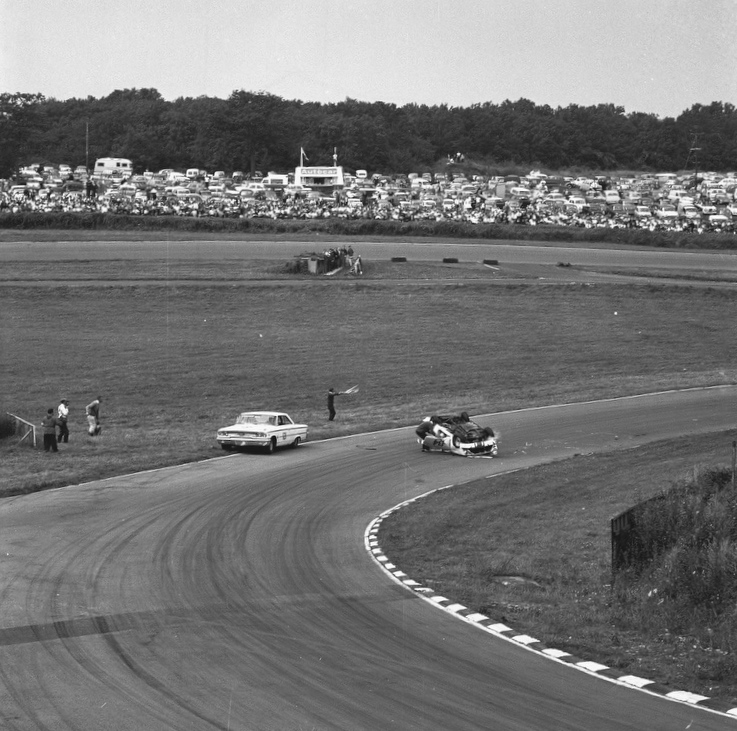
Captions, from top: Jack Sears sits on the pole with rear wheels spinning while Jim (middle of the front row) smokes away from the line. On the right, Graham Hill is up-and-running in John Coombs’ 3.8 Jaguar; lap one, and Jim leads Jack Sears along Bottom Straight. Amongst the Jags, Roy Salvadori has passed Graham…; rear view of the opening lap battle. Characteristically, Jim has already begun an early, small, initial turn towards South Bank Bend (with brakes yet to be applied). Jack, more traditionally, is beginning to brake to a wider turn-in point; within a couple of laps, Jim had begun to put a little air between his Alan Brown Galaxie and Jack’s Willment car. Here, on the entrance to the uphill South Bank Corner, he balances an oversteer slide; Jim takes to the grass to avoid what remains of David Haynes’ Cortina GT. Images: LAT Photographic
As Jim Clark’s 1963 season continues, we head to the Nurburgring
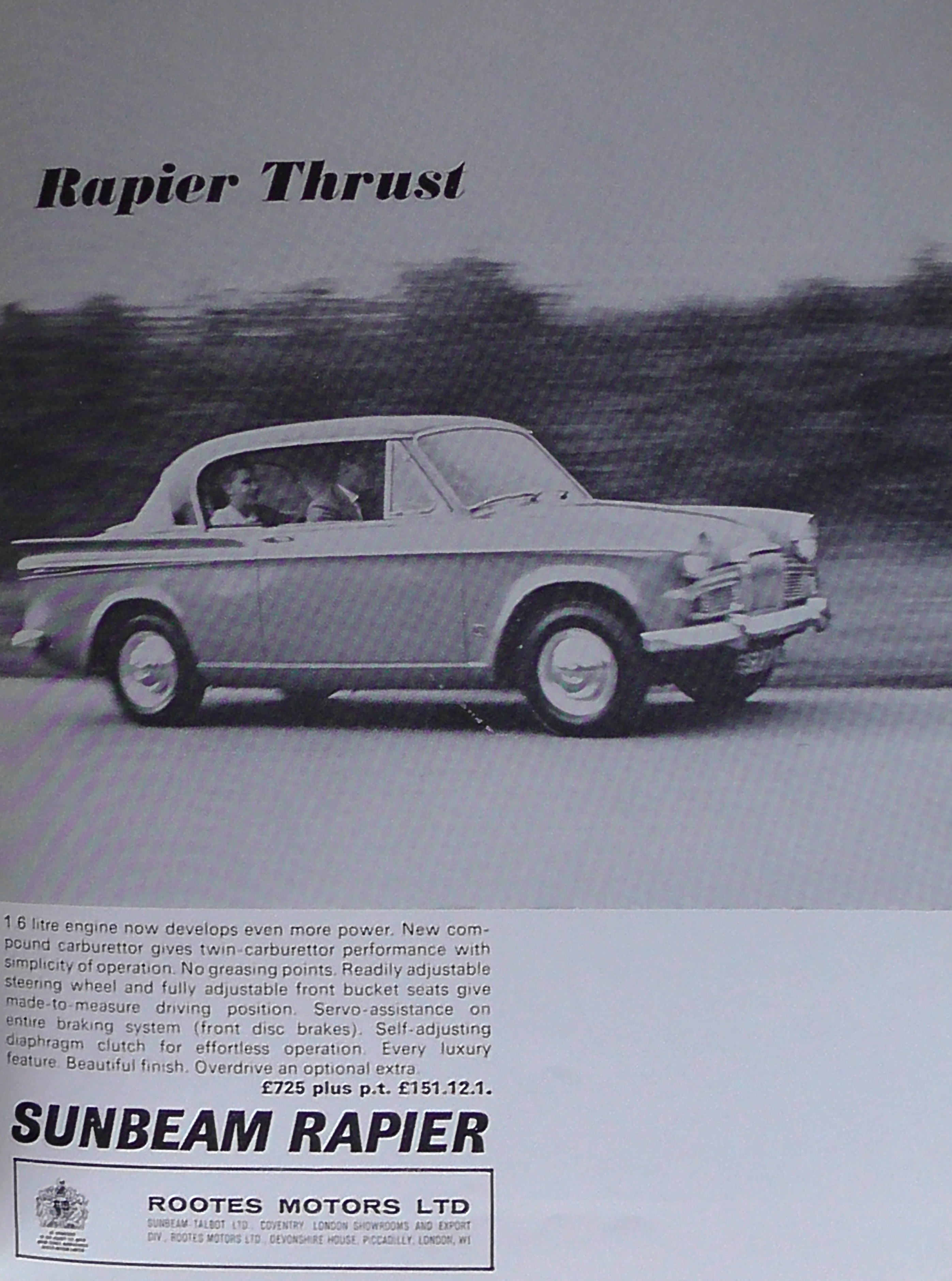
Bruce McLaren journeyed to the Nurburgring, for the German GP, in a Sunbeam Rapier road test car (arranged and co-driven by his secretary, Eoin Young). In the days when standards, and tastes, were more in tune with real life, Bruce described the Rapier as “surprisingly fast” and “very comfortable”. He would have cause to repeat his descriptions, post-race, in ways that he could never have imagined.
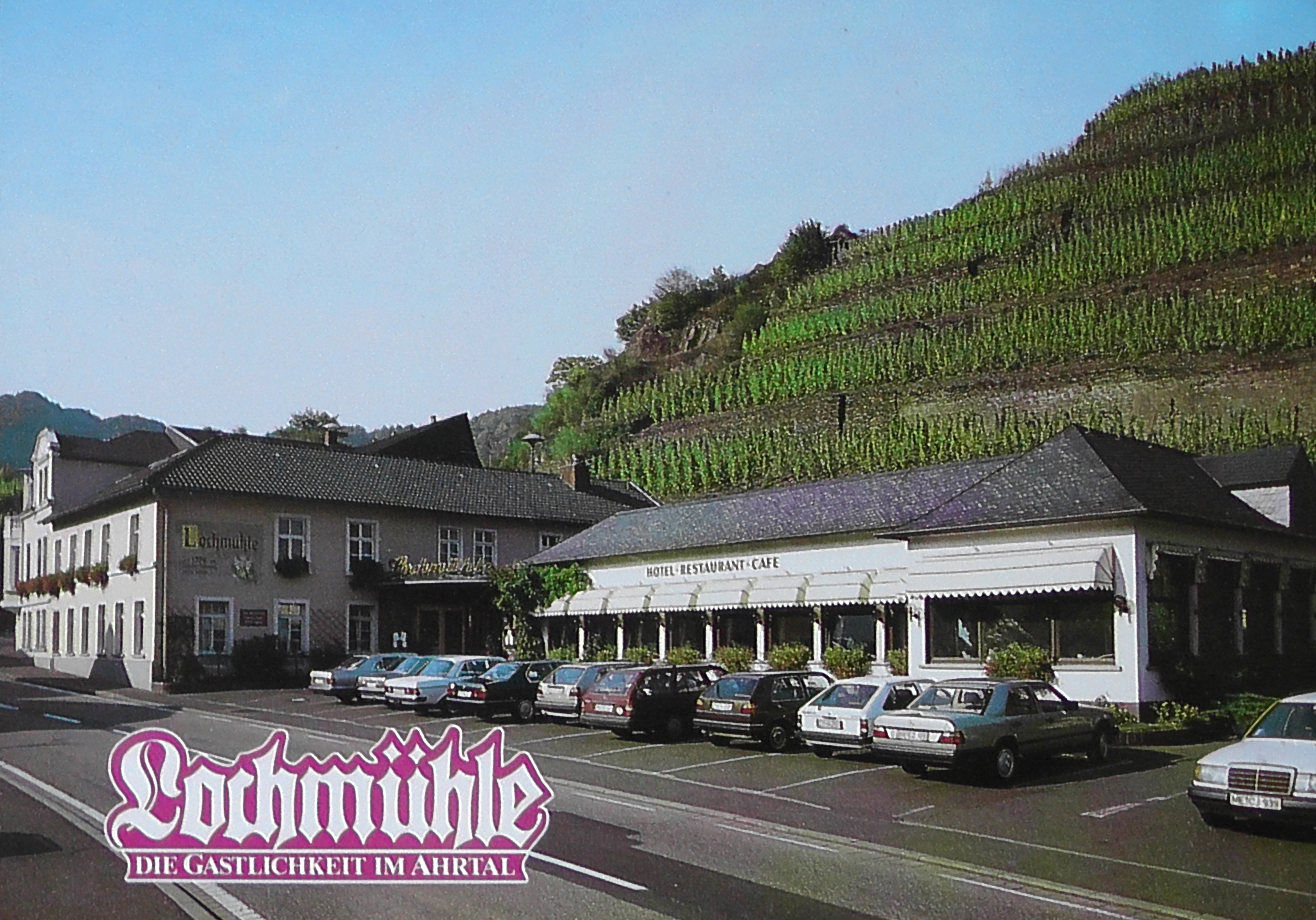
As in 1961 and 1962, when they had raced as team-mates in John Ogier’s Essex Racing Team, Bruce McLaren and Jim Clark stayed at the Lochmuhle hotel in Altenahr for the 1963 F1 race. There’s no record of exactly what they specifically ate that weekend, but Bruce had said this about their stay the previous year: “They serve some of the best food in Europe at the Lochmuhle and, as Essex were paying the bill, most of us stuck to four large courses, such as lobster or that delicious oxtail soup, followed by a quick chicken and mushroom entrée or pate, then an exotic steak, grilled with oranges and tomatoes or a wine sauce. Jim generally managed to fit in a grilled trout, probably caught an hour earlier in the river by the hotel. For a small man, it was amazing how much he could stow away!”
Jim, Peter Arundell and Trevor Taylor attended Huschke’s Sunday night party in Solitude and thus Jim and Trevor left at a leisurely hour for the autobahn thrash up to the Eifel hills on Monday. Jim was thirsty for a win on the circuit that for him represented the greatest of all tests of drivers’ skill. He had first raced there in 1961, in that Essex Aston with Bruce, and had quickly learned the circuit in Bruce’s 3.8 Jag. Then, two months later, he had finished fourth in the German GP in the Lotus 21. That race will forever be remembered as one of the finest hours (or two and a half hours!) in the career of Stirling Moss – but Jim’s fourth place, in his first full season, nursing a brake problem in the spare car (after a big practice accident), should never be under-rated. From then on, Jim had a Monaco-like relationship with the 15-mile circuit: he was always quick, always its master – but the circuit, in turn, always found a way of throwing him a joker. Whilst leading the 1962 1000km race easily in the Lotus 23, Jim became nauseated by an exhaust gas leak from a loose manifold. And at the ’62 German GP, whilst focussed on de-misting his goggles, he forgot to switch on the fuel pump just before the start. He recovered to finish a brilliant fourth.
Now, with four World Championship victories behind him, and that new lap record at Solitude, Jim was returning to the Ring with the Lotus 25 in its latest, delectable, form. Of course he could be worried about suspension failures and the like over the switchbacks of the ‘Ring; he knew that Cedric Selzer and the boys were, too. He trusted them, though; and, ultimately, he had to trust Colin Chapman.
Jim began Friday practice with his race Climax engine from Solitude; and, continuing that Solitude connection, a driveshaft broke (again) as Jim was preparing for a quick lap. He thus finished the session third-quickest behind John Surtees in the works Ferrari and Lorenzo Bandini’s old Centro Sud BRM. Cedric Selzer and the boys fitted new driveshafts during the lunch break in the Team Lotus lock-up garage in the paddock quadrangle. Bratworst anyone?
Then, in the afternoon, it rained on the main part of the circuit (but not in the pit area). In a nice counterpoint to 2013, all the drivers nonetheless ventured out. Jim was quickest, slicing his 25 through the mist and standing water in 9m 44.0sec. Surtees was second and Ritchie Ginther third in the factory BRM. Overnight, Jim asked for an engine and gearbox change. Oh yes, and how about leaving reverse out of the ZF ‘box on this occasion, just as a safeguard against any further selection issues? It’s one thing to hold the car in gear through the Masta kink; it’s another to do so over a blind brow at the Nurburgring…
It was dry, but overcast, on Saturday, which meant that now was the moment for The Lap. The 25 felt taut on exploratory looks around the North and South Curve loops; the new engine, mated to the new ZF, seemed strong. Jim lowered himself in.Peakless Bell, Dunlop blue overalls, Leston string-backed gloves, Westover shoes. No seat belts.
The new engine faltered. It coughed, irritatingly, as Jim left Pflantzgarten for the long roller-coaster straight at the finish. And it wasn’t just a question of losing a second or two: the baulk killed his acceleration run through third, fourth and fifth gears. There was no telling how much time he had lost.
Still, though, he was on the pole: that was the quality of the lap. 8min 46.7sec – the fastest ever recorded at the Nurburgring. Without that mis-fire (or whatever it was), he could easily have been in the 43s. Surtees, looking consistently quick, was second-fastest; and third – amazingly – was Lorenzo in the old BRM. It was at about this time that Jim’s long-lasting friendship with Lorenzo was born. Graham Hill, always a threat at the ‘Ring, rounded out the four-car front row; and Bruce was on the inside of the second row in the Cooper, ahead of Ritchie and Jack Brabham. Dan, again wearing a white, Clark-like, peak on his Bell for this race, had nothing but engine trouble with his Brabham. Was Solitude but a dream, he must have been asking?
Wally Hassan, of Coventry Climax, was present at the ‘Ring (on the third anniversary of the V8’s appearance) and suggested the usual remedies: plug changes, fuel injection clean-outs. In the quadrangle, as they all sat and stood around, and as the mechanics worked flat out, Jim’s engine sounded perfect. Fingers were crossed for tomorrow.
The start I encourage you to watch on the German TV video below. Drivers shuffle in their cockpits; officials wave hands and twitch flags. Some of the slower cars begin to creep. Not Clark. The 25 stays rock-solid still. And then – bang! Jim releases the clutch against revs, the rear tyres smoke and he is gone, soaring into an immediate lead…
His start, indeed, was exactly as he planned it: “I decided that a fast start was absolutely vital,” he would say later to Graham Gauld, “because, with all its twists and turns, the ‘Ring can be tricky for anyone trying to overtake, particularly in a Grand Prix car. So when the flag dropped I departed as quickly as possible…”
It wasn’t to last. As Jim selected third gear – and this can just be seen on the video – his engine hesitates again, just as it had on his pole lap. “Surely I haven’t oiled a plug on the line?” he thought, fearing the worst. Jim had specifically started the engine only a few minutes before the off to prevent just such a problem. Now, as he focused on the first left- and right-handers and then on the run down back behind the pits, he could see the pack surging nearer in his mirrors. All around the lap he lived with the problem. Ritchie Ginther went past in the BRM – then Surtees. The engine would feel as if it was on seven cylinders – and then suddenly it would go onto eight, mid-corner.
In time, of course, Jim began to maximise what he had – “but my progress was erratic, to say the least,” he would say later. “I developed a whole new system for going around the Nurburgring on seven cylinders. This was completely spoiled on occasion because I would arrive at a corner I knew was flat-out on seven cylinders and set the car up. Then the eighth cylinder would come in with a bang and there would follow an exciting second or two as I sorted the car out. What a difference that one cylinder makes when you have committed yourself to a line with what you thought was a seven-cylinder motor car!”
For the most part of the race Jim was able to keep the Ferrari of John Surtees in sight; indeed, as can be seen in the videos, he was on some parts of the circuit able to re-take the lead – for John, too, was fighting a mis-fire of his own. Usually the Ferrari ran on six clear cylinders; occasionally it ran on five. Surtees was up there with Clark, allowing for the intrusions, fighting with the car.
And, towards the end, he was able to pull away, for Jim began to feel his gearbox tighten. On this occasion Jim would settle for second place – the first and only second place he would ever record in a World Championship Grand Prix. It wasn’t a question of “driving for points” because of “the championship”. It was simply a question of “bringing the car to the finish”. He did so – 1min 20sec behind John. Afterwards, the engine problem was traced to yet another dud spark plug.
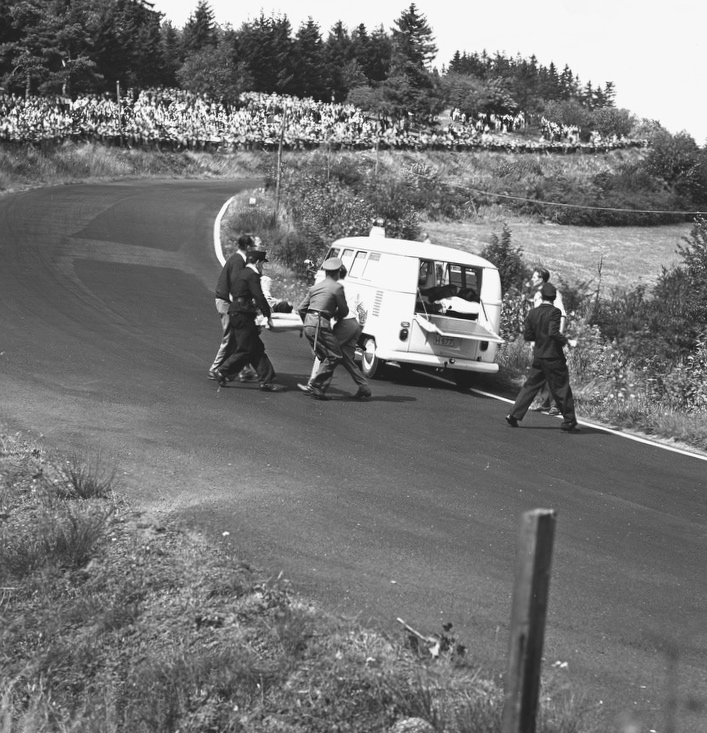
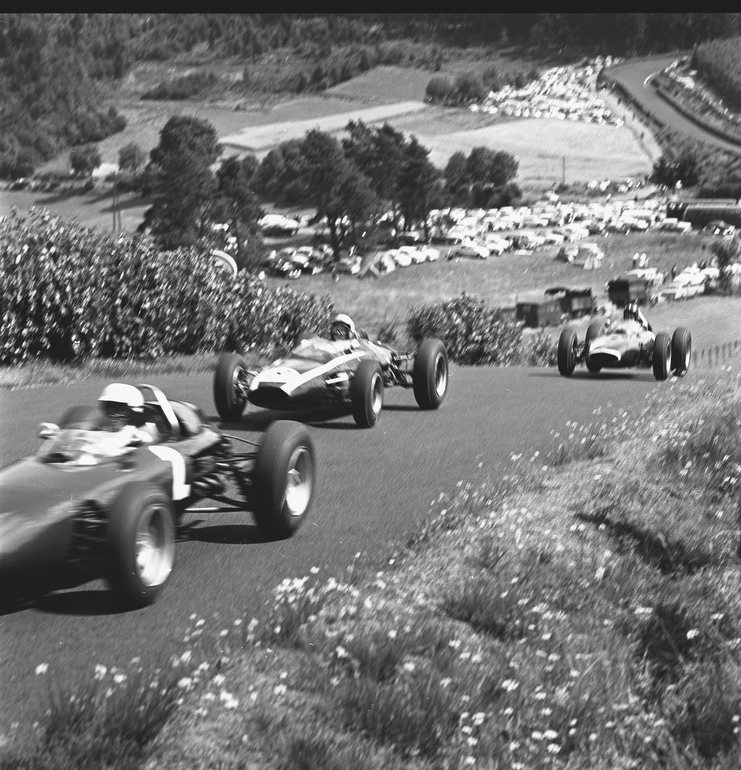
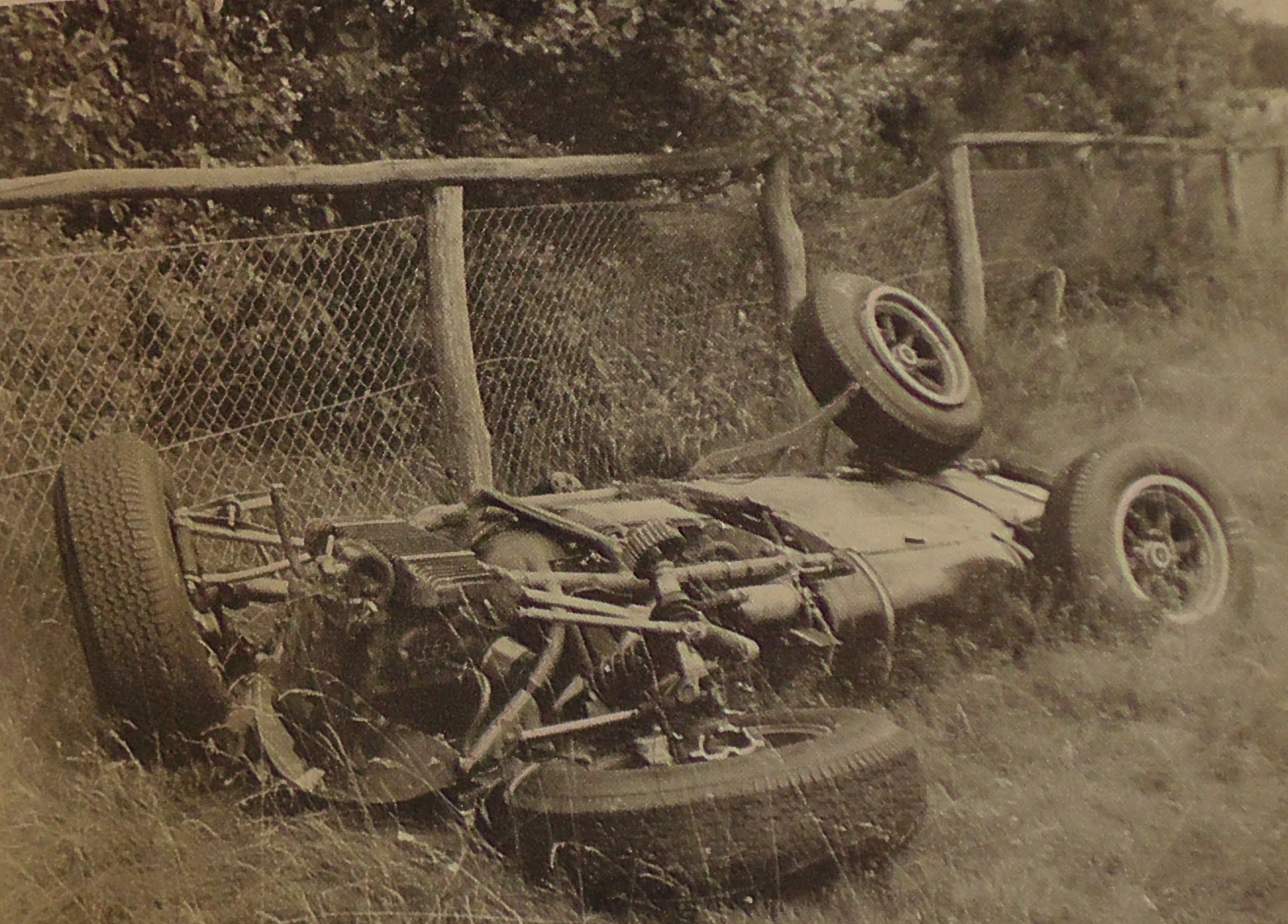
It was in many ways a momentous race, marked for eternity by highs and lows. John Surtees, the former mult-World Motor Cycle Champion, had now won his first Grand Prix; for their part, Ferrari had scored their first victory since that dark day at Monza, in 1961. Ferrari’s other driver, Willy Mairesse, had meanwhile been seriously injured when he lost his car at Flugplatz; Bruce McLaren had crashed heavily when his Cooper broke a rear wishbone (as distinct from the front suspension that had cracked in practice!); Bruce had been thrown out and knocked unconscious but further, serious, head injuries had been prevented by his new Bell Magnum. Chris Amon had broken a couple of ribs when the suspension also failed on his Parnell Lola. Lorenzo was out early after a shunt with Innes Ireland’s BRP but had still done enough to earn himself a works Ferrari drive at Monza (in place of Mairesse). Amon, Jo Siffert and Jo Bonnier could all have finished fourth but for mechanical dramas. (Dan Gurney, who also retired his Brabham, can be seen briefly in the German TV feed, standing by the Rob Walker Cooper after it retired with a “broken chassis”); at the end, fourth position had been taken by a German (Gerhard Mitter) and his old Porsche (shown on the video near the podium); Jim Hall had again driven extremely well to finish fifth; and third, after leading and spending most of the race holding his BRM in gear, was another American, Ritchie Ginther. Over 350,000 paying spectators attended this German GP – even though a Gerhard Mitter-type result was about their greatest expectation; for these were the days when people watched because it was their national Grand Prix and because these were the best drivers in the world, regardless of nationality.
All the drivers – or those who weren’t in hospital – attended the Sunday night celebrations at the Sport Hotel. Jim visited Bruce in Adenau, where he was relieved to find him in reasonably good spirits, and left the victory proceedings early, for he was racing at Brands Hatch the following day in Alan Brown’s Ford Galaxie. Bruce regained consciousness in his hospital bed, completely unaware of how he had got there. “I was a bit shocked at first,” he said later, “because all around me in the same ward there seemed to be people with bashed heads and banged-up legs. I had this awful suspicion that I had caused all the carnage…” He hadn’t – but he had been very lucky. While Bruce’s wife, Pat, drove back to the UK with the Australian driver, Frank Matich (who was staying with the McLarens in Surbiton whilst building up his new Brabham for the 1964 Tasman series) Bruce, resting comfortably in the rear seat of the Rapier, his leg in a precautionary plaster, was chauffeured back to the coast by Eoin Young. It was then but a short hop across the channel in a BUA (British United Airways) Bristol Freighter, with Bruce staying on board the Rapier while Eoin re-fuelled in the cabin. Eoin then drove Bruce all the way to Kingston hospital, where his plaster was quickly removed. “After that crash at the Nurburgring I thought hard about my future,” Bruce would later say. “I had once promised myself to give up racing after my first big shunt. I realize now that that would have been the worst possible thing I could have done. If you are ever going to look yourself in the eye again, it’s essential to go straight out again and have a go…”
Even though Bruce would lose his life in another accident, at Goodwood, in 1970, I think these words would have been fully-endorsed by his friend, Jim Clark.
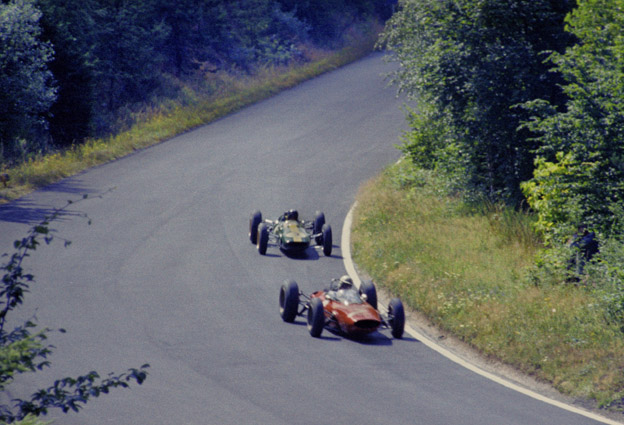
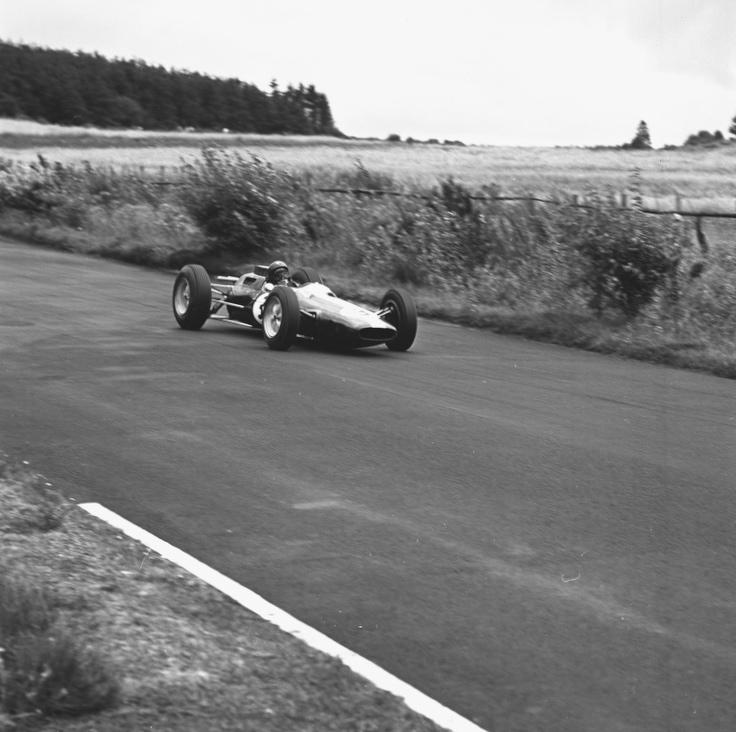
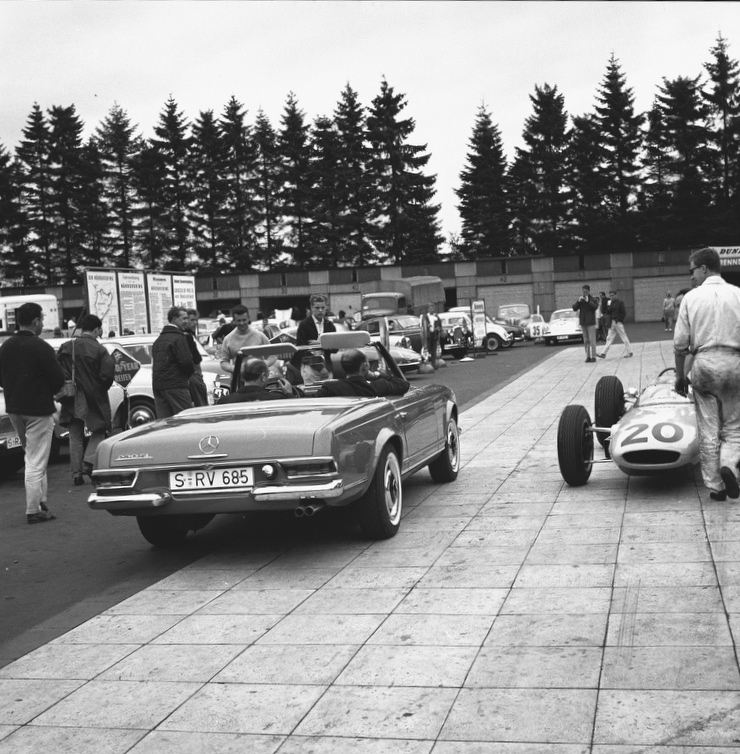
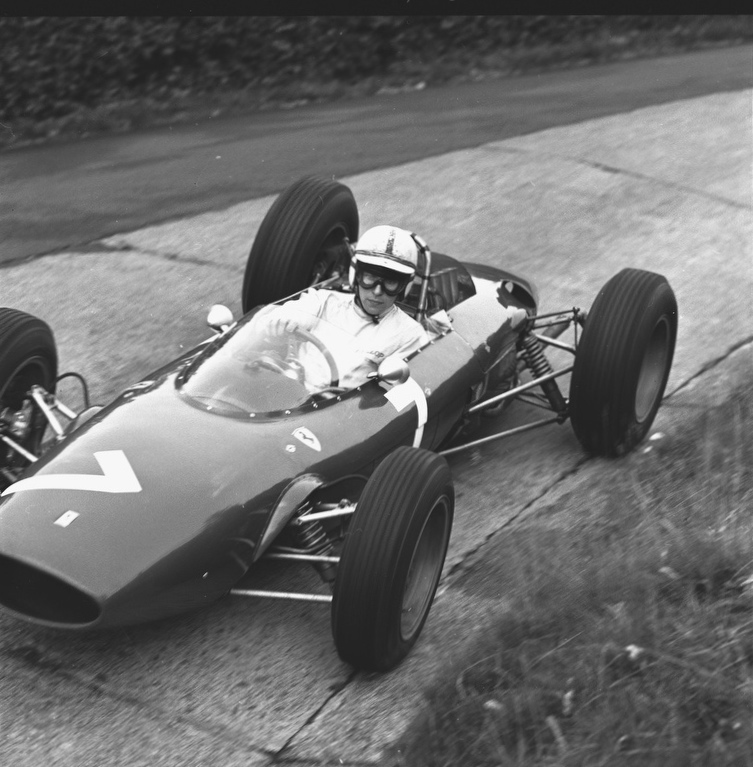
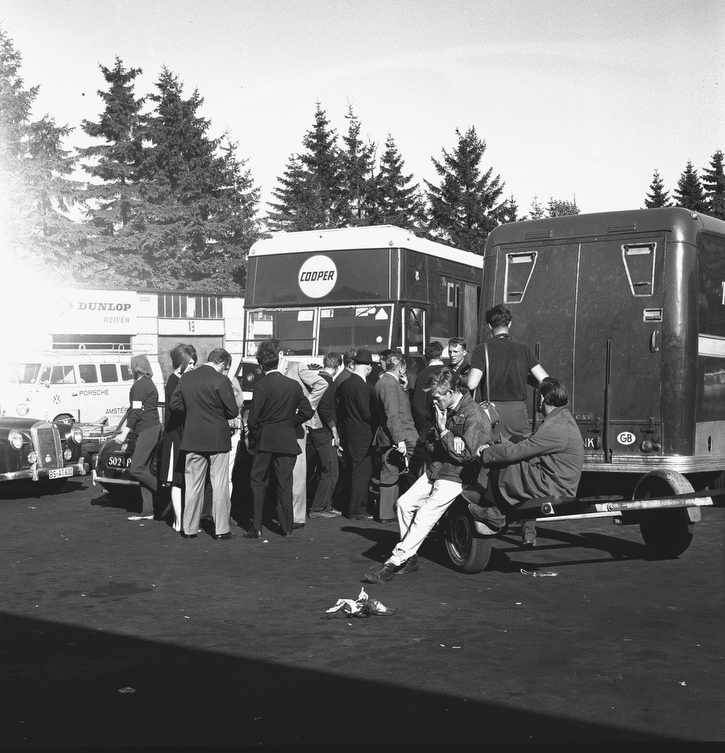
Captions, from top: John Surtees in the “V5” Ferrari leads Jim’s “V7” Lotus 25 around the Nurburgring; Sunbeam Rapiers were all the rage in ’63!; the Lochmuhle Hotel – still there today and still trout-worthy; despite yet another engine mis-fire, Jim Clark took the pole with a brilliant lap in the Lotus 25; in the days when former champions were regularly welcomed at races, former Mercedes F1 team-mates, Stirling Moss and Juan Fangio, had fun in a 230SL convertible. That’s Jim Hall’s fifth-placed BRP Lotus 24 on the right of the paddock quadrangle; Surtees glides the Ferrari around the Karussel; Willy Mairesse is stretchered to an ambulance after his Flugplatz shunt. This sort of scene was all-too-regular at the Nurburgring; Bruce McLaren was running his Cooper right up with the leaders before his big accident. And then there was that awful moment: Bruce’s team-mate, Tony Maggs, draws on a cigarette while journalists and team people hover nervously around the Cooper transporter, awaiting post-race news on Bruce’s condition. Note the Team Lotus truck on the right. Images: Grand Prix Photo; LAT Photographic; Peter Windsor Collection











 peterwindsor.com