Jim Clark in Mexico: 66% at 7,000ft
 The Team Lotus mechanics had been usefully employed at Ford’s Dearborn headquarters whilst Jim was racing at Riverside and Laguna, for the development Lotus 29-Ford was now scheduled to be tested at Indianapolis on the Tuesday and Wednesday (October 29/30) after the Mexican Grand Prix. As a group, though, they all re-assembled in Mexico City on Wednesday, October 23, for the first World Championship F1 race ever to be run on the futuristic autodrome. Following the sad death of Ricardo Rodriguez in the 1962 non-championship event, the last corner (Peraltada) had been re-modelled slightly but, otherwise, the circuit remained unchanged and a definite standard-setter. Over to Jim Clark’s mechanic, Cedric Selzer, for his description:
“The circuit was absolutely spectacular. The most amazing thing, so far as we were concerned, was that the garages were built into the back of the pits. Electricity, water and compressed air were laid on – and we had a work bench, too!”
The F1 cars all remained at The Glen for a week before being trucked across to Mexico on four huge semis – open-top semis! “As if this was not bad enough,” recalls Cedric, “the cars had been chained through the suspension wishbones. When they ran out of chain, they had then used bailing wire. This meant that some of the wishbones had to be changed as they were bent and no longer serviceable. Where the chrome plating had come off there was not a lot we could do about it. It was part of Team Lotus policy to keep the cars in Concours condition so we then spent a whole day just making the cars look the part. Then we set about making them reliable and quick…
“Coventry Climax and Lucas had designed a metering unit to compensate for Mexico’s 7,000ft altitude. This was not a five minute adjustment job because the metering unit was in the middle of the engine vee, under the throttle slides. It was impossible to get your hand in there so, being the smallest of the mechanics, I was required to remove the inlet trumpets and find my way through. Even so, the engines wouldn’t run very well during first practice. We then discovered a Vernier adjustment on the back of the revised metering unit. It was a simple question of pushing in a pin and rotating a little wheel.”
Bruce McLaren described the power loss in his Autosport column the week after the race: “The loss of power was generally accepted to be about 25 per cent. You gradually became accustomed to this during the practice sessions but it was the start of the race that really showed up the difference. I let out the clutch on my Cooper with the rev-counter showing the usual 7,000rpm and the engine nearly stalled, obliging me to slip the clutch a couple of times. Even so, I managed to pass three cars off the line (the two BRMs and Dan Gurney’s Brabham)!”
Jim received a bit of fright early on Friday’s four-hour practice session when a dog ran out in front of him. He narrowly avoided the stray but it would be a portent of the chaos that would typify the Mexican GP for several years thereafter. There were track invasions as the decade wore on; and, as late as 1991, I was stopped by the local police en route to the circuit for no obvious reason than that they wanted a couple of $100 bills; nor will anyone who was at that race forget Anthony Marsh’s hotel room in Mexico City being robbed in the dead of night…by one of the hotel security guards. Such was the Mexican GP. I guess it was all summed-up by the local Automobile Club being based in, um, a former house of disrepute. Everyone loved racing in Mexico…and will again love racing in Mexico…but you had to be ready for what you knew it was going to throw at you.
Practice was inconclusive – and very hard work for Team Lotus. Pedro Rodriguez’ carburettor engine had blown at The Glen – and did so again in Mexico: a tiny piece of debris had remained lodged near the timing chain. Trevor Taylor’s Colotti-gearbox 25 stopped with a broken first gear – and Jim stopped practice early when his ZF car developed its familiar tendency to jump out of gear. Even so – and partly because Saturday practice was rained-off – Jim started from the pole. Such was his ability to put together The Quick Lap. The Team Lotus boys left the circuit at 4:00am on Sunday morning. “Not bad, if I do say so myself,” says Selzer, who typically (but totally falsely) blamed himself for the ongoing problems with Pedro’s engine. “The mechanics got down to the job of fixing Pedro’s car as though a World Championship depended on it,” remembers Jim Clark. “It was just like the old days. The boys managed to get some Reynolds bicycle chanin from a Mexico City cycle shop and then started to rebuild the engine.”
In his autobiography, Jim Clark, Cedric remembers arriving back at his hotel to find Phil Hill walking about in the gardens. “’What are you doing?’ I asked. ‘You should be in bed. You’re racing in under 12 hours.’ Phil replied that he couldn’t sleep and had decided to take a walk. I understood later that this was fairly common practice for him. For our part, we were back in the garages at 8.00am…”
 The Mexicans put together an amazing programme on race day. On Sunday morning none other than “Fireball” Roberts won an exhibition stock car race; and then, to much fanfare, the F1 drivers were introduced to the Mexican President, Adolfo López Mateos. Jim anticipated a decidedly early flag-drop, allowed for the power loss, seized an immediate lead…and was never headed, despite a problem with fuel starvation late in the race. (As he would at the British GP in two year’s time, Jim magically adapted his driving to absorb the troughs of the engine. Over the long, 2hr 10min race, and despite that fuel problem, his lap time average was never further than two seconds away from his fastest lap. Thus, with style, Jim won his sixth GP of the year.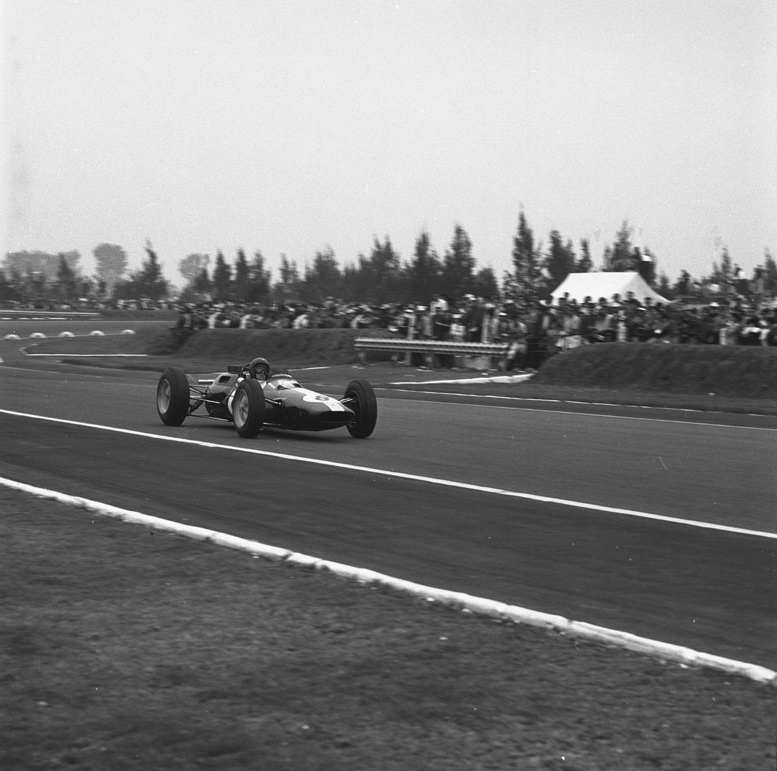
At a time when much is made of Sebastian Vettel’s amazing run this year, it’s worth recording that Jim in Mexico became the first driver since Alberto Ascari (1952) to win six races in a season and that his scoring rate for 1963 at this point was a stunning 66 per cent. Seb’s, post-India, is currently 55 per cent.
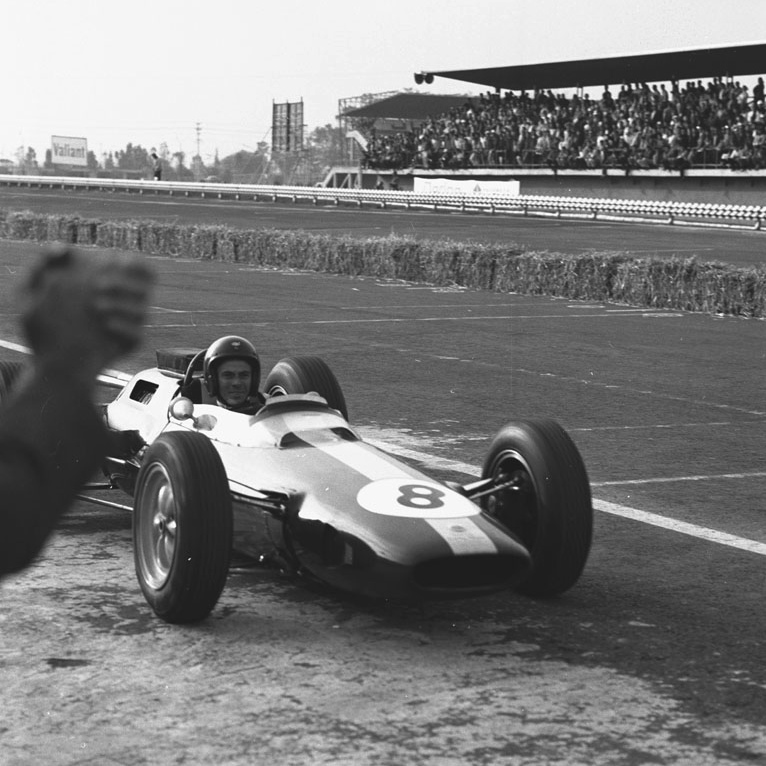
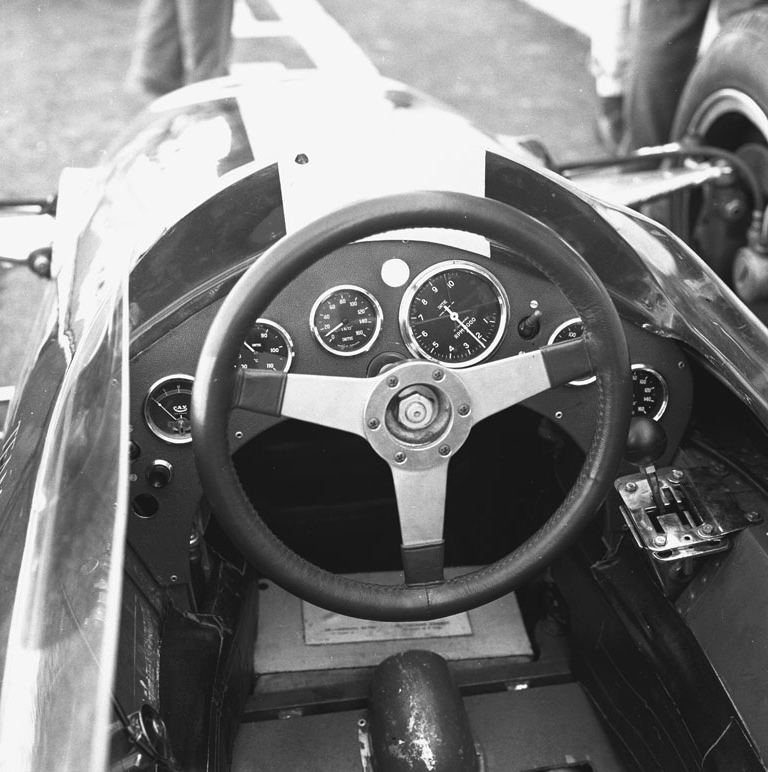
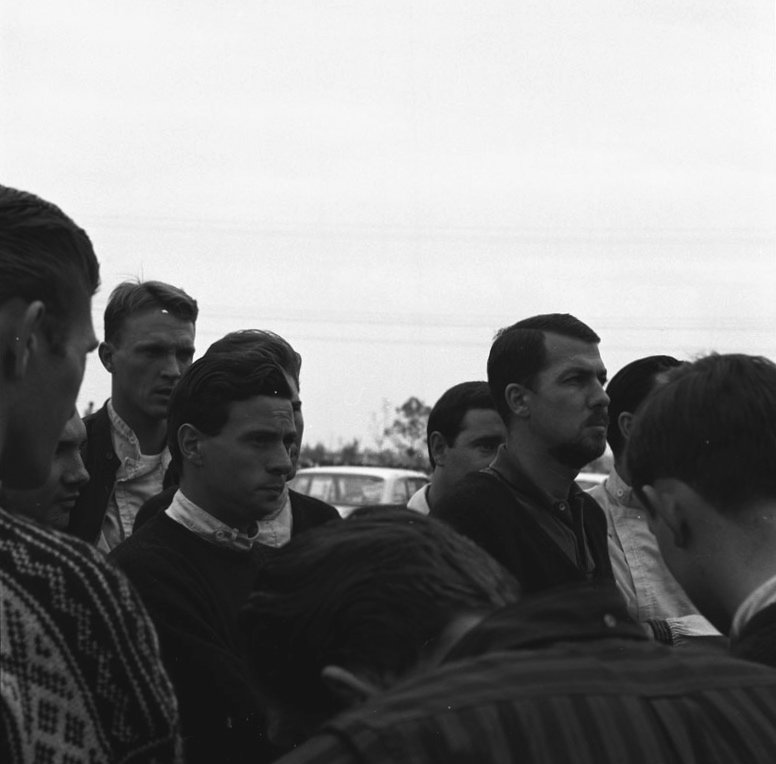
Captions (from top): Although he led the Mexican GP from start to finish, it was by no means an easy weekend for Jim Clark and Team Lotus. Gearbox problems delayed him in practice and in the closing stages of the race the Lotus 25 developed a fuel vaporisation issue. Here, very relieved, he receives the plaudits; Jim’s 25 looked a little spare in Mexico, lacking, as it did, the plastic Lotus badge normally mounted in the centre of the red-rimmed steering wheel; with Pedro Rodriguez on his right and Jo Siffert just behind him and to the left, Jim listens attentively to the drivers’ briefing. Dan Gurney stands in the background and Jo Bonnier to Jim’s left; Jim accelerates out of the Esses towards the Peraltada. Note the small deflector added to the front of the windscreen for this race ; below – one of the sadest photographs I know. As we remember 50 years since the first World Championship Mexican GP, here’s Ricardo Rodriguez at the non-championship 1962 race the year before, just prior to his fatal accident. Unfamiliar in Everoak space-type helmet, Ricardo kisses the hand of his father before setting out for another practice run with Rob Walker’s Lotus 24-Climax. His youngest brother, Alejandro (who died recently), looks on. Soon afterwards, the right-rear suspension broke on the Lotus, plunging Ricardo head-on into the Armco. Ricardo and Pedro were Mexican motor racing, and their world stood still when news of the tragedy broke. Pedro, just as gallant, just as brilliant, died in a minor sports car race in 1971. As we look forward to Mexico’s return to the F1 calendar in 2014, we’ll always remember los hermanos Rodriguez Images: LAT Photographic, Diego Merino/Luc Ghys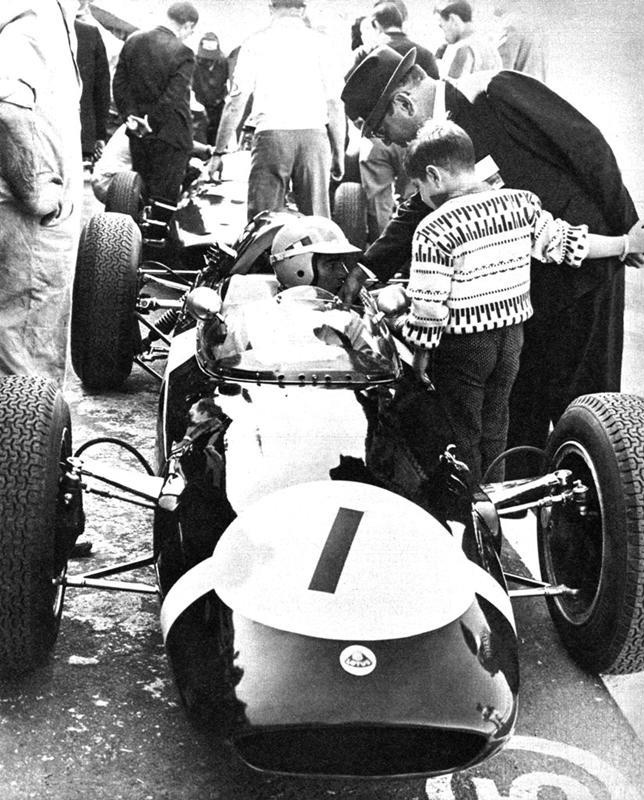













 peterwindsor.com