peterwindsor.com

…chance doesn't exist; there's always a cause and a reason for everything – Elahi

Archive for the category “F1”

Some classic Gilles

As we approach the 30th anniversary of the passing of Gilles Villeneuve, let’s look back at one of his most famous wins – the 1981 Spanish GP at Jarama.  Against all odds, Gilles withstood race-long pressure to beat his four pursuers by 0.2sec.  

All pictures courtesy of Sutton Images (the David Phipps Archives)
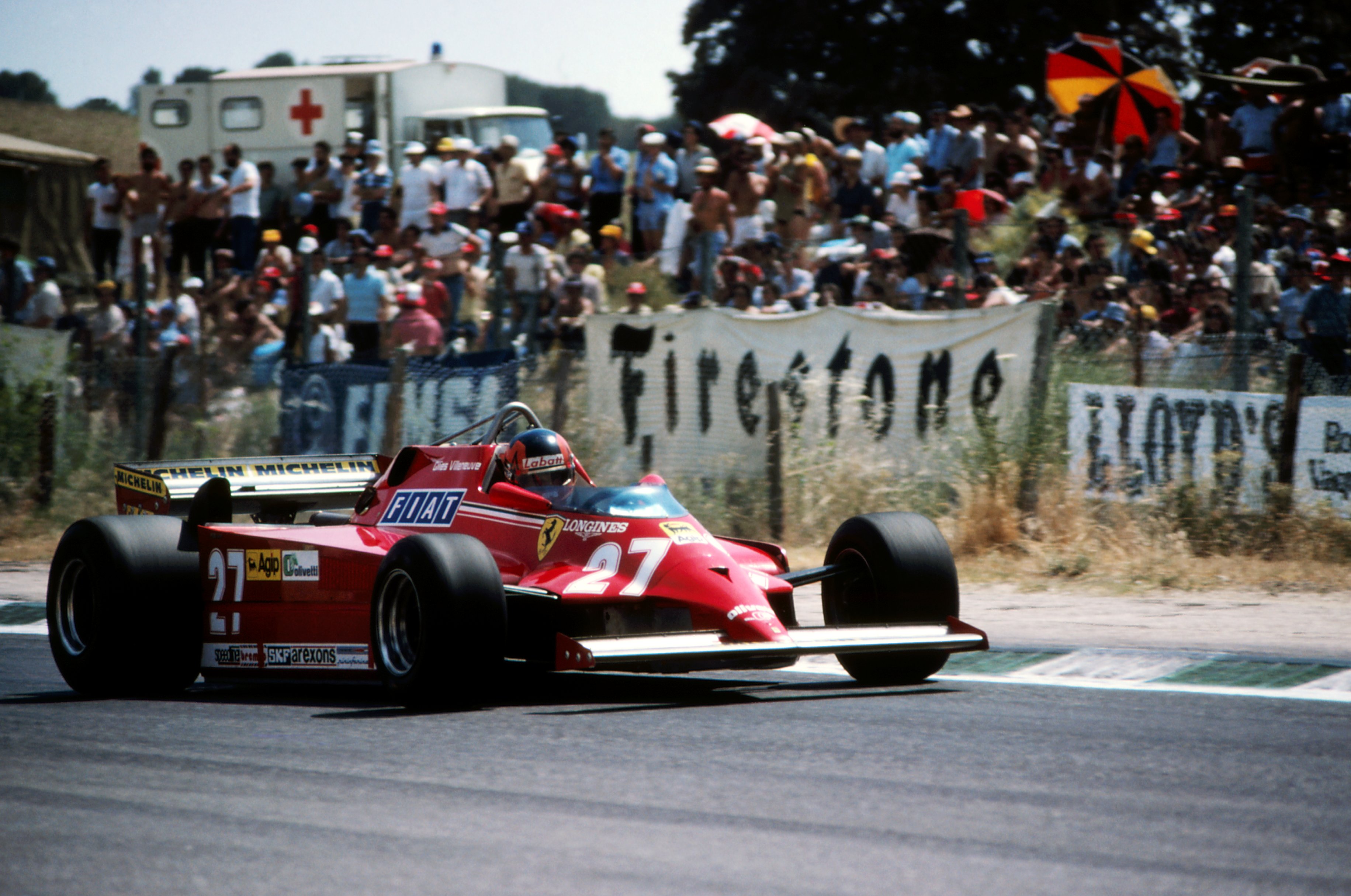
“I’M REALLY upset,” said the Monaco winner, Gilles Villeneuve, walking into his personal motorhome.  For once, he didn’t remove his shoes.  On this opening practice day at Jarama, near Madrid’s international airport, even the cleanliness of his wall-to-wall carpet took second place to the handling of his Ferrari 126CK V6 turbo.  “I mean, I win Monaco, score nine points at a circuit that didn’t really suit us, and then we come to Jarama, where the car should be quick.  And this is my reward:  terrible handling.  Shocking.  I’m not flat on any of the four quick corners.  The car is a disaster.  Maybe for two or three laps, when the tyres are new, it’s not bad on the tight stuff.  But after that it’s impossible.  Worse than last year’s T4.  Much worse.  Oh, we can work at it.  We can make the car driveable, I guess, for the race.  But we won’t stand any chance of winning – not when we’re this bad.  You’ve only got to look at the lap times.  We’re two seconds off the pace.  If you assume that our engine is worth half a second over the Cosworths, which it is, that puts us two-and-a-half seconds away.  It’s ridiculous.”

That was Friday.  On Saturday, Gilles squeezed the absolute maximum out of his standard-wheelbase 126CK and, on a brand new set of Michelins, lapped in 1min 14.9sec.   That would have made him fifth quickest on Friday and it made him seventh fastest overall.  He still wasn’t flat on the quick corners but he was spectacular.  So quiet is the Ferrari engine that you could hear his rear tyres skipping over the kerbs while he kept his foot on it with his arms fully-crossed.  “It’s quite funny,” he said afterwards.  “On the quick corners you can see the track marshals running for cover…”

For the second consecutive race, Gilles made a perfect start.  He could see Laffite edging forward and then stopping, edging then stopping, just as the pole man often does.  Gilles went when the centre of the red light began its first millisecond of fade, weaved around Lafitte, banged wheels with Alain Prost – and found himself third, behind the two Williams, as they braked for the first (double-apex) right-hander.  Over the lap he followed Reutemann (or “bloody Carlos”, as he affectionately calls his ex-Ferrari team-mate).  The Ferrari felt reasonably good on full tanks, so Gilles darted right as they left the right-hander at the end of the lap.  The power of the Ferrari took him easily past the Williams.  Second place was his.   After the South American races, when Gilles had had trouble with a broken drive-shaft, Enzo Ferrari had addressed his engineers tersely: “I don’t ever want to have a Ferrari retire for that reason again.”  For Monaco, sure enough,  Ferrari had fitted their biggest possible drive-shafts and Gilles had been able to bounce them off the guardrails and hit kerbs and apply full power down over the bumps without the slightest hint of trouble.  On the Monday after that race, he had sent a Telex to the Commendatore, explaining a lot of things that had happened over the weekend.  He finished it thus:  “For 76 laps I tried to break your drive-shafts but I wasn’t successful.  Thank you very much.”   Knowing that the Ferrari was that strong, that he could do virtually what he liked with it, Gilles reeled off his laps at Jarama.  For ten laps he saw a plus-sign over Carlos (never more than two seconds) and a minus-sign to Alan Jones.  This grew larger by the lap, and was up to ten seconds by lap 13.  On the following lap, though, Gilles had an unbelievable slice of luck:  he accelerated out of the uphill hairpin and glimpsed yellow flags, waved frantically.    He braked early for the next right-hander – and saw Jones’s Williams, sitting stationary in the sand.  Head down, he completed his 15th lap in the lead of the Spanish Grand Prix.

On the 79th lap, with one to go, they were still behind him. Read more…
Notes on Kimi’s driving – 2012

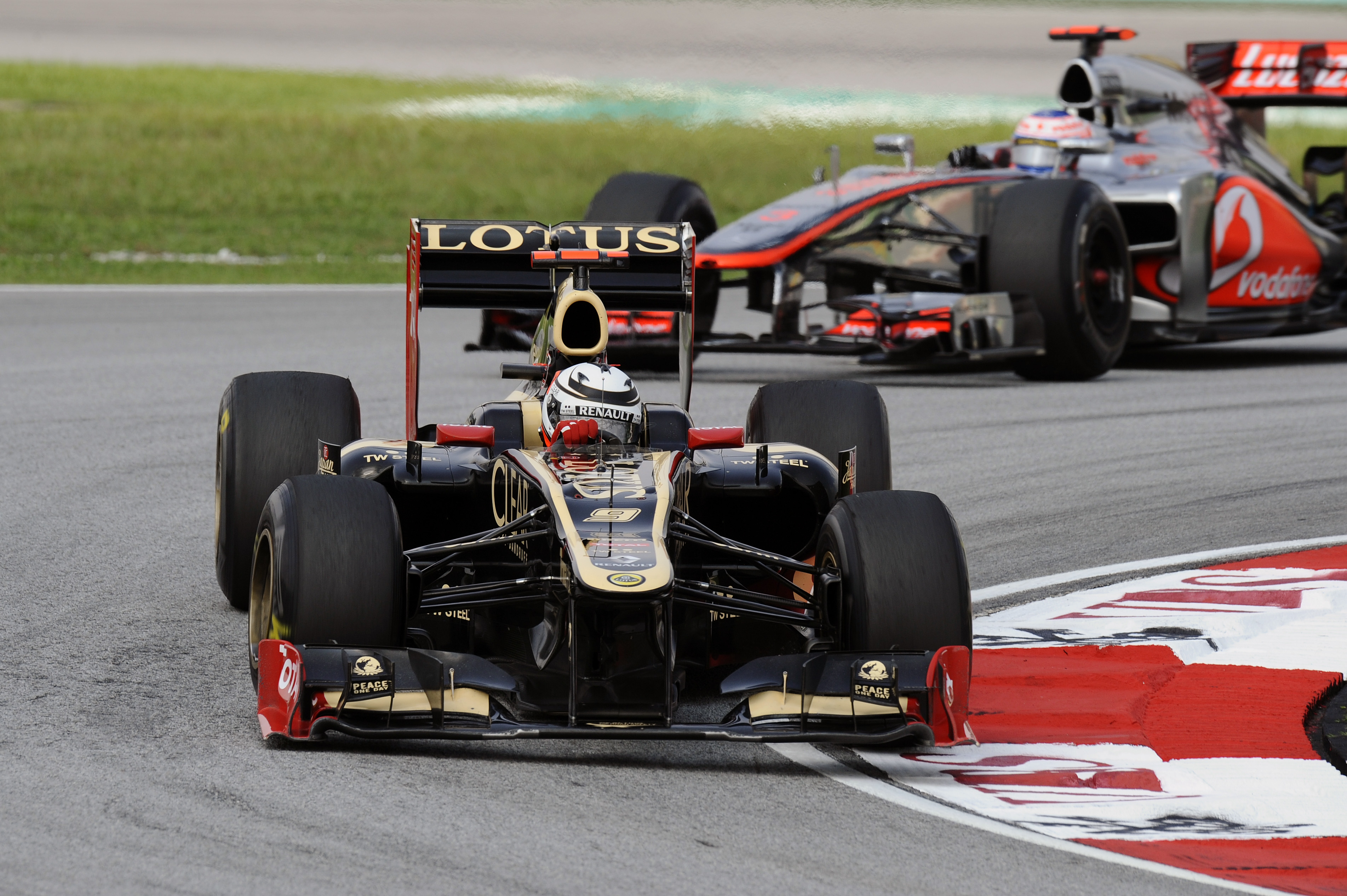
Kimi Raikkonen works hard at a rotation point: Sepang,Friday. Picture courtesy of SuttonImages

It was interesting to see LotusF1 trying different steering rack settings on Kimi Raikkonen’s car on Friday in Malaysia.  Technical Director, James Allison, said in a team press release before the race that “Kimi likes to drive with quite a light steering wheel, but one which also has great precision.  Our baseline rack is precise, but it’s not light enough for Kimi’s driving style.  Our challenge is to produce a hydraulic rack that is more powerful than the current unit, but which sacrifices none of its precision.  We have not got there yet, but we will do.”

I mention this because (a) it is quite unusual to have relatively detailed information like this from a current F1 team and (b) because it gives us a little more insight into what comprises the God-given talent that is Kimi Raikkonen.

It’s no surprise that Kimi is finding the initial steering set-up of the E20 to be on the “heavy” side.  He is a fingertip driver if ever there was one – and I don’t think you can say that about the 2011 LotusRenault drivers, Vitaly Petrov or Bruno Senna, (although Nick Heidfeld certainly tends towards Kimi’s end of the spectrum) .  “Weight” , however, in my view tells just part of the story.  Of course Kimi is as fit as the rest of them – certainly in his upper body muscular strength – so  I don’t believe that this is a question of Kimi not being able to handle “heavy” steering.  On the contrary:  his drive in Melbourne, fresh from his two-year lay-off, shows how fit he is already.   No, I think this is a question of how Kimi feels the surface of the road.  With heavy steering, the shoulders and upper arms come more into play;  with lighter steering – providing it is “precise” (as James puts it) – the feel flows much more through the lower arms and hands.  Kimi’s initial steering movements are always relatively slow compared with those of many F1 drivers.  I remember watching him from overhead in the McLaren at La Rascasse at Monaco in 2006.  Compared with his team-mate, Juan Pablo Montoya, Kimi was approximately two metres later with his mid-corner rotation, which is to say that in the initial phase of the corner Kimi had perhaps five degrees of steering lock where Juan had at least 15 degrees.  Juan was on the power earlier – but the early power application led to oversteer bobbles on exit.  Kimi was travelling faster in the early stage, had a lower minimum speed while he rotated car the car, but a much straighter, flatter exit that he “guided” with easy accuracy.

Criticial to Kimi, then, is his ability to feel the car in that early stage of the corner – to be able to manipulate the car, as if on aut0-pilot, as he floats in towards his minimum speed (rotation) point.  The car is losing speed;  slip angles are coming into play;  and Kimi is managing the forces via brake pedal pressure release and increased steering load.  It is an infinitely variable thing from corner to corner, lap to lap.  There is no “turn-in” point or fixed apex.  The track surface is constantly changing;  so is the fuel load, so are the tyres – and so are the precise points, down to a centimetre, at which Kimi brakes and begins his initial, gentle movements.

It looks as though Kimi has found the early-season steering of the E20 to be heavy enough to be able to dampen his feel for that early corner phase.  There were fewer messages travelling to his lower arms and hands in the tests and in Melbourne;  the emphasis was on musclepower – the enemy of  the senses.  Kimi, reduced to that, was basically just another F1 driver.

The mechanical job for the team, of course, is to be able to give Kimi the sort of power assistance he needs without taking away any of the feel – and it was with this that they played on Friday at Sepang.  I suspect this is a similar situation to Jarno Trulli’s at Team Lotus last year.  Jarno’s initial corner movements are very similar to Kimi’s, although in my view Kimi is a much more creative driver than Jarno when it comes to managing, say, understeer.

Of course, this isn’t the only way to drive.  What I love about F1 is that every driver is different.  For every Kimi, there is a Fernando Alonso.

I haven’t yet seen enough of the re-invented Romain Grosjean from the right vantage points to describe accurately how he uses the pedals and the steering.  Early impressions put him pretty near Sebastian Vettel (in terms of style):  he has slightly more (and faster) initial steering inputs that Kimi but a lovely feel for eliminating load from the car; an oversteer driver he is not.

Jim Clark vs The Rest

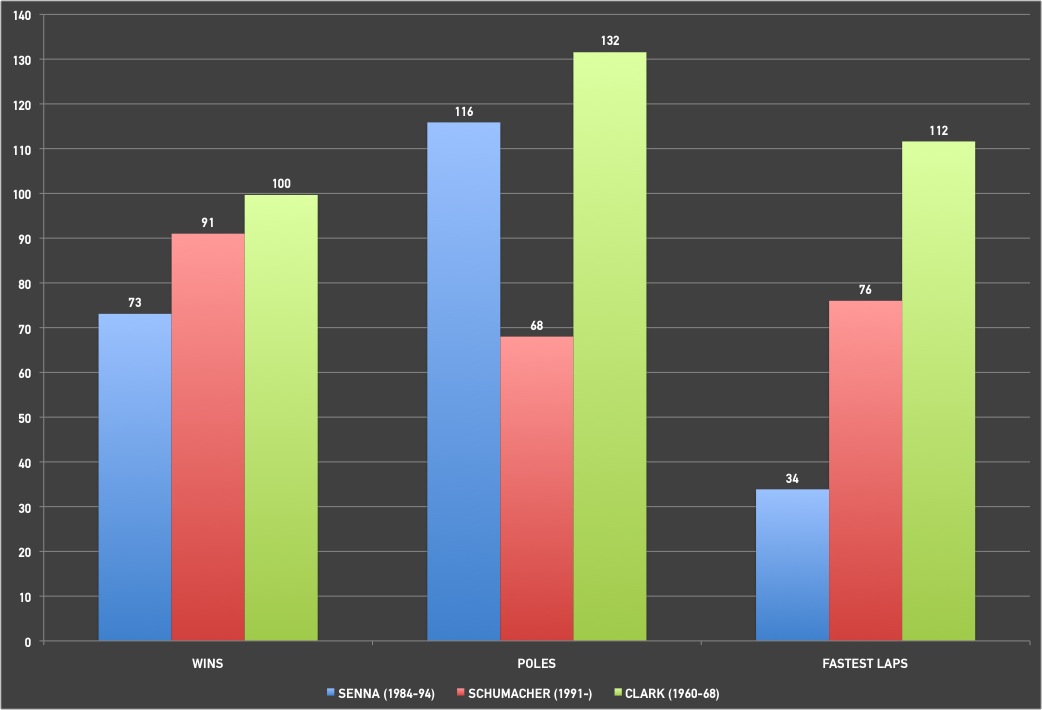
Sean Kelly – @virtualstatman – produced an amazing suite of graphics for Ep 62 of The Flying Lap yesterday. (To see a re-run of the show, click the TFL icon in the column on the right here or go to http://smibs.tv/live.)  One of my favourites was this – his vision of what would have happened if Ayrton Senna and Jim Clark had not been cut down in their primes but instead had continued to win at the rate that had characterised their careers from the outset.  Ayrton’s blue, Michael Schumacher is red (and currently at 2012, of course); and Jim Clark is lime green.  Oh, and by the way:  that’s Jim in the header picture above (at Monaco, 1966, in the Lotus 33B-Climax).

Sahara Force India F1’s press statement re copyright

Read more…

Daniel Juncadella on his 2012 EuroF3 campaign

We spoke to him on The Flying Lap last year only 24 hours after his victory at Macau.  Now it’s time again to talk to Daniel Juncadella, the talented young Spaniard who is racing again this year in EuroF3 for  Prema Powersport. Daniel talks about the latest Dallara F312, the switch to Hankook tyres and his hopes for the future.

Big John Surtees charity karting event this summer

I’m delighted to hear that John Surtees has finalised a date for his excellent Team Challenge karting event in aid of the Henry Surtees Foundation.

Slotting neatly in between the Goodwood Festival of Speed and the British Grand Prix, this relaxed but extremely worthwhile event will be held on July 4, 2012, (fittingly) on the stunning Mercedes-Benz World Test Circuit at Brooklands, in Surrey, England.  Format:  a two-hour endurance race for teams of four or five persons, with karts supplied by Daytona.  The cost of the event per team will be £1,000 and, with John confirming that a certain B. Ecclestone has already reserved two teams, I hope we’ll see plenty of other key motor racing people taking up the challenge – either as drivers or as bystanders.   It’ll also be interesting to see who Mr Ecclestone has signed up!

Full details of this event (and other fund-racers for the Foundation, including the end-of-year All-Comers kart event at Buckmore Park and the Beaujolais Run) can be found at http://henrysurteesfoundation.com and/or http://daytona.co.uk.  Aside from direct costs, 100 per cent of funds raised by the Surtees Team Challenge will go to charity.


Post Navigation