peterwindsor.com

…chance doesn't exist; there's always a cause and a reason for everything – Elahi

Archive for the category “Days Past”

The legend begins….

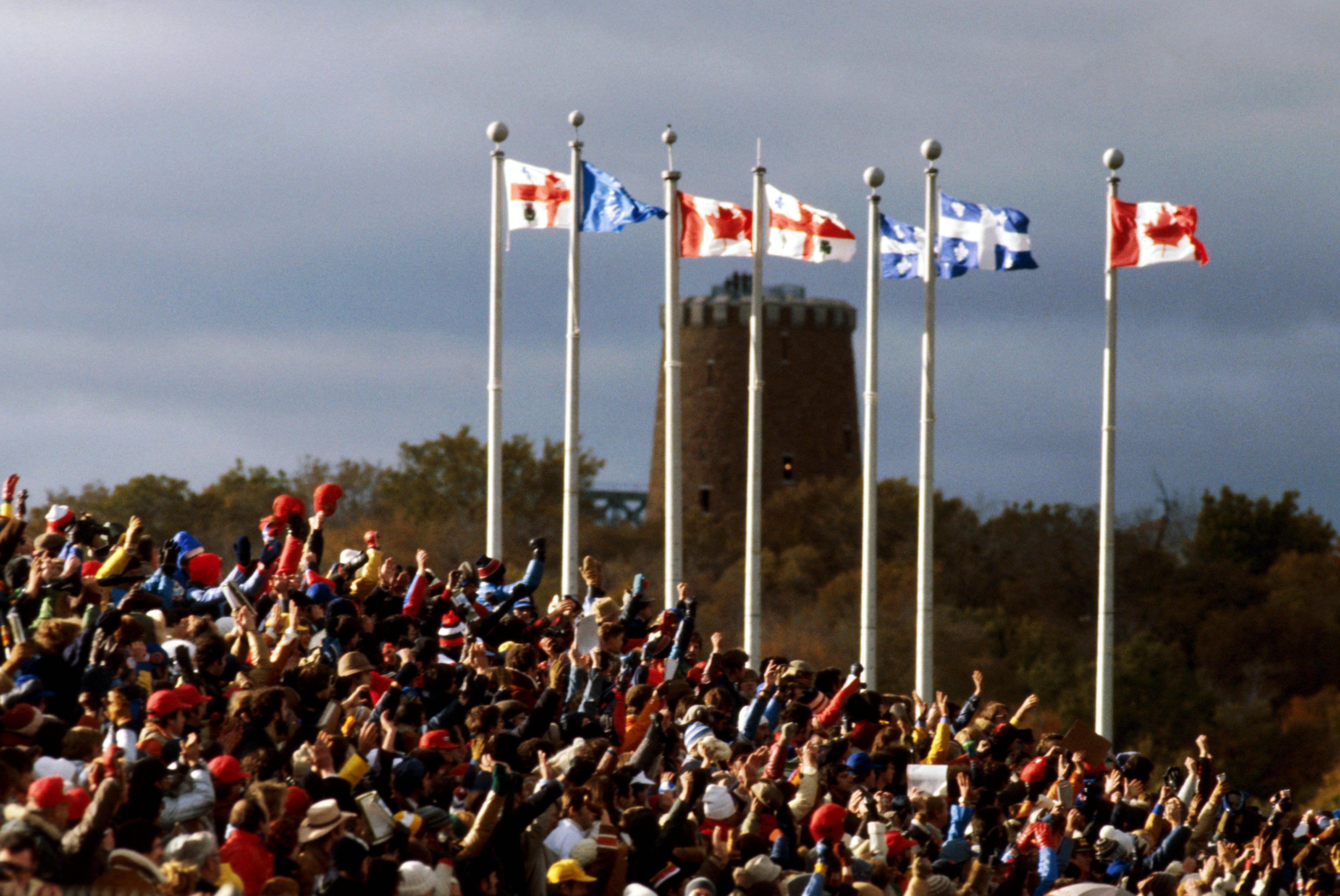
In October, 1978, in the cold of the Canadian fall, Montreal staged its first Grand Prix.  The race also enabled a young driver from nearby Berthierville to win his first Grand Prix.  And so the legend of Gilles Villeneuve was born.  We join that momentous week in the newly-completed Hyatt hotel, headquarters of the Labbat’s Grand Prix of Canada

Wednesday, October 4

The Hotel Hyatt Regency is a $50m tower in the south of downtown Montreal.  It is one year old;  it is in keeping with the newness of this part of the city.  It is also serving as “Grand Prix Headquarters”, which means that you collect your credential from the basement of the Hyatt, that the pre-race festivities, like the Gilles Villeneuve Ball, are held at the Hyatt, and that most of the Grand Prix teams, including mechanics, stay at the Hyatt.  Some remain aloof – Walter Wolf’s team for one, Michelin for another – but, otherwise, this is already a Grand Prix with a difference: the paddock area is effectively marble-floored and graced with Muzak.

This morning, with most of the teams together again after two or three days in New York, or brief trips to the Goodyear factory in Akron, Ohio, is to be much like any other.  Emerson Fittipaldi is clad in a red-and-white track suit as he sits down to breakfast, and Jody Scheckter is wearing his white outfit from TV’s “Superstars”.  Emerson will later train at the nearby, indoor athletic track;  Jody will hit a tennis ball or two.  Everything is within easy reach, within calling.  Clay Regazzoni, with “Klippan seat belts” emblazoned on his track suit, has booked a court for two hours.  Patrick Tambay will play with John Watson, Jacques Laffite and Riccardo Patrese.  Lauda and Hunt?  They are to stay at the hotel today, recovering from what must best be described as a quick trip to New York.  The weather was better down there – but that would appear to be all.  Here, in Montreal, only two miles from the circuit, there are facilities to make out-of-town Grands Prix look positively ancient.  The shopping malls are so large you need a golf cart to cover them.

This, then, is a glimpse of the future:  the more the Grand Prix business expands, the more inclined will be the business to stage its races near or in major cities.  Who wants to camp at Mosport when you can be in the Hyatt ten minutes after practice?  At Montreal, you do your next Goodyear deal in the air-conditioned bar, 30 minutes before dinner (and not in sokme steamed-up, hired motorhome).  Is there a downside to it all?  Will the Montreal “street” circuit justify the Hyatt?  We shall see on Friday, when practice begins.

There is an end-of-year feeling in the Hyatt this winter’s morning. The Championship has been won;  for drivers like Niki Lauda the race is of only academic interest, even if this is his – and also Carlos Reutemann’s 100th GP start – even if second place in the title chase is still wide open.  For drivers like Jean-Pierre Jarier, Keijo Rosberg and Rene Arnoux, by contrast, there is everything – including a good drive for 1979 – for which to fight.  And for teams like Ligier this is the time to say goodbye to the Matra engine.  Indeed, this is the over-riding, pre-practice mood:  such has been the dominance of the Lotus 79 that a good number of cars will be having their last race at Montreal:  next year they’ll all be going ground-effect.

That’s your first glimpse of this first Canadian GP in Montreal:  it is at once a glimpse of the future and a last look at the past.

Thursday, October 5

You reach the track by turning left out of the Hyatt, driving 500 yards on the freeway and taking the “Ile Note Dame” ramp.  Over a bridge, onto the island – and you are there, at the sight of Expo 67 and the 1976 Water Olympics.

The island is small – artificially built out of earth moved when the city’s underground railway was constructed.  And, necessarily, the circuit seems small.  It stretches the length of the island, with hairpins at either end and six chicanes in between.  It is also brand new: the timber is still light-coloured, the grass verges recently-placed, the paint still tacky.  Everywhere, artificiality prevails.

The cars are garaged in the old rowing sheds, back-to-back and side-by-side, as at Monza.  And the pits are a short walk away at the exit of the hairpin, before a quick chicane.

We are out on the course now, tooling around in a road car, when up comes Hans Stuck Jnr, completely sideways in his Mercury Monarch.  A grin splits his face:  it must be Hans’ sort of circuit.  Then Mario Andretti passes us, his station wagon on opposite lock out of the hairpin, avid journalists round about him.  (And ready to cause him some bother, it turns out:  remarking the circuit seems a little tighter, and a little slower than it might have been, and concluding lightly that the track seems designed for Gilles Villeneuve, he subsequently is quoted out of context by the local press.  Mario is impressed with the organizers and with the circuit build overall, but the locals whack him hard re his Villeneuve comments.  By Sunday morning he is saying to the media: “My criticism was over-emphasised and mis-directed.  I am not critical of the race organizers.  I am more critical of our own FOCA officials who were sent over here to approve the track”.)
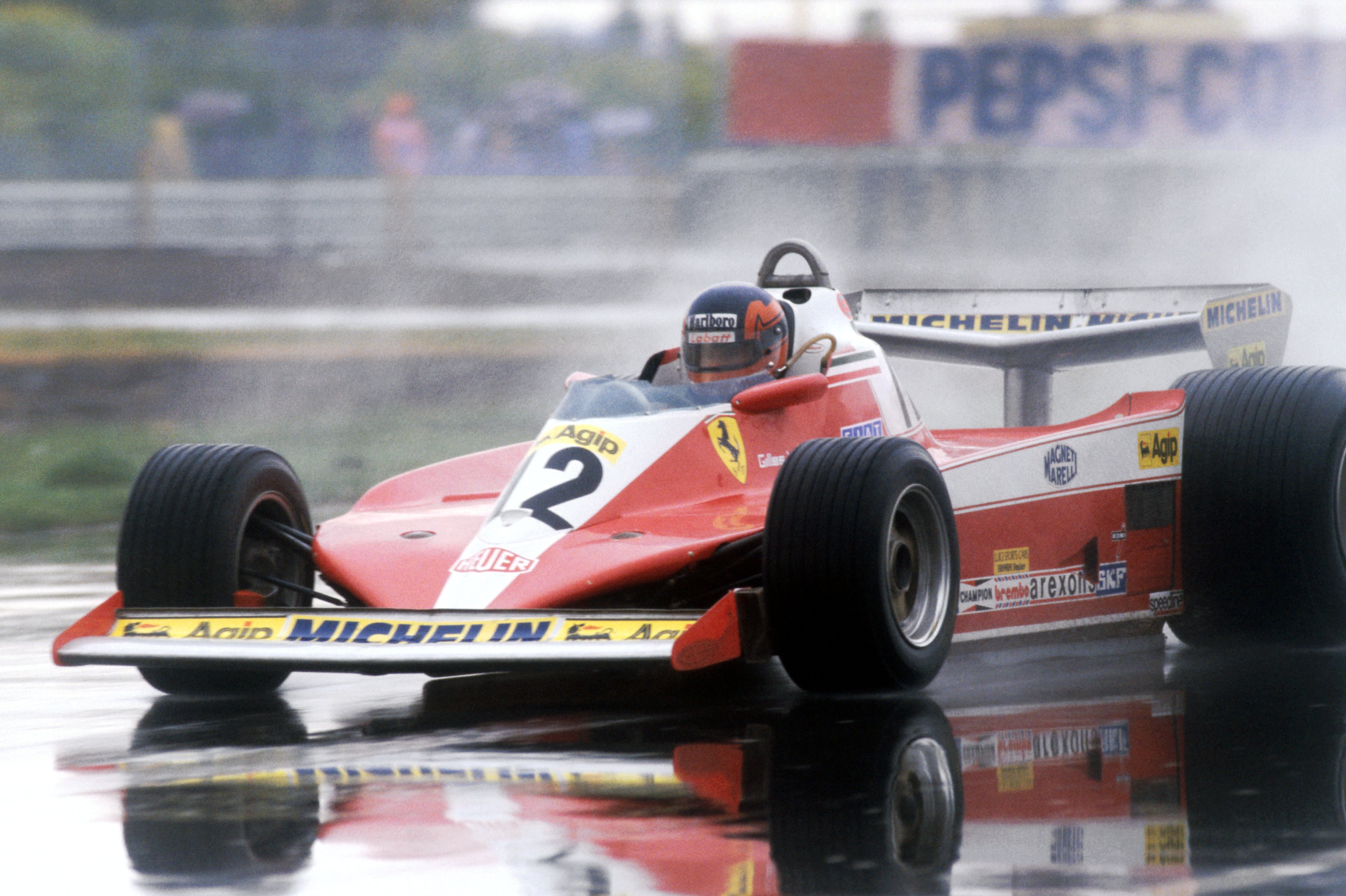
Gilles in the wet on Friday, when his team-mate, Carlos Reutemann, had the advantage

Friday, October 6 Read more…
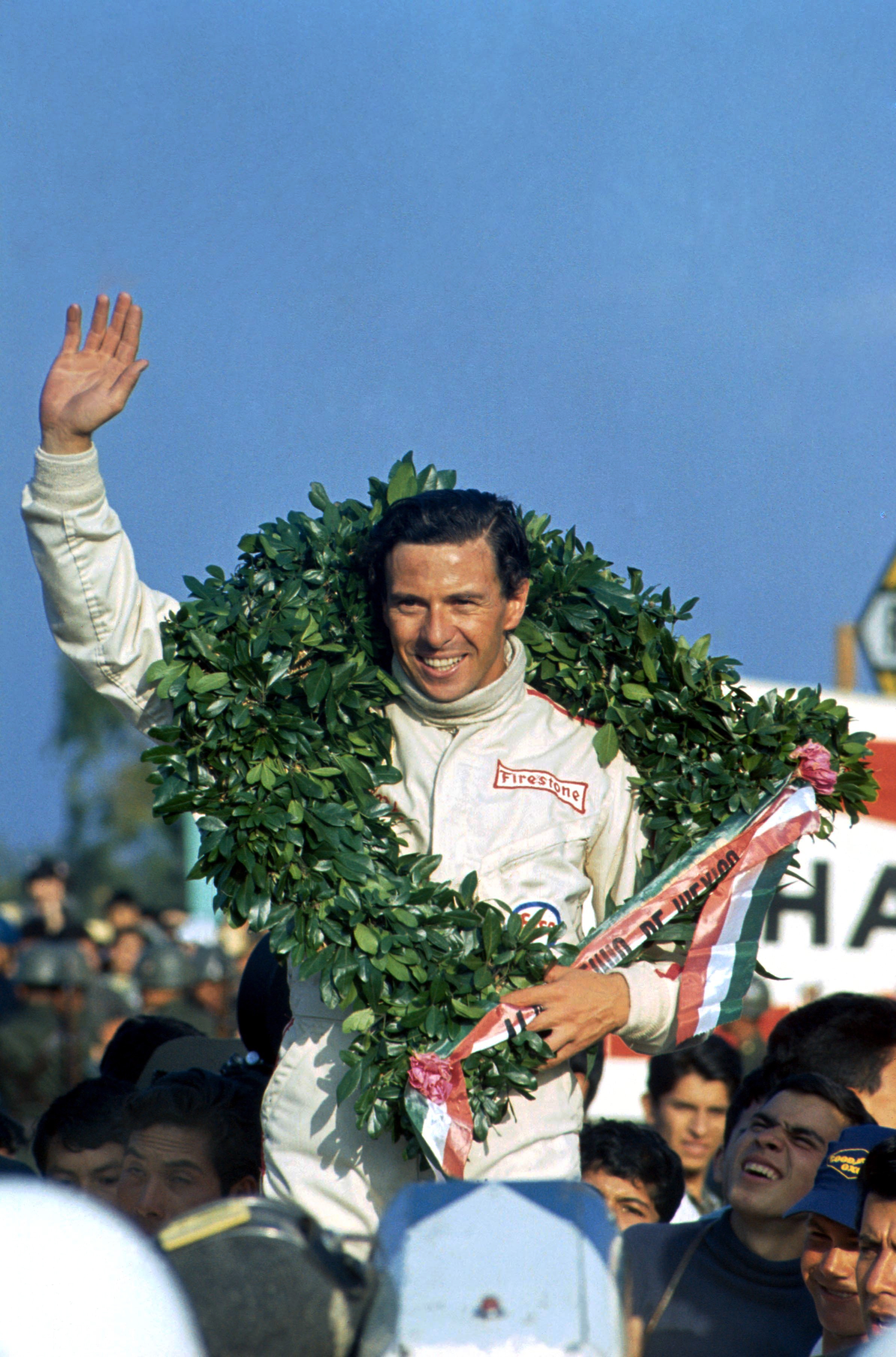
The Unforgettable Jim Clark

He was nibbling his nails the first time I saw him – just as they said he would be.  Not absently-mindedly but seemingly with aggression, palm turned upwards, free hand inspecting frequently.  He wore black sunglasses, square of frame – Rayban Wayfarers – fawn slacks and no shirt.  His shoulders were as broad as a boxer’s, yet he was short, even by my schoolboy standards.

And he walked with that amazing twinkle-toe lilt, springing upwards, like a Scots sword-dancer, with every step.  Jackie Stewart did likewise, we noticed – although his feet were splayed outwards.  (Was this their secret, we wondered?  Were these gaits the key to all that brilliance?)

Jim was lilting now towards the Lotus camp – to the tent which shaded his Lotus 32B-Climax.  The air was surprisingly still, the tempo unhurried.  There was no Colin Chapman in Australia – just Jim and the boys, led by Ray Parsons, the Team Lotus Cortina/Elan/F3 driver.  Standing there, on the Warwick Farm lawn, it all seemed like Fun in the afternoon Sun, not practice for the International 100.

Yet a Clark performance it was.  First there were the powder-blue Dunlop overalls, clean and freshly-ironed.  Then, for protection against flying stones, Clark tied a checkered handkerchief around his mouth and nose.  Next were the Pioneer goggles, heavily taped from the mid-point upwards.  Finally came the legendary helmet, the dark blue Bell Magnum with the white peak.  Clark stepped sideways into the red seat, pulled on a pair of his own-make red gloves and fitted the goggles over the famous eyes.  Down the side of the car, on flanks of emerald green, ran the neat yellow lettering:  Team Lotus.

That afternoon, in Australia, I watched him qualify on the front row, alongside the Brabhams of Graham Hill and Frank Matich.

And then, on Sunday, I saw him win.  He followed Hill for the first phase of the race – while he adapted to a car without third gear – then passed his friend under braking for Creek Corner.   “Copybook Clark” the headlines said the next day.

A few years later, still in Sydney, I joined a small band of people saying goodbye to him at Kingsford Smith Airport.  The last Tasman race had been run;  Jim was flying to Indianapolis via Chicago to test the new Lotus 56 turbine Indy car.  After drinks in the VIP lounge he disappeared through Customs; the crowd disbanded.  Clark had gone for another year.

Or had he?  His Qantas 707 halted at the threshold, then taxied back.  I was standing with my father in the Arrivals hall when Clark re-appeared, stewardess at this side.

“Plane’s been delayed,” he said.  “Come and have a drink.”

I asked him about why he’d used a dark blue peak (instead of white) in the 1964 Dutch and 1966 Mexican GPs.  (He said he’d broken the white one and that had been all that was available.)  I asked him about the wet race he’d just driven at Longford in the Lotus 49 (“It was crazy.  Only Piers Courage had the right tyres”) and about his chances in the F1 season to come.  I remember him talking wryly about soon having to drive a Ford Taunus down to Monaco for a Ford publicity stunt and, yes, I remember him describing what it had been like to have been hit in the face by a bird at Reims, 1966.  “It felt like a bloody great crow…” I recall him saying.  I told him that I wanted above all to work in motor sport – perhaps as a journalist.  “Just work hard and never give up,” he said.  “That’s the key.”

At the time, though, my appreciation of Clark’s talent, of his standing, was too youthful.  For me, live motor racing began with Clark – and the fact that he was so statistically successful was hardly the point.  I revered his character, his way of speaking, the way he presented himself, his home town of Chirnside, his shyness, his desire to drive anything, anywhere, his honesty, his respect for others.  I revered everything about Jim Clark.

Jim was not only a good person;  he was a genius amongst his peers.   The Standard.  When someone else won a race, they said, “So what happened to Clark?”  When you arrived late for practice, and you wanted to know the lap times, you asked, “So what’s Jim doing?”

I am not alone;  I know that.  Mention Jim Clark to your average racing person and even the most ardent Michael or Ayrton fan will say, “Yes.  Jim Clark.  He was another.”

As we record yet another anniversary of his passing, then, it is tempting to mark April 7 with some solemnity.  Equally, so many people still want to talk about Jim – to learn about him.

Here, then, are some views of people who knew him well – colleagues to whom I have spoken over the years in order to glean just a little more about the man and the driver who just might have been the very best we’re ever going to see. Read more…

From the desk of Jim Clark

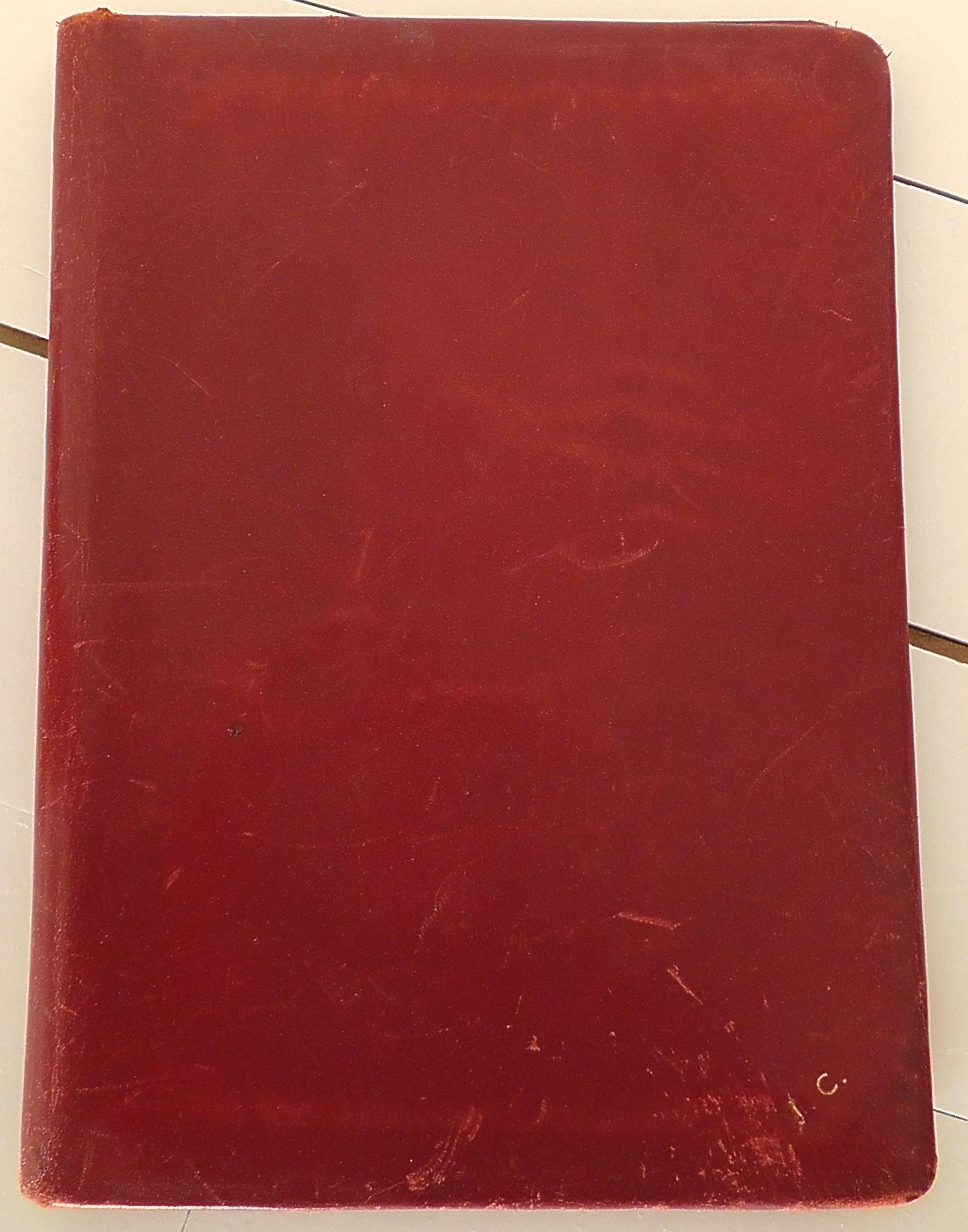
This was the Girling brakes letter folder that Jim Clark used for many years on his desk at Edington Mains.  Inside I keep a few of my favourite Jim Clark items and pictures…

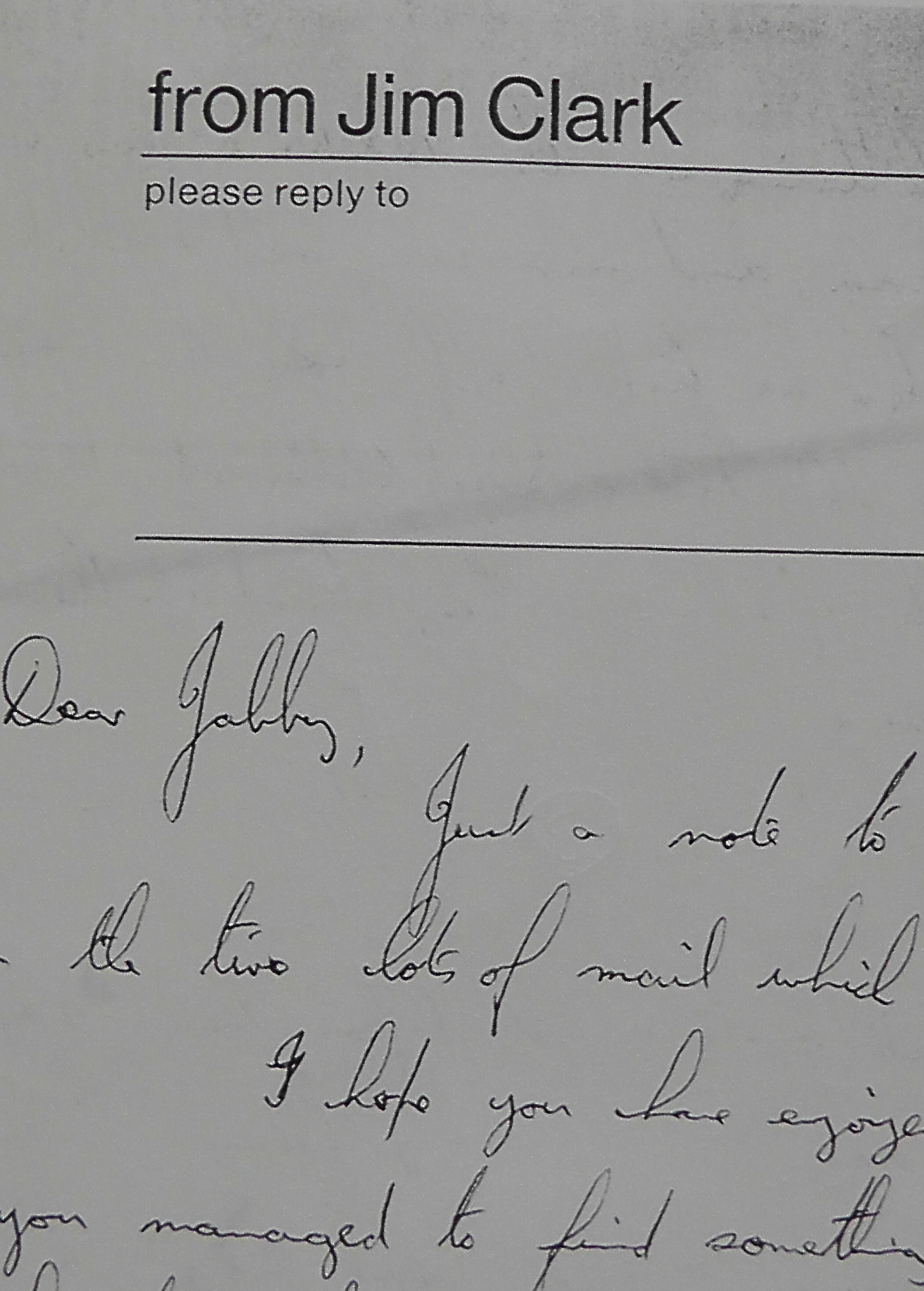
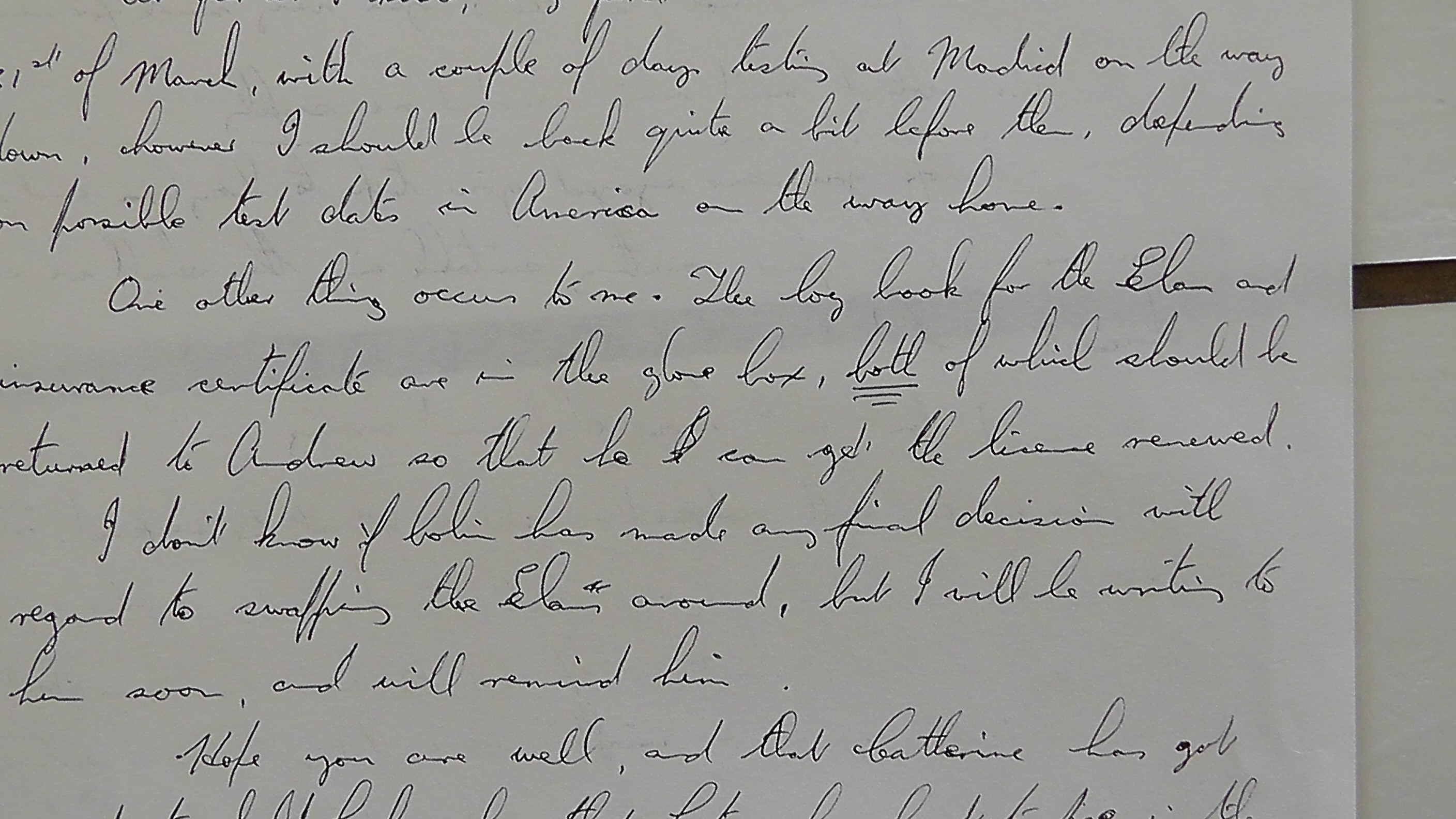
Left: Jim was a diligent letter-writer and thus carried his own notepaper when travelling.  This missive  was written from the Rushcutter’s Bay Travelodge on the eve of the 1968 International 100 at Warwick Farm, Sydney (which Jim won)

Below: So there he was, preparing for the big race – and what should cross his mind but the expired licence disc on his Lotus Elan , which at that time was garaged in Paris?  One wonders if any of today’s World Champions, in their hotel rooms before a race, would be similarly diligent about small, but important, details..

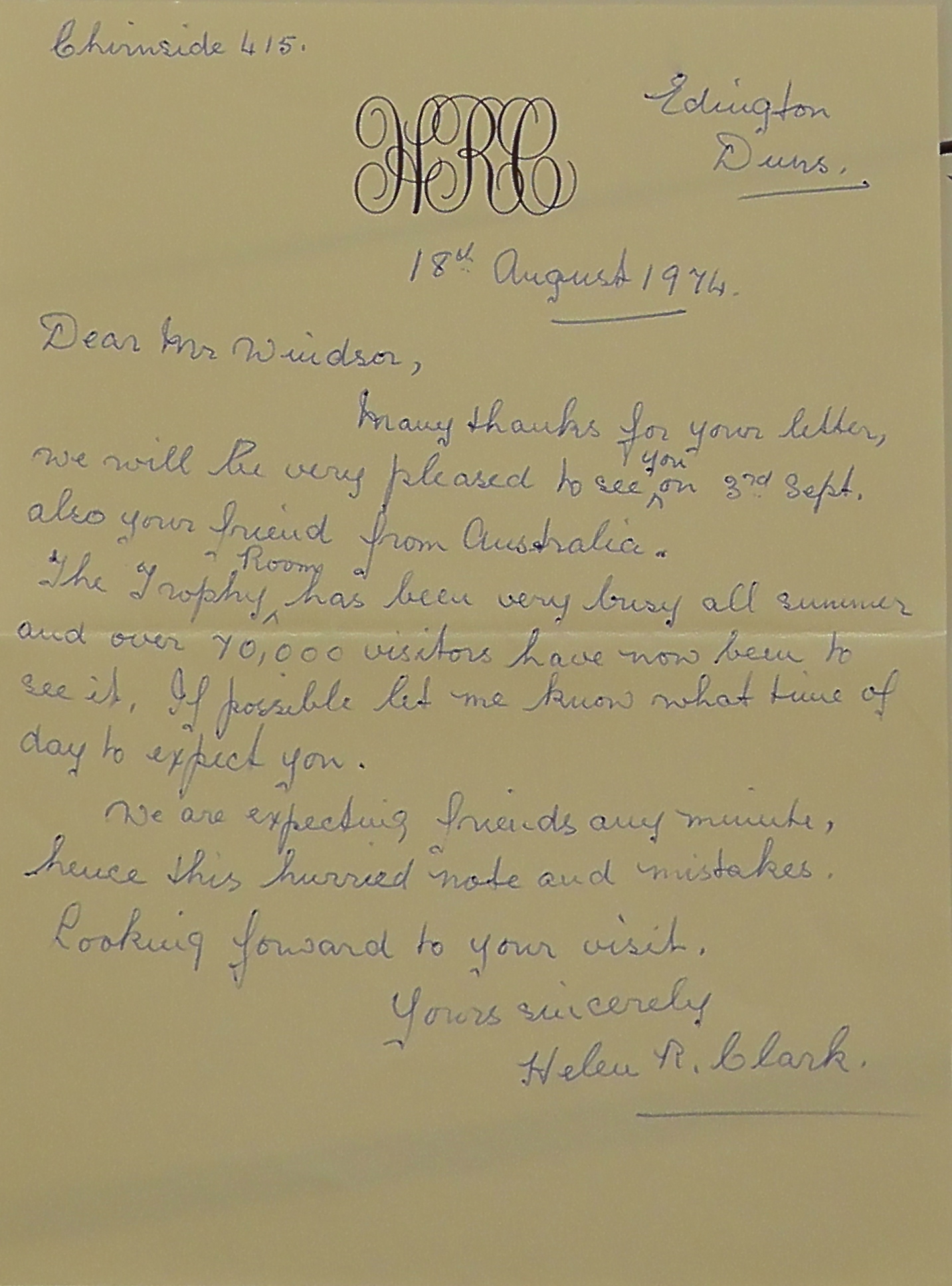
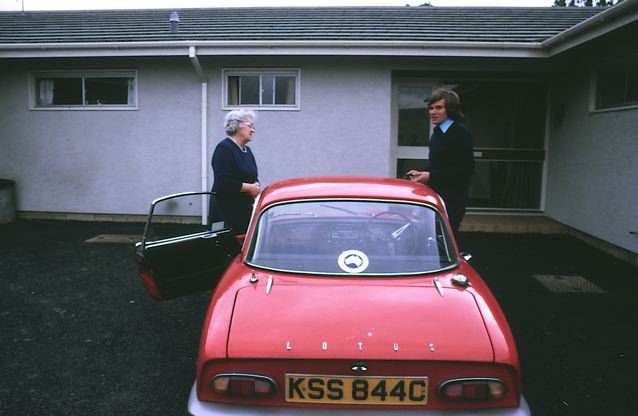
Above: This was a letter I received from Jim’s mother, Helen, after an article I wrote for Competition Car magazine in 1974.  I had just bought the red Lotus Elan S3 Coupe formerly owned by Jim’s manager, Ian Scott-Watson. As a result of this invitation, I drove it up to Edington Mains to meet Mrs Clark and to see the farm and Trophy Room. The Elan, which I still drive, ran like clockwork

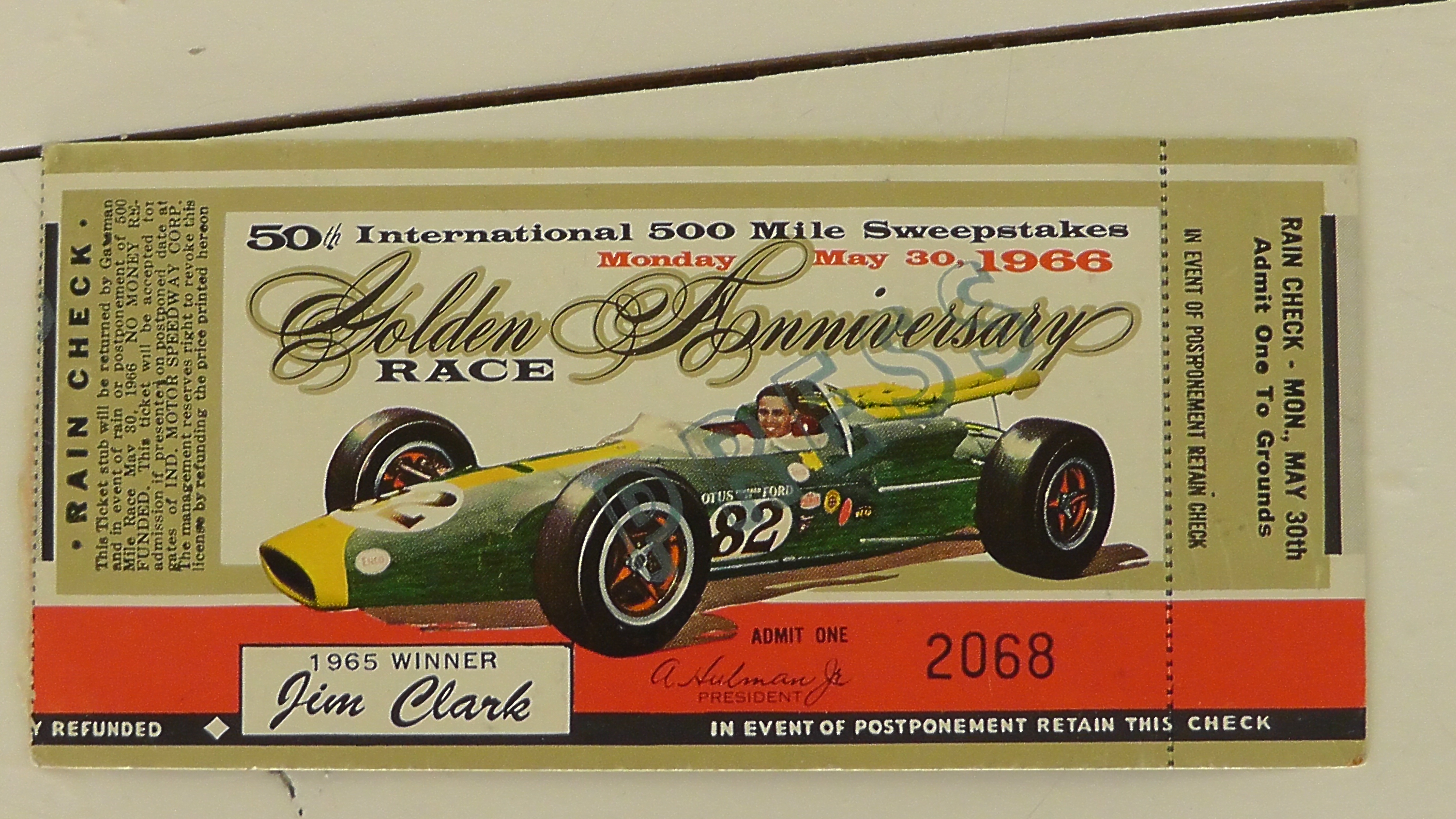
Below: As ever, the Indy organizers did a great job with the 500 race tickets for 1966 

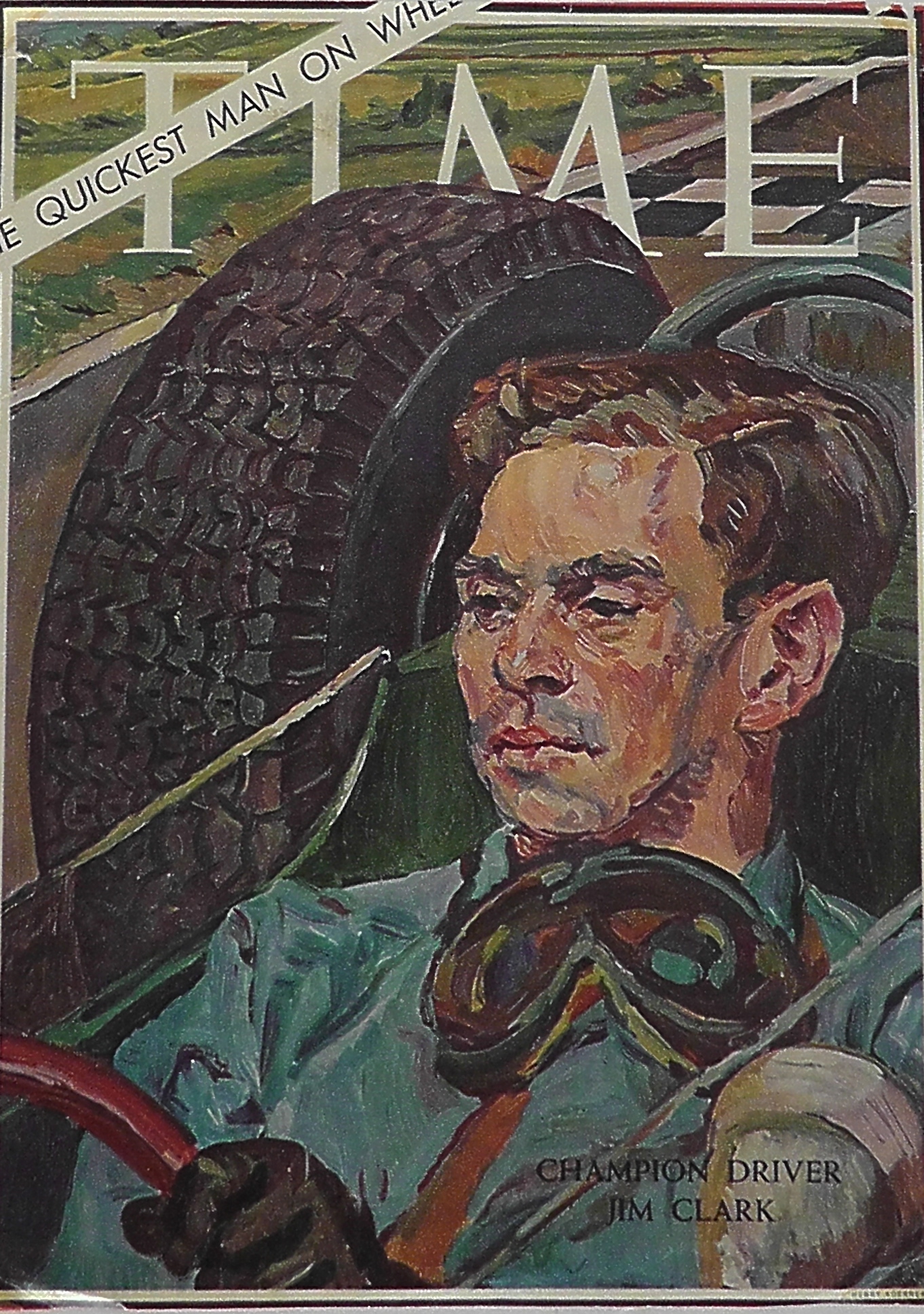
Jim made the front cover of Time – which was a huge thing in those daysI always liked their choice of words – “quickest” rather than the more predictable “fastest”

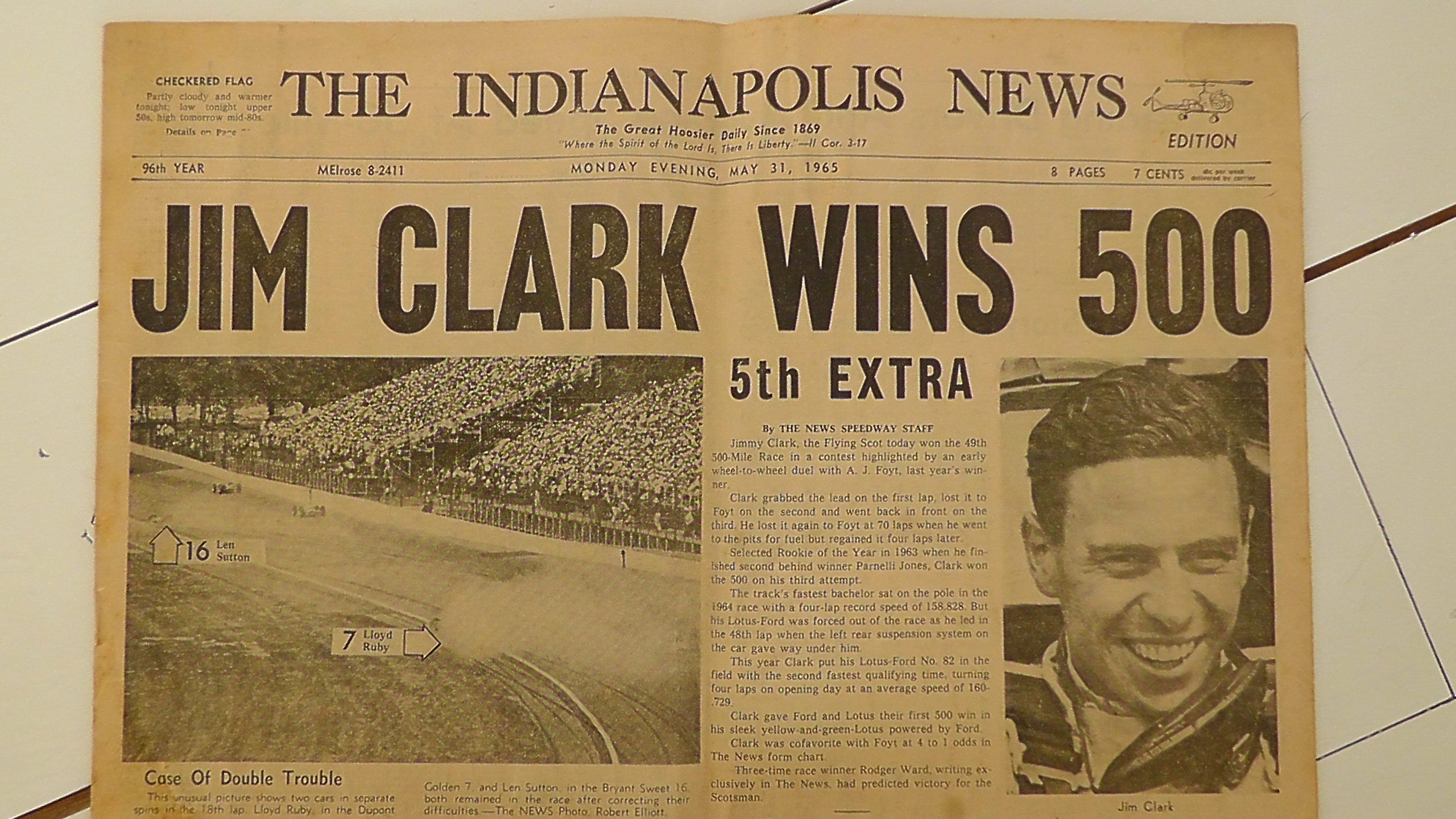
This is the edition of The Indianapolis News that Jim was able to hold in Victory Lane after winning the Indy 500 in 1965

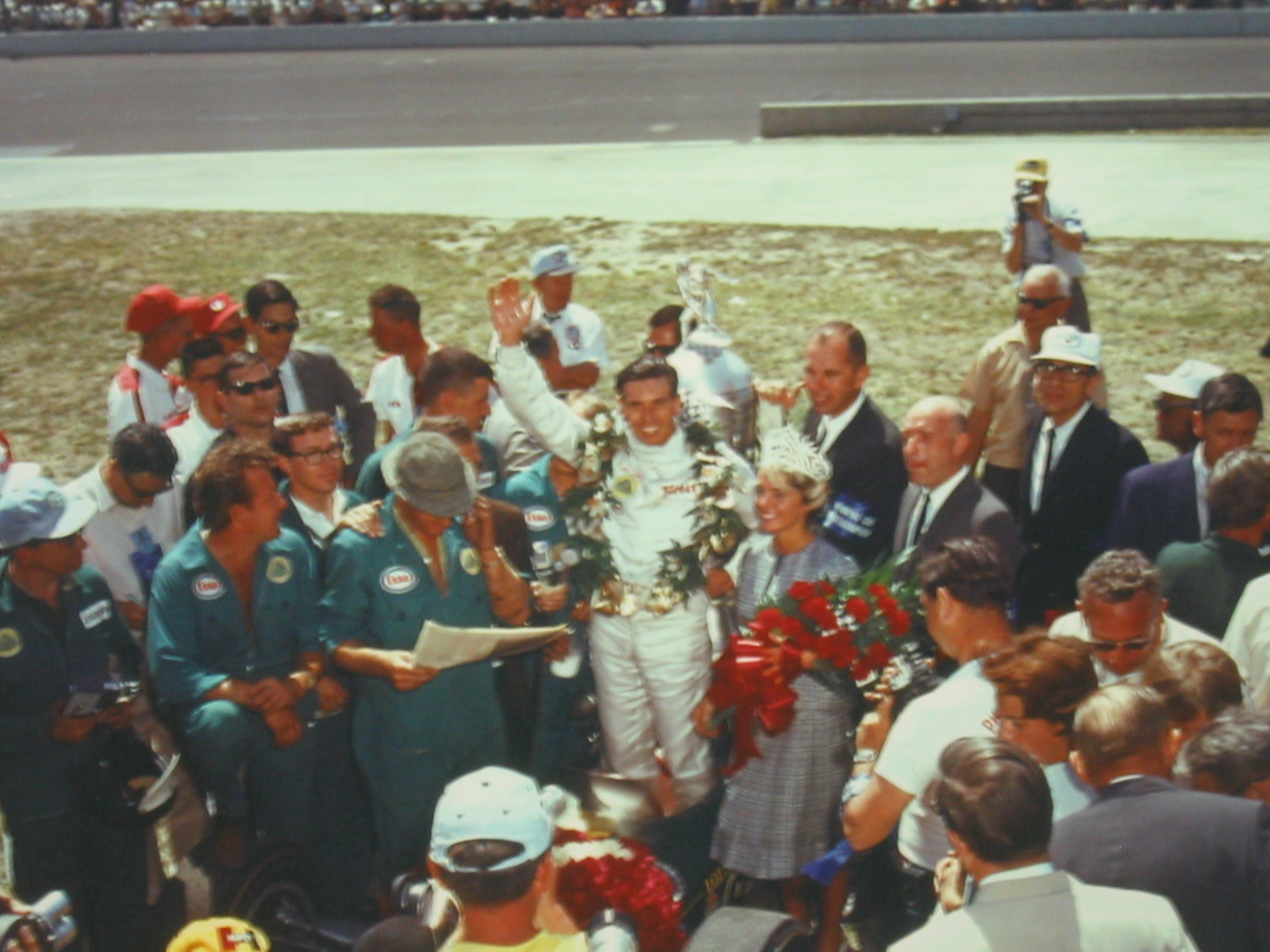
…and this is the not-so-famous photograph of that Victory Lane celebration.  Jim has already handed the newspaper to David Lazenby.  I love this shot because it includes two of my best buddies from Australia, both of whom worked on Jim’s car at Indy in 1965.  Second mechanic from the left is Jim Smith – and to his left is a young Allan Moffatt, the Canadian driver who would become an icon in Australian racing circles. Jim Smith was a marine engineer by trade and joined Lotus earlier that year after replying to an ad in the newspaper.  When Colin Chapman realized he was a transmission specialist he was quickly flown to Indy!

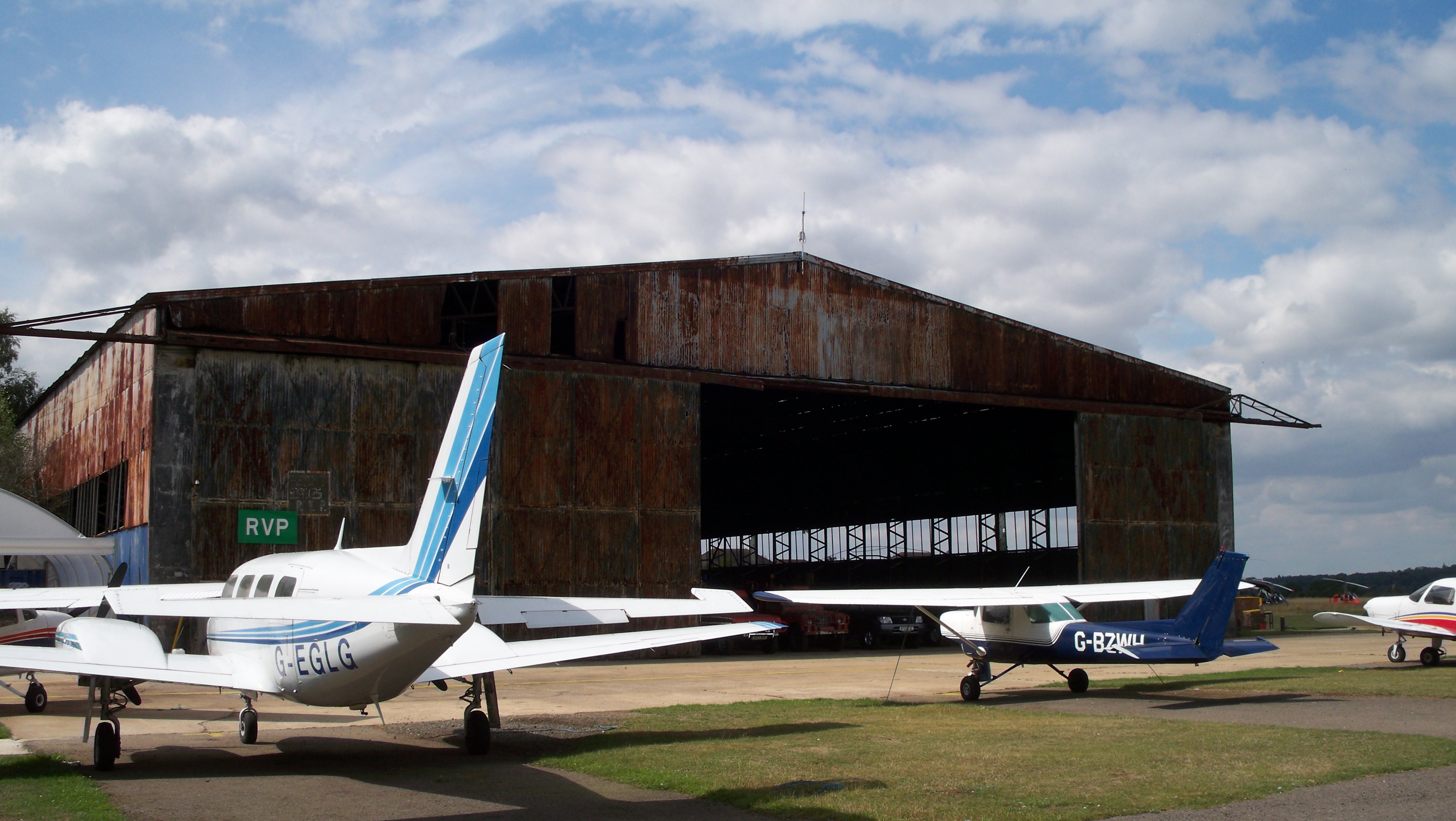
Panshanger Aerodrome, in Hertfordshire, North London, from which Jim and Colin Chapman did much of their flying in the Cheshunt Lotus factory days

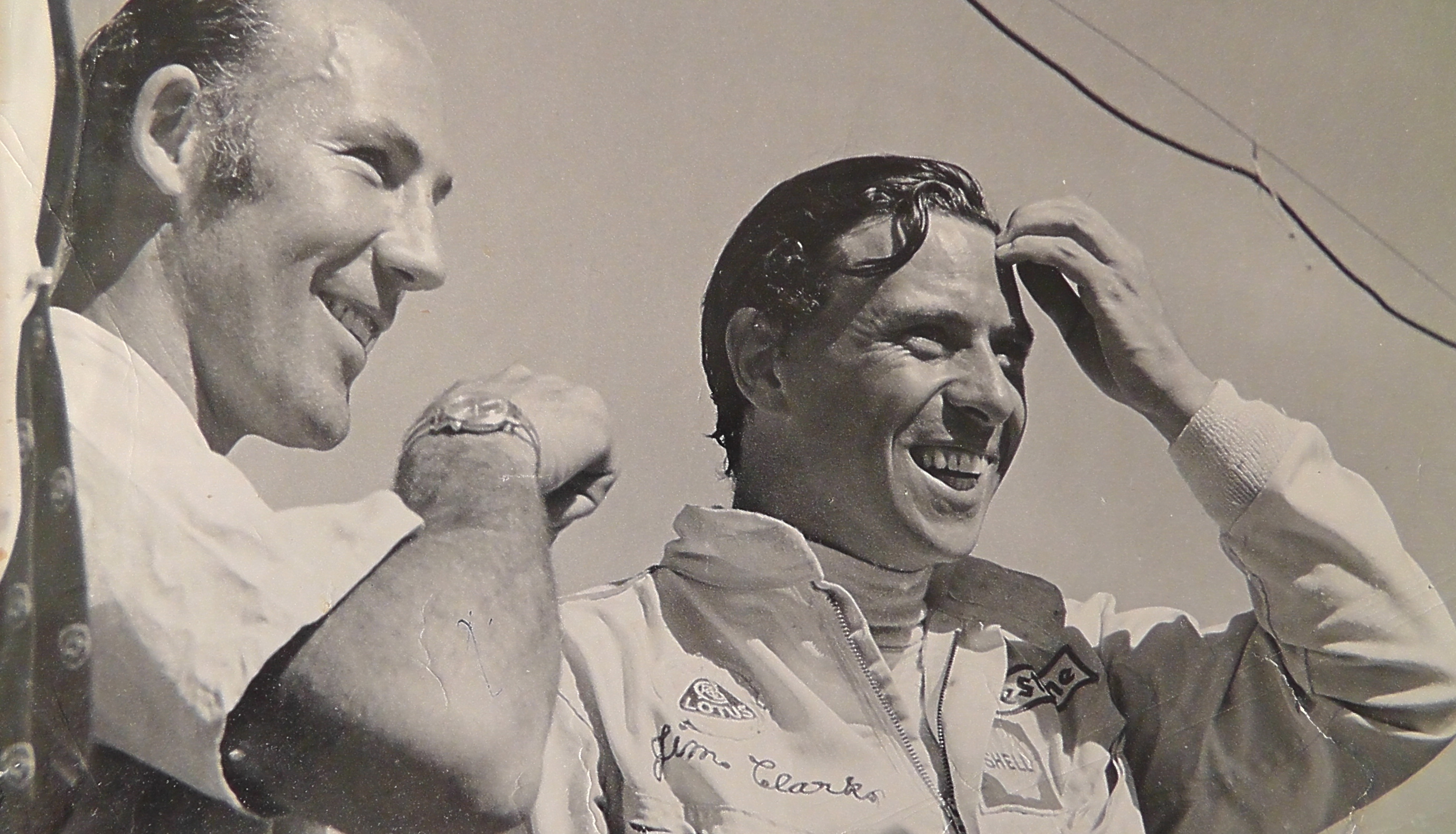
One of my favourite pictures of Jim.  It’s taken after the 1968 International 100 at Warwick Farm, which he won from his GLTL team-mate, Graham Hill.  Stirling Moss was present to help with the awards – and so two of the greatest F1 drivers of all time were able to smile and to laugh and to enjoy the moment.  It would be Jim’s second-last win

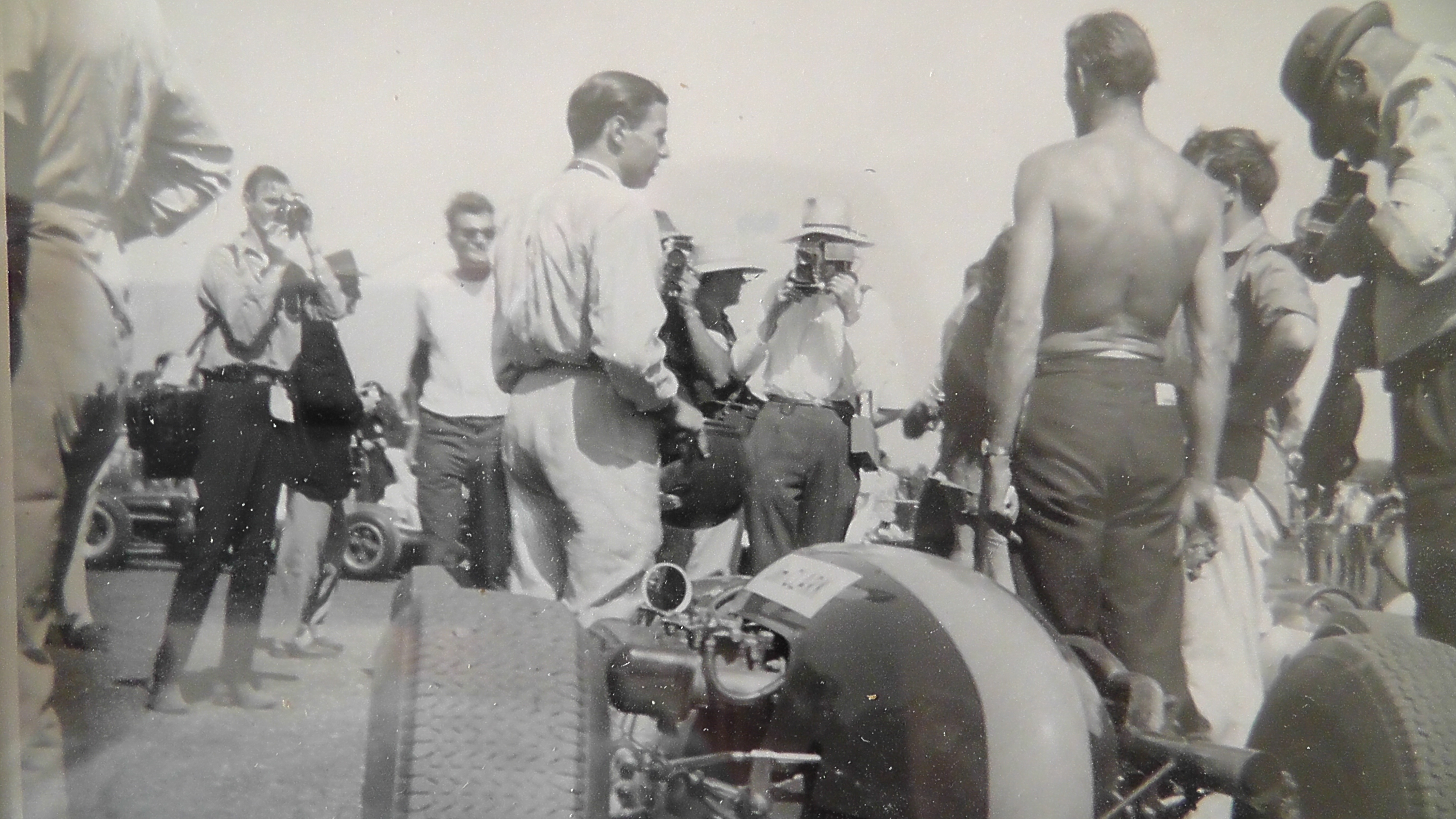
I took this shot of Jim with my Kodak Box Brownie camera just before Friday practice for the 1965 International 100 at Warwick Farm.  Jim is about to don his Bell Star and climb into the Lotus 32B-Climax.  That’s the brilliant photographer, Nigel Snowdon, on the left (much of Nigel’s work is now in the Sutton Images archives) and, to his left, in the white t-shirt, is Ray Parsons, sometime Team Lotus F3, Elan and Cortina driver, who on this occasion was acting as Team Manager

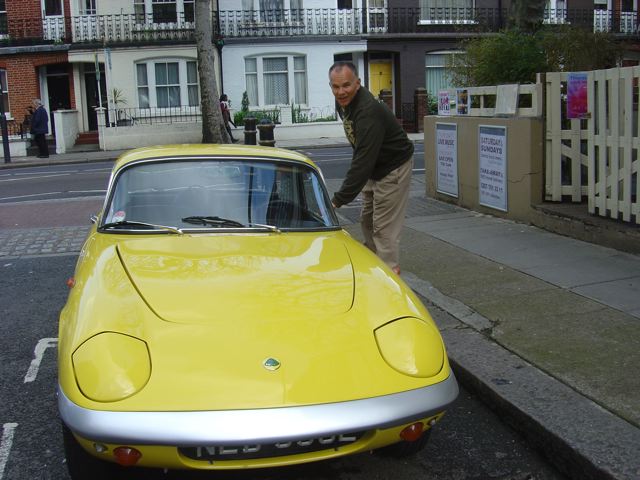
The left-hand-drive Lotus Elan S3 Coupe that Jim drove throughout Europe in 1967 – and about which he was concerned in his letter to Jabby (above).

The red, ex-Ian Scott-Watson Elan with Jim’s mother, Helen Clark, in September, 1974.  This car was beautifully built in kit form by Jock McBain’s mechanics in 1965 and was used regularly by Jim whenever he was up in Scotland in 1965-66

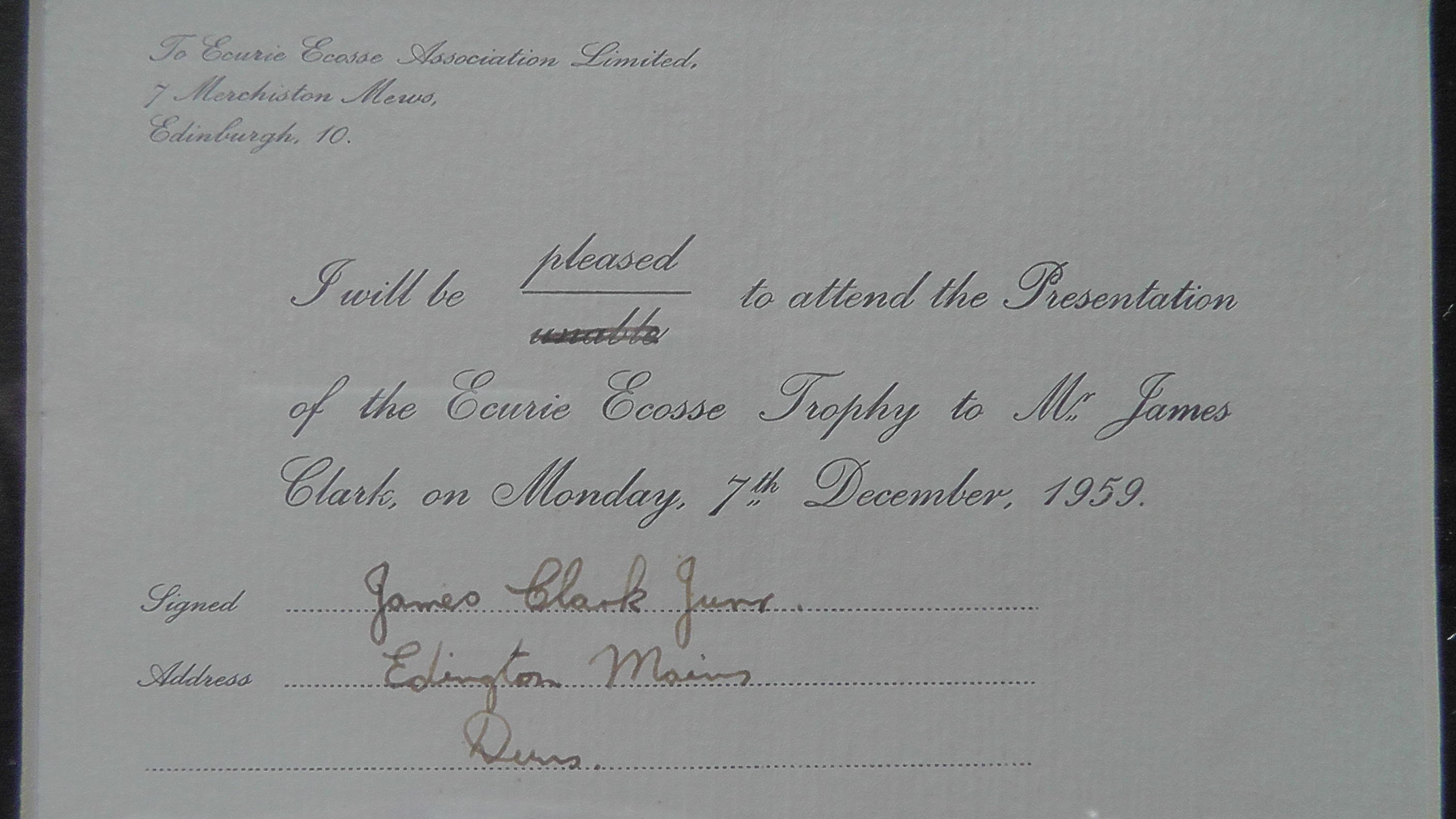
Over the years there’s been plenty of discussion about whether Jim liked to be called “Jim” or “Jimmy”.  Personally, I’ve always favoured “Jim” on the basis that he called his autobiography Jim Clark at the Wheel (and not Jimmy Clark at the Wheel).  Anyway, perhaps this reply card settles the argument.  Invited by Ecurie Ecosse to receive an award at the end of the 1959 season, Jim signed his RSVP “James Clark Jnr” – the name by which he was known in Scots Border farming circles before he became a celebrity.  Jim’s father was of course “James Snr.”  (It is also characteristic of Jim, I think, that he took the trouble to reply formerly to an invitation that in reality was only about him in the first place!)

Photos: The Colin Piper and Peter Windsor Collections

Some classic Gilles

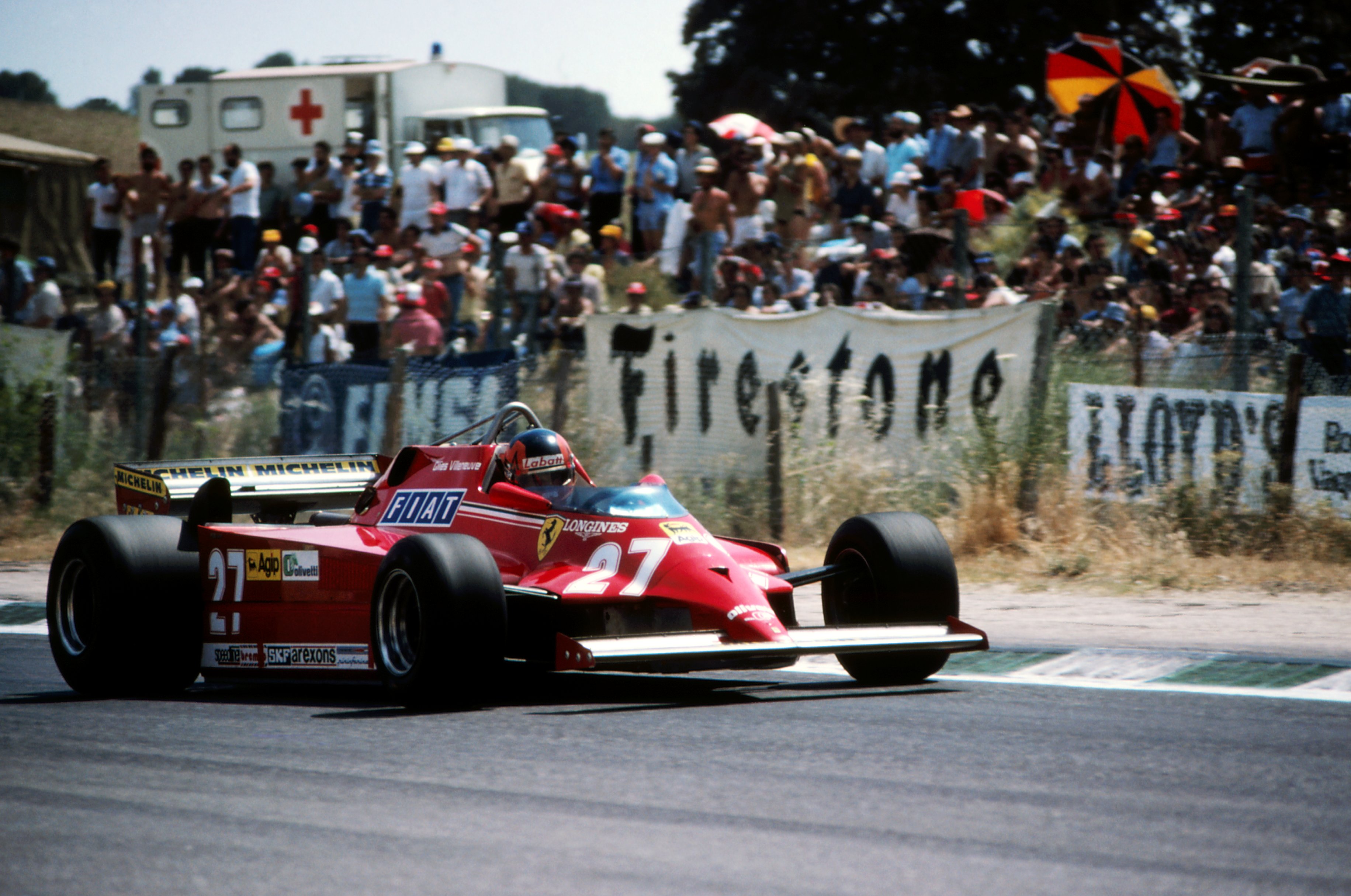
As we approach the 30th anniversary of the passing of Gilles Villeneuve, let’s look back at one of his most famous wins – the 1981 Spanish GP at Jarama.  Against all odds, Gilles withstood race-long pressure to beat his four pursuers by 0.2sec.  

All pictures courtesy of Sutton Images (the David Phipps Archives)

“I’M REALLY upset,” said the Monaco winner, Gilles Villeneuve, walking into his personal motorhome.  For once, he didn’t remove his shoes.  On this opening practice day at Jarama, near Madrid’s international airport, even the cleanliness of his wall-to-wall carpet took second place to the handling of his Ferrari 126CK V6 turbo.  “I mean, I win Monaco, score nine points at a circuit that didn’t really suit us, and then we come to Jarama, where the car should be quick.  And this is my reward:  terrible handling.  Shocking.  I’m not flat on any of the four quick corners.  The car is a disaster.  Maybe for two or three laps, when the tyres are new, it’s not bad on the tight stuff.  But after that it’s impossible.  Worse than last year’s T4.  Much worse.  Oh, we can work at it.  We can make the car driveable, I guess, for the race.  But we won’t stand any chance of winning – not when we’re this bad.  You’ve only got to look at the lap times.  We’re two seconds off the pace.  If you assume that our engine is worth half a second over the Cosworths, which it is, that puts us two-and-a-half seconds away.  It’s ridiculous.”

That was Friday.  On Saturday, Gilles squeezed the absolute maximum out of his standard-wheelbase 126CK and, on a brand new set of Michelins, lapped in 1min 14.9sec.   That would have made him fifth quickest on Friday and it made him seventh fastest overall.  He still wasn’t flat on the quick corners but he was spectacular.  So quiet is the Ferrari engine that you could hear his rear tyres skipping over the kerbs while he kept his foot on it with his arms fully-crossed.  “It’s quite funny,” he said afterwards.  “On the quick corners you can see the track marshals running for cover…”

For the second consecutive race, Gilles made a perfect start.  He could see Laffite edging forward and then stopping, edging then stopping, just as the pole man often does.  Gilles went when the centre of the red light began its first millisecond of fade, weaved around Lafitte, banged wheels with Alain Prost – and found himself third, behind the two Williams, as they braked for the first (double-apex) right-hander.  Over the lap he followed Reutemann (or “bloody Carlos”, as he affectionately calls his ex-Ferrari team-mate).  The Ferrari felt reasonably good on full tanks, so Gilles darted right as they left the right-hander at the end of the lap.  The power of the Ferrari took him easily past the Williams.  Second place was his.   After the South American races, when Gilles had had trouble with a broken drive-shaft, Enzo Ferrari had addressed his engineers tersely: “I don’t ever want to have a Ferrari retire for that reason again.”  For Monaco, sure enough,  Ferrari had fitted their biggest possible drive-shafts and Gilles had been able to bounce them off the guardrails and hit kerbs and apply full power down over the bumps without the slightest hint of trouble.  On the Monday after that race, he had sent a Telex to the Commendatore, explaining a lot of things that had happened over the weekend.  He finished it thus:  “For 76 laps I tried to break your drive-shafts but I wasn’t successful.  Thank you very much.”   Knowing that the Ferrari was that strong, that he could do virtually what he liked with it, Gilles reeled off his laps at Jarama.  For ten laps he saw a plus-sign over Carlos (never more than two seconds) and a minus-sign to Alan Jones.  This grew larger by the lap, and was up to ten seconds by lap 13.  On the following lap, though, Gilles had an unbelievable slice of luck:  he accelerated out of the uphill hairpin and glimpsed yellow flags, waved frantically.    He braked early for the next right-hander – and saw Jones’s Williams, sitting stationary in the sand.  Head down, he completed his 15th lap in the lead of the Spanish Grand Prix.

On the 79th lap, with one to go, they were still behind him. Read more…

Jim Clark vs The Rest

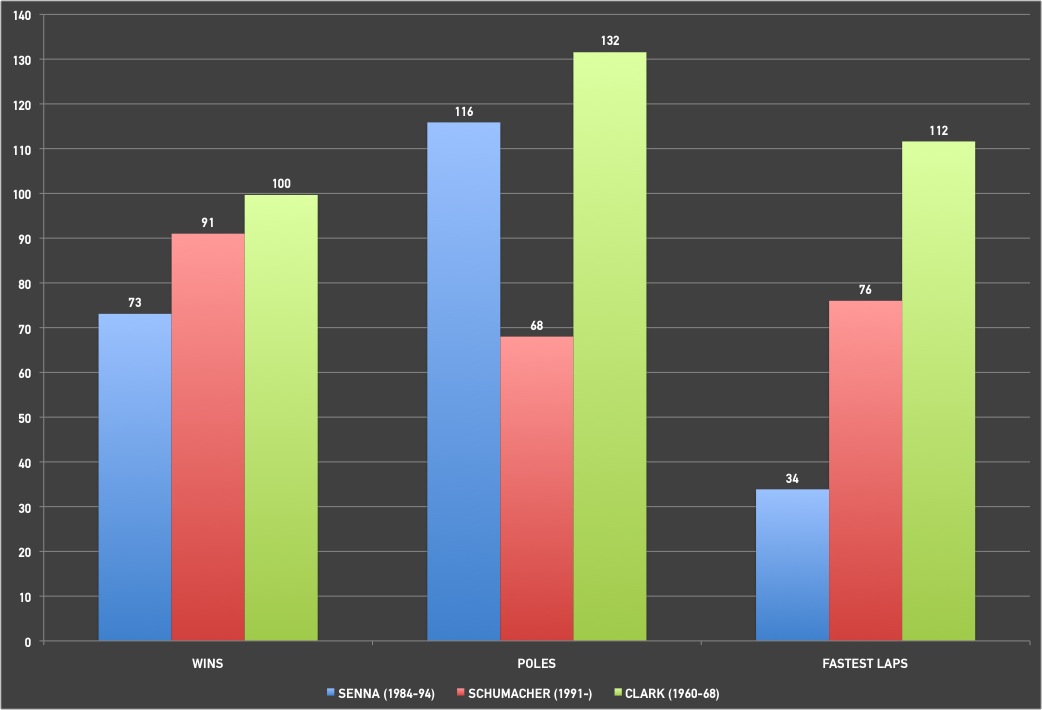
Sean Kelly – @virtualstatman – produced an amazing suite of graphics for Ep 62 of The Flying Lap yesterday. (To see a re-run of the show, click the TFL icon in the column on the right here or go to http://smibs.tv/live.)  One of my favourites was this – his vision of what would have happened if Ayrton Senna and Jim Clark had not been cut down in their primes but instead had continued to win at the rate that had characterised their careers from the outset.  Ayrton’s blue, Michael Schumacher is red (and currently at 2012, of course); and Jim Clark is lime green.  Oh, and by the way:  that’s Jim in the header picture above (at Monaco, 1966, in the Lotus 33B-Climax).

Farewell to a racing gentleman

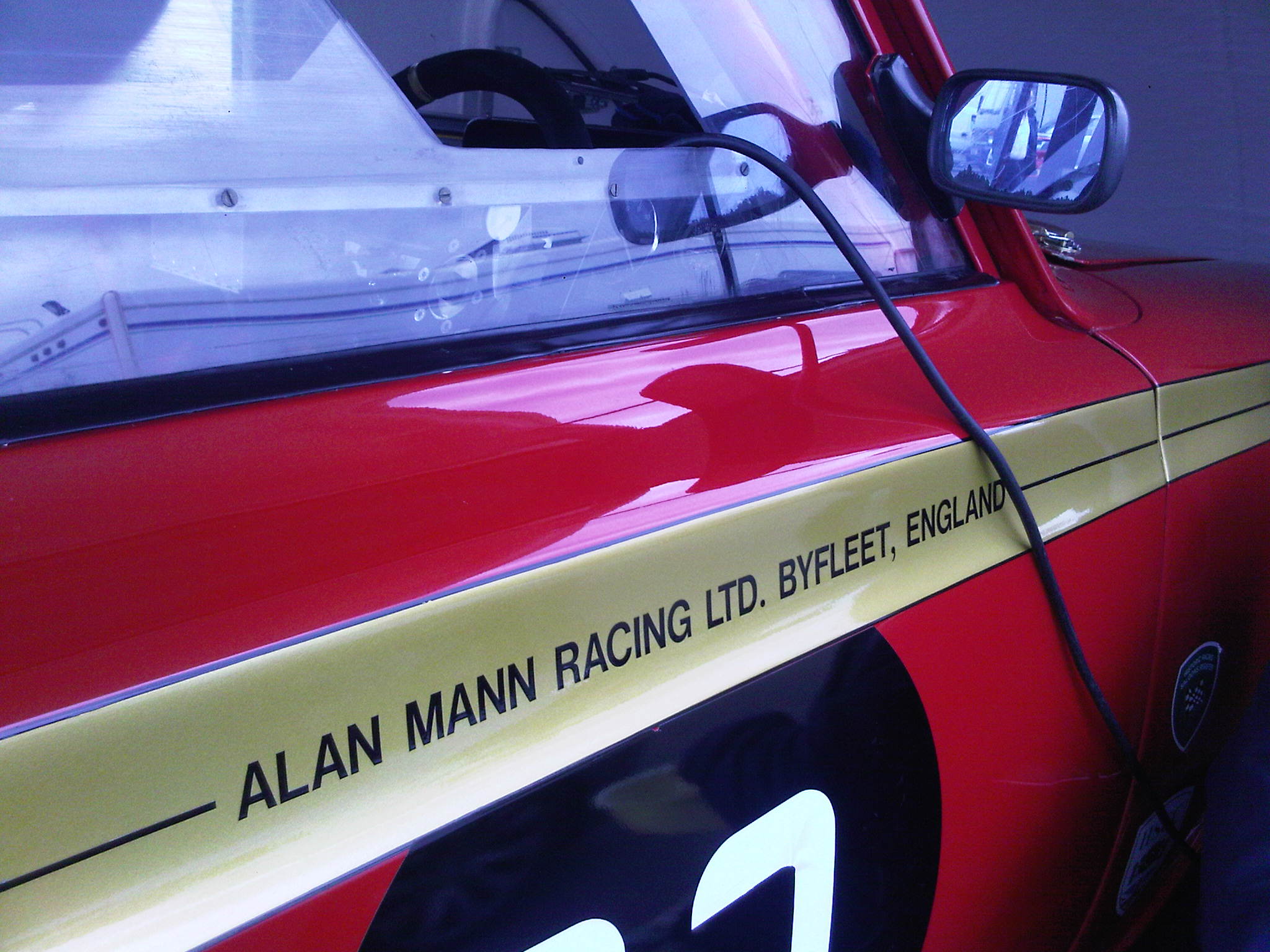
Alan Mann, who passed away yesterday, was one of those excellent racing people with whom it was always a privilege to spend time.  He knew how to run racing teams;  he knew how to prepare cars – and to present them beautifully;  he knew the aviation business;  he knew people.  I spoke to him not so long ago at Goodwood.  “Tell me about the Ford F3L,” I said, somewhat presumptuously.  Alan was a delight.  We spoke for 30 minutes or more.  Mike Spence, I recall, emerged from the conversation with a five-star rating.

He will be greatly missed.  It was only last night, still oblivious to the sad news, that  Sir John Whitmore’s voice sparkled at the other end of my phone.  Sir John won – make that dominated – the 1965 European Touring Car Championship with his Alan Mann Lotus-Cortina.  Those who watched him three-wheeling over the cobble stones of the Budapest street circuit still talk about it today, years after the event.  Alan Mann-Sir John Whitmore was one of the great racing combos of all time.  Hand-in-glove.  Always in synch.

Frank Gardner, too, was another Mann driver:  “If you’ve got the preparation taken care of, you can focus on the driving….” Frank used to say after another of his walkover wins in an Alan Mann Ford Falcon Sprint or Escort.

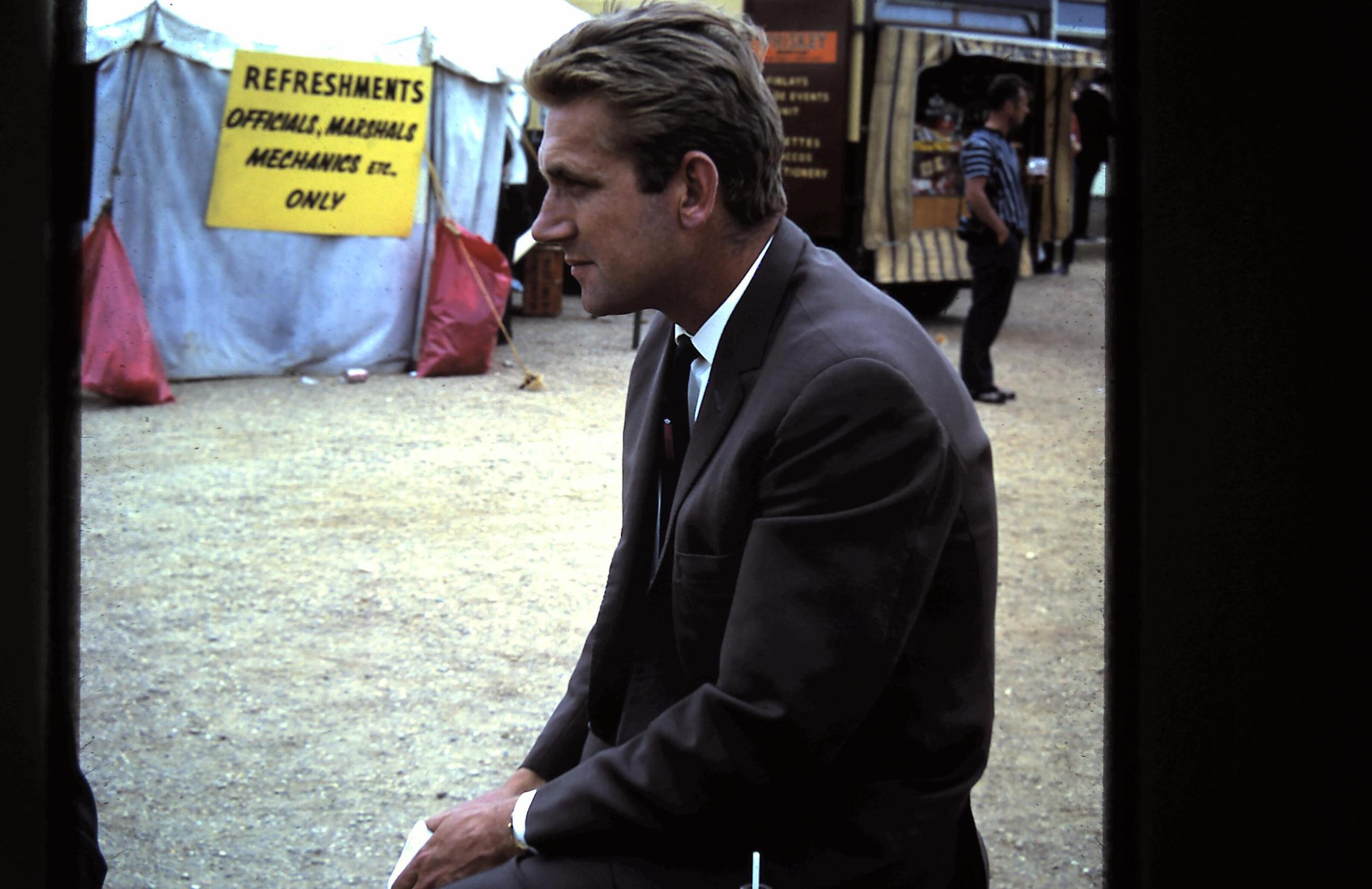
The picture I show here was taken in 1969 at the British GP by a great admirer of Alan’s.  Geoff Sykes, the Warwick Farm Tasman promoter, was in the UK to sign-up drivers for the upcoming Australian summer leg of the series.  I’ll never forget his words, upon his return to Sydney, as he described this shot of a contemplative Alan Mann in one of his regular “slide shows”:  ” Outstanding car preparation and presentation.  Knows what he’s talking about.  Knows his helicopters, too! A gentleman.”


Post Navigation