peterwindsor.com

…chance doesn't exist; there's always a cause and a reason for everything – Elahi

Archive for the category “Circuits”

Front Row Tours – what a view!

As true F1 enthusiasts go, Colin Bach is amongst the purest.  If I tell you that he owns the Ferrari 312T2 (chassis 031) that took Niki Lauda to the World Championship in 1977 (winning the Dutch and German GPs that year)  and Carlos Reutemann to victory in the 1978 Brazilian Grand Prix, I’m sure you’ll get the picture.

A lover of all things Italian – cars, food, design – Colin most of the time lives in San Francisco, where he is a major player in a blue-chip car club called The Candy Store.   Members of TCS meet regularly at local circuits to drive their hardware – and also to enjoy the company of such special guests as Parnelli Jones and Gordon Murray when the moon is in the seventh house.

The reason I bring Colin to your attention is that he regularly attends F1 races, is extremely well-connected to many of the F1 teams and is putting together a number of selected F1 tours, for limited numbers, in 2012.  The prices will not be cheap – I leave that for you to discuss with Colin (colinbach@msn.com) – but I know he his planning tours at the very least to the Monaco, Canadian and Italian GPs.

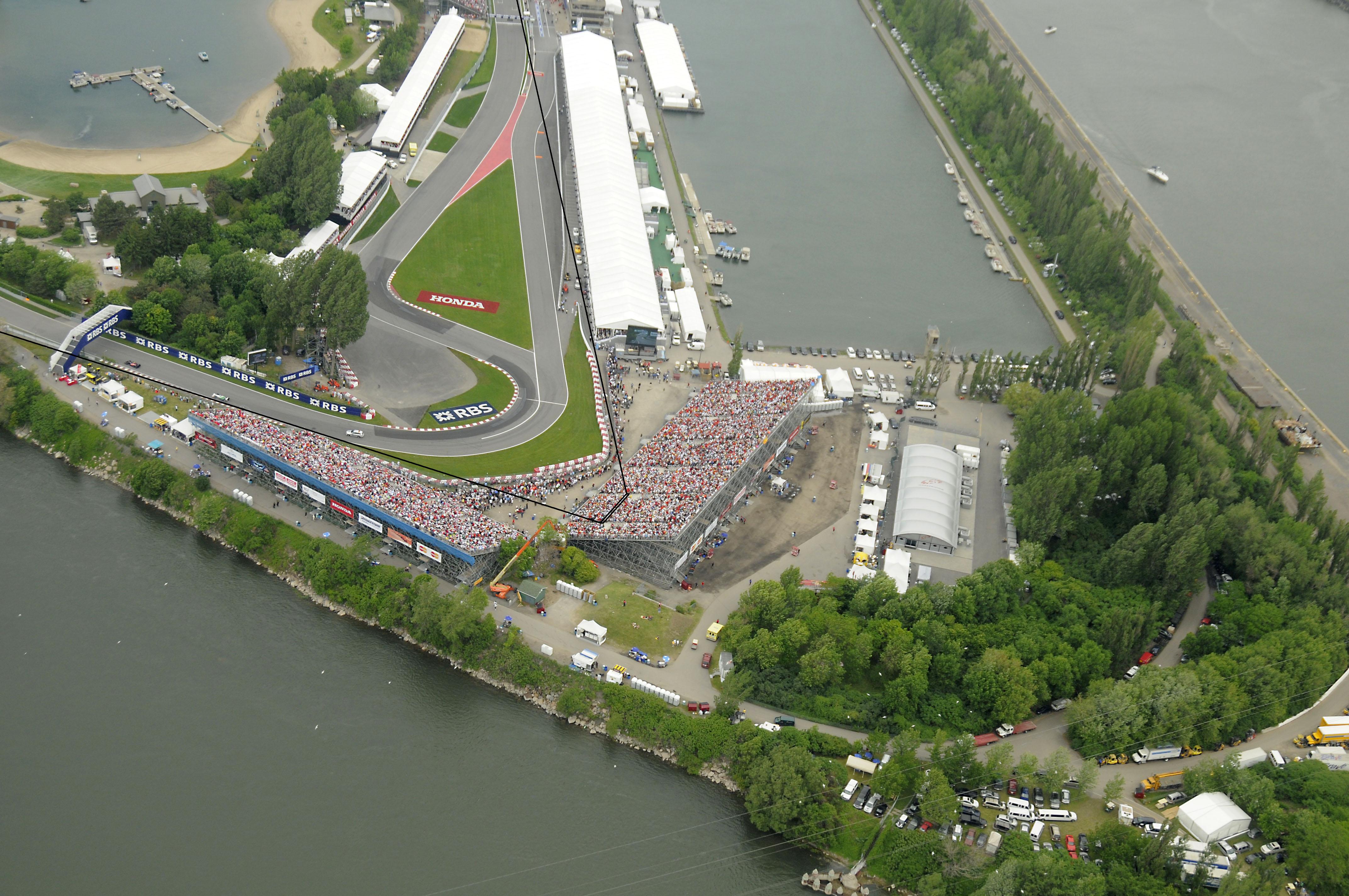
Location is everything, of course, when you attend an F1 race, so here is an example of the sorts of grandstand seats he has secured:

Monaco practice from the tribune opposite the pit lane, overlooking the swimming pool exit; qualifying from Tabac, overlooking the harbour;  and race day at Monaco from the outside of Casino Square.  And in Canada he has obtained seats with a panoramic view of the Turn One complex (see below).

The Front Row Tours (as Colin calls them) will include dinners and cocktails with special F1 guests and hotel accommodation where the drivers stay (the Columbus at Monaco, for example).

If you love F1, therefore, and if you want to talk, think and eat F1 with like-minded people, contact Colin.

Oh yes.  And he also owns a Williams FW12 (passive-suspension)-Judd, as if you hadn’t guessed.
Longford, 1964

Longford was one of those circuits – very fast, very spectacular…and very dangerous.  There’s a jocular feel to this video from the 1964 Tasman race, but that’s how they were back then.  It hides the tragedy of Timmy Mayer’s practice accident in the second Bruce McLaren Motor Racing Ltd Cooper-Climax.  Tim was pushing hard in the afternoon session, enjoying himself in the beautiful little car that his brother, Teddy, had helped to produce.  He took off over one of the many bumps on the street circuit – nothing new there –  but his landing on this occasion was skewed.  The car spun into one of the trees you can see early in the first lap here, on the straight leading up to the tight right-hander, Pub Corner.  Tim – a wonderfully fast driver who had made his name in a rapid Lotus 23 against the likes of Graham Hill  – was killed instantly.  That was on the Friday.  On Saturday there was a motor race….

John Watson – Part 1

In the first segment of our three-part interview with John Watson, MBE, recorded originally for http://speed.com, we talk about his early years in F2 and F1, including his time with Penske Racing: replacing the late Mark Donohue, he won the Austrian GP exactly 12 months after Mark’s tragic loss.  To see a photo album tied to this segment, with detailed captions, log on to http://speed.com/thewindsorjournals

My Post Card from India

Thoughts on corner names and numbers

My thanks to Raymond Umbara (@Raymondu999) for pointing out a mistake in my Korean GP report (http://gpweek.com).  I described Seb Vettel brilliantly taking the lead from Lewis Hamilton at “Turn 3” when I should have said “Turn 4”.

As ever with these things, I wondered why I had made that basic error.   And, as ever, I began to appreciate that there was more to the issue than I first realized, for my subconscious had driven me in a certain direction.

Turn 1 in Korea is basically a left-hander that takes the cars onto the “back” straight.  The FIA  decree this to be two corners – two left-handers joined by a short straight – but in reality this raises the question of “when is a corner not a corner?”.  For example:  the first corner at Suzuka was for many years known as exactly that.  If you wanted to get down to detail, you could sub-divide into into “1A and 1B”, which in my view perfectly captured the tightening-radius nature of the zone.   Today, the second part of the first corner is officially known as “Turn 2” – which begs the question of where “Turn 1” begins and ends.   For me, it is a similar situation in Korea at the end of the pit straight. You brake for the first corner – and if you get that right the second part more or less follows in sequence.   If a driver messes up the entry into “Turn 1”, and spears off to the outside of the short straight, has he in reality gone off at “Turn 1” or on the approach to “Turn 2”?

All this confusion would be obviated by reverting to the traditional corner naming system.  I understand that commercial corner names – “Kodak Curve” or “Vodafone Viaduct” – would cause unnecessary friction within the F1 Economic Community, but natural corner names provide a perfect platform for race promoters – particularly the owners of expensive circuits built in new-frontier countries with no racing heritage.  Is there a better way to record the names of local towns and geography, important people behind the circuit and famous landmarks?  I wouldn’t have heard of “Lavant” village but for Goodwood – and nor would I be aware of Stowe school but for Silverstone.    If Korea’s Turn 1 and Turn 2, for example, were collectively known as “MacArthur Corner” we’d all have a bit of a chuckle every time they hit the brakes.

A final couple of thoughts.  Since when has a corner been a “turn”, anyway?   And would Eau Rouge be as dramatic if it was known, annoyingly, as “Turns TwoThreeandFour”? Paddock Bend at Brands Hatch always was – and still is – a great corner.  I shudder at the thought that one day it could be known simply as “Turn One”.

Post Navigation