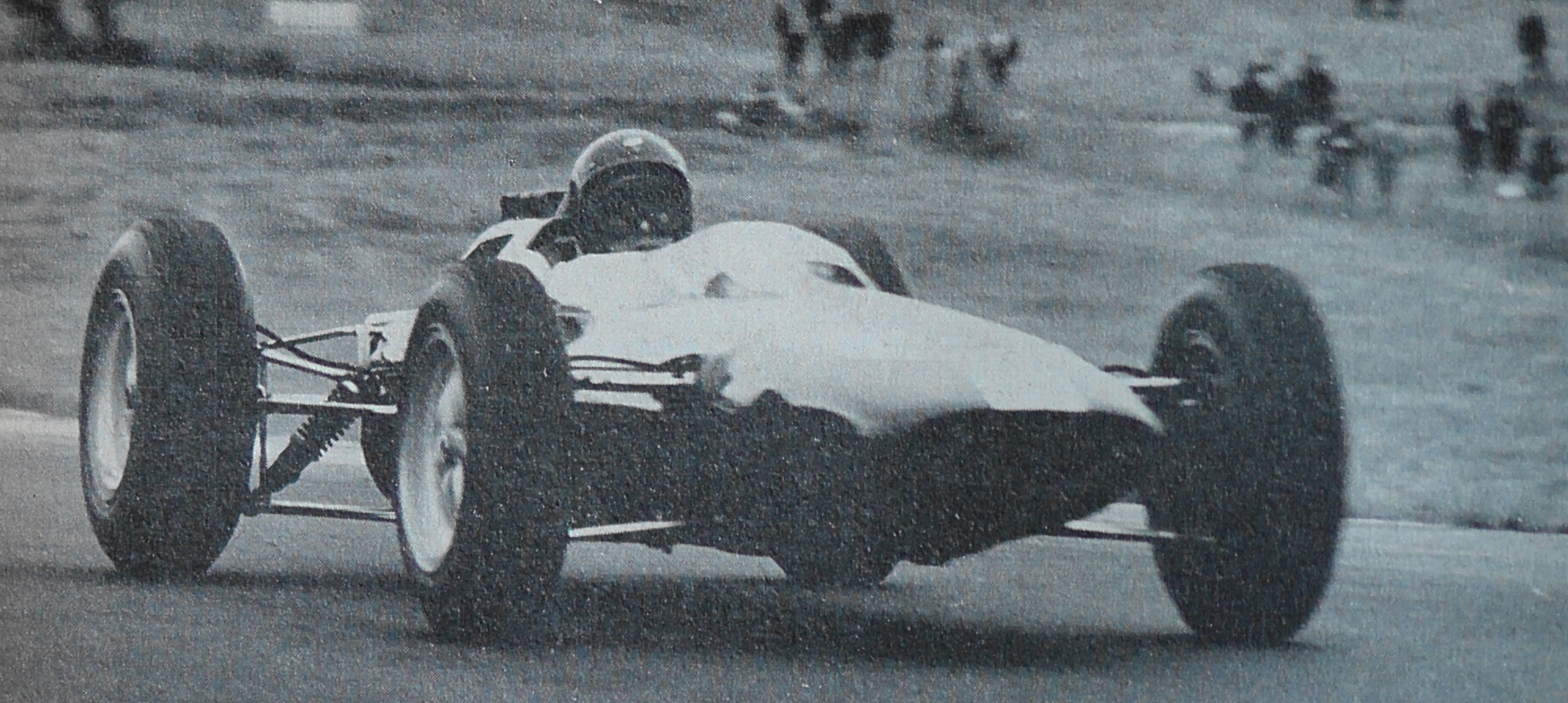
To Sweden, for the Kanonloppet – to a non-championship F1 race with a bit of history, given that Stirling Moss (Rob Walker Lotus 18/21) won it in 1961 (from the back of the grid, after Jim Clark’s retirement) and Maston Gregory followed that with victory in 1962 at the wheel of a UDT-Laystall Lotus 24-BRM. (It should also be remembered that Graham Hill, fresh from his momentous victory for BRM in the 1962 German GP, drove Rob Walker’s Lotus 24-Climax the following week in the downbeat Kanonloppet. He qualified on the second row at Karlskoga but retired early.) The Swedish race was bracketed with with Danish GP (Roskildering) in ’61 and ’62 but it stood alone in ’63. As the former factory Lotus and BRM driver, Reine Wisell, recalls in the adjoining interview, Karlskoga was, and is, best-known for the Bofors armament factory. Thus the name of the race: Kanon (gun), Loppet (trophy).
Jim Clark won the two-part race (the results of which were based on points awarded for finishing positions, with total times deciding the ties) but – as at Solitude – it was Black Jack Brabham who again set the “non-championship” pace. Jim experimented with the spare, carburettored, Lotus 25, leaving the fuel-injected car for Trevor Taylor – but couldn’t live with Jack’s BT7 out of the slow corners (of which there were about five at Karlskoga, including the banked hairpin). Jack, who took the pole from Jim by half-a-second, was heading towards a sure victory in Heat One when his engine suddenly cut-out (as per Dan Gurney’s chronically at the Nurburgring). Jim thus won easily from Trevor.
Jim calculated during the lunch break that he could finish third in Heat Two and still win overall (providing he crossed the line no more than 1min 35.2sec behind Brabham) and so, on a wet afternoon, he did exactly that: Jack duly won the second heat; Jim let Trevor finish second – and thus the Kanonloppet was Jim’s. As it happened, he finished that second heat exactly 35 sec behind Jack and right on Trevor’s gearbox. Denny Hulme, having his first F1 drive in the 1.5 litre formula, finished fourth in the other works Brabham.
As I say, Reine Wisell paints a nice picture for us of the 1963 Kanonloppet in the video interview below. I caught him last week on a day similar to that of August 11, 1963, dragging him out of a restaurant on a wet day Motala. His chat is best watched in conjunction with the “Kanonloppet 1963” video (also embedded here) which has become something of a YouTube cult hit. Think a very early Swedish Woodstock and you have some picture of what that Karlskoga meeting, on August 9-10-11, 1963, was all about. You get a feel for ’63 Karlskoga (the town) and for what it was like for the fans there. I kind of like the Swedish commentary, too! Reine also mentions a video of the 1967 Kanonloppet but I couldn’t find it on a quick, initial search. Let me know if you have more luck.
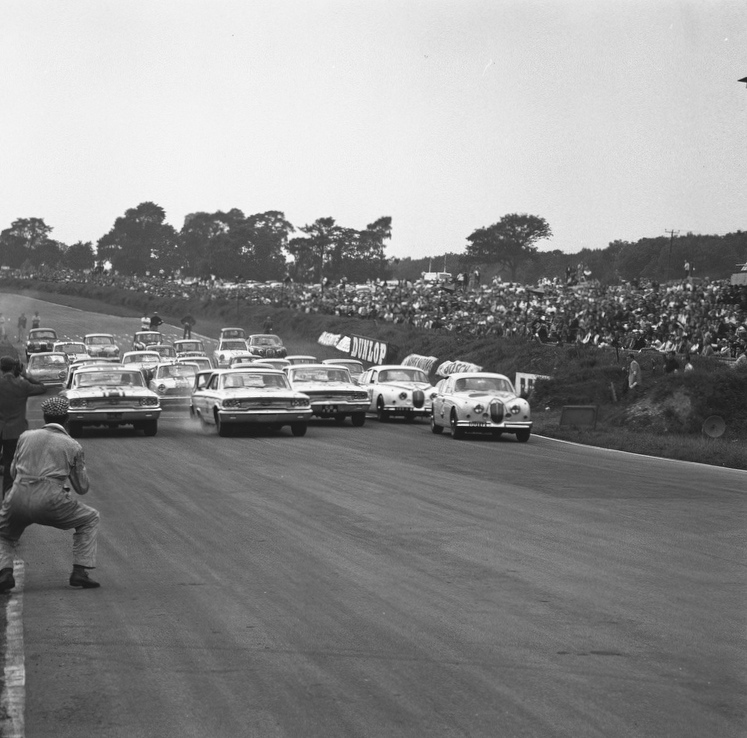
Monday, August 5, was a holiday in the UK in 1963, which meant that all eyes turned towards Brands Hatch for the Guards Trophy (as in Carreras Guards filter cigarettes). This was a classic British international race meeting run by the British Racing and Sports Car Club (BRSCC) in front of a classically-large crowd. The feature race was for sports cars over 50 laps; support events were for saloon cars, smaller sports-racing cars and GT cars. Consider that this meeting was staged exactly 24 hours after the German GP, and that the line-up of drivers at Brands included F1 stars like Jim Clark, Graham Hill, Lorenzo Bandini, Trevor Taylor, Innes Ireland and Tony Maggs, plus other names like Roy Salvadori Roger Penske, Jack Sears, Timmy Mayer, Paddy Hopkirk, Sir John Whitmore, Frank Gardner, Mike Salmon, David Piper, Lucien Bianchi, John Miles (the future Lotus F1 driver) and Ray Parsons, (Jim Clark’s part-time mechanic) and you have a picture of what motor racing in the 1960s was all about: it was about the drivers – about star names having one-off races in interesting cars, regardless of their chances of winning. Trevor Taylor, for instance, jumped from an F1 Lotus 25 at the Nurburgring into a Lotus Elite at Brands. The World Champion, Graham Hill, swapped his works BRM for a Jaguar 3.8. Le Mans winner, Lorenzo Bandini, went from his Centro Sud BRM to a big Ferrari 330LM.
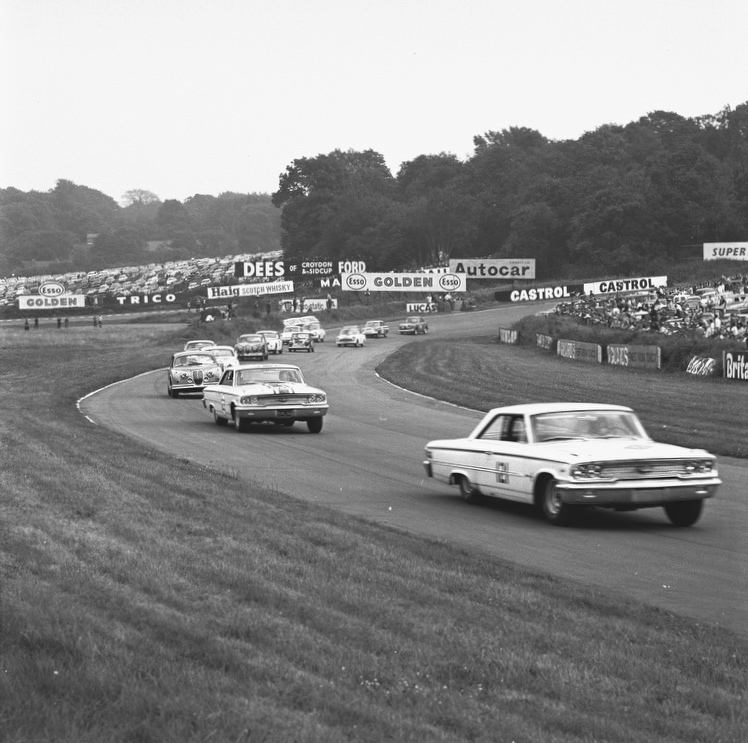
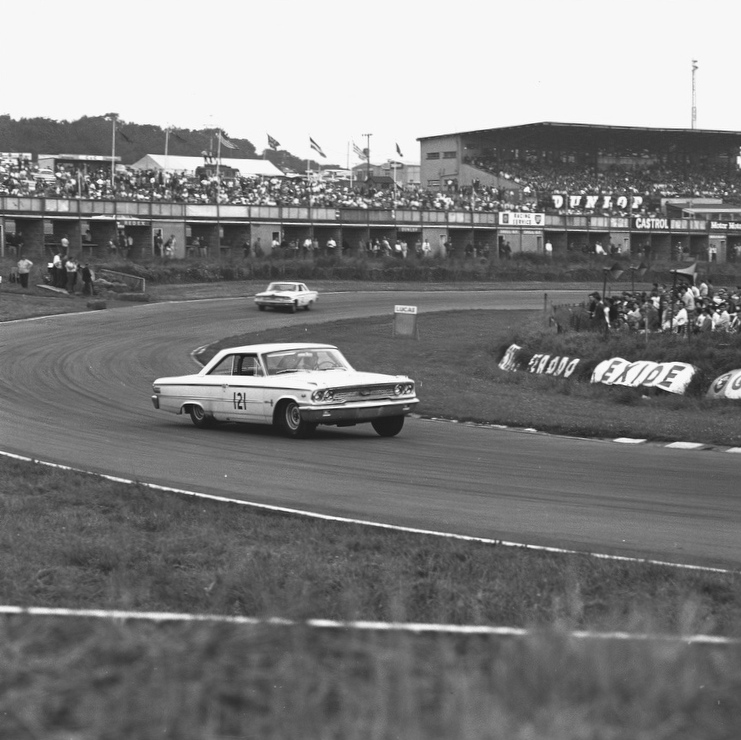
And Jim Clark, if you please, stepped from his Lotus 25 into…a Holman-Moody-prepared, Alan Brown-run, 7-litre Ford Galaxie. Featuring lightweight panels, blueprinted V8 and stripped interior, this two-door “fastback” Galaxie was one of three Ford-commissioned, Holman and Moody-prepared cars to colour the British touring car scene in 1963. One Galaxie, owned by John Willment (who knew Holman and Moody well from his interests in marine engines) immediately won races in the skilful hands of Jack Sears; the Alan Brown car was effectively a “guest” Galaxie, driven by Dan Gurney, Jack Brabham and, at Brands, Jim Clark; and Sir Gawaine Bailey, the very rapid baronet, owned and drove the third car. Lee Holman, son of John, was 18 when, in early 1963, he was asked to drive the Alan Brown Galaxie from the H-M headquarters in Charlotte, North Carolina, to the port of New York. “We put some Brillo pads up the exhaust to try to dampen the sound,” remembers Lee, “but the biggest help were the $100 bills I took with me to pay off the traffic cops! One of them stopped me somewhere in Virginia so I showed him the paperwork about the car being owned by the Ford Motor Company and being shipped to the UK for racing and he was so impressed that he let me go…”
It’s hard to picture it, now – Jim, Graham, Trevor, Tony Maggs, Lorenzo and Innes all rushing back to England to race their widely-different cars at this Brands International. Jim wasn’t even in the big race! Instead, he could relax down at the lower end of the paddock with Alan Brown and the mechanics, settle himself into the Galaxie’s spacious, padded “bucket” seat and apply some of the intel he’d been given by Dan. The left-hand-drive Galaxie had a “four-speed, on-the-floor (L-shaped) shifter”, a lap seat belt only, a deeply-dished plastic steering wheel and a lateral (ie, not longitudinally-braced) roll-bar. Driving it was all about taming the power – ie, minimising the wheelspin and the oversteer….and allowing for brake fade.
Why was Jim racing that Monday in a car he’d never even tested? As much as Jim loved to drive nimble sports cars on the road like the Lotus Elite, Lotus Elan and Porsche 356 he was also amused by the concept of big, comfortable American “slushmobiles” like the Galaxie. And controlling the Galaxie on a race track appealed to Jim’s sense of curiosity. Ask one of the current F1 drivers to compete in a Porsche Supercup race and their initial response – even before they considered the complication of contracts – would be to ensure that their image was not dented by the likes of a Sean Edwards; Jim had no such qualms. He was intrigued by the concept of racing the Galaxie; he liked the Ford connection, in view of his plans to race more extensively in the US; he liked the Holman and Moody people, who were at that point doing great things with the Falcon Sprint rally cars in Europe; and he wasn’t afraid of being beaten by an ace like Jack Sears: this was but a part of motor racing.
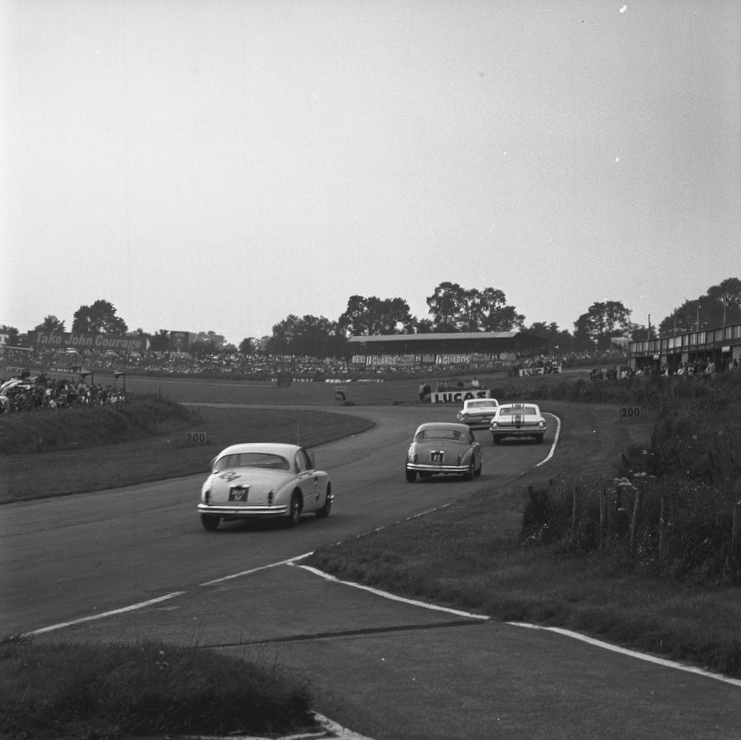
As it happened, Jim qualified second to Jack but seized the lead into Paddock Bend: Jack’s start, on the lower side of the track, had suffered from the usual Brands Hatch wheelspin. Jim held the inside line up the hill into Druids, won the mid-corner barging match at the hairpin and headed the field into Bottom Bend, his right rear Firestone picking up the dirt as he power-slid the big Galaxie onto Bottom Straight. Jack Sears had won on all types of circuit (from Silverstone to Crystal Palace) with the Willment Galaxie and was not about to fall away; it was Jim Clark, though, who emerged from the back of the circuit still in the lead. One can hear the voice of Anthony Marsh now, as the lumbering V8s teetered into Clearways:
“And it’s Jim Clark in front! Clark leads from Sears and then come the three Jaguars – Graham Hill in the Coombs car, Roy Salvadori, Mike Salmon, who banged into Sir Gawaine Baillie’s slow-starting Galaxie off the line…”
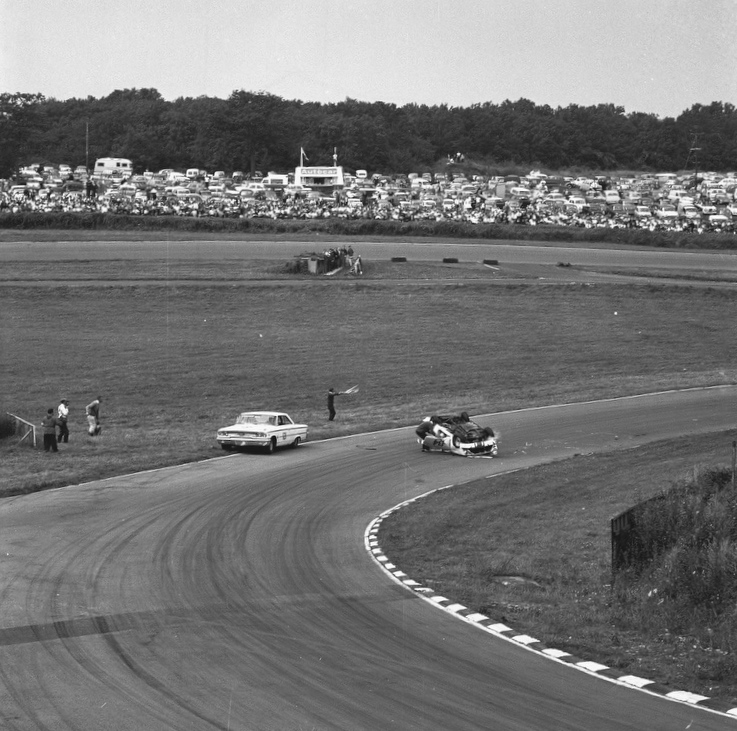
Jack, for once, ran into trouble – a punctured Firestone, to be precise. Jim was left to win from F1 arch-rival Hill – but not without incident. David Haynes demolished his Cortina GT on Bottom Straight right in front of Paddy Hopkirk’s Mini. Paddy took major avoiding action on the grass – but Jim, too, was forced to put two wheels out there on the turf to miss the melee. Fortunately, Haynes escaped uninjured.
So Jim won the 20-lap Slip Molyslip Trophy for B-class Group 2 saloon cars. The race was considered at the time to be so minor that no pictures at all were published in Autosport of the F1 Championship leader in the Galaxie. Instead, the headlines went to Roger Penske, who won the Guards Trophy with his Zerex Special (basically a Cooper-Climax F1 car with bodywork). Frank Gardner’s Brabham beat the Lotus 23s in the sports car event; Bob Olthoff, who on August 18 would, with Jack Sears, win a 12-hour race in Washington, USA, in a Willment Cortina GT, took the up-to-3-litre class of Jim’s race; and Sir John Whitmore again reigned supreme in his Mini-Cooper. (Sir John would also win the GT race with his Stirling Moss special-bodied Elan.) Balfour Place was thus heaving that Monday night – particularly as Cleopatra was on the agenda for Jim and Sally. Jim would head over to Cheshunt on Tuesday to see Andrew Ferguson (to sort out some accounts!) – and they would leave on Wednesday for Sweden, where Jim was due to race in the non-championship F1 event at Karlskoga, near Orebro, west of Stockholm. Jim had had the pole there in 1961 but had retired from the race with that old Lotus foible – broken front suspension. Here was a chance to redress the balance.
Also eagerly awaiting the appearance of F1 stars on his home track was an Orebro 19-year-old who had over the past 18 months been winning a string of kart races. His name was Ronnie Peterson.
Captions, from top: Jack Sears sits on the pole with rear wheels spinning while Jim (middle of the front row) smokes away from the line. On the right, Graham Hill is up-and-running in John Coombs’ 3.8 Jaguar; lap one, and Jim leads Jack Sears along Bottom Straight. Amongst the Jags, Roy Salvadori has passed Graham…; rear view of the opening lap battle. Characteristically, Jim has already begun an early, small, initial turn towards South Bank Bend (with brakes yet to be applied). Jack, more traditionally, is beginning to brake to a wider turn-in point; within a couple of laps, Jim had begun to put a little air between his Alan Brown Galaxie and Jack’s Willment car. Here, on the entrance to the uphill South Bank Corner, he balances an oversteer slide; Jim takes to the grass to avoid what remains of David Haynes’ Cortina GT. Images: LAT Photographic
As Jim Clark’s 1963 season continues, we head to the Nurburgring
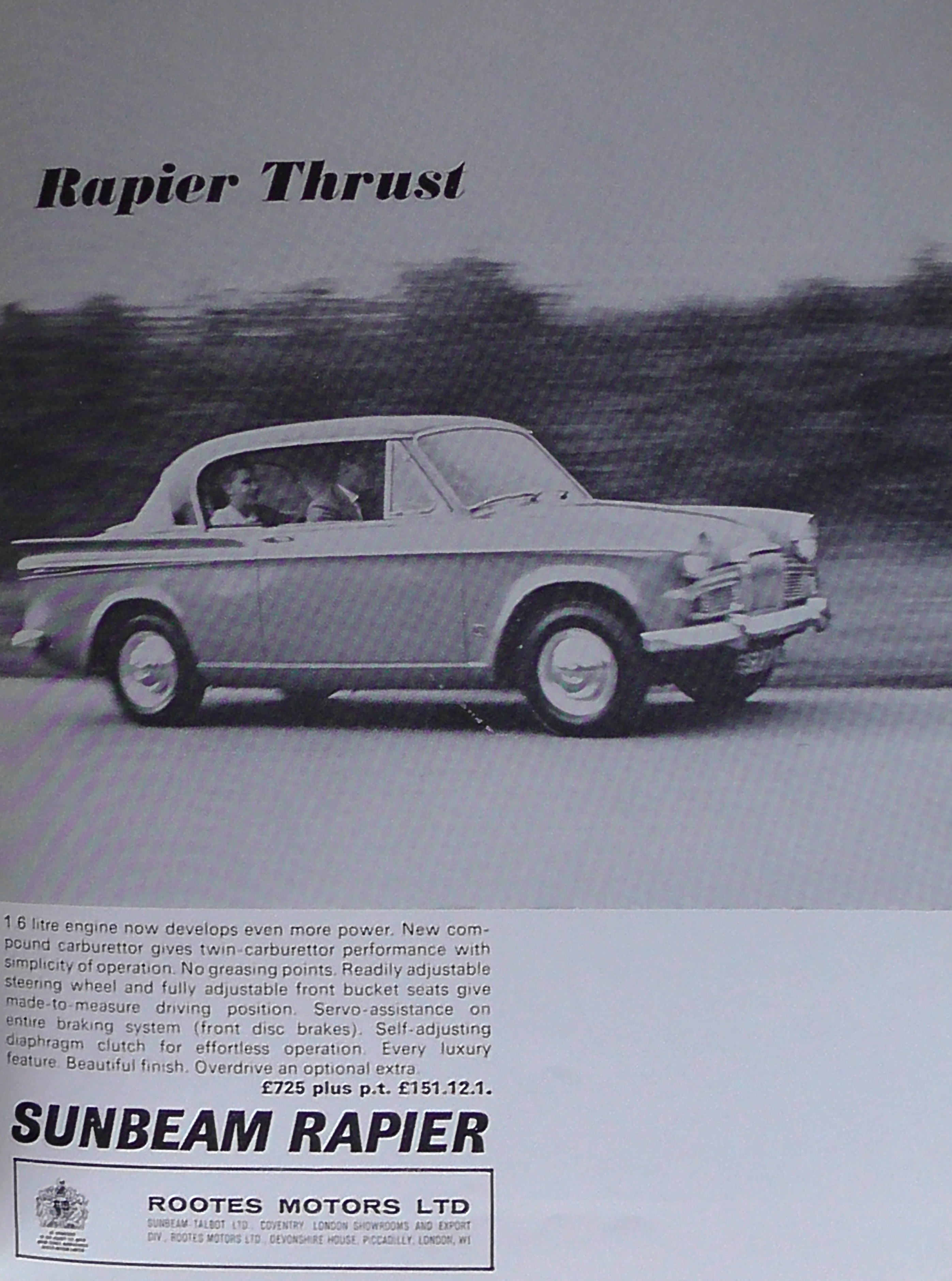
Bruce McLaren journeyed to the Nurburgring, for the German GP, in a Sunbeam Rapier road test car (arranged and co-driven by his secretary, Eoin Young). In the days when standards, and tastes, were more in tune with real life, Bruce described the Rapier as “surprisingly fast” and “very comfortable”. He would have cause to repeat his descriptions, post-race, in ways that he could never have imagined.
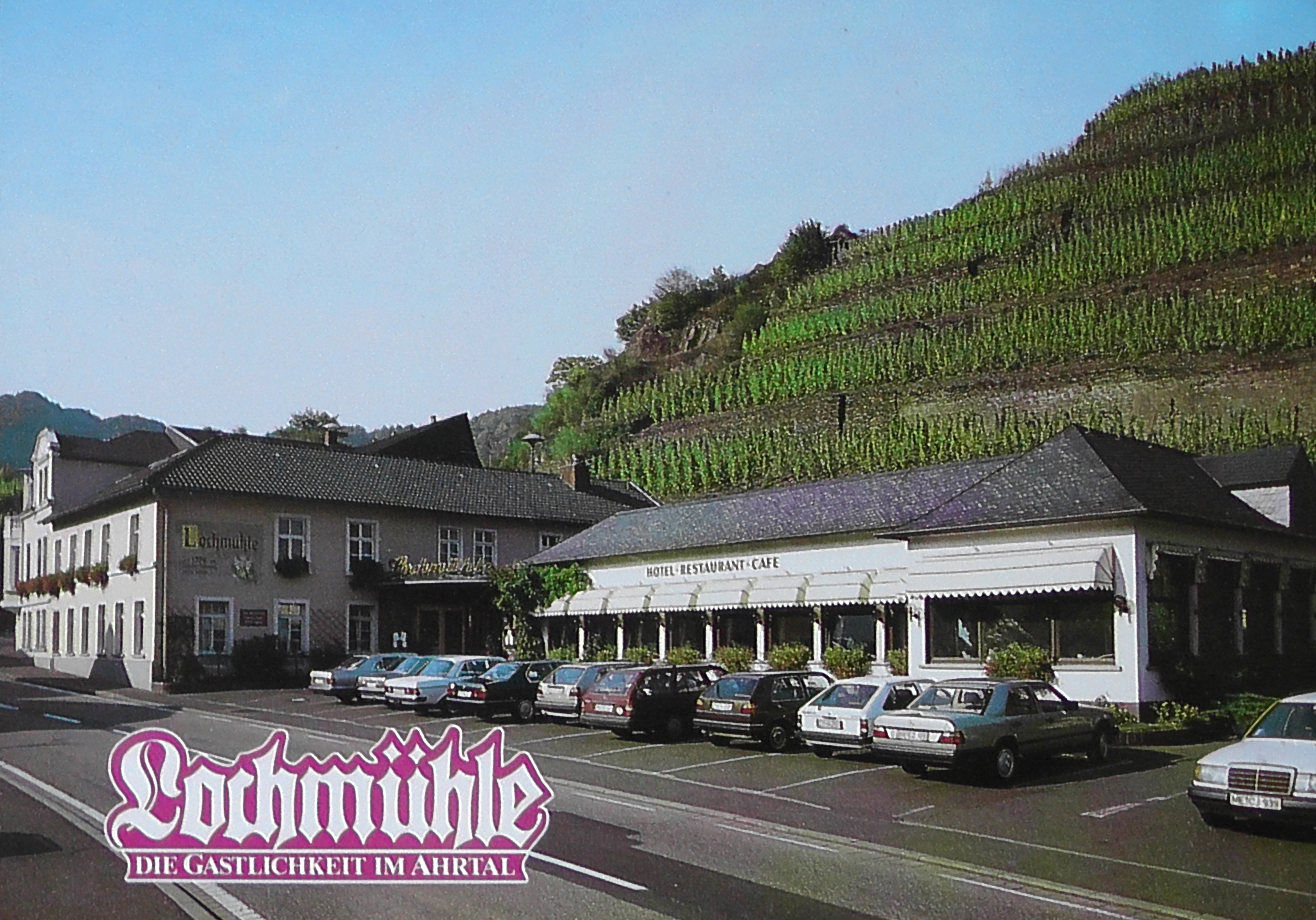
As in 1961 and 1962, when they had raced as team-mates in John Ogier’s Essex Racing Team, Bruce McLaren and Jim Clark stayed at the Lochmuhle hotel in Altenahr for the 1963 F1 race. There’s no record of exactly what they specifically ate that weekend, but Bruce had said this about their stay the previous year: “They serve some of the best food in Europe at the Lochmuhle and, as Essex were paying the bill, most of us stuck to four large courses, such as lobster or that delicious oxtail soup, followed by a quick chicken and mushroom entrée or pate, then an exotic steak, grilled with oranges and tomatoes or a wine sauce. Jim generally managed to fit in a grilled trout, probably caught an hour earlier in the river by the hotel. For a small man, it was amazing how much he could stow away!”
Jim, Peter Arundell and Trevor Taylor attended Huschke’s Sunday night party in Solitude and thus Jim and Trevor left at a leisurely hour for the autobahn thrash up to the Eifel hills on Monday. Jim was thirsty for a win on the circuit that for him represented the greatest of all tests of drivers’ skill. He had first raced there in 1961, in that Essex Aston with Bruce, and had quickly learned the circuit in Bruce’s 3.8 Jag. Then, two months later, he had finished fourth in the German GP in the Lotus 21. That race will forever be remembered as one of the finest hours (or two and a half hours!) in the career of Stirling Moss – but Jim’s fourth place, in his first full season, nursing a brake problem in the spare car (after a big practice accident), should never be under-rated. From then on, Jim had a Monaco-like relationship with the 15-mile circuit: he was always quick, always its master – but the circuit, in turn, always found a way of throwing him a joker. Whilst leading the 1962 1000km race easily in the Lotus 23, Jim became nauseated by an exhaust gas leak from a loose manifold. And at the ’62 German GP, whilst focussed on de-misting his goggles, he forgot to switch on the fuel pump just before the start. He recovered to finish a brilliant fourth.
Now, with four World Championship victories behind him, and that new lap record at Solitude, Jim was returning to the Ring with the Lotus 25 in its latest, delectable, form. Of course he could be worried about suspension failures and the like over the switchbacks of the ‘Ring; he knew that Cedric Selzer and the boys were, too. He trusted them, though; and, ultimately, he had to trust Colin Chapman.
Jim began Friday practice with his race Climax engine from Solitude; and, continuing that Solitude connection, a driveshaft broke (again) as Jim was preparing for a quick lap. He thus finished the session third-quickest behind John Surtees in the works Ferrari and Lorenzo Bandini’s old Centro Sud BRM. Cedric Selzer and the boys fitted new driveshafts during the lunch break in the Team Lotus lock-up garage in the paddock quadrangle. Bratworst anyone?
Then, in the afternoon, it rained on the main part of the circuit (but not in the pit area). In a nice counterpoint to 2013, all the drivers nonetheless ventured out. Jim was quickest, slicing his 25 through the mist and standing water in 9m 44.0sec. Surtees was second and Ritchie Ginther third in the factory BRM. Overnight, Jim asked for an engine and gearbox change. Oh yes, and how about leaving reverse out of the ZF ‘box on this occasion, just as a safeguard against any further selection issues? It’s one thing to hold the car in gear through the Masta kink; it’s another to do so over a blind brow at the Nurburgring…
It was dry, but overcast, on Saturday, which meant that now was the moment for The Lap. The 25 felt taut on exploratory looks around the North and South Curve loops; the new engine, mated to the new ZF, seemed strong. Jim lowered himself in.Peakless Bell, Dunlop blue overalls, Leston string-backed gloves, Westover shoes. No seat belts.
The new engine faltered. It coughed, irritatingly, as Jim left Pflantzgarten for the long roller-coaster straight at the finish. And it wasn’t just a question of losing a second or two: the baulk killed his acceleration run through third, fourth and fifth gears. There was no telling how much time he had lost.
Still, though, he was on the pole: that was the quality of the lap. 8min 46.7sec – the fastest ever recorded at the Nurburgring. Without that mis-fire (or whatever it was), he could easily have been in the 43s. Surtees, looking consistently quick, was second-fastest; and third – amazingly – was Lorenzo in the old BRM. It was at about this time that Jim’s long-lasting friendship with Lorenzo was born. Graham Hill, always a threat at the ‘Ring, rounded out the four-car front row; and Bruce was on the inside of the second row in the Cooper, ahead of Ritchie and Jack Brabham. Dan, again wearing a white, Clark-like, peak on his Bell for this race, had nothing but engine trouble with his Brabham. Was Solitude but a dream, he must have been asking?
Wally Hassan, of Coventry Climax, was present at the ‘Ring (on the third anniversary of the V8’s appearance) and suggested the usual remedies: plug changes, fuel injection clean-outs. In the quadrangle, as they all sat and stood around, and as the mechanics worked flat out, Jim’s engine sounded perfect. Fingers were crossed for tomorrow.
The start I encourage you to watch on the German TV video below. Drivers shuffle in their cockpits; officials wave hands and twitch flags. Some of the slower cars begin to creep. Not Clark. The 25 stays rock-solid still. And then – bang! Jim releases the clutch against revs, the rear tyres smoke and he is gone, soaring into an immediate lead…
His start, indeed, was exactly as he planned it: “I decided that a fast start was absolutely vital,” he would say later to Graham Gauld, “because, with all its twists and turns, the ‘Ring can be tricky for anyone trying to overtake, particularly in a Grand Prix car. So when the flag dropped I departed as quickly as possible…”
It wasn’t to last. As Jim selected third gear – and this can just be seen on the video – his engine hesitates again, just as it had on his pole lap. “Surely I haven’t oiled a plug on the line?” he thought, fearing the worst. Jim had specifically started the engine only a few minutes before the off to prevent just such a problem. Now, as he focused on the first left- and right-handers and then on the run down back behind the pits, he could see the pack surging nearer in his mirrors. All around the lap he lived with the problem. Ritchie Ginther went past in the BRM – then Surtees. The engine would feel as if it was on seven cylinders – and then suddenly it would go onto eight, mid-corner.
In time, of course, Jim began to maximise what he had – “but my progress was erratic, to say the least,” he would say later. “I developed a whole new system for going around the Nurburgring on seven cylinders. This was completely spoiled on occasion because I would arrive at a corner I knew was flat-out on seven cylinders and set the car up. Then the eighth cylinder would come in with a bang and there would follow an exciting second or two as I sorted the car out. What a difference that one cylinder makes when you have committed yourself to a line with what you thought was a seven-cylinder motor car!”
For the most part of the race Jim was able to keep the Ferrari of John Surtees in sight; indeed, as can be seen in the videos, he was on some parts of the circuit able to re-take the lead – for John, too, was fighting a mis-fire of his own. Usually the Ferrari ran on six clear cylinders; occasionally it ran on five. Surtees was up there with Clark, allowing for the intrusions, fighting with the car.
And, towards the end, he was able to pull away, for Jim began to feel his gearbox tighten. On this occasion Jim would settle for second place – the first and only second place he would ever record in a World Championship Grand Prix. It wasn’t a question of “driving for points” because of “the championship”. It was simply a question of “bringing the car to the finish”. He did so – 1min 20sec behind John. Afterwards, the engine problem was traced to yet another dud spark plug.
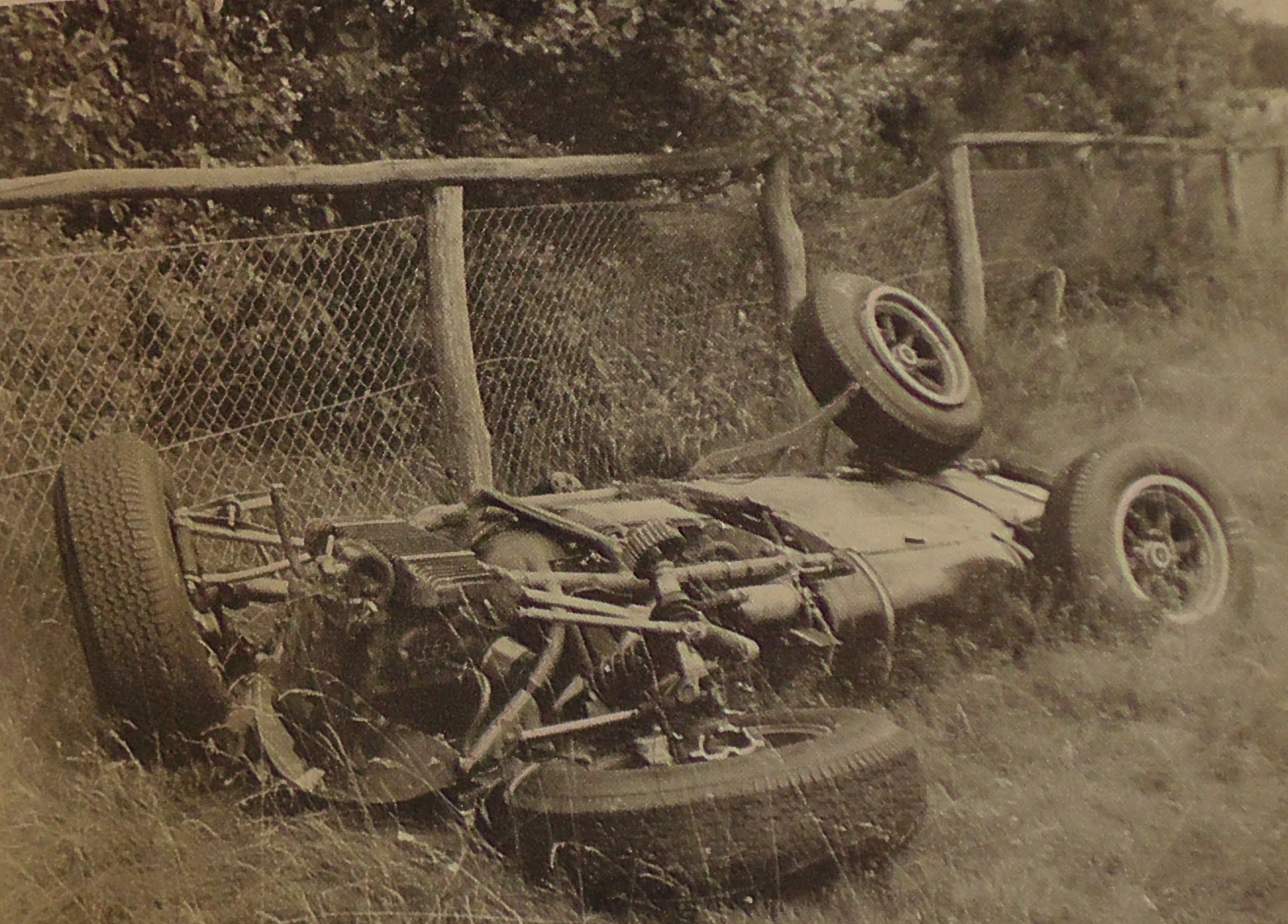
It was in many ways a momentous race, marked for eternity by highs and lows. John Surtees, the former mult-World Motor Cycle Champion, had now won his first Grand Prix; for their part, Ferrari had scored their first victory since that dark day at Monza, in 1961. Ferrari’s other driver, Willy Mairesse, had meanwhile been seriously injured when he lost his car at Flugplatz; Bruce McLaren had crashed heavily when his Cooper broke a rear wishbone (as distinct from the front suspension that had cracked in practice!); Bruce had been thrown out and knocked unconscious but further, serious, head injuries had been prevented by his new Bell Magnum. Chris Amon had broken a couple of ribs when the suspension also failed on his Parnell Lola. Lorenzo was out early after a shunt with Innes Ireland’s BRP but had still done enough to earn himself a works Ferrari drive at Monza (in place of Mairesse). Amon, Jo Siffert and Jo Bonnier could all have finished fourth but for mechanical dramas. (Dan Gurney, who also retired his Brabham, can be seen briefly in the German TV feed, standing by the Rob Walker Cooper after it retired with a “broken chassis”); at the end, fourth position had been taken by a German (Gerhard Mitter) and his old Porsche (shown on the video near the podium); Jim Hall had again driven extremely well to finish fifth; and third, after leading and spending most of the race holding his BRM in gear, was another American, Ritchie Ginther. Over 350,000 paying spectators attended this German GP – even though a Gerhard Mitter-type result was about their greatest expectation; for these were the days when people watched because it was their national Grand Prix and because these were the best drivers in the world, regardless of nationality.
All the drivers – or those who weren’t in hospital – attended the Sunday night celebrations at the Sport Hotel. Jim visited Bruce in Adenau, where he was relieved to find him in reasonably good spirits, and left the victory proceedings early, for he was racing at Brands Hatch the following day in Alan Brown’s Ford Galaxie. Bruce regained consciousness in his hospital bed, completely unaware of how he had got there. “I was a bit shocked at first,” he said later, “because all around me in the same ward there seemed to be people with bashed heads and banged-up legs. I had this awful suspicion that I had caused all the carnage…” He hadn’t – but he had been very lucky. While Bruce’s wife, Pat, drove back to the UK with the Australian driver, Frank Matich (who was staying with the McLarens in Surbiton whilst building up his new Brabham for the 1964 Tasman series) Bruce, resting comfortably in the rear seat of the Rapier, his leg in a precautionary plaster, was chauffeured back to the coast by Eoin Young. It was then but a short hop across the channel in a BUA (British United Airways) Bristol Freighter, with Bruce staying on board the Rapier while Eoin re-fuelled in the cabin. Eoin then drove Bruce all the way to Kingston hospital, where his plaster was quickly removed. “After that crash at the Nurburgring I thought hard about my future,” Bruce would later say. “I had once promised myself to give up racing after my first big shunt. I realize now that that would have been the worst possible thing I could have done. If you are ever going to look yourself in the eye again, it’s essential to go straight out again and have a go…”
Even though Bruce would lose his life in another accident, at Goodwood, in 1970, I think these words would have been fully-endorsed by his friend, Jim Clark.
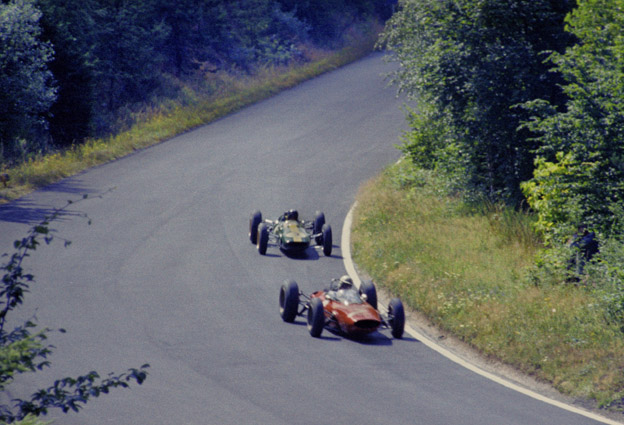
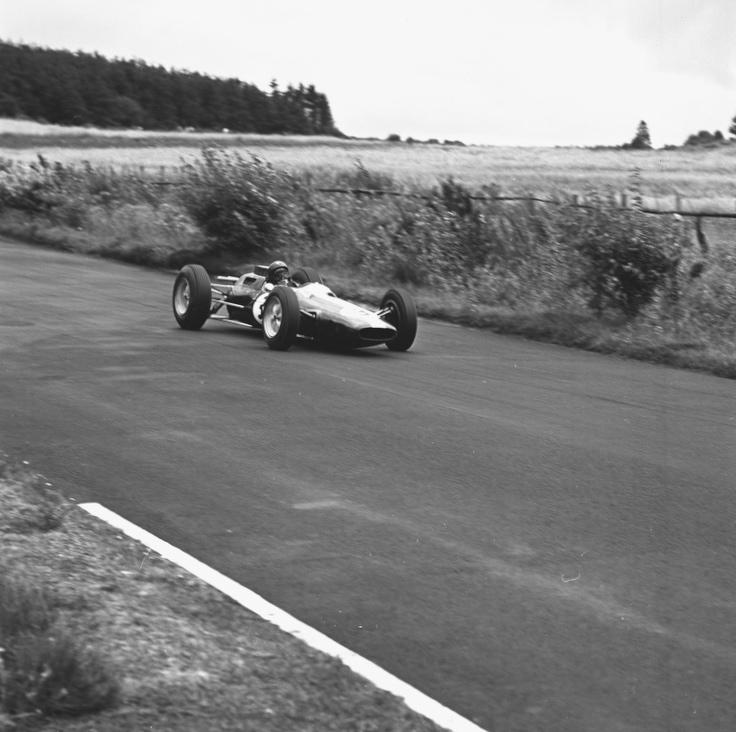
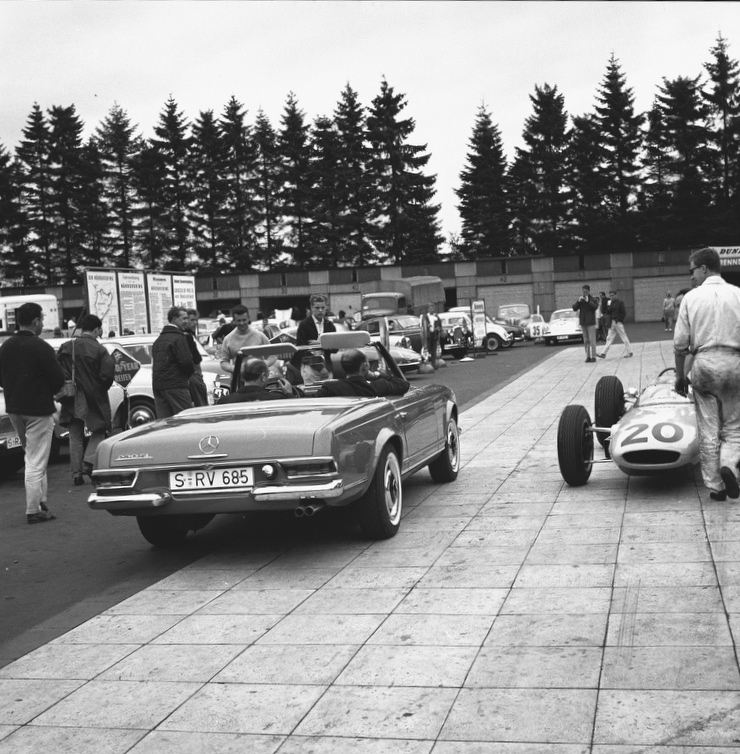
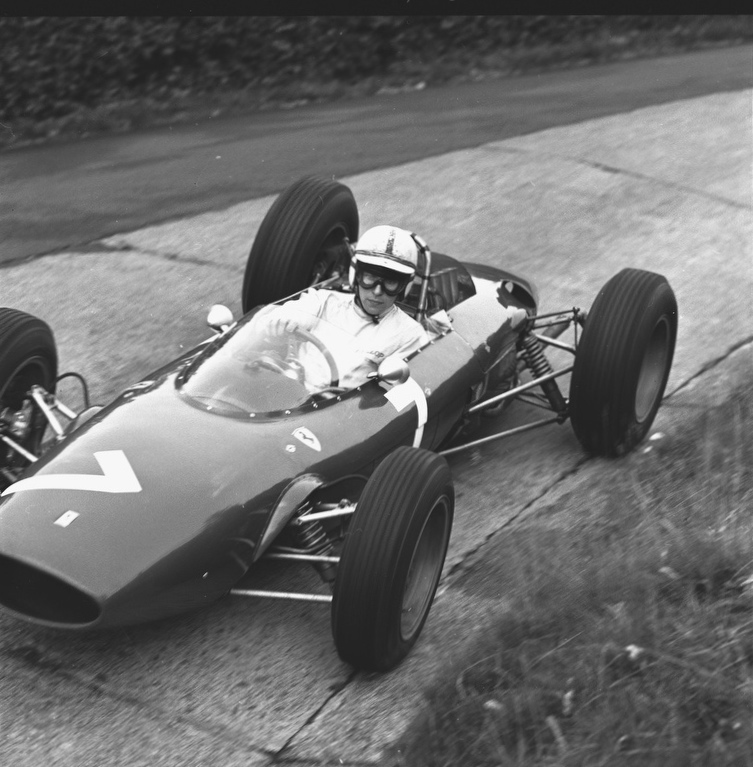
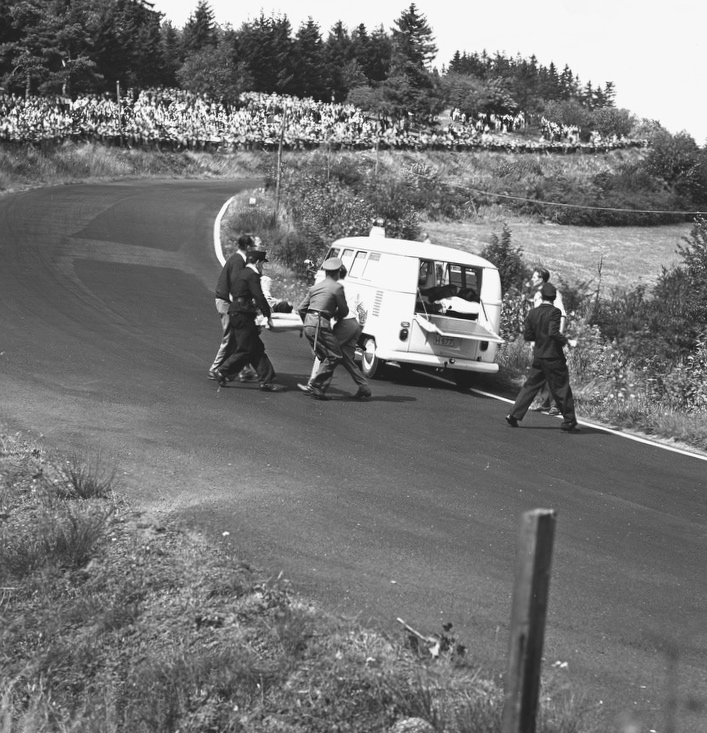
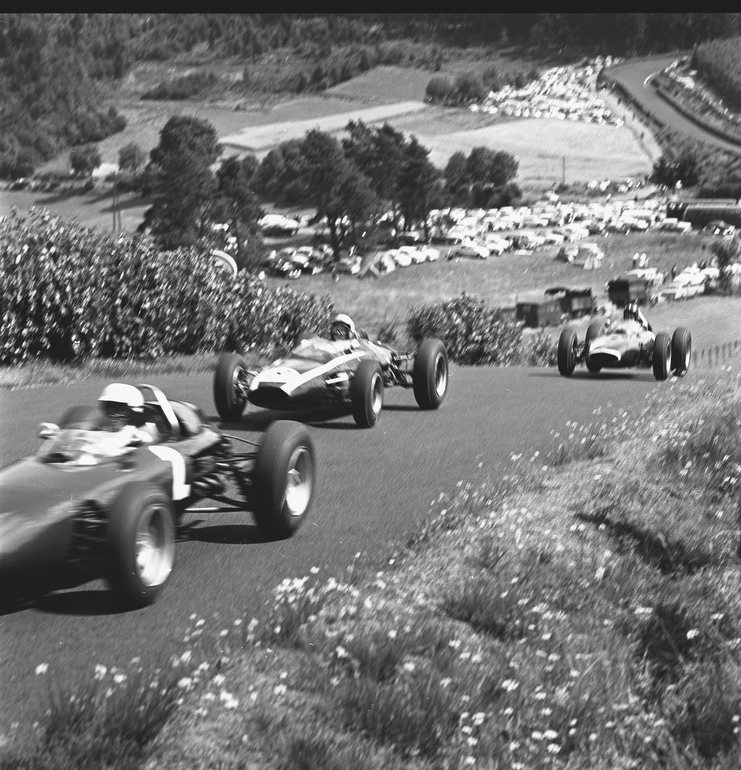
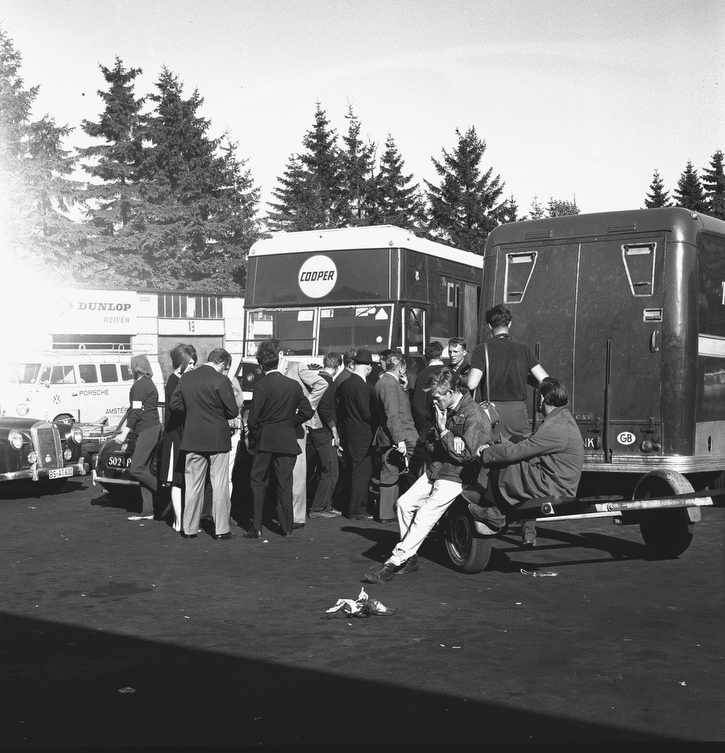
Captions, from top: John Surtees in the “V5” Ferrari leads Jim’s “V7” Lotus 25 around the Nurburgring; Sunbeam Rapiers were all the rage in ’63!; the Lochmuhle Hotel – still there today and still trout-worthy; despite yet another engine mis-fire, Jim Clark took the pole with a brilliant lap in the Lotus 25; in the days when former champions were regularly welcomed at races, former Mercedes F1 team-mates, Stirling Moss and Juan Fangio, had fun in a 230SL convertible. That’s Jim Hall’s fifth-placed BRP Lotus 24 on the right of the paddock quadrangle; Surtees glides the Ferrari around the Karussel; Willy Mairesse is stretchered to an ambulance after his Flugplatz shunt. This sort of scene was all-too-regular at the Nurburgring; Bruce McLaren was running his Cooper right up with the leaders before his big accident. And then there was that awful moment: Bruce’s team-mate, Tony Maggs, draws on a cigarette while journalists and team people hover nervously around the Cooper transporter, awaiting post-race news on Bruce’s condition. Note the Team Lotus truck on the right. Images: Grand Prix Photo; LAT Photographic; Peter Windsor Collection
Solitude. The name is enough to suggest that this was more than just another circuit – and indeed it was. The Solitude Grand Prix, held on a sweeping, undulating and therefore very demanding road course under the shadow of the Schlosse Solitude, near Stuttgart, Germany, was in reality the Grand Prix of the German Motor Industry. Massive crowds flocked to the circuit when it opened pre-war – and continued to do so in the 1950s and 1960s, when over 350,000 people attended the July F1 races. It was bigger than the Nurburgring; only Indianapolis, on a global scale, attracted a larger race crowd than Solitude. Mercedes did their share of winning, as did Porsche. Bosch was based at Stuttgart, too. Motor-cycle races were a huge success at Solitude; and the post-war F1 non-chamionship Grands Prix, and also Formula 2 races, held at a time when Porsche were on the ascendant, were no less spectacular.
The drivers and key team people stayed at the nearby Eis hotel; it still exists today. Legend has it that Innes Ireland once shot a loaded pistol there at a post-race party. It’s probably true, because Innes in later years became quite irritated when anyone mentioned it. Baron Fritz Huschke von Hanstein, the wonderful Porsche Team Manager, was the early 1960s Solitude Grand Prix in much the same way that Geoff Sykes would be Warwick Farm, or Mrs Topham ruled Aintree. It was Huschke’s home race. He hosted parties at both the Porsche factory and at his residence – often for 400 people at a time, including royalty. He was everybody’s friend back then – and he was a friend to me, too, in the very early 1970s, when I was starting my F1 journalistic life. I met Huschke through the indefatigable Bernard Cahier, who described Huschke thus in his magnificent two-volume autobiography (entitled, appropriately, F-Stops, Pit Stops, Laugher & Tears): “Huschke had been a very talented driver before the war and as a result of his racing successes he’d become an honorary officer in the SS. This was all well and good before the war but when conflict broke out his status became official. Huschke wanted nothing to do with the war or the SS and for a time took refuge in Budapest, where he hobnobbed in high society while living with a beautiful Hungarian countess who was part-Jewish. He was eventually caught and sent to prison in Spandau, where he found himself in real trouble. Luckily, he had connections everwhere. It didn’t take long for him to pull some strings and get himself released. He contacted one of his old girl-friends whose father held an influential position in the German army, who in turn told the authorities that Huschke was going to marry his daughter! He was very lucky because, a short time later, the plot to kill Hitler was uncovered and there were wholesale executions in which Huschke might very well have been swept up.
“When he was released from prison, Huschke was assigned the job of driving an armored vehicle to the Russian front. He was happy to do this as it gave him the opportunity to meander around the country and visit all his friends. He started working for Porsche in the early 1950s as a salesman and, being an avid racer, he was the person most responsible for pointing Porsche in the direction of motor racing.”
Huschke operated from “Factory Two” within the Porsche Stuttgart compound and employed an attractive assistant named Evi Butz. It was in 1962, by which time Dan Gurney had won Porsche’s first Grand Prix victory, that Huschke asked Dan if he would give Evi a lift home, after a long day in the office, in Dan’s “Unsafe At Any Speed” light blue Chevvy Corvair. Dan naturally obliged and got to know young Evi in the course of a 45min traffic jam that clogged downtown Stuttgart. For their 25th wedding anniversary, Evi gave Dan another Corvair…
Dan won the Solitude Grand Prix that year, heading a Porsche one-two, and would never forget his victory lap, in an open Carrera, when thousands of caps and hats filled the air like leaves in an autumn wind; in 1963, though, with Porsche out of it, he didn’t race. Instead, he flew straight back to Indianapolis after the British GP in order to drive Frank Arciero’s Lotus 19 at the Hoosier Grand Prix at Indianapolis Raceway Park. He won – and then flew to Germany for the next round of the Championship at the Nurburgring. Such were the schedules of F1’s front-runners in 1963.
Brabham were thus represented in the 1963 Solitude Grand Prix only by Black Jack. Team Lotus, by contrast, entered three cars, enticed no doubt by copious starting money. Jim Clark was in his regular Lotus 25 (prior to racing it the following weekend at the Nurburgring); Trevor Taylor drove the second car – and Peter Arundell, the FJ star, would finally be having his first race in a Lotus 25 (having briefly practiced at Reims.) A full grid of 29 cars started this 13th Solitude Grand Prix, with Jim on the pole from Jack Brabham and Jo Bonnier (a former Solitude winner, now driving Rob Walker’s ageing Cooper-Climax). The two other Lotus drivers filled the second row, Peter ahead.
As it happened – as it frequently happens in Championship Years – Jim went nowhere in this race that didn’t count. Team Lotus tried a new drive-shaft design which promptly failed as Jim dropped the clutch at the start. His race prospects may have been over; still there were over 300,000 spectators at Solitude, crammed into the natural grandstands around the circuit, all hoping to see the maestro at work. Jim’s 25 was pushed back into the pits and re-fitted with the older-type drive-shafts. Jim waited patiently, helping the mechanics with pit signals to Trevor and Peter (who were running second and third behind Brabham). Then, donning his Les Leston gloves and lowering his goggles back around his peakless Bell, Jim climbed back into R4 for a few demonstration laps of high-speed precision motoring.
Amazing all who saw it, Jim smashed the lap record with a time of 3min 49.1sec – a full 1.1sec faster than even he had managed in qualifying. Solitude was as dangerous as you could make it, with its exposed trees and walls; it was very fast, particularly on the 3.5-mile serpentine return stretch; and Jim was so far in arrears that he wasn’t even classified as a finisher. And yet he drove those laps at 100 per cent. Ten-tenths. Flat out. His fastest lap, when the tanks were at their lightest, was but one of 17 that were similarly on the limit.
Black Jack, who had had nothing but mechanical problems from the start of the year, meanwhile breezed home without a worry to win his first F1 race at the wheel of a car bearing his own name. (Jack won the ’63 Australian Grand Prix in a similar car fitted with a 2.7 litre Climax engine). Peter Arundell drove beautifully to finish second ahead of Innes Ireland (and also to win the Formula Junior race that morning from Denny Hulme and Frank Gardner); Trevor retired with a broken crown-wheel-and-pinion; and Lorenzo Bandini, the young Italian pushing hard for a genuine chance at Ferrari, finished a spectacular fourth in the two-year-old Centro Sud BRM. I should also make mention of Chaparral founder, Jim Hall, who again drove well with his Lotus 24, qualifying on the fourth row and finishing sixth on Sunday. Jo Bonnier won the big-bore support GT race with his Porsche; and Teddy Pilette, son of Andre and future F5000 winner, headed the smaller GT race with his Abarth.
From Solitude it was but a short autobahn blast to the Nurburgring, for the August 4 German GP. Jim had never won at the ‘Ring but had been phenomenally quick there in 1962 (in both the Lotus 25 and the little Lotus 23 sports car). An enjoyable, if frustrating, Solitude weekend now over, Jim’s thoughts turned to making it five World Championship Grand Prix wins in a row.
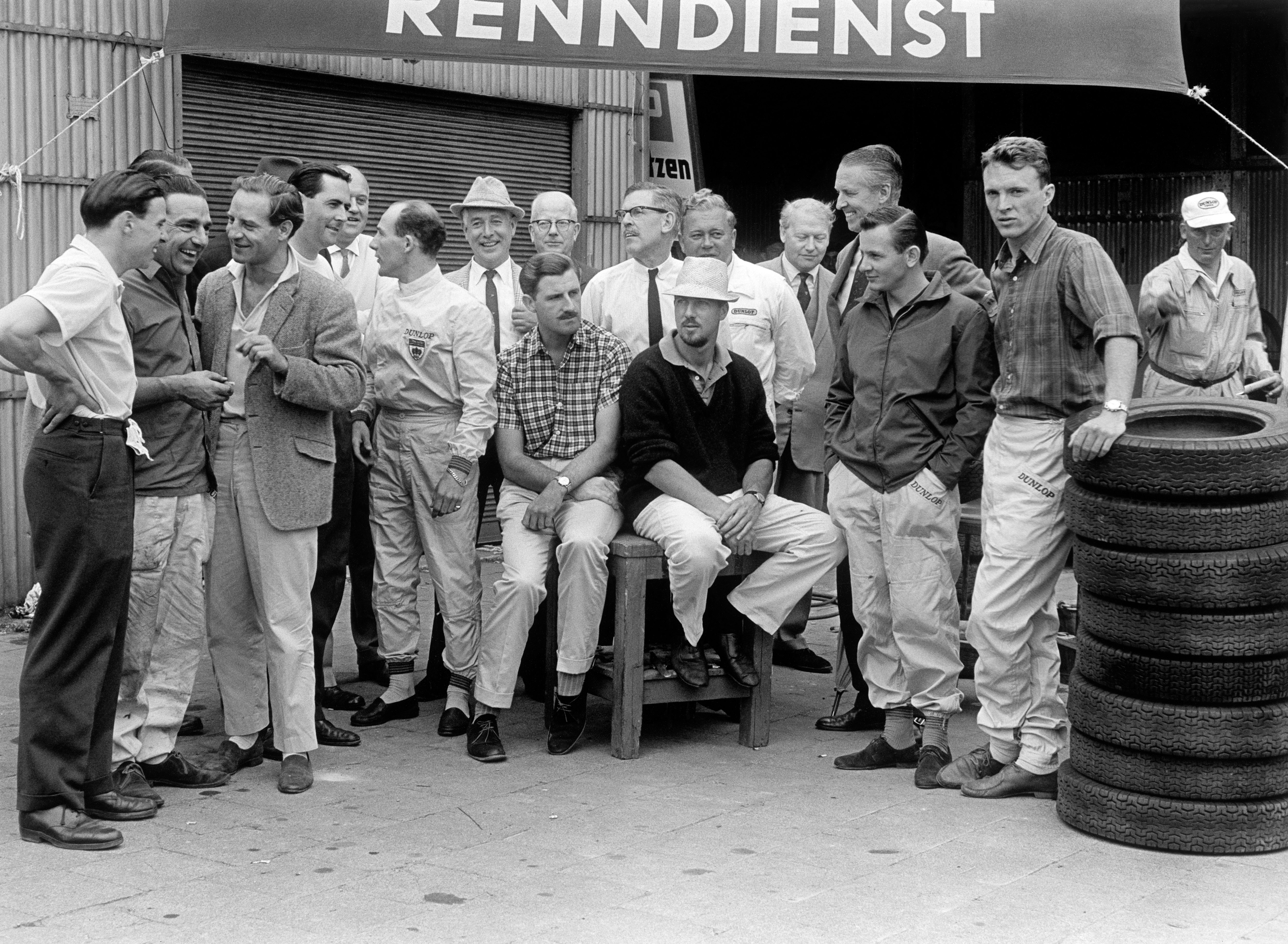
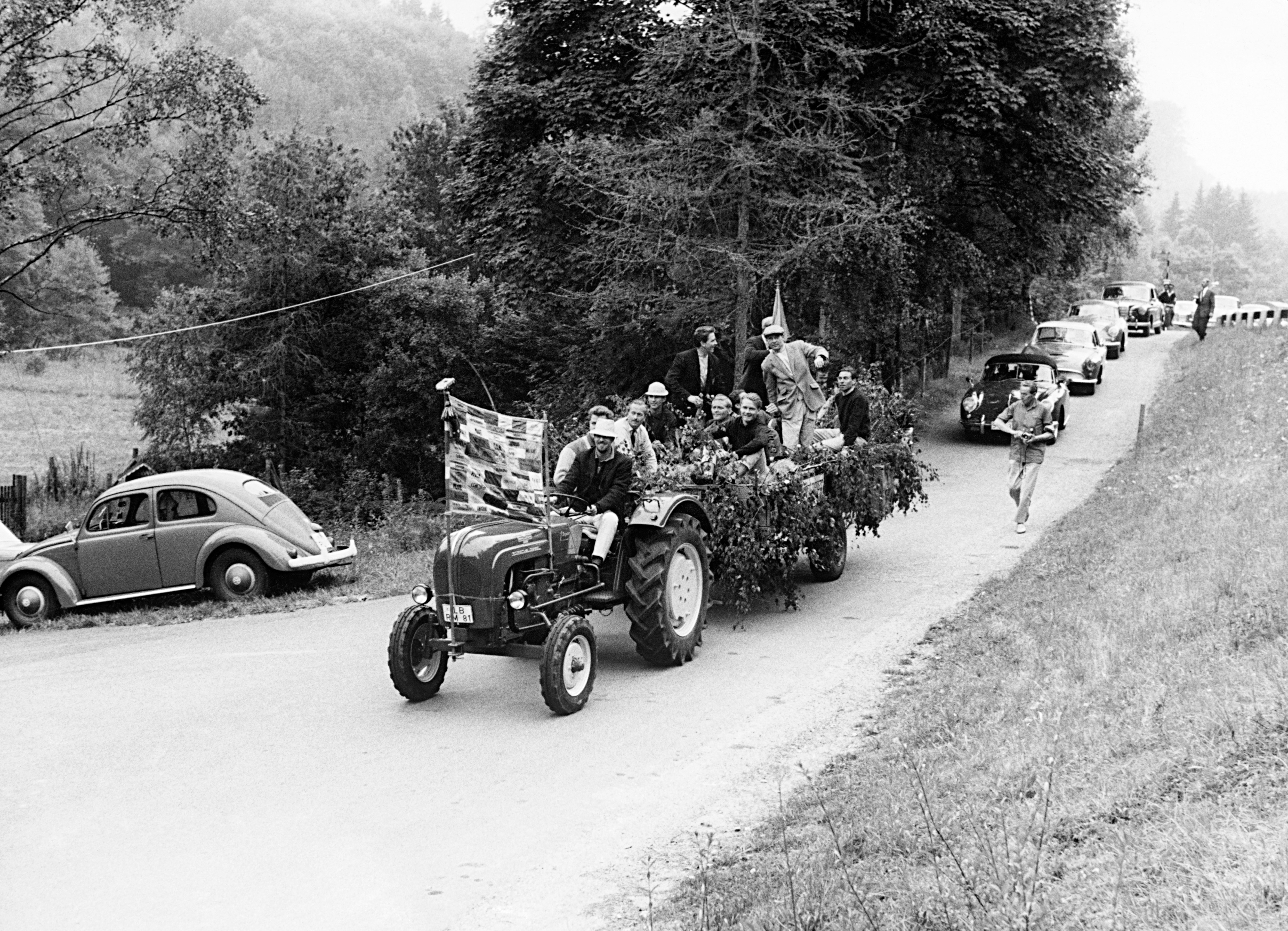
Captions, from top: Lotus 25 re-fitted with standard drive-shafts, Jim Clark lights up Solitude with a lonely but record-breaking display of precision driving; Huschke von Hanstein in his element – organizing a group photograph at the 1961 German GP. From left to right – Jim Clark, John Cooper, Innes Ireland, Jack Brabham, Stirling Moss, Graham Hill, Huschke (in glasses), Jo Bonnier, Dick Jeffrey (Dunlop), Prince Metternich, Bruce McLaren and Dan Gurney; the 1961 von Hanstein-created “tractor pull” at Solitude – Jo Bonnier does the driving for Dan Gurney, Colin Chapman, Peter and Wolfgang Porsche (sons of Ferry), Huscke and Jim. That’s Julius Weitmann, the excellent photographer, running up alongside with the long-lens Leica. The “flag” was actually made from Huschke’s race passes and for years stood in his house as a form of welcome to guests; Jim is all smiles after taking the pole at Solitude in 25/R4 Images: LAT Photographic
As some of you will know, I was raised in Sydney, Australia, where, looking back now, the sun usually shone, the air was scented by eucalyptus and Warwick Farm was the heart and the soul of motor racing in all its forms. I grew up in the knowledge that, every summer, I would see a bunch of F1 drivers competing in the International 100 and that, in between times, I would see five national race meetings of extraordinary quality. Drivers like Frank Matich, Leo and Ian Geoghegan, Greg Cusack, Kevin Bartlett, Niel Allen, Bib Stillwell, Johnny Harvey, Spencer Martin, Max Stewart, Brian Foley, Peter Manton, Norm Beechey, Allan Moffatt and Bob Jane were my “national” heroes; Sports Car World, Modern Motor and Racing Car News were my regular fare.
Then there were the F1 drivers in their Tasman-engined F1 cars.
I still find it hard to capture accurately what motor racing was like back then. Was it the way the Warwick Farm paddock was laid out, by the lake, with the marshalling area opposite the huge grandstands? Was it the colour- and word-perfect attention to detail of the Australian Automobile Racing Club (AARC)? Was it the relatively safe circuit layout, designed by the immaculate Geoff Sykes? I know not the answers, even now. All I know is that it was motor racing. Nothing, since, has compared. Not even Monaco on a good day. Not even a packed Brands Hatch. When I was at The Farm, first as a young kid, smuggled into the paddock area in the boot of a car owned by a marshal who worked with my Dad, then as a marshal myself and finally as Press Officer, I was at one with the world. Flags would flutter in the breeze. Jim Clark and Jackie Stewart, sun-tanned and shirtless, would laugh their famous laughs. Then the sun would set, the beer cans would pour and, over the PA, they would play The Long and Winding Road.
I have lots of photos from that era. Some I took with a black-and-white Kodak Box Brownie. Then, in 1967, I bought a half-frame Fujica. The quality from both was not great, but for me that didn’t matter. I had captured the moment, cut a slice from time. That was all I needed. I had been there, seen it happen.
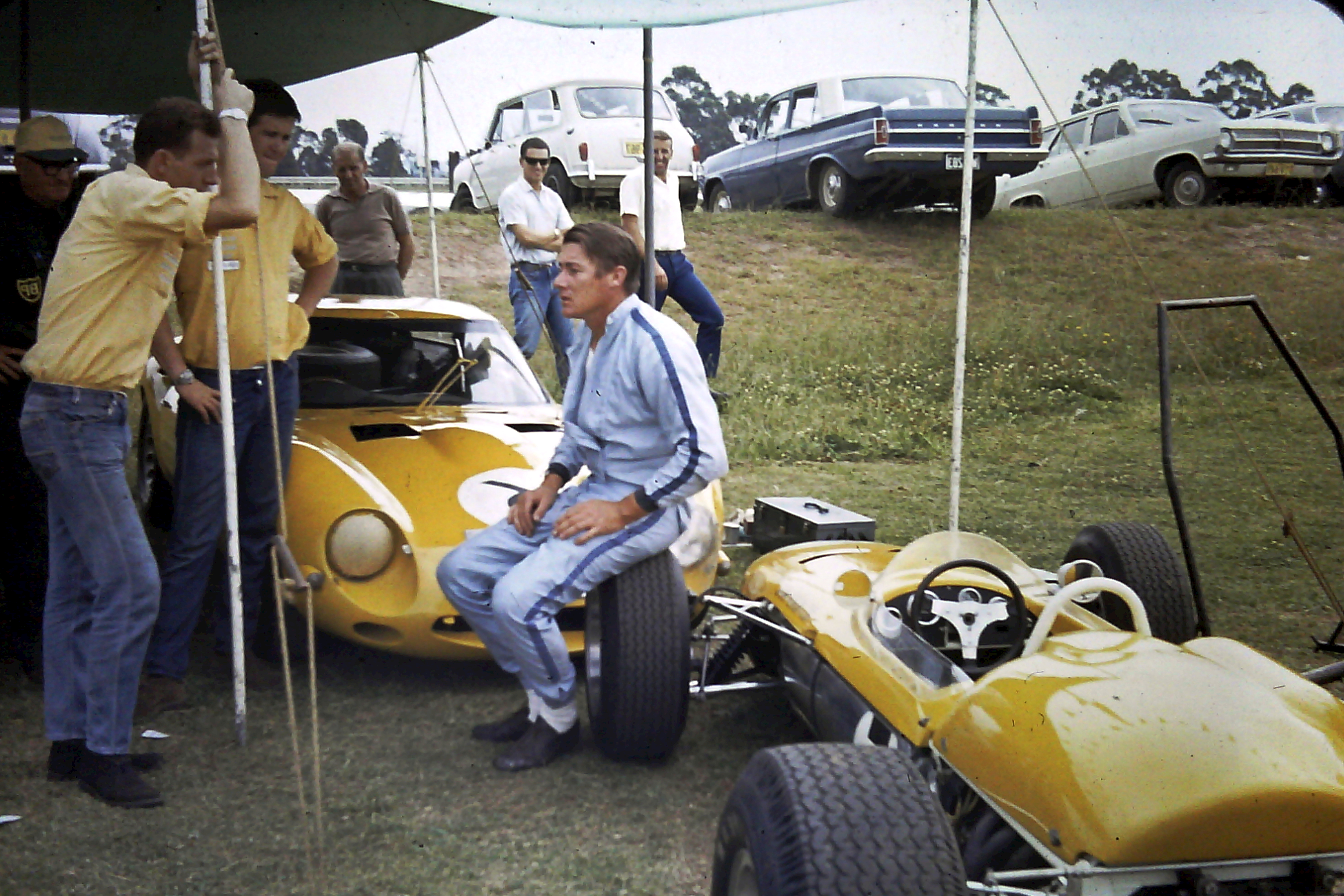
Kevin Bartlett, in blue Nomex, sits on the front wheel of Alex Mildren’s 2.5 litre Tasman Brabham-Climax.
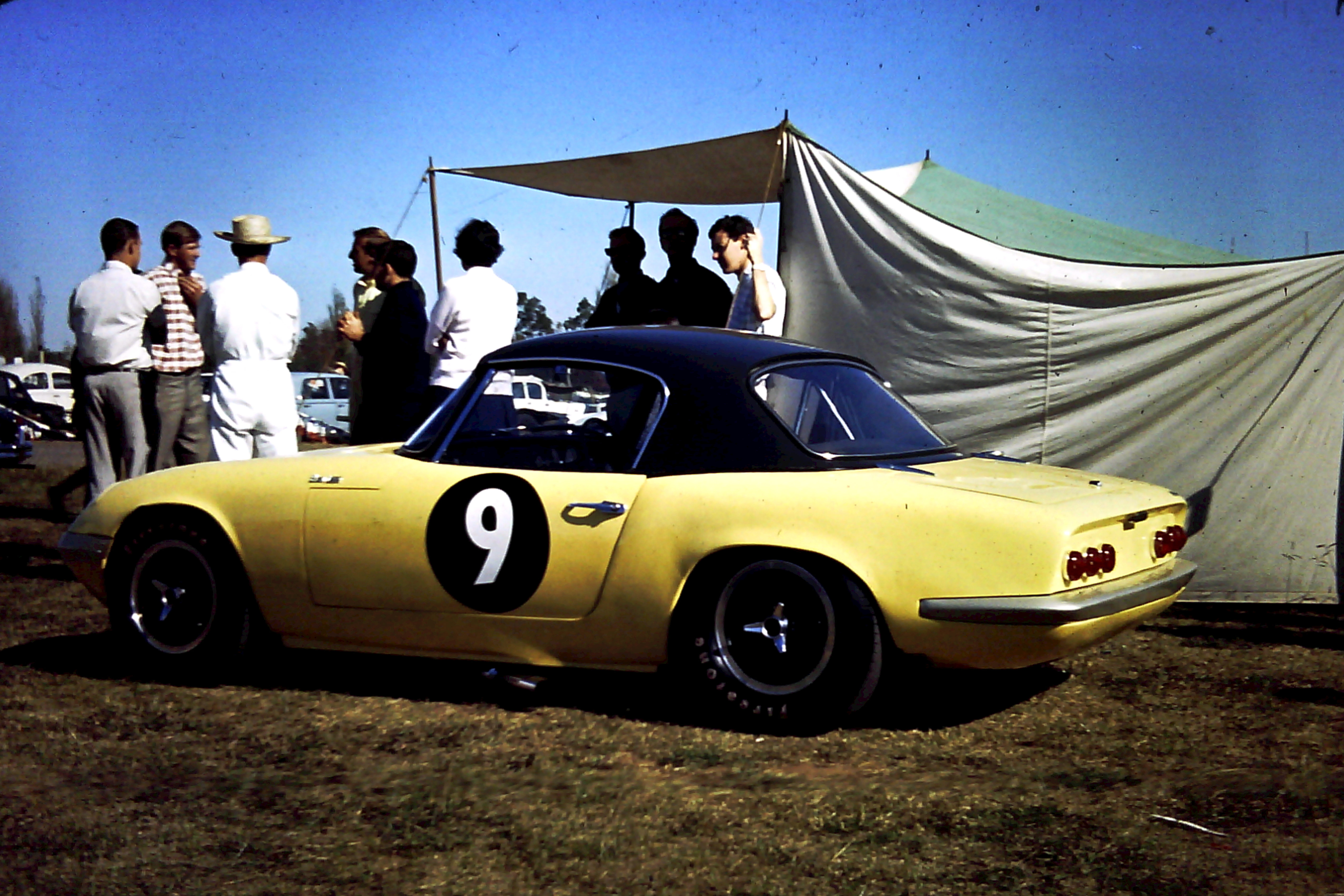
The Mildren team was a mid-1960s staple at The Farm. The cars were always painted yellow; Glenn Abbey, the team’s Chief Mechanic, was a master. Kevin’s car control was superb. To this day I’d put him up there with Le Mans winners and GP2 front-runners. He could balance an Alfa GTA on the outer extremities of opposite lock through Paddock Bend and then in the next race glide the Tasman Brabham through Homestead with fingertip precision. That’s actually the Mildren Alfa GTZ behind the Brabham; and there, in the background, smiling, is Fred Gibson, whose yellow lightweight Elan (shown here, not Mildren yellow) was both gorgeous and very fast. I don’t recall its inside front wheel touching the road very often. I know you think the cars in the background have not been parked with FOM-like precision but that’s what I liked about The Farm: it was neat but natural and retained lots of grass. Note the Mini Cooper S and the two Holdens. You were in one of two sectors back then: the Mini brigade or The Rest.
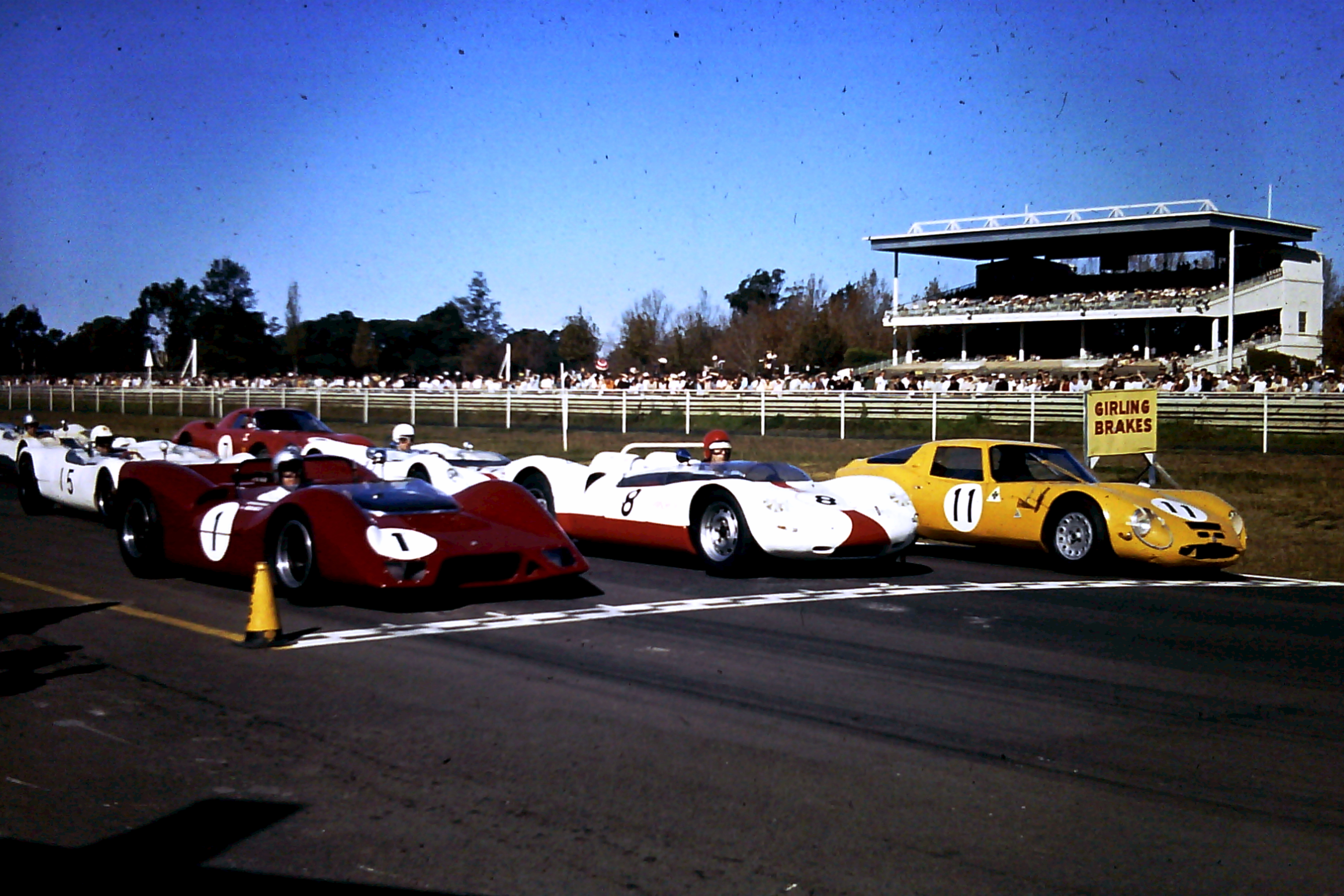
And here’s a shot of said Alfa GTZ lined up and ready to go. The genius that is Frank Matich is on the pole in one of his first races with the big Elfin sports car he developed in 1966; Alan Hamilton, who always seemed to have access to exotica, is in the middle of the front row in his Porsche Spyder; and KB is there in the Alfa. Two lovely, white Lotus 23Bs fill the second row (I think driven by Frank Demuth and Niel Allen) and on the outside of the third row you can see David McKay’s famous Ferrari 250LM, driven by Spencer Martin. From memory, Hamilton jumped this start by a mile and was leading by about 100 yards when the flag dropped! This is a typical Warwick Farm scene: packed grandstands, perfect weather, stunning collection of cars and drivers.
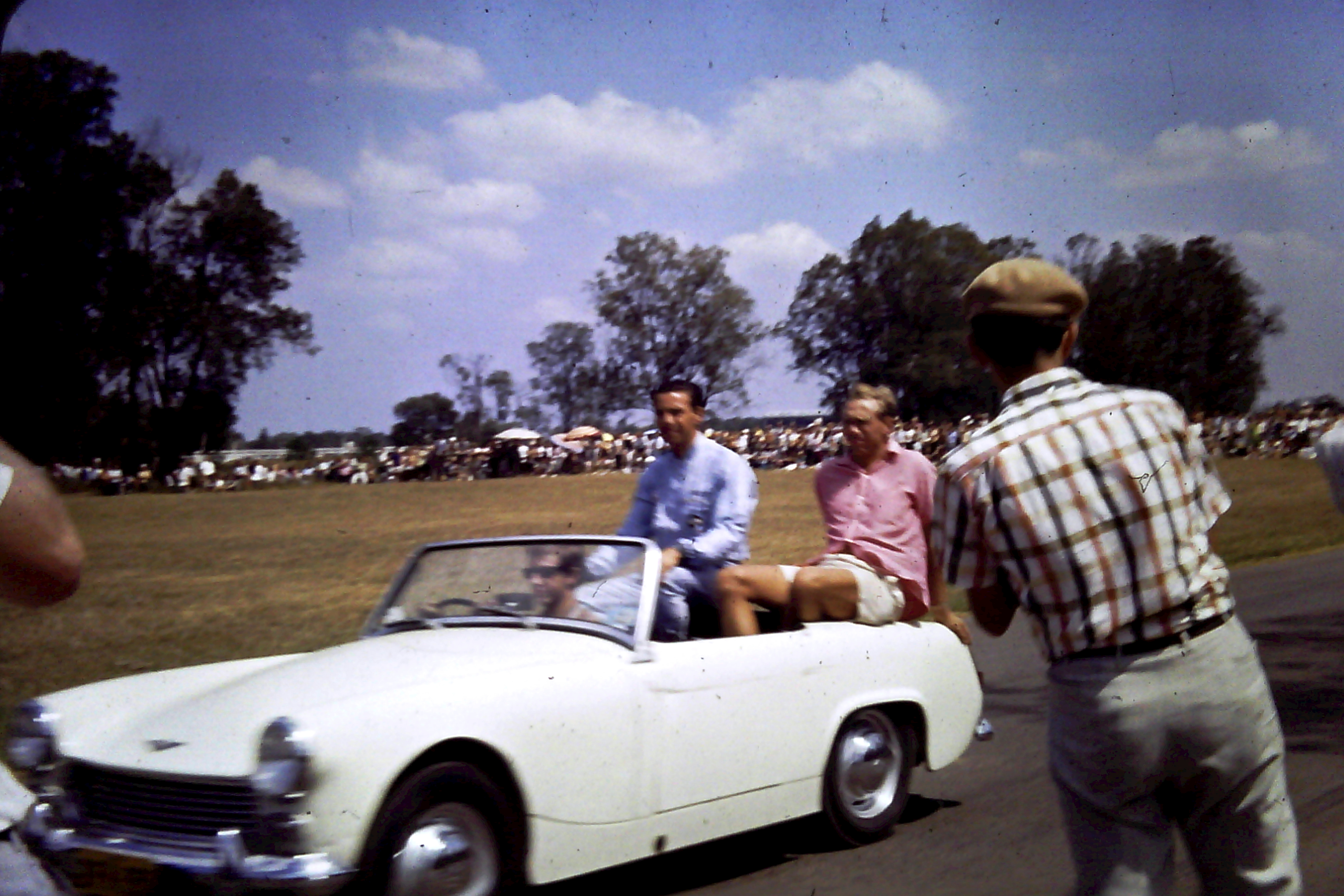
My last picture today is one I’ve always treasured. I watched the 1965 International 100 from the spectator bank at Creek Corner. Jim Clark won the race in his green and yellow Lotus 32B-Climax, with Frank Matich a brilliant third in the Total Team Brabham. All was right with the world. Then came The Moment: as one, the crowd jumped the wooden fences and swarmed onto the track, there to greet the winner on his parade lap. I remember standing there, hot and sweaty, so nervous that I could barely breathe. I was going to see Jim Clark! He was going to be driven right past me, mere feet away!
The white Sprite shimmered into view. I could pick out the light blue overalls of the winner, black hair glistening in the afternoon sun. Who was that next to him, though, in the red-and-white checked shirt? I was mystified. I didn’t know whether to line up the camera or to keep peering at the slowly-approaching car, trying to identify The Other Guy. Then suddenly it hit me: Mike Spence! Mike Spence! Jim Clark’s F1 team-mate. He hadn’t raced at The Farm that day. I didn’t even know he was in Australia. In a panic, I raised my camera and fired. The result wasn’t very pretty.
Perfectly balancing smaller diameter rear Dunlops on an oily Silverstone track surface, Jim Clark wins the British GP
After a whirlwind start to the year Jim Clark was able to relax for a few days. Three successive wins enabled him to enjoy the farm like never before; and, back in Balfour Place for a few days before the run up to Silverstone, Sir John Whitmore was full of Rob Slotemaker’s antics and all the recent racing news. In between, however, there was the little matter of the Milwaukee test. The Indy Lotus 29-Fords had basically been garaged at the Speedway since the race but, in the build-up to the Milwaukee 200 on August 18, rebuilds and further fettling took place at Ford’s headquarters in Dearborn, Michigan. Jim flew to Chicago on July 10 and on July 12 completed a successful day at the one-mile Milwaukee oval, running through Dunlop tyre compounds and in the process raising the average lap speed – over one mile! – by nearly 5mph.
Dan Gurney, who also tested at Milwaukee, had meanwhile shared a Ford Galaxie with Jack Brabham in the Six-Hour Race at Brands Hatch on July 7. A massive spin at Paddock in the rain (due to having to run Firestone wets on the front and Goodyear dries on the back) had cramped his style somewhat. Mike Parkes had cleaned up at Silverstone in his GTO Ferrari but, worryingly, the day had been ruined by two fatal accidents – one (John Dunn) at Abbey in the Formula Junior race and another in the pit lane (Mark Fielden, whose stationary Lotus was hit by a car spinning its way out of Woodcote). The excellent Sheridan Thynne, who would later become Commerical Director of Williams F1, won his class and set fastest lap at Snetterton in a Mini and a few days later wrote poignantly to Autosport, suggesting that a Safety Committee be convened to look into all matters of motor racing safety “before they were underlined by fatal accidents”. Sadly, as ever, his words went unheeded: a third person (a pit lane scrutineer, Harald Cree) would be killed at Silverstone on British GP race day when the very talented Christabel Carlisle spun her Sprite into the Woodcote pit wall. In another Woodcote incident, former driver and future Goldhawk Road car dealer, Cliff Davis, would exhibit immense bravery as he leapt onto the track to clear it of debris after an MGB rolled itself to destruction. Davis was later deemed to have saved several lives. Lorenzo Bandini, who would finish an excellent fifth at Silverstone in his the old, red, Centro Sud BRM, had not only won for Ferrari in the big sports car race at Clermont-Ferrand but had also been a part of the first all-Italian win at Le Mans on June 15-16. He co-drove a Ferrari 250P with Ludovico Scarfiotti; and, in the Formula Junior race at Clermont, Jo Schlesser had won from an amazing line-up of future stars – Mike Spence, Peter Arundell, Tim Mayer, Richard Attwood, David Hobbs, Alan Rees and Peter Revson. John Whitmore himself had won the Mini race at Silverstone after a big dice with Paddy Hopkirk – and Tim Mayer, that FJ star and future McLaren driver – had even raced a Mini at Mallory Park, door-to-door with Paddy Hopkirk. Whilst up in Scotland, Jim had been able to catch up with young Jackie Stewart, who had won at Charterhall in the Ecurie Ecosse Tojeiro on the same day as the French GP; and, finally, with the London premiere of Cleopatra set for July 31, Jim had thought it a good moment to ask Sally Stokes if she might be free for a night on the town…
The British Grand Prix was held on Saturday, July 20, (oh for a return to Saturday racing!) which meant that the big event of the weekend would undoubtedly be Graham Hill’s party at his Mill Hill house on the Sunday. Prior to that, there was a little bit of business to which to attend. Most of the F1 teams began testing on Tuesday, prior to practice on Thursday and Friday morning, and Jim was almost immediately on the pace. I say “immediately”: a loose oil line lost him time on Thursday morning but he was quickest by a whole second from Graham Hill (spaceframe BRM) later that day and fractionally faster than his Indy team-mate, Dan Gurney (Brabham), on Friday. Jim thus took the pole with a 1min 34.4sec lap of Silverstone, equaling Innes Ireland’s very fast practice times with the BRP Lotus 24-BRM at the International Trophy meeting on May 11. (Years later, when I chatted to Jim Clark at some length, he re-iterated what he frequently said about the space-frame Lotus 24: it was an easier car to drive than the 25 and in Jim’s view could just have capably have won races in both 1962 and 1963. Indeed, Innes’ Goodwood-winning Lotus 24 was actually being advertised for sale by the time of the British GP, viewable at BRP’s headquarters in Duke’s Head Yard, Highgate High Street, London N6. It wasn’t sold that year, as it turned out, and was raced again, in Austria and Oulton Park, by Innes. Jim Hall then drove it – for BRP – at Watkins Glen and Mexico.)
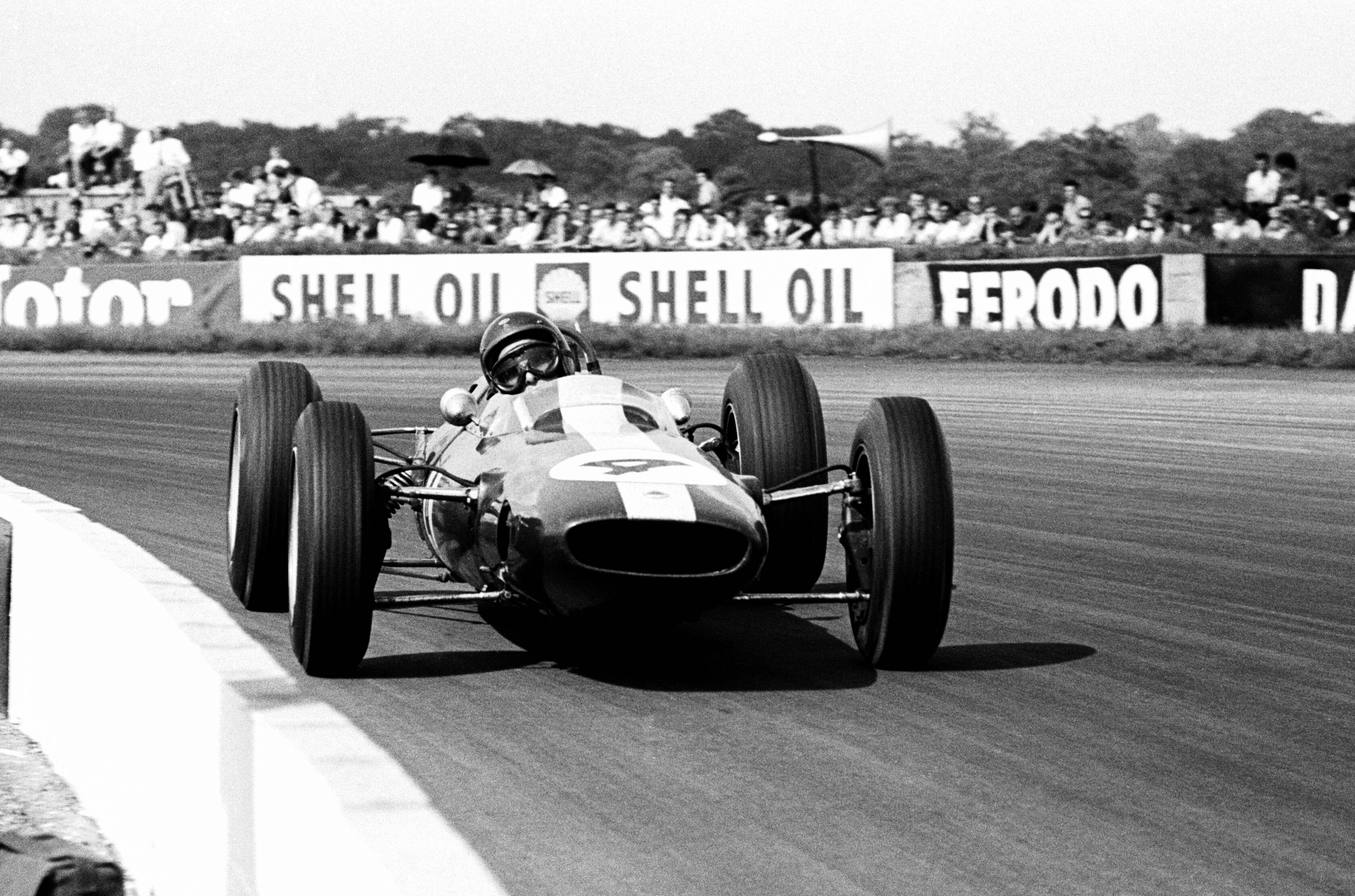
Still running a five-speed ZF gearbox (whilst team-mate Trevor Taylor persisted with the six-speed Colotti on carburettors), Jim’s trusty, fuel-injected Lotus 25/R4 had now blossomed into its ultimate, legendary 1963 form: Colin Chapman had decided to run a wide yellow stripe down the car, front to rear, co-ordinating the yellow with the wheels and the “Team Lotus” lettering and pin-striping down the cockpit sides. The car also ran the Zandvoort-spec aeroscreen. Jim, as ever, wore his Dunlop blue overalls, his peakless Bell helmet, string-backed gloves, Westover boots and, for when he was out of the car, helping the mechanics or strolling over to the Esso caravan or the paddock cafe for a cuppa, his dark blue Indy Pure jacket. The 25, meanwhile, finally wore a new set of Dunlops – around which revolved the usual number of discussion points. On this occasion it was gear ratios: as part of the compromise with the five-speed (but more reliable) gearbox, Jim and Colin decided to race smaller-diameter rear Dunlops.
Bruce McLaren, driving the beautiful, low-line works Cooper-Climax, stopped practice early on Friday to begin preparation for the race. While John Cooper supervised the job list, Bruce, as was his style, took his new E-Type Jag down the infield runway to the apex of Club Corner, there to watch his peers. At this point I can do no better than to record the words he later gave to Eoin Young for Bruce’s wonderful, regular, Autosport column, From the Cockpit:
“Dan Gurney had got down to a time equaling Jim’s best, and Jim was out to see if he could do better. Graham was in danger of being knocked off the front row so he was out too, and for 15 minutes, while Jim, Graham and Dan pounded round, I was graphically reminded of the reason why people go to see motor racing.
“When you’re out in an F1 car you haven’t got time to think about the fact that you’re moving fast: you’re concentrating on keeping the movement of the car as smooth and as graceful as possible, getting the throttle opened just that fraction quicker than last time and keeping it open all the way when you’ve got it there.
“At Silverstone you concentrate on shaving the brick walls on the inside, just an inch or two away, and you hold the car in a drift that, if it were any faster, would take you into a bank or onto the grass. If you are any slower you know you are not going to be up with those first three or four. You know perfectly well you are trying just as hard as you possibly can, and I know when I’ve done a few laps like this I come in and think to myself, well, if anyone tries harder than that, good luck to them.
“But you haven’t thought about the people who are watching. At least I haven’t, anyway, but there at Club Corner the role was reversed and I was watching…
“Jim came in so fast and left his braking so late that I leapt back four feet, convinced that he wouldn’t make the corner, but when he went through, working and concentrating hard, I’m sure his front wheel just rubbed the wall. I barely dared to watch him come out the other end.
“It struck me that Clark and Gurney’s experience at Indy this year may have had something to do with their first and second places on the grid. Silverstone is just one fast corner after another, taken with all the power turned right on and the whole car in a pretty fair slide but, nevertheless, in the groove for that corner. Something like Indy, I should imagine.
“I’ve seen a lot of motor racing and if I could get excited over this I can imagine how the crowd of 115,000 on Saturday must have felt.”
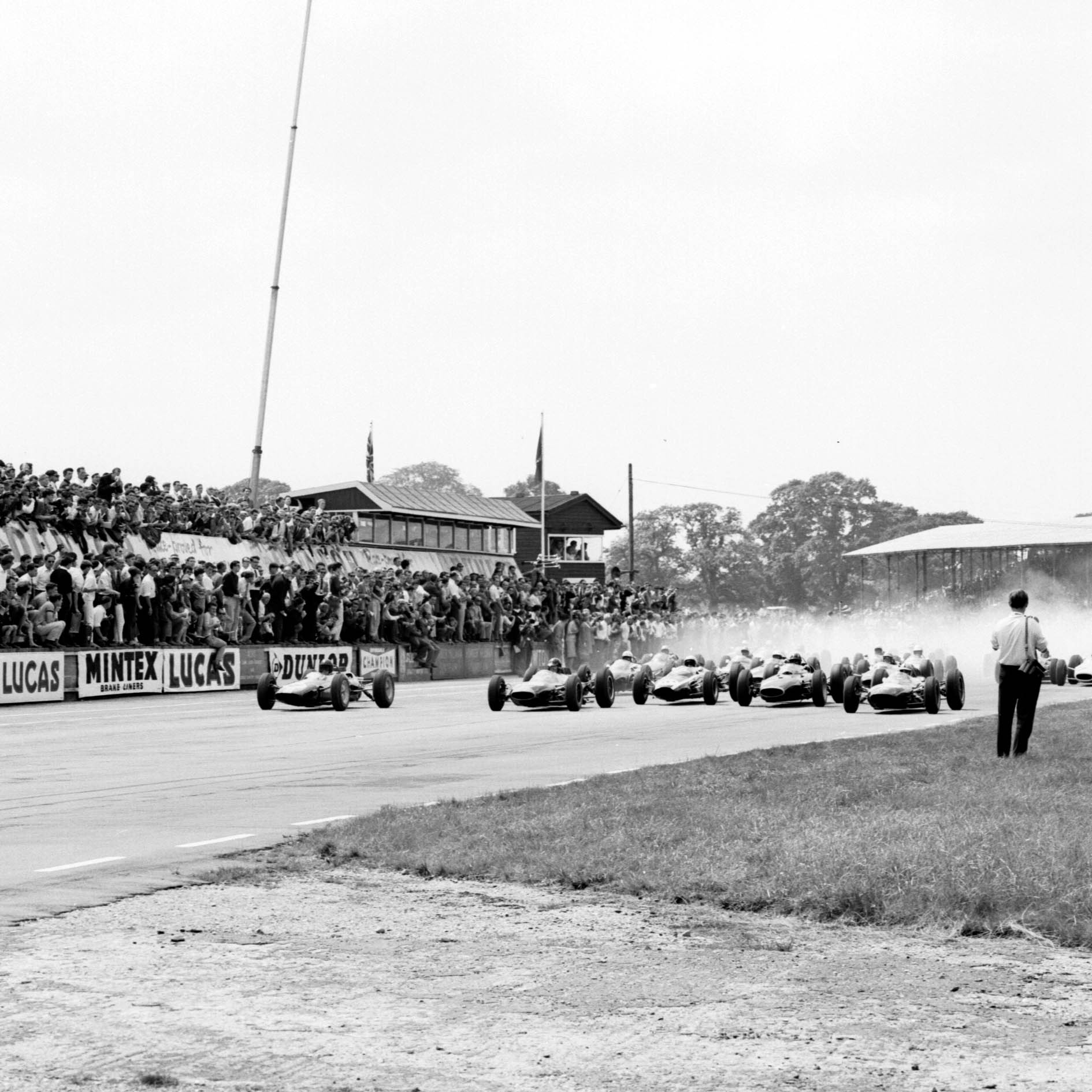
Saturday was one of those great sporting occasions in the United Kingdom. One hundred and fifteen thousand people were crammed into Silverstone by 10:00am; and by 2:00pm, by which time they’d seen Jose Canga two-wheeling a Simca up and down pit straight; Peter Arundell win the FJ race from “Sally’s MRP pair” (Richard Attwood and David Hobbs); Graham Hill demonstrating the Rover-BRM turbine Le Mans car; an aerobatic display and the traditional drivers’ briefing, everyone was ready for the big event. Dan Gurney settled into his Brabham with Jim Clark to his right in the Lotus 25. To Dan’s left, Graham Hill, the World Champion, lowered his goggles under the pit lane gaze of young Damon. Making it four-up at the front, Dan’s team-mate, Jack Brabham, sat calmly in his BT7. With but minutes to go, Jim asked for more rear tyre pressure: Silverstone had felt decidedly oily on the formation lap. The 25 had never been more oversteery.
Jim was slow away on this occasion: wheelspin bogged him down. He was swarmed by the lead pack as they headed out of Copse and then onwards to Maggotts and Becketts. The two Brabham drivers – showing how relatively closely-matched the top Climax teams were in 1963 – ran one-two; then came Bruce McLaren in the svelte Cooper, then Hill and then Jim. They were running nose-to-tail – and sometimes closer than that. Gurney pitched the Brabham into oversteer at Club; Jack, helmet leaning forwards, kicked up dirt at the exit of Woodcote.
The 25 was also tail-happy; you could say that. Jim felt the car to be little better than it had been before the start – particularly now, on full tanks. Around him, though, everyone else seemed to sliding around. Maybe it was just the circuit after all…
Jim began to dive deeper into the corners, to gain a tow – and then to pull out of that tow under braking. By lap four he was in the lead and pulling away…whilst Bruce McLaren was pulling up on the entry to Becketts Corner, the Climax engine blown in his Cooper. There was no quick rush back to the pits for Bruce, no beat-the-traffic early departure. Instead, as on Friday, he stayed and watched, for that is what great athletes do.
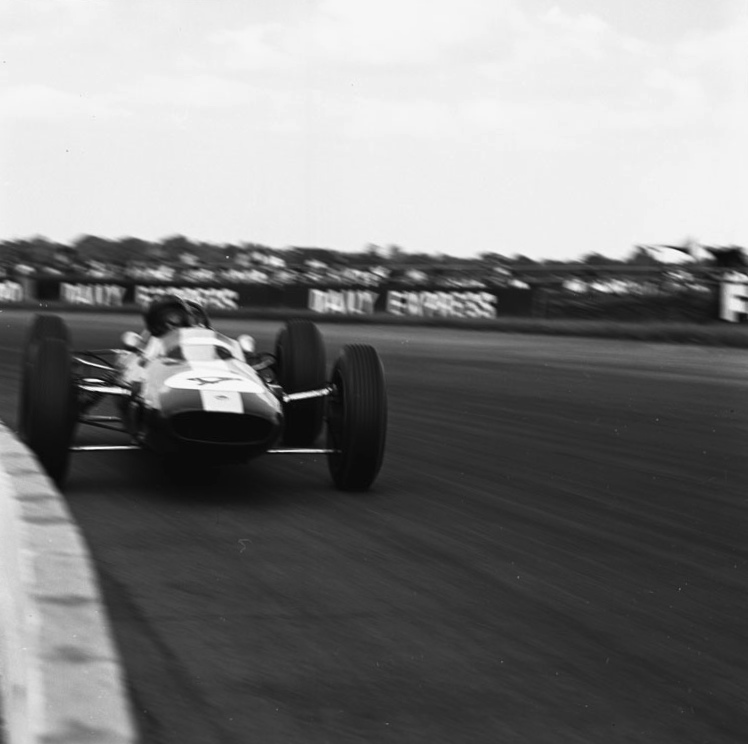
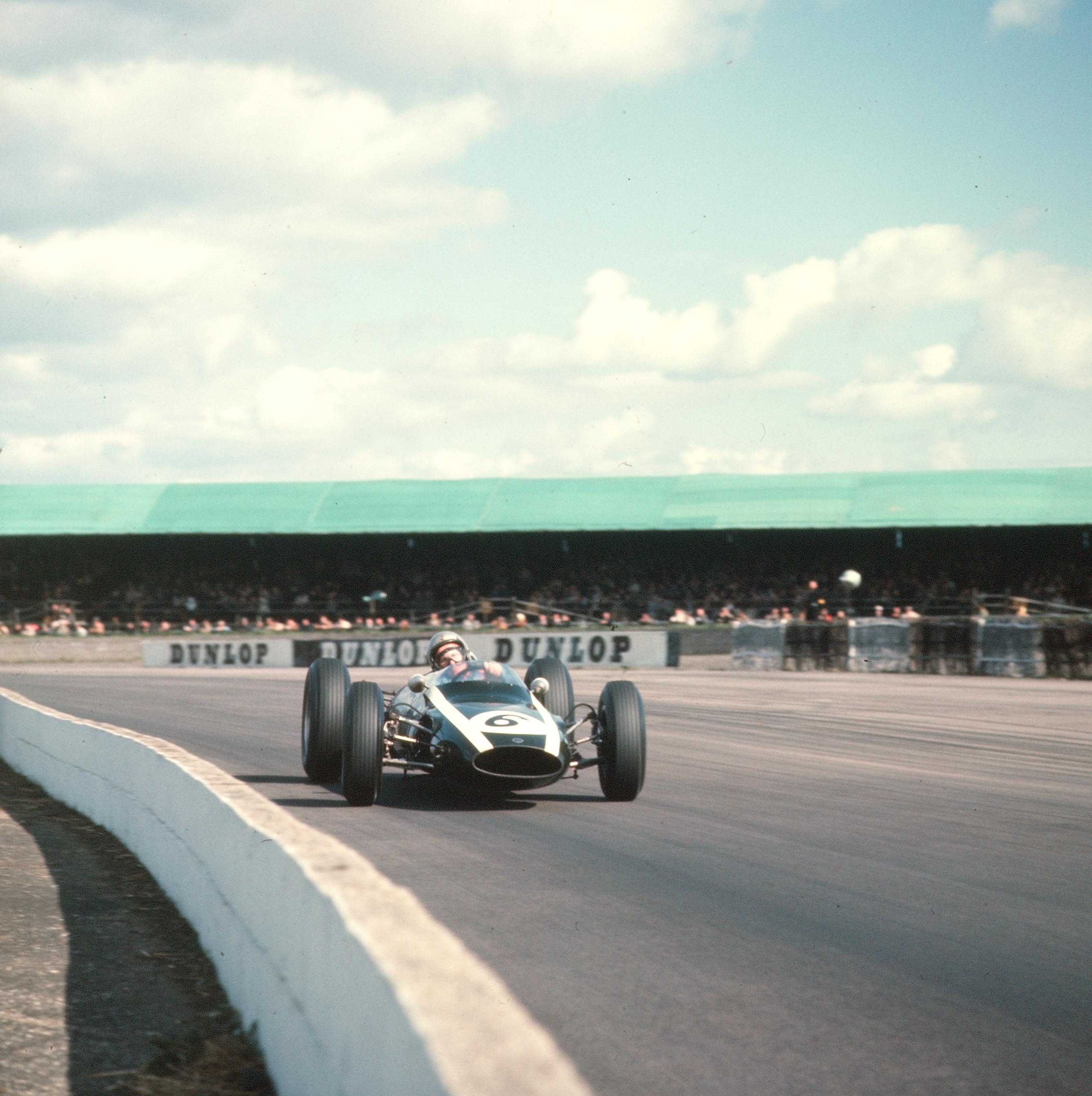
Bruce: “Jimmy came through with his mouth open and occasionally his tongue between his teeth. The tyres were holding a tenuous grip on the road with the body and chassis leaning and pulling at the suspension like a lizard trying to avoid being prized off a rock by a small boy. Then Dan arrived, really throwing the Brabham into the corner, understeering and flicking the car hard until he had it almost sideways, then sliding through with the rear wheels spinning and the inside front wheel just on the ground…”It was a demonstration of four-wheel-drifts; it was Jim Clark rhythmically poised like never before in an F1 car, the small-diameter Dunlops combining with the surface oil to produce a slide-fest of classic proportions. There was no need for a score of passing manoeuvres to make this British GP “work” for the crowds; there was no need for forced pit stops or for overtaking aids. It was enough, this day at Silverstone, for the fans, and for drivers of the quality of Bruce McLaren, merely to see a genius at work.
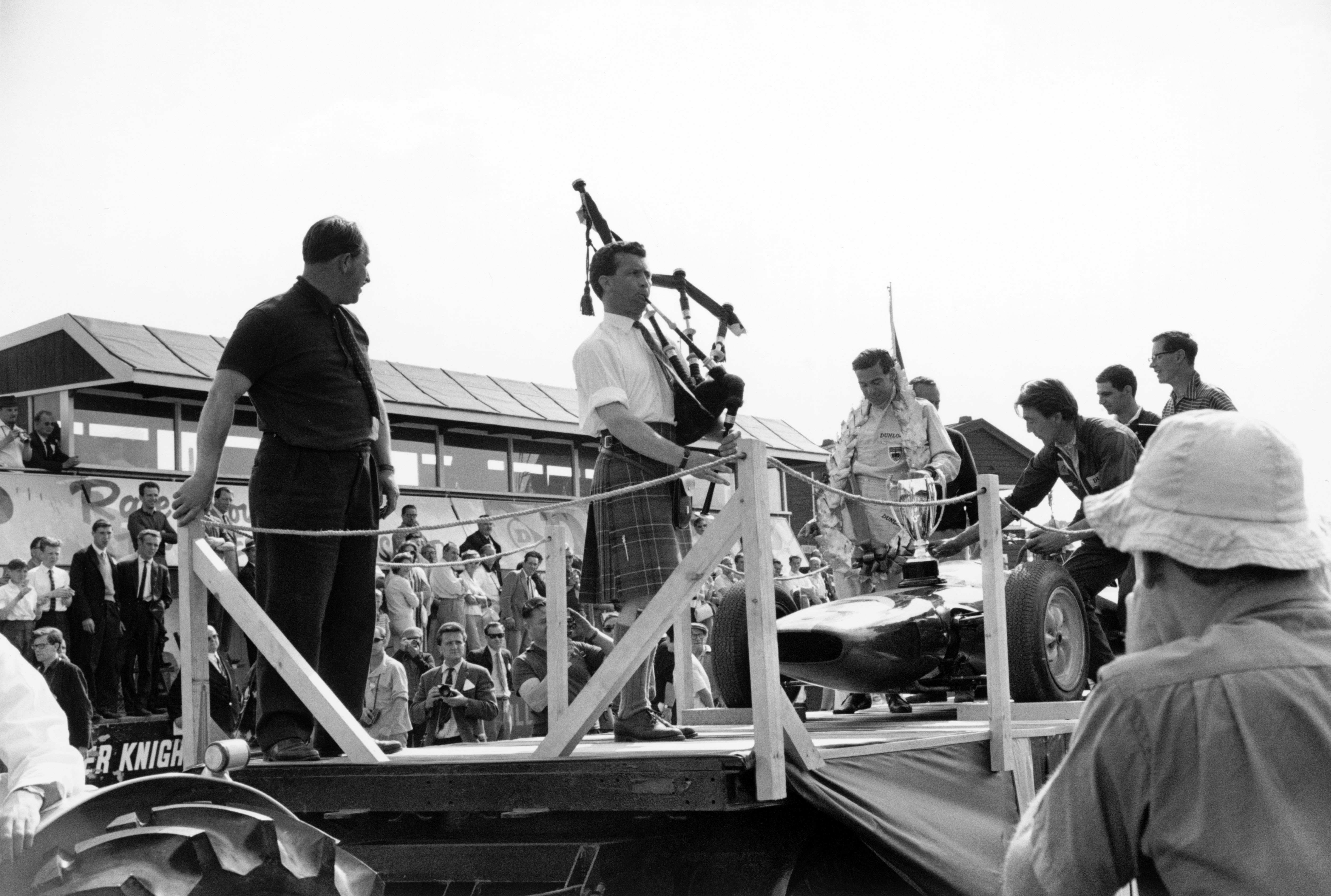
Jim won the British Grand Prix by 20sec from John Surtees’ Ferrari and Graham Hill’s BRM (for both Brabham drivers also lost their engines after excellent runs). Graham, who, like Innes Ireland, was always fast at Silverstone, ran short of fuel on the final lap and was pipped by Big John, the lone Ferrari driver, on the exit from Woodcote. The race was also notable for Mike Hailwood’s F1 debut – he finished an excellent eighth (or, in today’s parlance, “in the points”) with his Parnell Lotus 24, and for the seventh place of his exhausted team-mate, the 19-year-old Chris Amon. Chaparral creator/driver, Jim Hall, also drove well to finish sixth with his Lotus 24. For this was a tough, hard race – 50 miles longer than the 2013 version and two and a quarter hours in duration. Jim Clark waved to the ecstatic crowd on his slow-down lap (no raised digits from James Clark Jnr) and, to the sound of Scotland the Brave – a nice touch by the BRDC – and to the lucid commentary of Anthony Marsh, bashfully accepted the trophies on a mobile podium that also carried the 25. Colin Chapman wore a v-necked pullover and tie; Jim looked exalted. He had won again at home. He had won his fourth race in a row. He had the championship in sight.
To Mill Hill, then, they repaired – and then, for a change in pace, to the following weekend’s non-championship race at Solitude, near Stuttgart.
Captions, from top: Jim Clark drifts the Lotus 25 on the greasy Silverstone surface; racing driver/flag marshal, Cliff Davis, whose selfless action at Silverstone saved several lives; Bruce McLaren finds slight understeer on the Cooper at Stowe; the two Brabham drivers, Gurney and Jack, together with McLaren and Hill, crowd Jim’s 25 at the start; classic four-wheel-drift from Jim Clark. The low apex walls were always a test at 1960s Silverstone; Scotland the Brave heralds the winner of a long, fast British Grand Prix. Two hours, 14 min of brilliant motor racing Images: LAT Photographic. Our thanks to AP and Movietone News for the following superb, colour, video highlights:
 To Sweden, for the Kanonloppet – to a non-championship F1 race with a bit of history, given that Stirling Moss (Rob Walker Lotus 18/21) won it in 1961 (from the back of the grid, after Jim Clark’s retirement) and Maston Gregory followed that with victory in 1962 at the wheel of a UDT-Laystall Lotus 24-BRM. (It should also be remembered that Graham Hill, fresh from his momentous victory for BRM in the 1962 German GP, drove Rob Walker’s Lotus 24-Climax the following week in the downbeat Kanonloppet. He qualified on the second row at Karlskoga but retired early.) The Swedish race was bracketed with with Danish GP (Roskildering) in ’61 and ’62 but it stood alone in ’63. As the former factory Lotus and BRM driver, Reine Wisell, recalls in the adjoining interview, Karlskoga was, and is, best-known for the Bofors armament factory. Thus the name of the race: Kanon (gun), Loppet (trophy).












 peterwindsor.com