peterwindsor.com

…chance doesn't exist; there's always a cause and a reason for everything – Elahi

Archive for the tag “Jim Clark”

Clark brilliant at Aintree

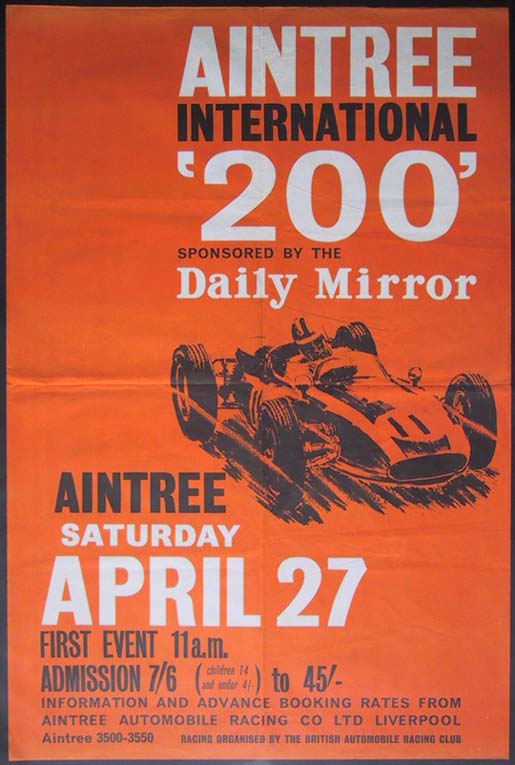
18303.tifJim Clark’s 1963 racing schedule now begins to gather real pace.  The back-to-back early-season European non-championship F1 races behind him, Jim returns to the farm for a couple of days before driving the 225 miles down to Liverpool for his third non-title F1 race of the season, the Aintree 200. (Jim will drive approximately 40,000 road miles in 1963.)  At Edington Mains there is always farm work with which to keep abreast but in addition there is plenty of racing-related admin, the relevant papers of which he files in his red leather desk folder.  A good example of Jim’s meticulous attention to detail can be seen in his correspondence with the Indianapolis Motor Speedway. Although the Team Lotus entries and surrounding paperwork are handled by Andrew Ferguson and – for Indy, 1963, also by David Phipps, the tall photo-journalist who had become a close friend of Colin Chapman – Jim receives a personal letter from the Speedway’s Henry Banks, inviting him to take part in an upcoming race at Indianapolis Raceway Park. Bearing in mind that the FIA inter-change between drivers licenced to different sanctioning bodies was a brand new thing in America, Henry’s letter to Jim, detailing an “all-comers’” race on April 28, in retrospect seems logical.  The exact description of the event – “a 300-mile race for American-manufactured cars in the improved touring category (or what would later be known as NASCAR’s Yankee 300!)” – obviously catches Jim’s attention because his written reply is as follows: “Unfortunately, like Dan Gurney and Jack Brabham, I am flying back and forth between Europe and America at the moment and on that particular date we are scheduled to race at Aintree here in Britain…”

As he sits at his desk, Jim also takes stock of his upcoming schedule.  Hectic travel is of course not new to him:  early in 1961 he competed in three New Zealand internationals before embarking on his European season – and he had finished that year, and begun 1962, with four South African races, an outing at Daytona in a Lotus Elite and then a one-off race in a Lotus 21 in Sandown Park, Australia.  What now lay ahead, however, takes him into new territory.  Following Saturday’s Aintree 200, Jim and Colin will fly immediately back to Indy via Chicago (Jim’s third trip to the States since January).  There they will continue to run the Lotus 29s at the Speedway before returning on May 7, with Dan Gurney now joining the group, to race at Silverstone in the Daily Express Trophy meeting.   Then it will be back to Indy again, this time for qualifying, before flying back for the Monaco and European GP on May 26.  (Assuming Jim qualifies on the first weekend, that is:  if rain intervenes, or they run into problems, Jim would then have to miss Monaco in order to qualify at Indy on the second weekend.)  Following Monaco, he, Dan and Colin will then fly back to Indy for the race the following Thursday (Memorial Day).  Jim will then drive to Mosport to race in the Players 200 two days later, catch a Toronto flight to London that night and race at Crystal Palace, in the Normand Lotus 23B, on June 3 (Whitmonday).  Nor will there be a break after that, for the Belgian GP at Spa is scheduled for the weekend of June 7-8-9.

Jim takes all of this merely as part of his job.  Comets and Boeing 707s make flying more fun than it had been in the turbo-prop days – and economy seats are relatively wide and relatively long.  You can actually sleep on a trans-Atlantic flight – and the immediate necessity to have to drive a racing car does away with jet lag.  Beyond that, Jim’s parents had never wanted him to race.  Now, with this sort of schedule, and with reasonable chances ahead of him for some good results, he can at least justify racing as a profession from which he can earn a living.

Aintree is bathed in sunshine on Friday, April 26 – and Jim, running the Lucas fuel-injected Lotus 25, feels as good in the car as he had at Pau and Imola.  Compared with the carburettored 25 of 1962, the fuel-injected 25 provides a more useable power band, particularly at low revs. The new short-stroke Climax engine can also be revved higher, additionally enhancing torque and power. The biggest talking-point in the Team Lotus truck is actually of the ZF gearbox and the ongoing problem of the thing jumping out of gear (a subject Colin Chapman prefers his drivers not to mention to the press!).  The root cause of the issue is that the ZF was basically a four-speed gearbox adapted to take an extra cog. The welds, reduced to a minimum, habitually came away from the spline.Trevor Taylor’s car occasionally runs a strong, heavier Colotti five-speed gearbox but Chapman does not want to compromise weight on the number one Clark car. He continues to work away with pencil drawings whenever he has a spare moment but an ultimate fix will not achieved until new ZF gearboxes, with the selector mechanism on the side of the gearbox, are fitted for 1964.  For now, Jim spends so much time wondering if the 25 is going to jump out of top that he begins to develop a one-handed driving style, steering with the left hand and holding the car in gear with his right. Jim also has reservations about the new Dunlop R6s. He hadn’t liked them at Snetterton, where the 25 had felt more skittish than at any time in its life – and he had used last year’s R5s (based on the older D9 and D12 tyres) at Pau and Imola.  He would do so again at Aintree but Dunlop are keen to try a new version of the R6 at Silverstone in two weeks’ time.   (Talking about Snetterton, Jim is a little surprised to see Denis “Jenks” Jenkinson write in the latest edition of Motor Sport that Graham Hill had won in the wet there because “Jim Clark was out of practice, Hill having raced in Australia and New Zealand over the winter.”  So Jim’s endless testing of the Lotus 29 hadn’t counted?

Jim is easily fastest on Aintree Friday, loving the circuit on which he had won the British GP in 1962 – and the 1962 Aintree 200 (in the Lotus 24:  he had also been quick in the wet at Aintree in 1961, before the Lotus 21 blew an oil pipe.). Strangely, though, he looks unfamiliar in the Lotus 25 on Friday, wearing, as he is, the older, 1961-spec, smaller-eyepiece, goggles he’d last worn at Zandvoort in 1962.  For race day, Jim switches to his customary wide-lens Panoramas (with black tape across the top-third of the lens).  Still he wears his trusty, stone-nicked dark blue, peakless Everoak.1963 BARC 200.
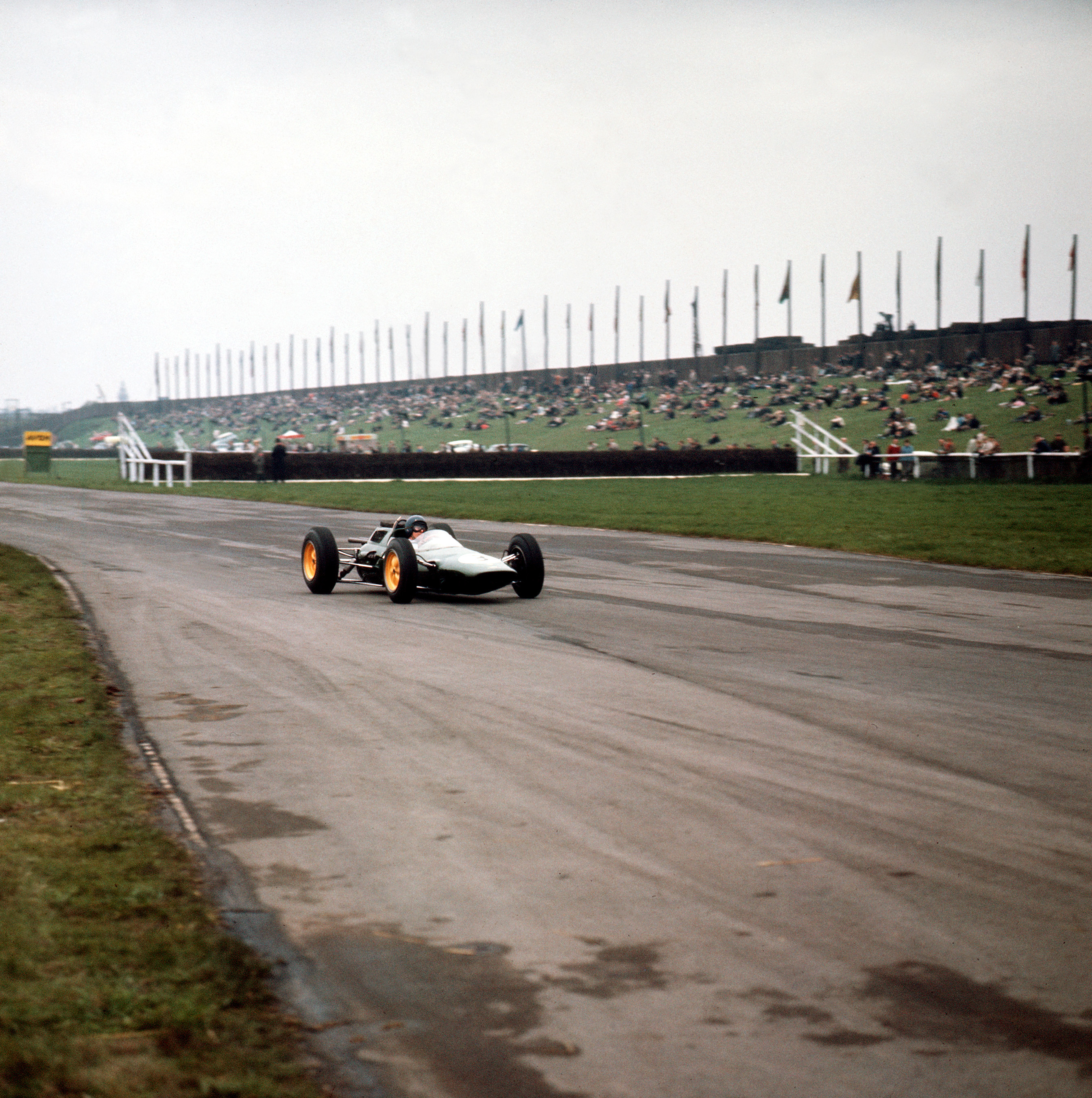
Despite the unchanged R5s, Jim’s pole time had been 1.2 sec faster than his fastest practice lap at the British GP the previous July. Jack Brabham is second, 0.8 sec slower in his 1962 BT3, but non-starts when his Climax engine throws a piston late on Friday. (This failure has the knock-on effect of delaying the completion of Dan Gurney’s new Brabham for the Daily Express Trophy, ensuring that Dan will remain a frustrated spectator after the long flight over from Indy. It is probably because of some of these dramas, and because Dan had initiated the Lotus Indy programme in the first place, that Colin Chapman will have no compunction about lending Jack Brabham a Lotus 25 for the Monaco GP a few weeks later.)

Graham Hill, who at Aintree is still in his 1962-spec BRM, is 0.8 sec quicker than he’d been the previous July – but slower than Innes Ireland, who is very fast in the Goodwood-winning BRP Lotus 24-BRM. Ireland qualifies third, Hill fourth and Ritchie Ginther fifth, equaling his team-leader’s time in the second BRM. Trevor, again in gearbox trouble, will start from the inside of the third row in the carburettored Lotus 25.

What should have been a Clark walkover under leaden skies on Saturday turns out to be one of the best races of the 1963 season. The record crowd at the famous Grand National venue can hardly believe it when Jim Clark’s hand goes up at the start and the field swarms around him.  With the 25’s battery completely flat, Jim is totally helpless. Ted Woodley and the boys push the car over to the pits, fit a new battery – and the car starts perfectly.  Jim leaves the pits even as the field is well into its second lap.

Clark drives brilliantly in these early stages but clearly the car still isn’t right.  A fuel-injection-related mis-fire comes and goes.  Trevor, meanwhile, is running fifth and looking good.18316.tif

On lap 16 Colin Chapman thus makes the sort of decision that even the most hardened of Team Principals always dread:  he pulls in both of his drivers and instructs them to swap cars. (I spoke only a couple of days ago to Anita Taylor, Trevor’s sister, about this. “Trevor was only too ready to oblige,” she said. “Of course he wanted to win. He was also a friend of Jimmy’s, a colleague, a huge admirer. If Chapman thought it was best for the team, Trevor went along with it. He was that sort of man.”)

It is a beautifully-orchestrated manoeuvre.  Jim comes in first and is ready, waiting, as Trevor screams to a halt. Out jumps Trevor and quickly Ted Woodley swaps seats. In slides Jim. He has the rear Dunlops alight before Ted is even clear of the car.

So Jim Clark is now in Lotus 25 Number 4 and Trevor in Lotus 25 Number 3. Out in front, Ritchie Ginther gives best to Graham after taking an early lead; Innes is third, followed by Bruce McLaren in the new 1963 Cooper 66-Climax.

Jim Clark then produces a supreme display of class driving, perfectly-balancing the carburettored 25 through Aintree’s medium-speed corners, blipping the throttle on the slow ones to keep the revs in the useable band. He works his way back to an eventual third place.  His lap times are consistent to within tenths; his fastest lap – a staggering 1min 51.8sec – is 0.6 quicker than his pole time and a full 1.8sec quicker than his pole lap at the British GP in ’62.  This in a car with the 1962-spec, 175bhp engine.

Afterwards, Jim says simply this:  “I really enjoyed this race – even though I didn’t win it;  I enjoyed it more than a number of the Grand Prix events I was to drive during the season.”

Graham Hill wins Aintree (from Innes Ireland, Jim/Trevor, Ritchie, Bruce, Chris Amon in the Reg Parnell Lola and Trevor/Jim) – wins his second F1 race since clinching the championship only four months before; and Graham wins the Saloon Car race, too, again heading the Jaguar 3.8 battle featuring Roy Salvadori and Mike Salmon.  Jack Sears wins his class in a Ford Cortina GT;  Sir John Whitmore wins the Mini division;  Roy Salvadori leads home Innes Ireland in the big sports car event (Cooper Monaco, Lotus 19); our friend Mike Beckwith wins his class with the 1600 Normand Lotus 23B;  Pete Arundell and Paul Hawkins head the 1100 Lotus 23 class; and Denny Hulme, a new rising star from New Zealand, brilliantly wins a wet Formula Junior race in the new Brabham (from Frank Gardner, Pete Arundell and Mike Spence).

With no vested interest other than as a guy who loves motor racing, Bruce McLaren has this to say about Denny’s win:  “For a driver who professes not to be particularly good in the wet, I thought fellow-New Zealander, Denny Hulme’s win in the works Brabham FJ was very good.  For a couple of years he ran his own FJ Cooper as a privateer with very little outside assistance, and he did much better than anyone expected.  18297.tifHe is now being trained in the Brabham tradition by building, working on, and developing his own car.  He works in the Brabham racing shop under Jack’s watchful eye and his fine drive in the rain at Aintree was the result – his first really big win for some time, and a most convincing one at that.”   No surprise, really, that Bruce would sign Denny to his McLaren F1 team some five years later.
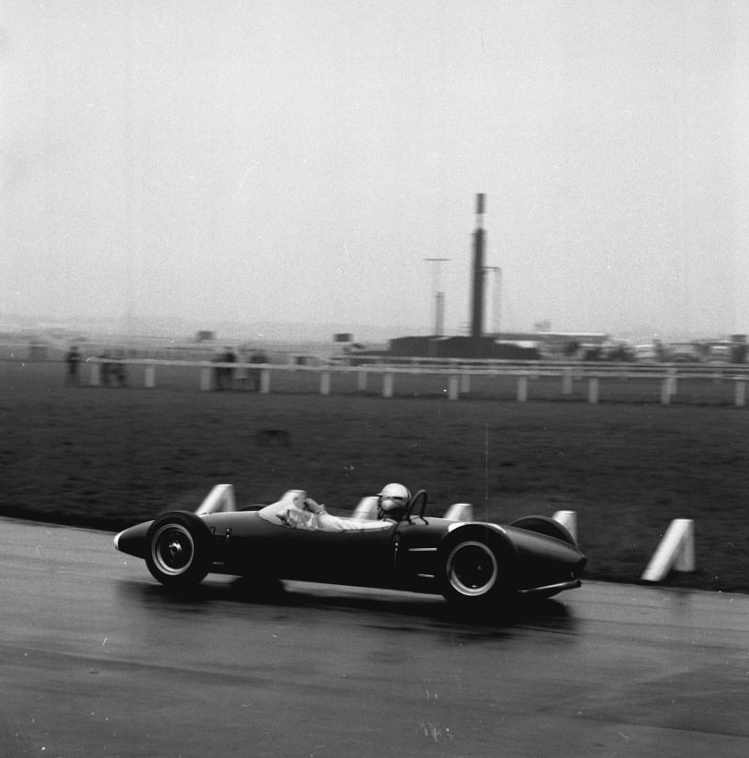
And, about Jim Clark’s performance at Aintree, Bruce is unequivocal: “It is interesting to note the way that Jim Clark is taking over the Moss role in motor racing.  After practice at Aintree on the Friday, a certain well-known driver said to me, ‘I’m very pleased with my car – very pleased indeed.  I’m only half a second slower than Clark’.  There was a time when the proud phrase ‘only just slower than…’ just had to refer to Stirling Moss.”

Note:  driver-swapping would continue through to 1964, when Jim took over Mike Spence’s Lotus 33 at the US Grand Prix at Watkins Glen.

Images:  LAT Photographic

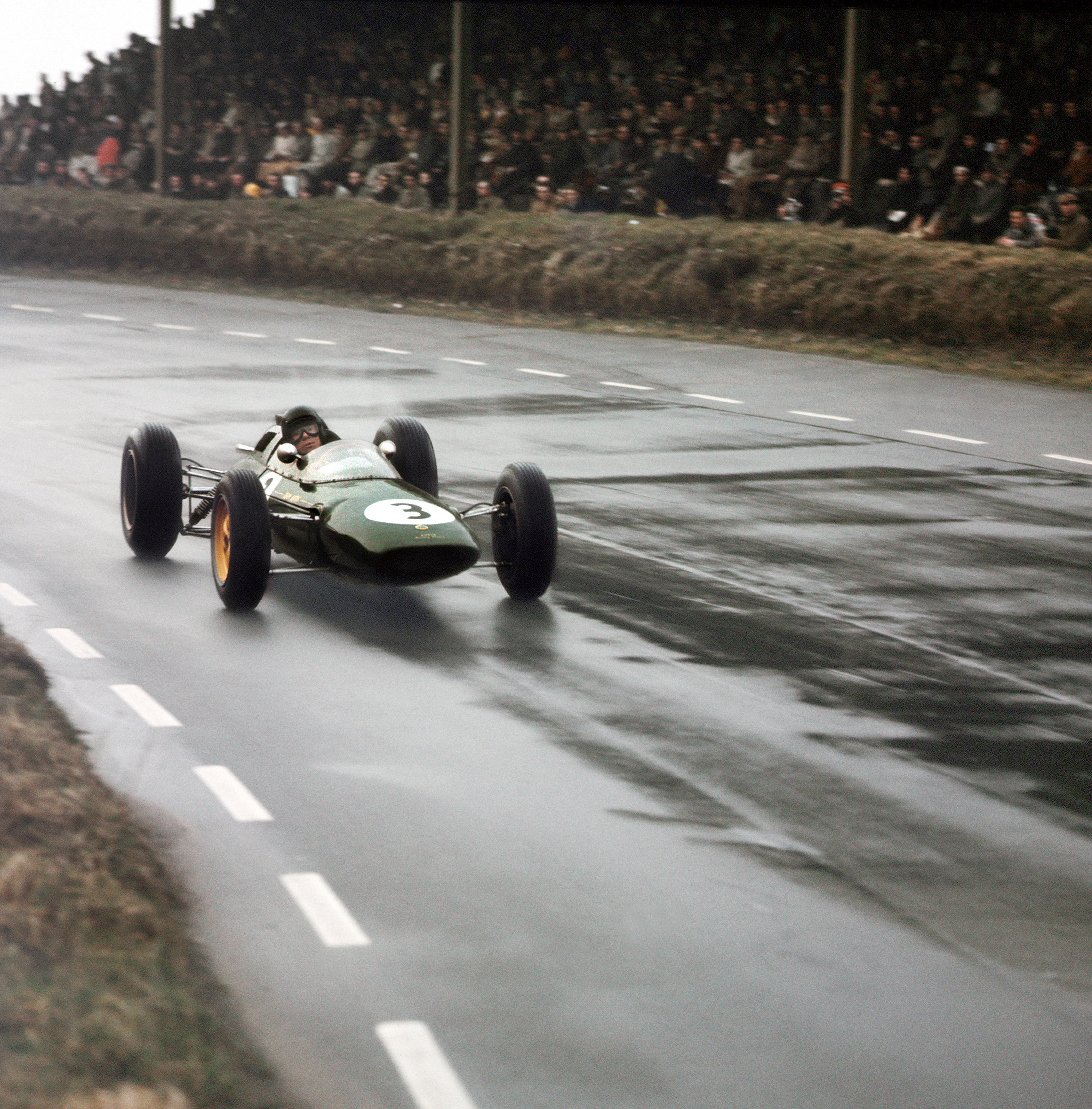
Captions Top: Jim Clark dances with the throttle in Trevor Taylor’s carburettored 25. Middle: Jim in the early phase of the race in his own, fuel-injected 25. Bottom:  Denny Hulme made his name by winning the wet Aintree FJ race 1963aintree200   
Flat out at Imola

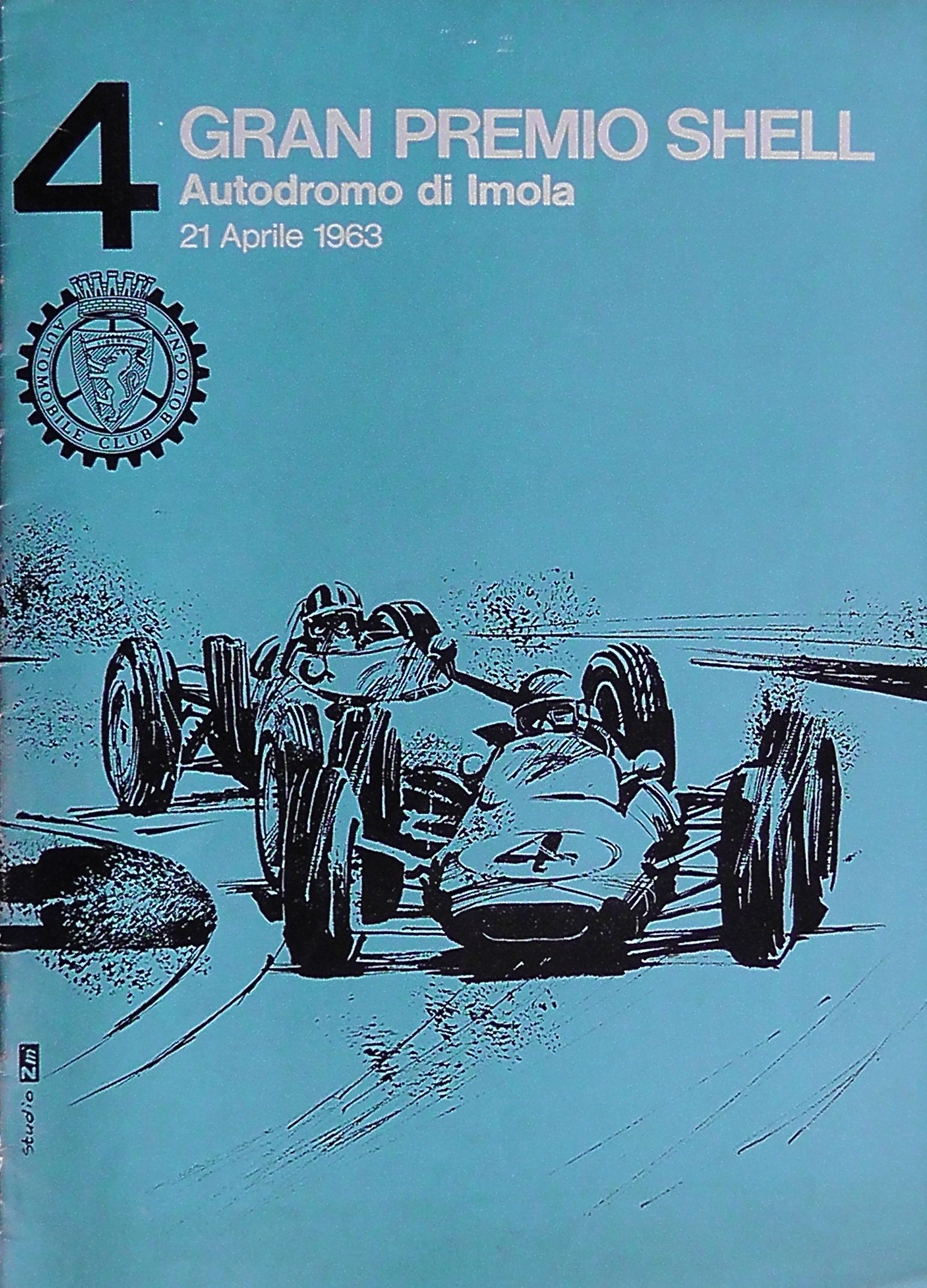
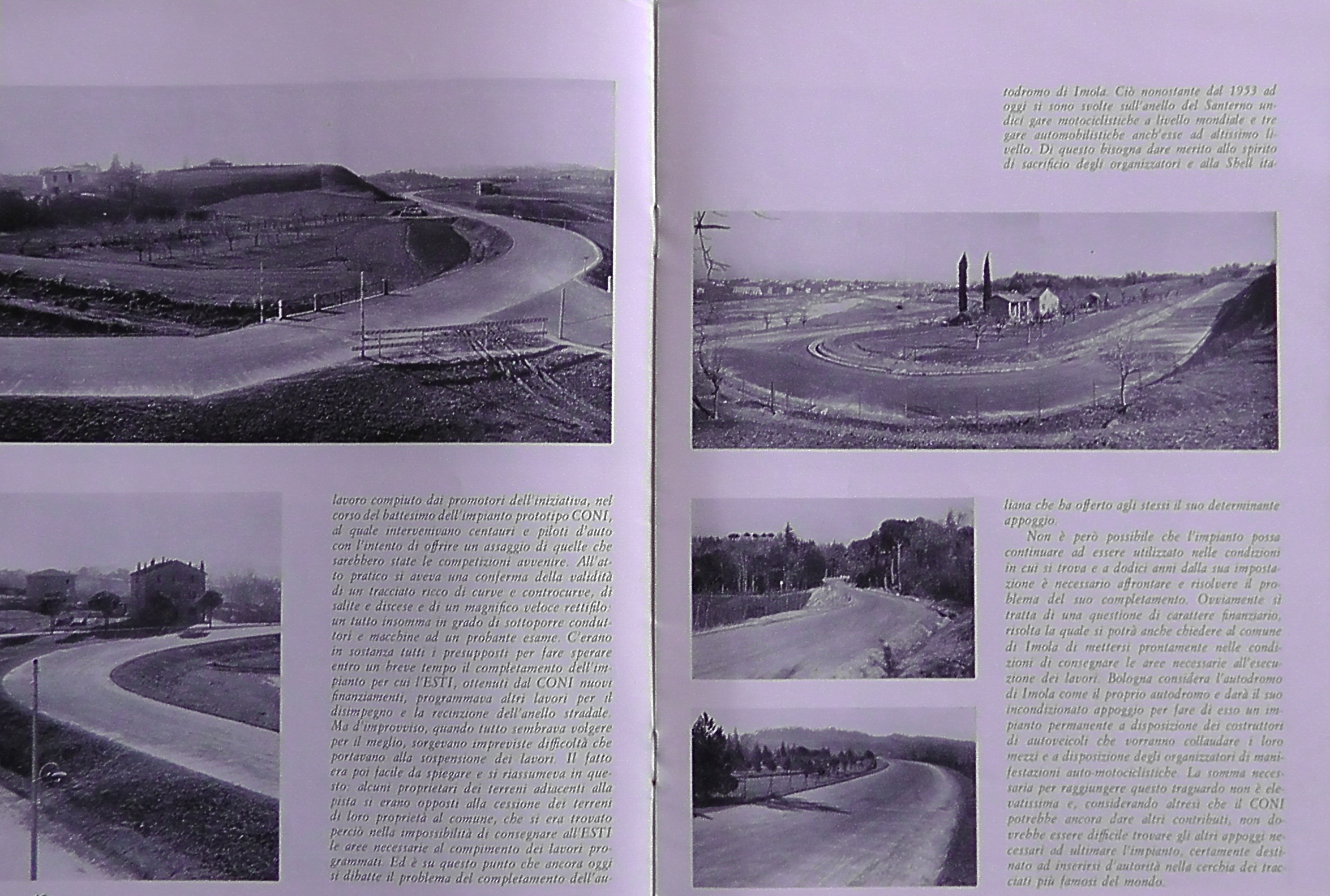
S2280010The beautiful spring weather continued as Jim and Trevor made their way to Imola via Bologna.  For both drivers, this race was a first.  Imola – running through the vineyards and orchards of beautiful, undulating countryside – was in 1963 better-known as a motor-cycle track that had seen some sports car racing in the 1950s.  There was no “Ferrari” element to it back then:  the circuit had actually been developed by the Italian Olympic Committee, based on public roads.

Nor were there any chicanes.  From what we know today as “Ravazza” – the left-hander that takes the circuit back towards the pits – Imola was basically flat-out all the way down to Tosa, the tight left-hander that leads uphill.  The road wasn’t straight, mind:  Tamborello was still a very fast left-hand kink back then and the right-hander that followed it was likewise right-on-the-edge.  There was no “Variante Alta” after Acqua Minerale – but in some ways the track gave back what it gained in fast corners by being incredibly bumpy, particularly on that climb to the top of the hill. I spoke to Brian Redman recently about his win at a pre-chicane Imola in a Gulf Porsche 917:  he reckoned that only Spa was more demanding.S2280014

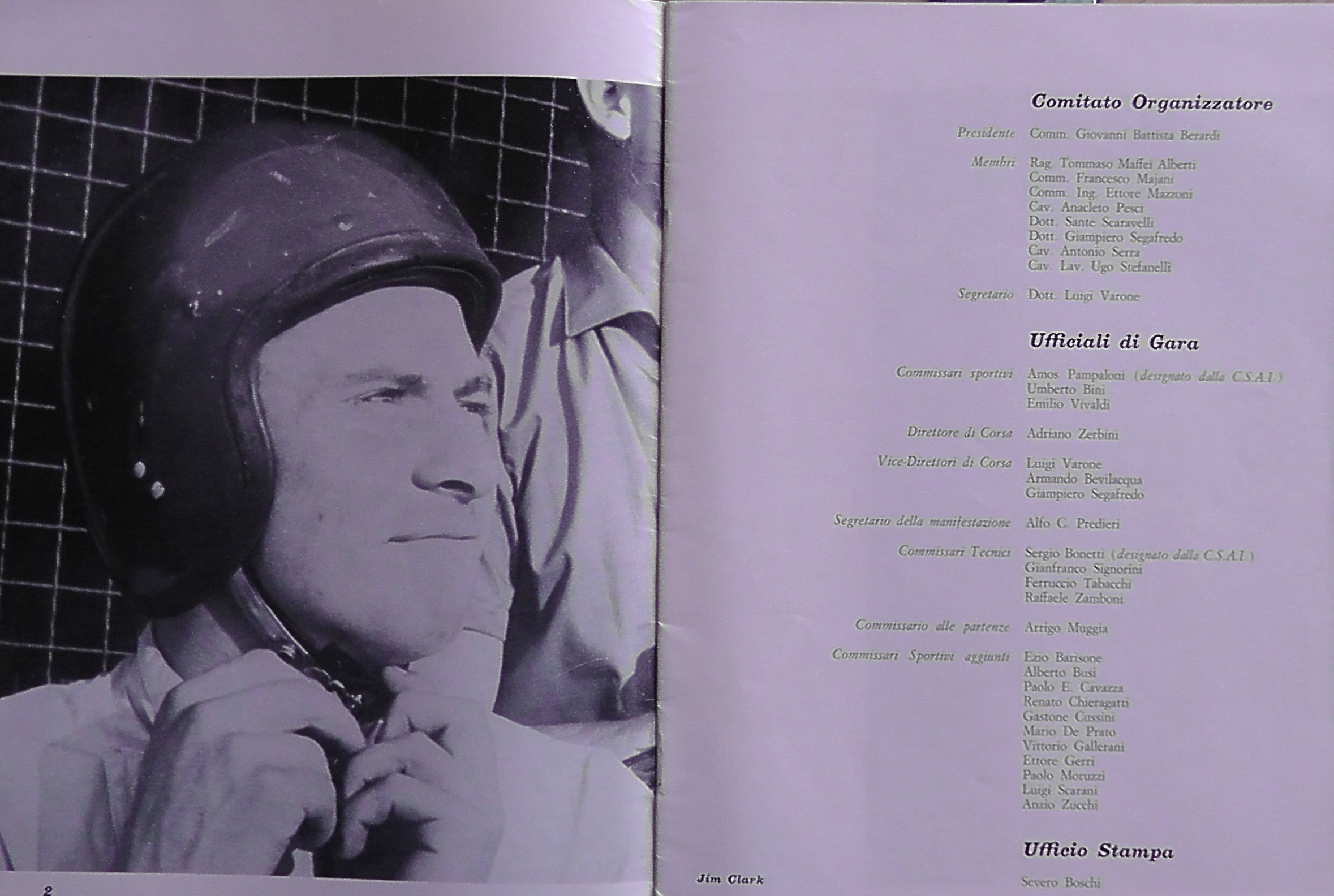
The sun shone, the air was fresh – and, for Team Lotus, the opposition was again negligible.  Not even Ferrari sent cars to this Shell-sponsored race, which meant that young Italian stars like Lorenzo Bandini had to seek rides in old Centro Sud Cooper- Maseratis.   As at Pau, though, Jim’s dedication to the perfect lap – and then to the perfect race – remained undimmed.  Over two days of practice he focused on taking the kinks flat and the high-speed corners in beautifully-balanced drifts: the result was a lap in 1min 48.3 sec – an easy pole, given that Trevor lost a lot of time with gearbox trouble.

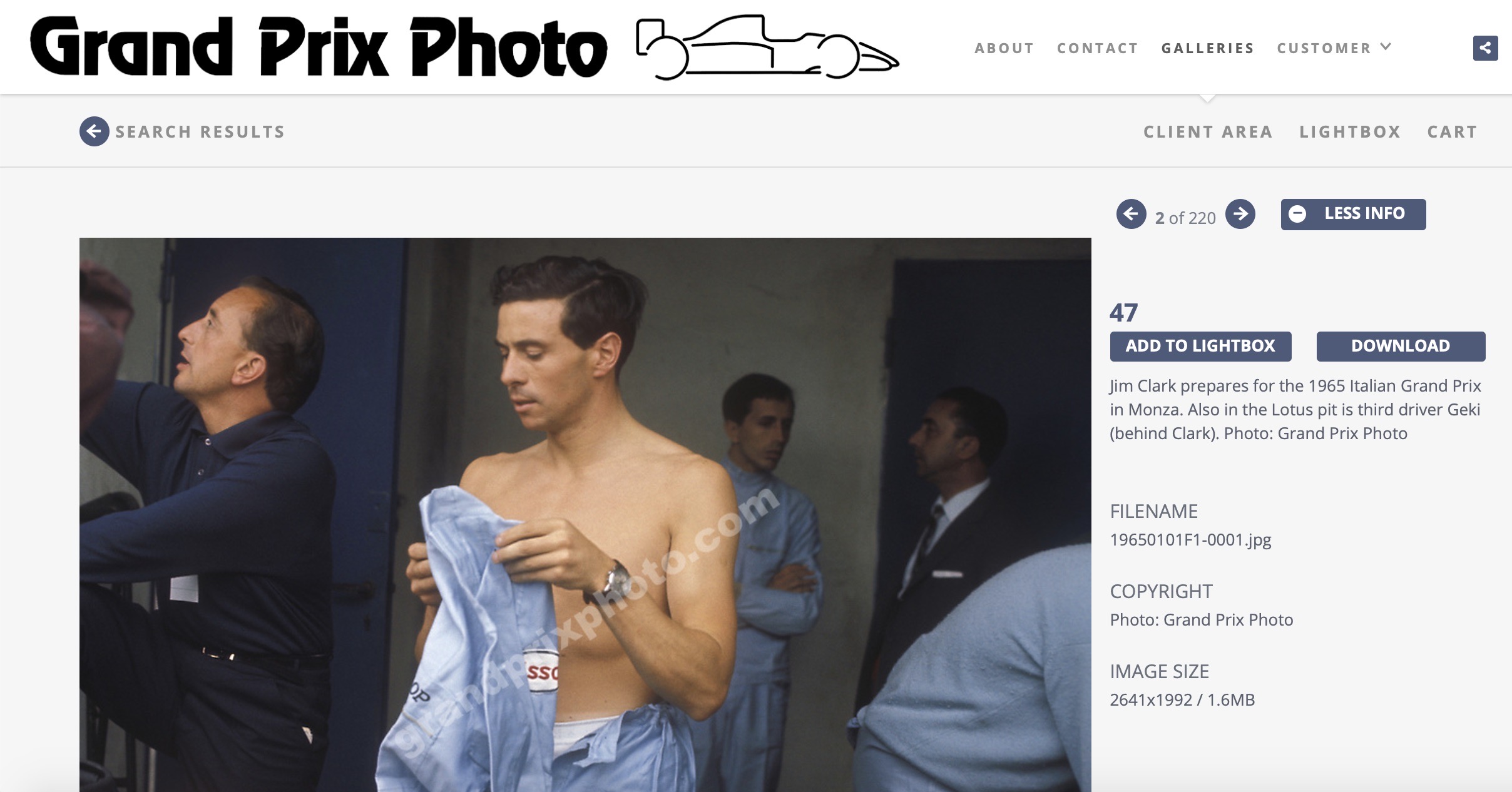
The race started relatively late on Sunday – at 4:00pm, after a Formula Junior race which featured such drivers as “Geki” (who would race for Team Lotus at Monza in 1965 and 1966) and the future Ferrari driver, Andrea de Adamich – which meant that the sun had already lost its sheen and the shadows were growing ever-longer as the tricolore fell.  Jim led from the line and was never headed – but still he found time to “play” for the crowd.  Trevor pulled into the pits at the end of the first lap, explaining again that the car was jumping out of fourth gear, and rejoined some 15 laps in arrears.  (One can understand Trevor’s nervousness about issues like this:  at Spa, the previous year, his Lotus 24 had jumped out of gear at Blanchimont, had spun sideways, and had been t-boned at high speed by Willy Mairesse’s Ferrari.  Both drivers had amazingly escaped uninjured, which I guess to some extent re-enforced the belief in the minds of most of their contemporaries, albeit in the short-term, that it was better not to be strapped into the cockpit by seat belts.  I mention this because, already, Jim had experienced the security of seat belts during Indy testing.  He wore them at Indy, and at other ovals, but never, throughout his career, would he wear belts in any European single-seater races.)

Towards the end of this Imola race, therefore, Jim waited for Trevor and “raced” him through to the flag.  Their pace, given that Jo Siffert was lying a very distant second in the Filipinetti Lotus 24-BRM, was breathtaking to watch.  Jim waved Trevor past – then shadowed him, pushing him as hard as he dared, bearing in mind that Trevor was driving now without fourth gear at all.  Taking this into account, it is amazing, I think, to note that Trevor eventually lapped in 1min 48.3sec – at Jim’s pole time (166.769kph).  So did Jim, of course – but that wasn’t the point.  The race, after all, had been fun.S2280012

Very fortunately, we have on this occasion some colour footage from this event, courtesy of Christopher Tate, the current Managing Director of Donington Park.  Chris’s father was closely associated with the Rob Walker F1 team in the early-to-mid 1960s and thus took a 35mm camera with him to many F1 races.  Christopher notes that “it was at Imola in 1963 that Rob really noticed Seppi Siffert and decided to sign him up for 1964”.  In confirmation, of course, Siffert would go on to win the non-championship F1 race at Syracuse the following Thursday (April  25).  I love the charm of this short video – the relaxed chat between Jim and Jo Bonnier before the start; the obvious enthusiasm of the Italian hosts; the oil-smeared mechanics’ white overalls; JoBo, driving his RRW Cooper in short-sleeved polo; the straw bales, the trackside trees; Trevor waiting patiently, watching the race, while they work on his car; the elegance of the dark green Lotus 25s; and Jim looking a little embarrassed as he stands on the podium, Dunlop overalls wet from sweat.  You catch a glimpse, too, of Bob Anderson beginning to make his name in his dark blue and white 1962 Lola – and of Jo Schlesser’s sky-blue FJ Brabham.  With thanks, then, to “A Gentleman’s Motor Racing Diary”, Copyright World Action Sports Productions, available on Amazon.co.uk/DVD/Motosport.  (See below.)

Thus Team Lotus’ pre-season European interlude comes to an end.  Next race: the Aintree 200.  Again – and good to see, too – it is on a Saturday.  Next Saturday. April 27.

The win that Clark tried to share

18275.tifAnd so Jim Clark’s 1963 season begins to gather pace:  after a further few days at Edington Mains, Jim set off for his two-week trip to Southern France and then Italy.  Ian Scott-Watson drove him in the factory prototype Lotus-Cortina to Edinburgh airport, where Jim flew first to London – in a turbo-prop BEA Vickers Vanguard – and then on to Pau.

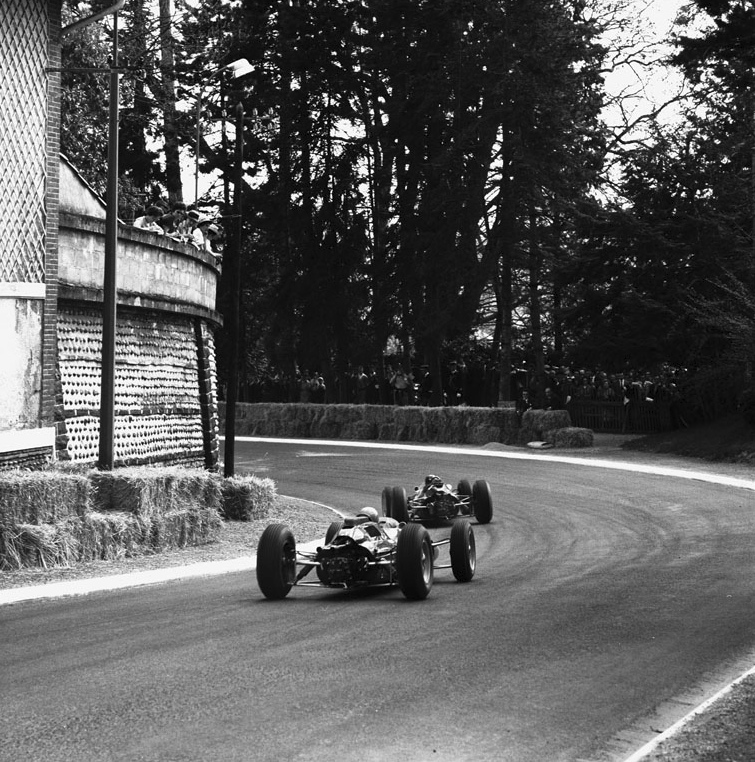
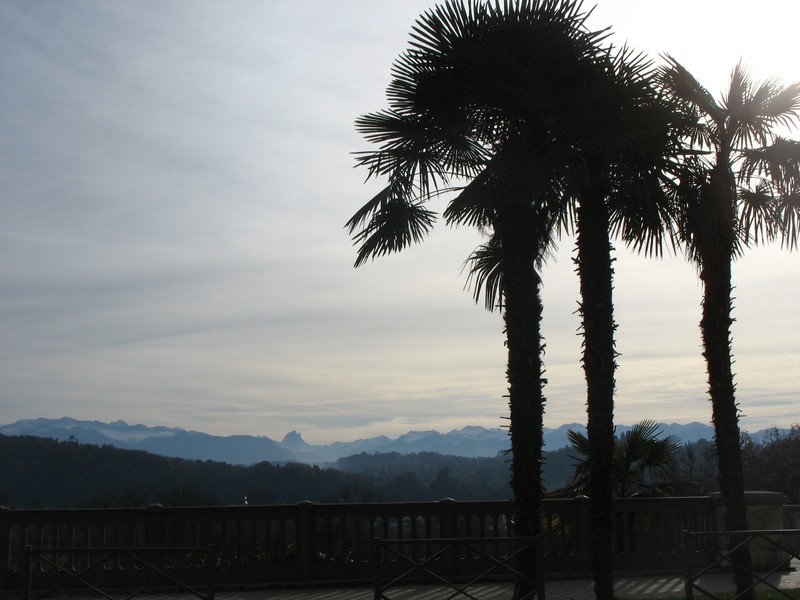
The warmer Mediterranean weather was a pleasant change from the rigours of the British winter.  There was a carnival atmosphere about the town this second week of April – partly because Pau was hosting an F1 race in its own right, with its own heritage and character;  partly because the race would be run on a public holiday – Easter Monday (April 15); and partly because, from the standpoint of Team Lotus, this weekend was effectively a demonstration run.  The opposition was negligible, for all the major works teams (bar Ferrari, who were busy on their Michael May-inspired fuel-injected semi-monocoque cars for John Surtees and Willy Mairesse) were racing at Goodwood in the Glover Trophy.  Once down near the Pyrenees, though, reality set in:  opposition or not, the works Lotus 25s were facing a 100-mile race in demanding track conditions.  Even as practice began on Saturday, the public roads began to melt and then to crumble.  The weather stayed warm; the crowds expected a speed-fest.  As it happened, the track grew slower and slower and increasingly treacherous…

Jim (in the Lotus 25 he had last raced in South Africa, at the end of 1962) nonetheless took an easy pole after two days of practice. Such was the potential danger of the stones, though, that he fixed masking tape over his nose and upper lip for the race.  He again wore his trusty Everoak;  his Panorama goggles were fitted with dark lenses for his exploits in the golden spring sunshine.

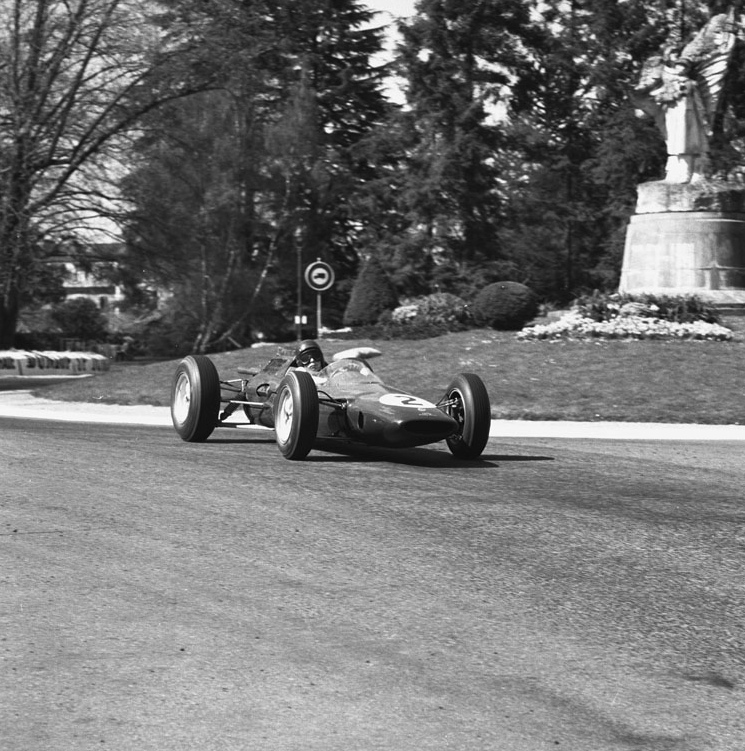
Trevor Taylor, Jim’s team-mate (in the 25 Jim had raced at Snetterton) actually led away from the line but – as great team-mates do – he backed-off before the first, fast right-hander to give the lead to Jim.  1963 Pau Grand Prix.Jim responded – then slowed down a little for Trevor.  And so it went on.  The crowd drank their wine, ate their baguettes, took their naps – but always, when they raised their heads to watch the leaders, there were Jim and Trevor, having fun, swapping places and demonstrating their skill amidst the rubble and the marbles and the frequently-waved yellow flags.

Who would win?  Trevor (right) was happy to cross the line right behind his team-mate.  Colin Chapman would be impressed – and Trevor was keen to consolidate his position as a perfect complement to Clark’s genius.  They’d raced this way in the Springbok series of 1961 – and Trevor had already scored a strong second place for Team Lotus in the Lotus 24 (1962 Dutch GP).  Now, with the 25s heading for more wins in 1963, Trevor wanted solidly to be a part of that.  For his part, Jim thought it much fairer to cross the line in a dead-heat finish.  Showpiece endings like this weren’t that difficult to organize in the 1960s (timing was down only to a tenth of a second), and even four years later (at Syracuse, in 1967, when the timing was a little more sophisticated) the feat would be pulled off by Ferrari.18228.tif

On this occasion, though, Trevor dabbed the brakes just before the line, foiling Jim in a neat reversal of what would see years later at Imola, 1982, and Malaysia, 2013:  Trevor wanted the win to go to Clark, despite Jim’s best efforts to share it.

As light as the opposition had been, Jim and Trevor were nonetheless exhausted after their torrid day’s work.  Over dinner, as plans were made for the drive down to Italy for the following Sunday’s Grand Prix of Imola, a radio crackled out some of the latest hits from England and America – “Big Girls don’t Cry” and the Beatles’ new single, “Please Please Me”.  Then, after phone calls back home, they discussed the news of the day: Innes Ireland had won at Goodwood in front  of 50,000 spectators in the BRP, from Bruce McLaren in the works Cooper and Tony Maggs’ Parnell Lotus 24 – but not before Graham Hill (’62 BRM) and Jack Brabham (’62 Brabham) had both run into mechanical dramas (fuel and ignition respectively).  The Formula Junior race went to Frank Gardner and Denny Hulme (Brabhams), from Richard Attwood’s MRP Lola; Graham Hill made up for his BRM disappointment by winning the Jag 3.8 battle for the St Mary’s Trophy from Roy Salvadori and Mike Salmon; Jack Sears had been quick in the new Ford Cortina GT; Sir John Whitmore and Christabel Carlisle led the Mini division; Graham Hill also won the Sussex Trophy GT race with John Coombs Jag E-Type; and Roy Salvadori won the sports car race – the Lavant Cup – with his Cooper Monaco. Normand Racing had been right up there in the wet, with Tony Hegbourne driving Jim’s Oulton Lotus 23B alongside Mike Beckwith.  The pair had eventually finished second and fourth (despite spins!).20328098

Images: LAT Photographic

Clark second in Lombank Trophy

1963 Lombank Trophy.Jim Clark’s first race meeting of 1963 did not go particularly well.  After several hectic weeks in the US (at Ford’s proving ground in Arizona and then at Indy, where he lapped at just over 150mph) and, before that, at Snetterton, testing the gorgeous Lotus 29 Indy prototype car, 1963 Team Lotus Factory.Jim drove back along the A11 to the Norfolk circuit  for the Fourth Lombank Trophy F1 race.  Probably at some point, I  suspect, the new Honorary President of the Scottish Racing Drivers’ Club would have been smiling at the thought of the Club Lotus dinner he’d attended a few weeks before at the Taggs Island Casino, near Hampton Court. He, Jabby Crombac and Mike Beckwith had driven one of the new Elans onto the stage and the evening had ended with Colin Chapman being spruced up in a pair of blue nylon knickers… As would become the norm for races at Snett, Jim would be staying with Jack Sears in Jack’s farmhouse near the circuit – and he would refrain, of course, from making any long-distance calls to the US.  (On Saturday, March 30, 1963, it became possible for the first time to make direct calls between the UK and the US.)

This would be the second Snetterton race meeting promoted by the circuit’s new owners – Motor Circuit Developments (the first was a club meeting held on March 17) – and therefore by John Webb, whose airline, Webbair, had become a regular part of motor racing logistics since the late 1950s.  As a journalist, manager and, as I say, race promoter, Webb would in the 1960s and 1970s become one of the most influential figures in British motor sport.  With support from Grovewood Securities, the Grovewood Awards, to name but one of Webb’s creative ideas, would eventually pave the way for today’s Autosport Awards.

The Lombank Trophy was the first F1 race of the year – a non-championship race, to be sure, but a significant one nonetheless.   Lombank was one of several London-based financial “institutions” (as investment banks were known then!) to see the benefits of motor racing sponsorship, although by a certain irony this Snetterton race would be the first since one of Lombank’s major competitors – UDT Laystall – announced their withdrawal from F1.

Today we go into internet-fed panic mode whenever teams or sponsors pull out of the sport, or change hands, but 50 years ago the usual ruptures of the winter were accepted with good grace in the belief that something – or someone – better would come along.  One thing was clear, however:  Stirling Moss’s retirement now seemed permanent (following a test at Goodwood in early May, Stirling would make the decision final) and he was busy now re-inventing himself as a team owner/team manager/Ogle Associate Director; and gone, too, were the factory Porsche and Lola F1 teams.  Although General Motors also announced a unilateral withdrawal from motor sport in early March, 1963, one of the private entrants at Snetterton (Jim Hall) no doubt read this notice with a smile.   (Even as Jim drove his BRP Lotus 24-Climax with not a little natural speed, the idea of a secret GM-supported Chaparral was formulating in his fertile mind.  Jim had raced his be-finned and be-spoilered front-engined Chaparral at Sebring the weekend before;  and many, he knew, were the ideas he could take to GM. Looking back now, and remembering for how long Jim was a fixture at F1 races, it is staggering that no-one in F1 took serious note of the winged Chaparrals of 1966-67.  Even Jim Clark’s attempt to mount a rear spoiler on his Lotus 49 at Levin, in 1968, was immediately quashed by Colin Chapman.)

Porsche’s loss was Jack Brabham’s gain:  Dan Gurney signed over the winter to drive a second factory Brabham in 1963, and John Surtees stepped from Lola to Ferrari.  (I can’t help reflecting here that Jack Brabham “lent” Big John his personal Lotus 24 to race in the end-of-season, 1962, Mexican GP, for Bowmaker Lola were by then concentrating on the upcoming Australasian Series and entered only one Lola in Mexico for Roy Salvadori.  John promptly qualified the 24 on the second row, only fractionally slower than Trevor’s Lotus 25.  Brilliant. Surtees drove most of the New Zealand-Australia series for Bowmaker Lola but his place at Sandown Park, Melbourne, interestingly enough, was taken by Masten Gregory.  Tony Maggs finished third at Sandown in the last appearance of a Bowmaker Lola entry.)  ATS, led by former Ferrari engineer, Carlo Chiti, would also be entering F1 in 1963 with drivers Phil Hill, Giancarlo Baghetti and (for testing) Jack Fairman;  and this would also be the first race for Coventry Climax since being bought by Jaguar Cars Ltd.

The Lombank Trophy race (won in 1962 by Jim Clark) was held on Saturday, March 30, at 3:00pm, with practice taking place on Friday.  Public address commentary was in the care of the excellent Anthony Marsh, the recently-appointed Publicity Officer for Brands Hatch, Mallory Park and Snetterton and the lynchpin, of course, of the Springfield Charity that still exists today.

Jim and Team Lotus had only recently lost the 1962 World Championship to Graham Hill and BRM.  No-one doubted that the monocoque Lotus 25 had been the quicker car in 1962 – but, since August, BRM’s Tony Rudd had been hard at work on his version of the Lotus “bathtub”.  Quickly, though, work at Bourne fell behind schedule.  The demands of the ’62 season in part accounted for the delay but in addition England was plagued by a ‘flu epidemic over the arctic-spec winter:  factory staff were thin on the ground and there was little or no back-up to replace them.  On top of that, BRM also began work on the radical Rover-BRM turbine programme for Le Mans.  As a result, BRM began the year with lighter versions of their reliable and very driveable P578 space-frame cars, albeit with slightly more powerful V8 engines.  They brought two to Snetterton, for Graham and for Richie Ginther, both of whom had been racing in the Sebring 12 Hours the weekend before.  Hill finished third there, sharing a Ferrari 330LM with Pedro Rodriguez, and Ginther sixth (Ferrari GTO, shared with Innes Ireland).   (These were the days of Boeing 707 intercontinental air travel, although turbo-props, such as the Lockheed Electra and Vickers Viscount, were still very much in use.)

Team Lotus entered two Lotus 25-Climaxes for Jim and his regular team-mate, Trevor Taylor but a shortage of engines (ie, one Climax V8 only!) rendered Trevor a non-starter.  Jim’s race engine, indeed, was way down on power.  Climax had planned to bring the new, 200bhp fuel-injected V8s to Snetterton for use by Lotus and Cooper but, like BRM, ran out of time.  Speaking of the Cooper Car Company of Surbiton, Surrey, Bruce McLaren flew from Sydney to the US after winning his fourth Australasian series race at Sandown Park, Melbourne with his Intercontinental Cooper-Climax – (this is a sad story, but I’ll tell it less we forget:  Bruce sold that car to Lex Davison, who raced it successfully in 1963-64 and who in turn then used it to enable the young and talented Rocky Tresise to make his career breakthrough in 1965.  Tresise died in a start-line accident at Longford with the Cooper, as did the talented Australian photographer, Robin d’Abrera;  it was Robin’s pin-sharp images that captured Bruce’s Sandown win in the Cooper for Autosport back in March, 1963) – and at Sebring raced the Briggs Cunningham Jaguar E-Type.  He finishing eighth there, partnered with Walt Hansgen.   Cooper entered only Bruce at Snetterton – again in a 1962 T60 car.   The interesting Cooper entry from Morris Nunn failed to appear;  and Jo Siffert pulled out after hitting a bank on the very wet practice day in his Filipinetti Lotus 24.

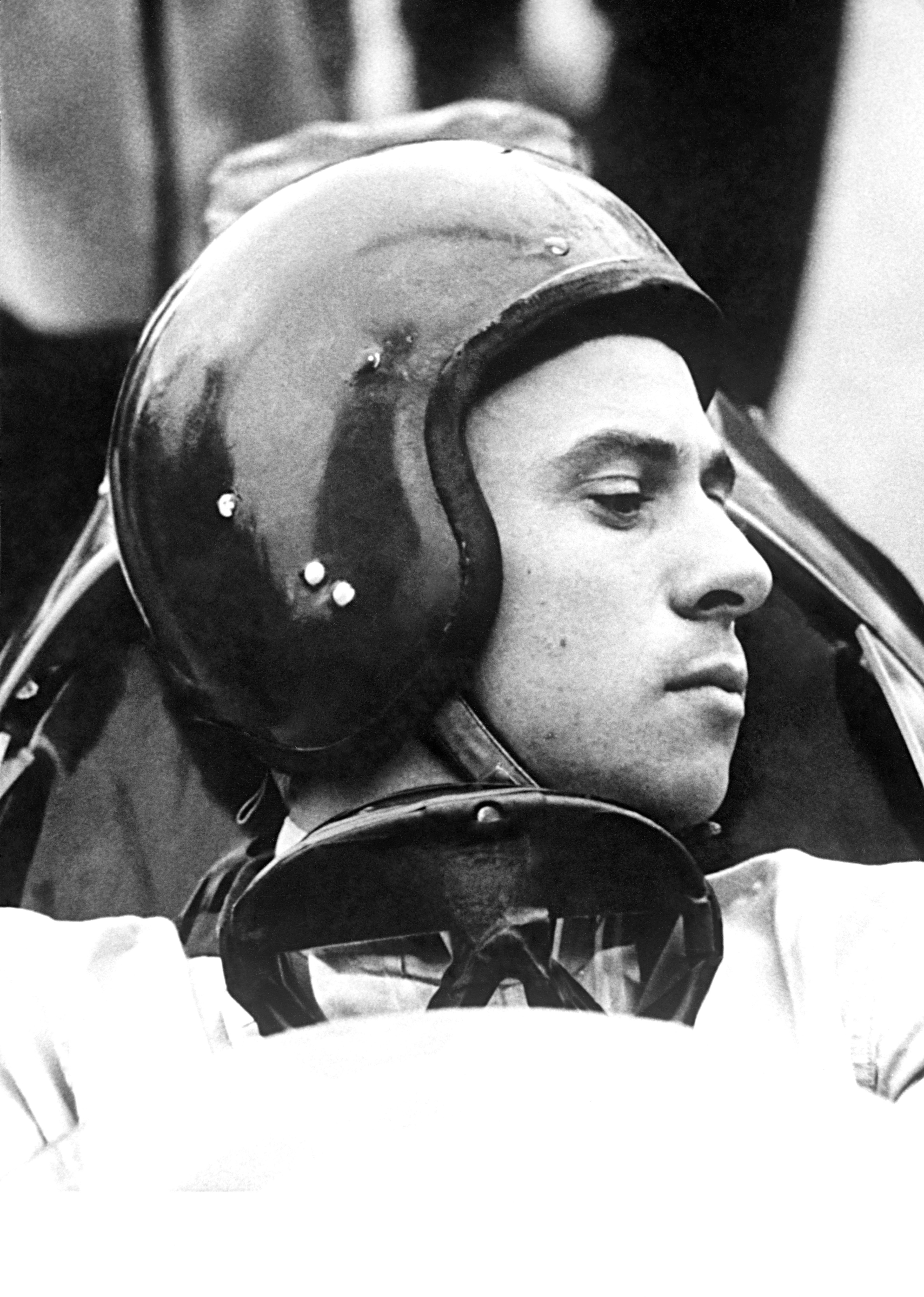
Jim, in  battle-scarred, dark blue, peakless Everoak helmet, 1965 Formula One World Championship.
was easily fastest on Saturday, lapping in 1min 44.4 in the torrential rain despite trouble starting the car (due to a lack of warm-up spark plugs).  Eventually the 25 was tow-started  into life. With Graham Hill’s BRM suffering from chronic fuel injection problems, Richie Ginther was next quickest (1min 46.8sec), followed by Bruce (1min 48.8sec), Innes Ireland in the BRP Lotus 24 and Innes’s team-mate, Jim Hall.

On Saturday the weather continued.  Snetterton became a quagmire of mud, rain, wind and spinning wheels.  There were no branded jackets back then, there was no North Face, no Timberland.  Instead, long raincoats, cloth caps and Wellington boots ruled the day. Les Leston’s racing umbrellas – each segment representing a marshal’s flag – were also at a premium.

Richie led from the line, using the superior torque of the BRM engine to full advantage, with Bruce second and Jim an initial third.  Jim quickly took second place at the hairpin – the left-hander at the end of the long back straight that runs parallel to the A11 – and passed Richie at the same place a few laps later.  Significantly, though, Richie was able to out-accelerate the Lotus.  All were running on the new Dunlop R6 but the traction advantage was with the BRMs.  Graham Hill had meanwhile flown through from the back of the grid.  He quickly passed Bruce and, now on a spray-free road, quickly caught Jim and Richie.  Jim took the lead and began to pull away – but then ran wide onto the grass while lapping a back-marker;  Richie again ran at the front.

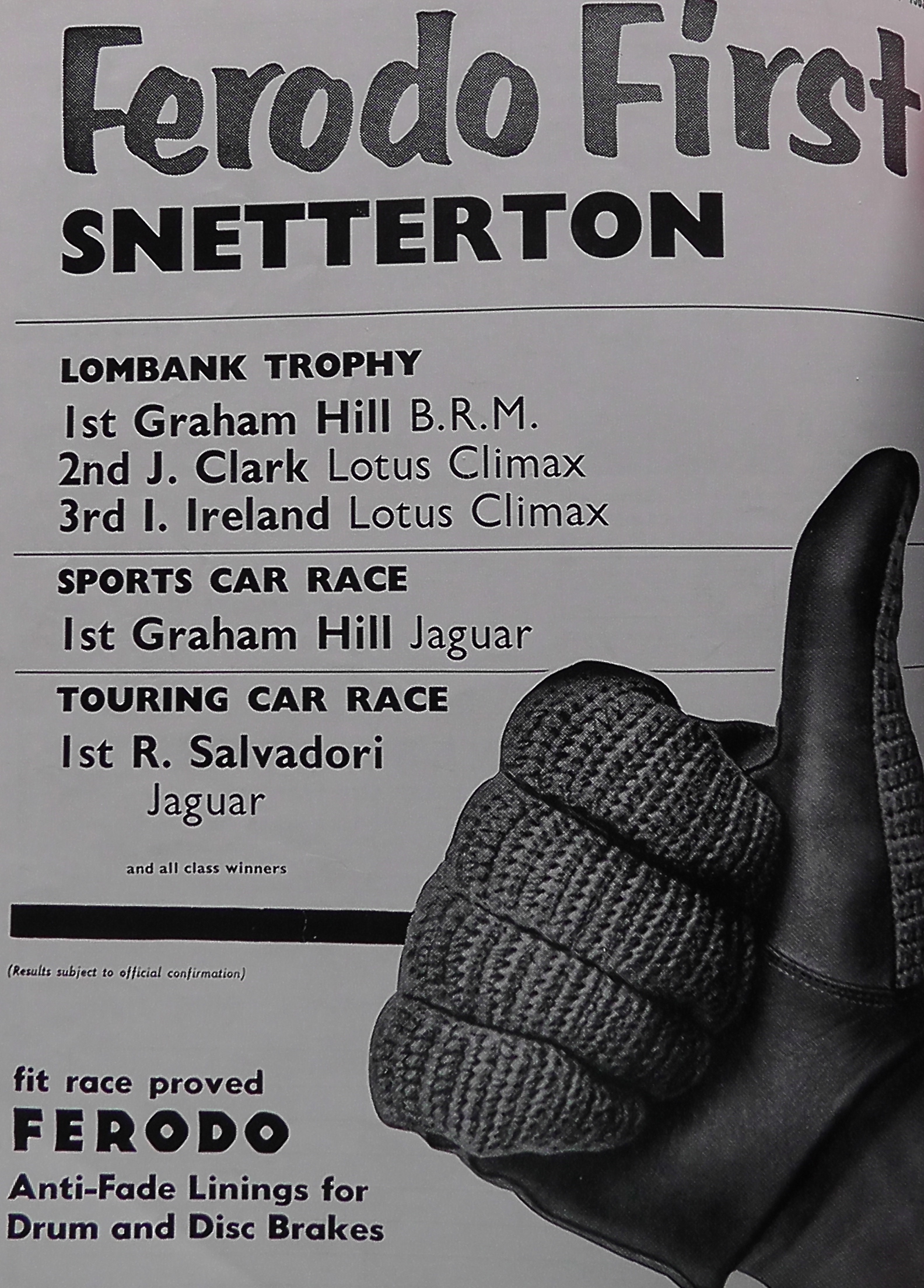
There was no stopping Graham Hill.  Driving superbly in the rain, he passed both Richie and then Jim to win decisively.   Unhappy with his engine, and finding the 25 surprisingly skittish in the wet, Jim backed away and settled for second place.   Innes Ireland eventually finished third, although not without incident.  During his battle with Bruce, the pair of them had lapped Innes’ team-mate, Jim Hall.  Innes slipped past without problem but then, with hand signals to Hall, made it clear that he wanted his team-mate to hold up Bruce for a corner or three.  You can imagine if Fernando Alonso today suggested to Felipe Massa (running a lap behind) that he hold up Seb Vettel for 20 seconds or so.  As it was, Bruce afterwards dismissed the episode as “a legitimate team tactic”.  Such was Gentlemen Bruce.

The Lombank meeting boasted a superb support-race programme.  The World Champion was also victorious in the 25-lap sports car race with John Coombs’ lightweight Jaguar E-Type (ahead of the Cooper Monaco of Roy Salvadori, now retired from F1); Roy made up for that by winning the Jaguar 3.8 battle in the 25-lap Touring Car race, gaining revenge on Graham Hill (who fought his way back from sixth place).  Mike Salmon, also in a 3.8, finished third.  Both Normand Racing Lotus 23s (driven by Mike Beckwith and Tony Hegbourne) had looked quick in the sports car event but eventually, in the wet, had to cede position to Alan Foster’s amazing MG Midget.  It should be noted that Frank Gardner also raced the new Brabham BT8 sports car at Snetterton, winning the 1151cc-2000cc class.

I mention the Normand Lotus 23s because Jim signed over the winter to race for Normand whenever his schedule allowed.  Just such an opening would appear at the BARC’s Oulton Park Spring Meeting on Saturday, April 6.

Full report next week.

Pictures: LAT Photographic and writer’s archiveS2390001

Geoff Sykes – Australia’s “Mr Motor Racing”

File0012Warwick Farm, the Tasman Series…and the cream of the world’s F1 drivers. It all came together in a golden age of Australian motor racing. Too quickly, though, it was over. The Farm was for the most part replaced by a housing estate; the Tasman became a championship too far. Geoff Sykes – dapper, under-stated, respected by all – rode into a motor-cycle- and aviation-oriented retirement.IMG_0002

Recently I was asked by the Australian Dictionary of Biography to write a brief profile of Geoff Sykes.  This was my attempt to do him justice:

Geoffrey Percy Frederick Sykes was born on September 6, 1908, at Beresford Manor Cottage, Plumpton, Sussex, England.  Percy Robert Sykes, Geoff’s father, was both a gifted wood-worker and the first Headmaster of the Chailey Heritage school for the disabled in Sussex, assisting disadvantaged children to forge their place in society.  The eldest of three children (his sister, Marjorie, was born in 1910, his brother, Reginald, in 1913), Sykes was educated at Brighton, Hove and Sussex Grammar School, to which he travelled each day by moped and then by train, thus ensuring that he was licensed to ride a moped from the age of 12.  Upon leaving school, he was apprenticed to British Thomas-Houston in Mill Road, Rugby – an electrical engineering industry leader. Certified as an electrical engineer in August, 1929, he then joined the Department of Works, where he was seconded to a number of public buildings, including Buckingham Palace.

Sykes married Margaret Rose White (a friend of his sister’s) on September 1, 1939.  They had three children – Robert (born April 28, 1943), who worked for the British Council abroad and is now retired;  Richard (born May 25 1945), who would study engineering and work for Ricardo, Tickford (where he was involved in the engine design of the Ford XR6) and TWR before joining Cosworth and subsequently Mahle Powertrain; and Julia (born August 15, 1948), who attended the Arts Educational School in London and taught dance for much of her career.  She was subsequently appointed Secretary of two branches of the Imperial Society for the Teachers of Dancing.

Motor racing very quickly became a passion for Sykes.  He regularly attended pre-war race meetings at Brooklands; he loved riding motor-cycles; and he competed in hill-climbs and trials with his open-topped Wolseley Hornet two-seater.  Sykes was an active member of his local motoring club, the Brighton and Hove Motor Club (BHMC), and during this period also met John Morgan, who was then Secretary of the Junior Car Club.

At the outbreak of war, Sykes applied for a transfer first to the Air Force and then to the Army (which he would have joined at the rank of Major) but The Air Ministry instead commissioned Sykes to top-secret electrical engineering work, concentrating on the guiding of damaged aeroplanes to bases throughout England using the Drem lighting system.  On one occasion, in the early dawn after the Luftwaffe’s bombing of Coventry, the aeroplane in which Sykes was flying was mistaken for the enemy.  Despite considerable shelling, Sykes and crew survived unharmed.

Sykes worked in various management positions in the immediate post-war period before joining the Electrical Drawing Office at the Ministry of Works. Simultaneously he fostered his love of cars and motor-cycles with the Junior Car Club. The JCC amalgamated with the Brooklands Automobile Racing Club in 1949 (under a new name – the British Automobile Racing Club, or BARC), thus enabling Sykes, who by now had been elected Chairman of the BHMC, to work for the man who would become his mentor – John Morgan.  A brilliant organizer and promoter, Morgan quickly established his reputation in British motor racing circles – and from 1954 did so with Sykes by his side.  As the club’s Assistant General Secretary, Sykes, charming and mild-mannered, was an obvious counterpoint to the no-nonsense Morgan, the club’s General Secretary;  and, as motor racing burgeoned in the 1950s, it did so in concert with the BARC’s growing stature.  (It should also be noted that Sykes’ second wife, Meris Chilcott Rudder, also worked for the BARC at this time, married to the aviator, Jim Broadbent.)

His life changed dramatically when Mrs Mirabel Topham, owner of the Aintree horse-racing circuit in Liverpool, contacted the BARC in 1953 to discuss the design and construction of a motor racing circuit.   After a number of meetings to discuss the project, she wrote to Morgan to say that she wished to go ahead but insisted that Geoff be the one she dealt with on a day-to-day basis.  Under Sykes’ direction, the Aintree circuit was completed in 1954 and would go on successfully to stage the British Grand Prix on five occasions – 1955, 1957, 1959, 1961 and 1962.  At many of these meetings – and at the early Grands Prix – Sykes officiated as Clerk of the Course.

In 1959 Sykes received a lawyer’s invitation to attend a meeting with the Australian Jockey Club (AJC) to discuss the design of an Australian version of Aintree.  Unbeknown to Sykes, Sam Horden of the AJC had mentioned his motor racing circuit concept to the pre-eminent British Formula One private entrant, Rob Walker; and Walker, impressed by the organization at Aintree, had had no hesitation in recommending Sykes.

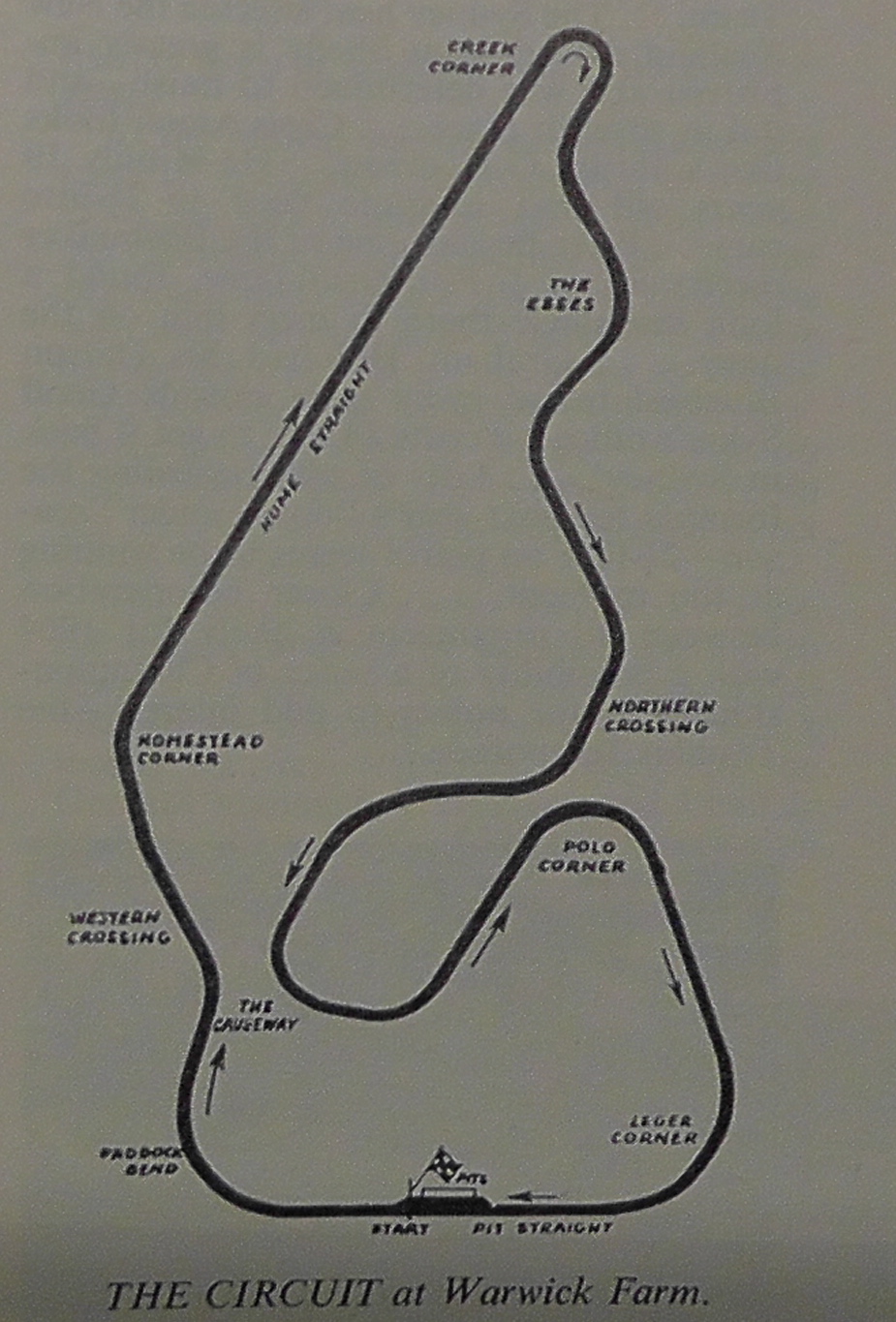
Sykes travelled by BOAC Comet to Australia for a three-week fact-finding tour, beginning in December, 1959.  Staying at Tattersall’s Club in Elizabeth St, he rang Meris Rudder, who had moved to Australia following the death of her husband and had bought a small flat in Kirribilli below the north-east pylon of the Harbour Bridge. In a matter of three hours, using Meris’s living room table as a flat surface, Sykes drew what was later to become the Warwick Farm motor racing circuit.  Few changes were made to the original design (which included two Aintree-inspired crossings of the horse-racing circuit).S2290005

That first draft – described by Meris at the time as looking more like a Picasso than a motor racing circuit – is today the property of Richard Sykes.

Sykes returned to Australia permanently in June, 1960, when work promptly began on the new circuit.  Thanks mainly to Sykes’ planning and organizational expertise, the new facility was finished in an astonishing six months.  The removable Tarmac sections for the two temporary crossings were designed and built by de Havilland (Australia) Ltd;  and the design overall of the 2.25-mile circuit combined fast corners with a series of ess-bends, a double-apex, negative-camber left-hander over the lake and two tight corners – Creek Corner hairpin at the end of Hume Straight (which was parallel to the Hume Highway) and a right right-hander by the AJC Polo field.  The three grandstands on the pit straight were as used for the horse-racing (as at Aintree).   The circuit was noteworthy at the time for its large expanses of grass and for its white railing (from the horse-racing track).   It was thus so far ahead of its time in terms of safety that Sykes felt obliged to try a “no-spinning” rule in 1964, arguing that this would be the equivalent of the trackside hazards that characterized other circuits throughout the world.  Given the dangers of motor racing in the 1960s, it is remarkable that not a single driver or spectator was killed at a Warwick Farm race meeting.  (One driver lost his life in a testing accident.)

The first Warwick Farm race meeting was held on December 18, 1960, and was followed soon afterwards, on January 29, 1961, by a major international race meeting that featured a 100-mile event for F1 drivers and top locals.  In 110 deg F (41 deg C) heat, 65,000 spectators watched Dan Gurney, Graham Hill, Innes Ireland, Jack Brabham and the eventual winner, Stirling Moss, give the new circuit, and its organization, a massive vote of approval. Moss declared the circuit’s layout and organization to be the equal of any venue in the world.  Warwick Farm was an instant success.

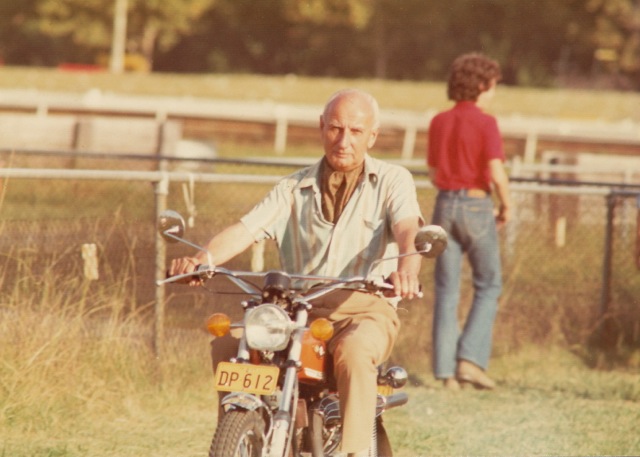
Sykes, who habitually wore light chino trousers, suede shoes, white shirt, club tie or cravatte, sports jacket and cloth cap, was also a man of great artistic talent and attention to detail.  He personally designed the badge of the circuit’s new club, the Australian Automobile Racing Club (the AARC, instigated in July, 1961), together with the circuit’s support merchandise, including the programme covers, posters and car stickers, nominating a local artist, Peter Toohey, for much of the artwork.  The AARC was from the start a small but extremely efficient operation, featuring Sykes as the General Secretary; John Stranger, formerly of the North Shore Sporting Car Club, as Accountant and Secretary of the Meetings; and Mary Packard as general administrator.  They were later joined by a young school-leaver, Peter Windsor (Press Officer).  The AARC was originally based at 184 Sussex Street, Sydney, but moved to the site of a former Bank of NSW, on the corner of Sussex and King streets, on June 24, 1967.

As one of the few locations in Australia where you could “talk motor racing” and read the latest publications from the UK (Motoring News and Autosport), the AARC offices quickly became a Mecca for both famous racing names and rank-and-file club members.  The AARC staged four to five major race meetings at Warwick Farm per year, including the February international, three or four club meetings (on a shorter circuit that looped back to the Causeway after the first corner) and numerous members’ film nights – these providing the only opportunity for motor racing enthusiasts in Australia to see the latest images from overseas.

On February 10, 1963, Warwick Farm hosted the Australian Grand Prix for the first time.  Again run in extremely hot conditions, it was reported in Autosport by Sykes himself, who wrote, “Race week was a busy one from a social angle, and there was for the first time in Sydney an atmosphere of Grand Prix fever… On Thursday the AARC put on their second annual cocktail party with an attendance of 550, and regrettably had to turn down almost 200 would-be attenders….both Stirling Moss and Graham Hill gave brilliant dissertations rather than speeches…Graham Hill also had his Datsun Bluebird towed away from outside Geoff Sykes’ office – it costs £4 10s to get it back in Sydney!…The meeting was voted the best so far at Warwick Farm, and all the officials did a magnificent job to keep everything going like clockwork under such trying conditions – full marks to all those with the thankless jobs.”

Sykes and his New Zealand counterpart, Ron Frost, initiated a new Tasman Cup in 1964, taking the Antipodean summer international series to even greater heights.File0047  As the promoter who had the unique respect of the major F1 teams and drivers, Sykes travelled to Europe each year to negotiate their appearances (a trip usually timed to allow Sykes to indulge his love of aircraft at the mid-July Farnborough Air Show).  Sykes and Jim Hazleton helped the great Scots driver, Jim Clark, learn to fly at Bankstown airport in 1965;  and the AARC would go on to own several light aircraft for the use of its members – a Cherokee 140 (registration VH-ARC), a Cessna 172 (VH-ARA), a Cherokee 180D (VH-ARD) and latterly a Beechcraft Sundowner (VH-ARF).  Sykes also flew his own low-wing Thorp T111 Skyscooter out of Bankstown, registration VH-DES.

Due to the long time they had spent apart on different sides of the world, Geoff and Margaret divorced in September, 1966.  Four weeks later Geoff married Meris Rudder.

kb-alfa.jpgWarwick Farm staged the Australian Grand Prix on four occasions –  1963 (won by Jack Brabham); 1967 (Jackie Stewart); and 1970 and 1971 (Frank Matich).  Sykes introduced the extremely popular, and affordable, Formula Vee cars to Australian motor racing (two Vees and a Formula Ford were owned by the AARC for the use of club members); pioneered the concept of the club race meetings and practice days; and, in the 1970s, was also one of the key figures behind the choice of production-block Formula 5000 cars for Australia’s premier single-seater category. The AARC continued to promote successful and well-attended national race meetings through to July, 1973, when the AJC decided that the land used for most of the motor racing circuit should be sold for property development.   Sykes and the AARC (primarily through the work of Mary Packard) then assisted with the promotion of club race meetings on the smaller Warwick Farm circuit (through to October 28, 1973) and then at Amaroo Park (through to November 30, 1986).  Living with Meris in the original Kirribilli flat, Geoff in his retirement spent much of his time with bikes and cars:  he enjoyed restoring historic motor-cycles and riding his vintage Velocette; and, following a succession of white, automatic Triumph 2000s, drove a yellow Alfa Romeo GTV.

After several years of battling a heart condition, Geoff died on April 12, 1992, at Royal North Shore Hospital, North Sydney.S2290004

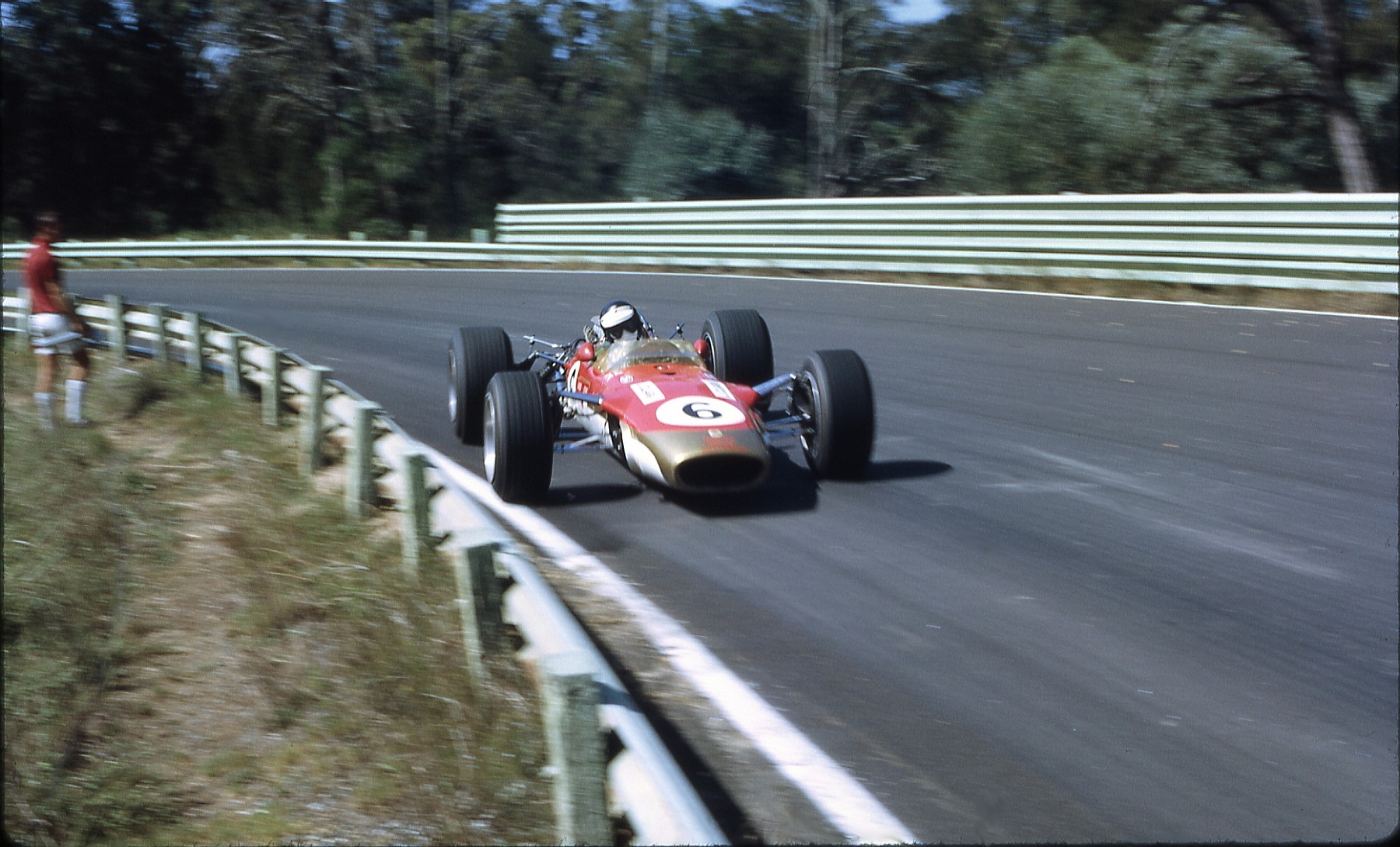
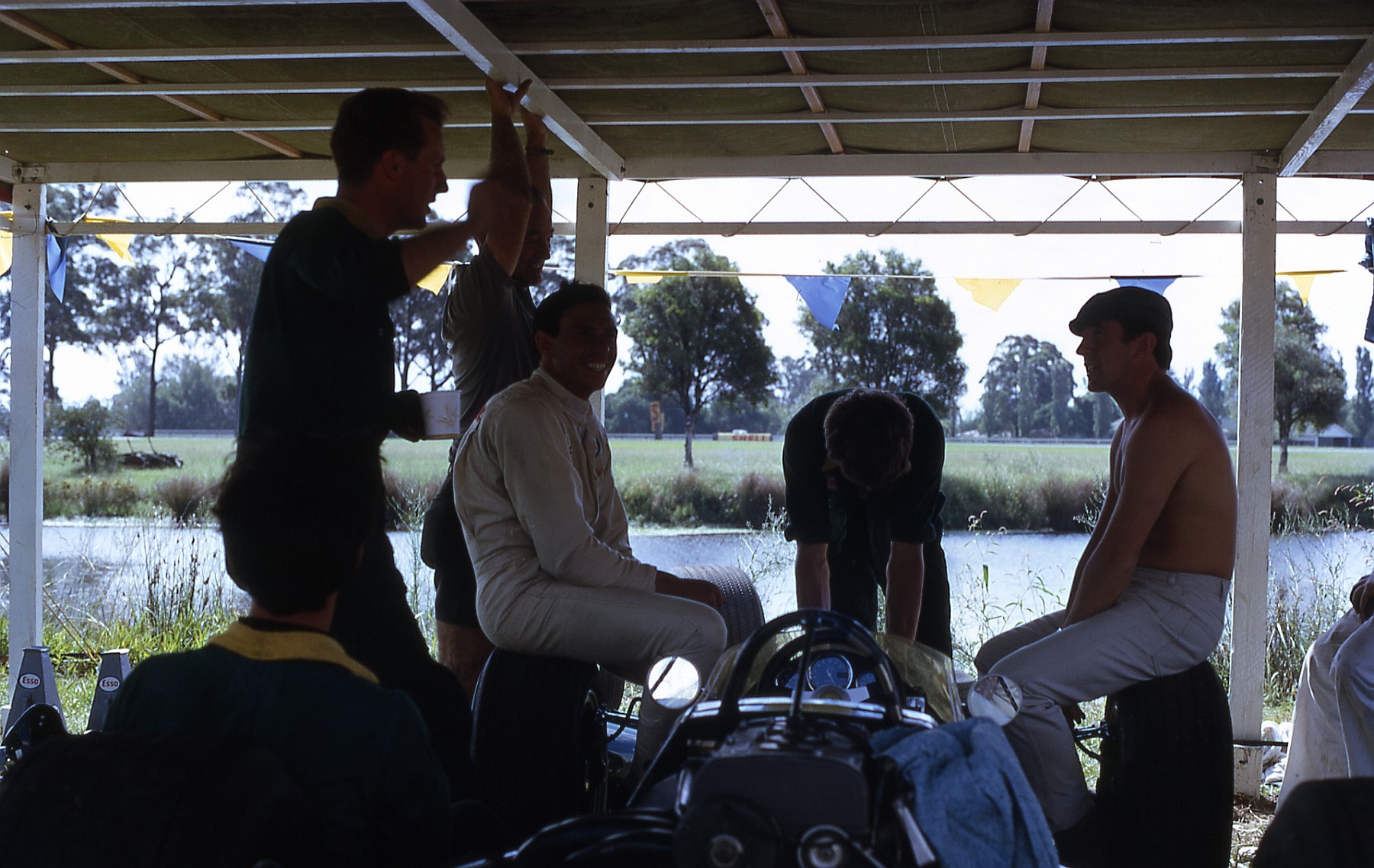
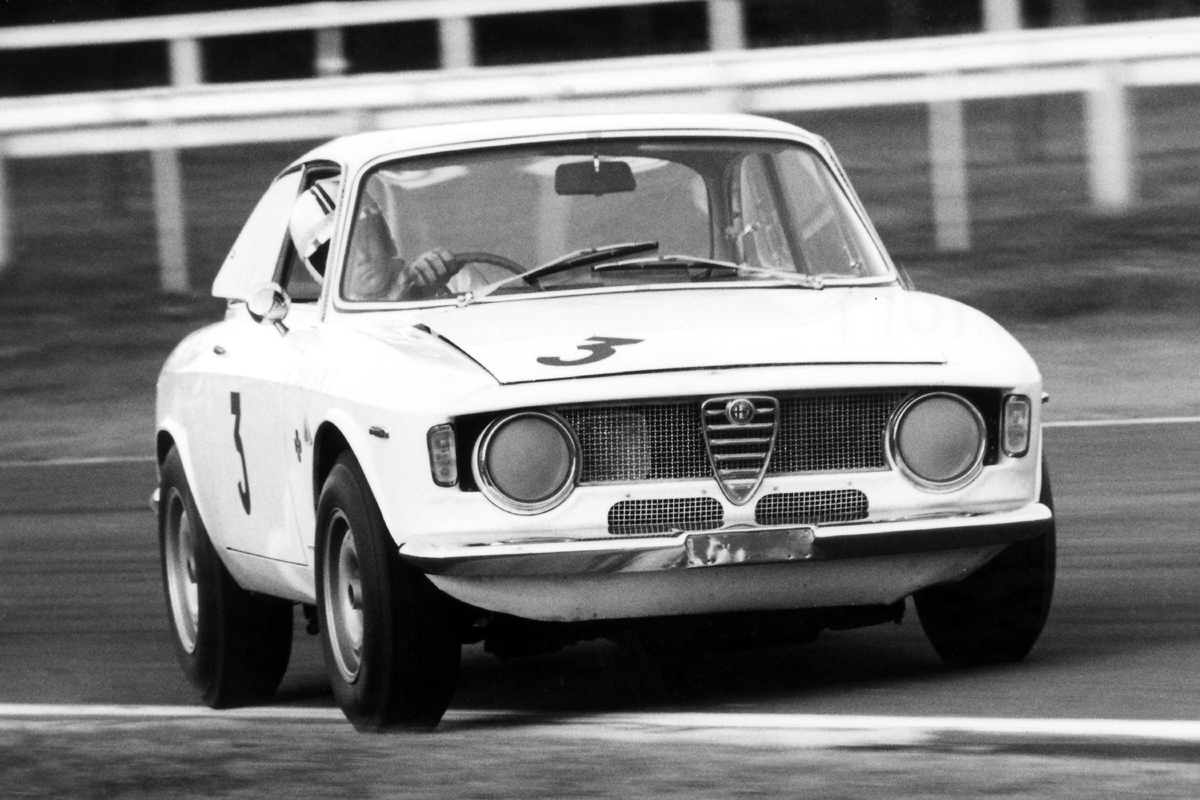
Captions from top: Jim Clark drifts the Gold Leaf Lotus 49 through the Warwick Farm Esses during practice for the 1968 International 100; Geoff takes Colin Piper’s new Suzuki for a quick spin around the Warwick Farm paddock; the Farm circuit changed not at all from Geoff’s original sketch; Jim Clark (left) and Jackie Stewart share a laugh.  The “chair” is Graham Hill’s new F2 Lotus 48, the background is the Causeway lake; Kevin Bartlett dances through Leger Corner in the Mildren Alfa; and (above), the AARC cloth badge

Photos: Paul Hobson, Colin Piper

It’s 1963 and the season’s under way…


Eagle-eyed readers may have noticed that the countdown widget on the right, entitled “Fifty Years Ago”, is actually keyed to an upcoming race that happened in 1963 – in this case the Lombank Trophy race at Snetterton on March 30.

The reason for this is twofold:  one, it’s 50 years since that amazing year when Jim Clark won 70 per cent of the F1 championship rounds to secure his first World Championship.  Along the way, he also finished second in the Indy 500, won numerous non-championship F1, sports, GT and touring car events and, together with Colin Chapman’s low-line, monocoque Lotus 25, changed the face of motor racing in general.

The second reason is because 1963 and 2013 share the same days – ie, February 15 was a Friday in both years.  Because of that, and because I’ve always been fascinated by how a driver like Clark managed to cram so much racing into such a tight schedule, I’m going to try to take us through Clark’s 1963 season as 2013 unfolds.  Thus the reference to Snetterton on March 30: it was Clark’s first race of the season.  We can think of it as we think of it now – as a Saturday in (hopefully!) the early British spring.

Let me begin, then, by bringing you up to speed:  the 1962 season ended with a classic showdown in East London, South Africa.  Jim and Graham Hill went into the December 29 finale knowing that only one could win – and the title went to Hill.  Jim was leading when a bolt worked loose.  The engine slowly lost its oil.  Jim, Colin and Hazel Chapman and the Team Lotus mechanics could only sit and watch from the pits as Graham cruised to victory.

There was little time, though, for post-mortems – not that they happened much in 1962.  For most drivers, a mechanical retirement was more likely than a reliable finish;  and, after a while, as Dan Gurney once said, you got used to the disappointments.  “It was just one of those things that happen in motor racing and it couldn’t be helped,” said Jim at the time.  “Graham had become World Champion deservedly.”

Jim returned immediately to the UK while many of his peers travelled on to New Zealand and Australia for the international series.  (Graham, as newly-crowned World Champion, was obliged to spend 12 hours in quarantine in Karachi due to a flight delay – he had no yellow fever inoculation – and then contracted tonsillitis in New Zealand.  He returned to England for an operation, leaving his Ferguson in the hands of Innes Ireland, and then flew back to Australia for the Feb 10 AGP at Warwick Farm.)  I’m not exactly clear why Jim didn’t compete in the Antipodies that January/February.  Team Lotus had given him a one-off drive in a Lotus 21 at Sandown Park, Victoria, in March, 1962, but didn’t enter the 1963 series in either New Zealand or Australia.  I suspect this was because Colin Chapman had decided to put a massive effort into the new Indianapolis 500 programme and had scheduled early-year tests for the new Lotus 29 in both in the UK and the USA.   The Ford-powered Indy car ran first at Snetterton in February, where it was set up with normal, symmetric suspension.  “To my mind, the engine we had in for that first test didn’t go too well, because the timing was a little out,” Jim told Alan Brinton.  “But though we were a trifle disappointed with the power, the car was certainly quicker on the straights than anything I’d driven before.  Even in this state the prototype comfortably broke my existing 2.5 litre lap record by a couple of seconds.”

Almost immediately afterwards, Jim flew to Ford’s high-speed proving ground in Kingman, Arizona, a circuit Jim described as “a beautiful track, about five miles around, with two banked curves each of about 1.25 miles.”  Dan Gurney, who had instigated the Lotus Indy programme, and who was to race a second Lotus 29 at Indy, was also present at the Kingman tests.  “We lapped at about 165 mph without using much of the banking,” recalled Jim.  “It was quite a change after the F1 Lotus and made for exciting driving.”

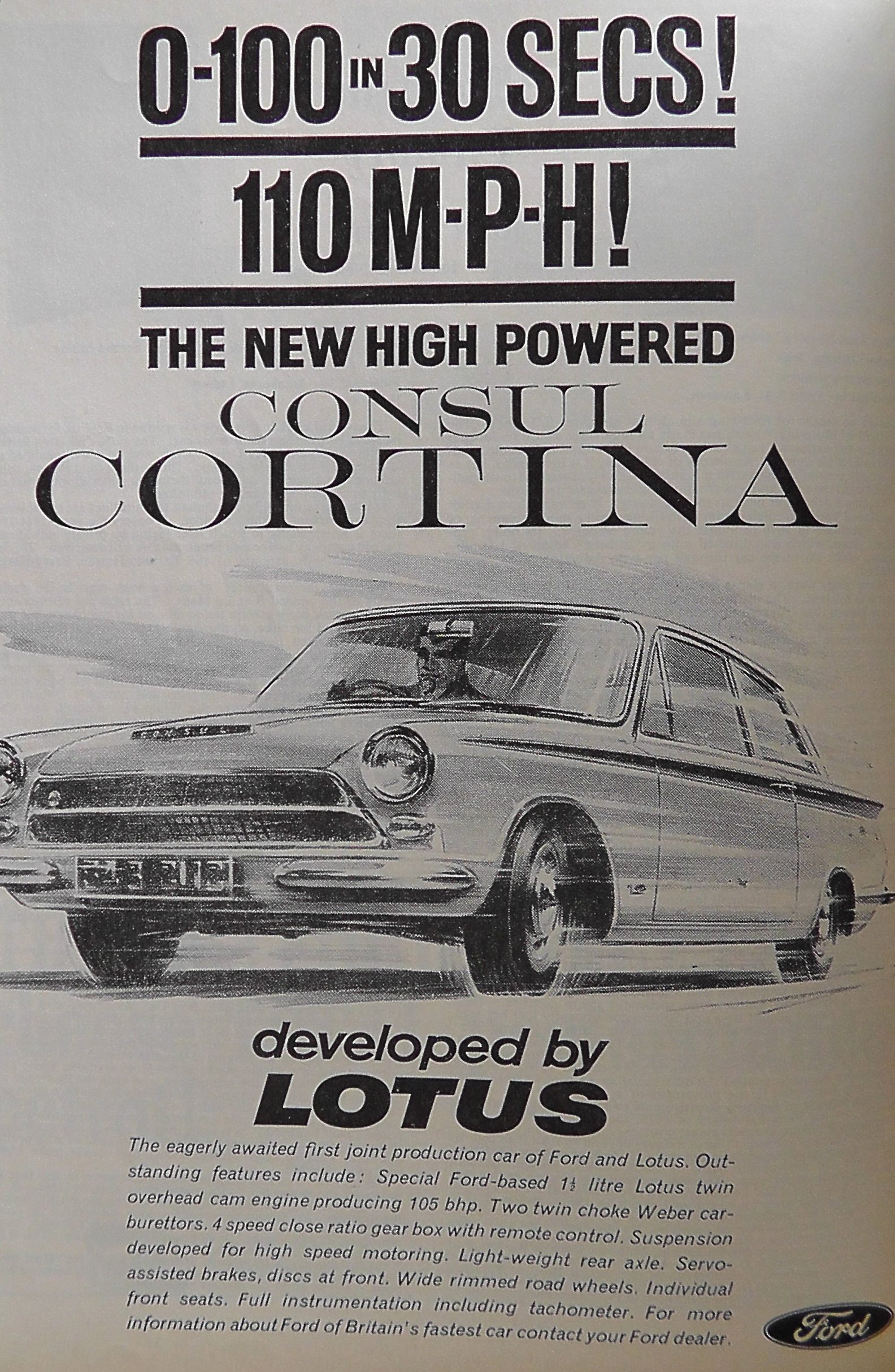
Those runs complete, Jim then returned to the UK – to Edington Mains, his farm on the Scottish Borders. 08-26-2010_53 He would move to a London base in 1964 but in 1963 his home was still in Scotland – and frequent were his road trips to and from the Lotus factory in Cheshunt.  The Lotus Elan had yet to be released so, for now, Jim was driving a prototype Lotus-Cortina.  “A number of development Lotus-Cortinas were built but when the model was announced in January, 1963, there was just the one vehicle built to the proper specification,” he wrote in Jim Clark at the Wheel.  “As it turned out, the Lotus-Cortinas were not raced until late in the season – but they proved to be worth waiting for.   I had already tried the Harry Mundy-inspired twin-cam engine in an Anglia in 1962 and I first drove a Cortina with a 140bhp version of the same engine in October, 1962.   It really surprised me and gave me just about as much of a thrill as the F1 car.  On the way to Snetterton for trials I thought the acceleration was out of this world for a family saloon but on the circuit for the first time I found the handling a bit odd.  That afternoon we had a good chuckle at Colin.  He decided to take the car round just after a short rain shower.  He left the pits and then suddenly there was silence.  We climbed into our cars and tore around the circuit to find Colin standing there, peering under the bonnet of the Cortina, muttering something about the engine cutting out.  I happened to notice some criss-cross tyre marks on the road behind him, so I sidled up to him, suggesting that perhaps an ignition lead had probably come loose when he had spun the car.  He turned bright red and admitted that he hadn’t been sure which had happened first!”

We’ll report next from the 50-lap, 133-mile non-championship F1 Lombank Trophy at Snetterton, where the entry includes two works BRMs for Graham Hill and Richie Ginther, a single Team Lotus entry for Jim Clark, Bruce McLaren in the works Cooper and two BRP Lotus 24s for Innes Ireland and Jim Hall (of future Chaparral fame).    I see also that Morris Nunn is entered in a Cooper;  it’ll be interesting to see how he gets on.  Graham Hill and Roy Salvadori head the Saloon Car field with their 3.8 Jaguars (although Sir John Whitmore should be spectacular in the works Mini-Cooper) and the new World Champion will be out again in the 25-lap Sports Car race, this time in the John Coombs Jaguar E-Type.  Can’t wait.

S2290002

Post Navigation