peterwindsor.com

…chance doesn't exist; there's always a cause and a reason for everything – Elahi

Archive for the tag “Ford”

“Very good! What can I say?”

While trolling through the YouTube library today I came across this recently-uploaded gem.  Thanks, straight way, to Patrick Pagnier for its discovery.  It’s a little cameo interview conducted for Swiss TV by Jo Bonnier on August 22, 1965.  Jo Siffert, fresh from his spectacular F1 win at Enna the previous Sunday, sits on Bonnier’s left while Jim Clark lies back in a replica of his Indy 500-winning Lotus 38-Ford prior to a “demonstration run” up the formidable Ste Ursanne-Les Rangiers hill-climb, south-west of Basle.  Jim never took these sorts of events half-heartedly, of course.  His early days in Scotland were filled with autotests and hill-climbs, and he climbed an F1 Lotus 21 (a difficult Filipinetti car) at Ollon-Villars in 1962 before returning to Switzerland again with the Indy car in ’65.  It seems amazing today that Jim would go along with the concept of threading the big four-cam, 500bhp Lotus Indy car up between the unprotected pine trees over three miles of semi-wet road, through very fast sweepers and unguarded hairpins, but such was the character of the man.  As he says in the interview, it was “different”.   For this event, Lotus converted the 38 back to symmetric suspension and fitted a five-speed ZF gearbox, so in this sense, too, there was more than a hint of seriousness about the performance.

Despite having no chance of outright victory, Jim was determined to put on a show for the vast crowds.  He completed six practice runs with the 38 on a dry-ish Saturday, the best of which was only four seconds slower than the much more suitable Rob Walker Brabham BT7-BRM of Jo Siffert, but his heart would have sunk on Sunday, when rain shrouded the mountains.  Still on its dry, Indy-spec Firestones, the 38 was virtually undriveable.  Even so, Clark gave it his all and finished the day – and the event as a whole – with a climb in 2min 36.9sec (or about 10sec slower than Siffert).  Words like “Wheelspin” and “opposite lock” don’t even begin to do justice to his performance.    Jim looks typically shy in this video and he shows his humility when Bonnier asks him about Siffert’s recent win at Enna.   “Very good!  What can I say?” replies Jim – although a driver of today’s times might then also have added “but then you have to remember that they dropped the flag early, I was caught in neutral, I drove up through the field, caught Seppi (Siffert) and only lost out because his BRM engine had more top end power than the Climax – particularly on lighter tanks.”  He said none of that, though.  Instead, as you can see, he just laughs.  (Mind you, Siffert also beat Jim in the 1964 Mediterranean GP at Enna, so Jim had an excuse to be non-plussed!)  Jo Bonnier, incidentally, also drove a Rob Walker Brabham (Climax) up the Ste Ursanne hill.  He finished fourth.

Enjoy then, this little chat.  Note the “Jim Clark” name across the 38’s number roundel in the first few seconds of the video and the boys in the background working on a lightweight Lotus Elan.

A Galaxie win for Clark

20791Monday, August 5, was a holiday in the UK in 1963, which meant that all eyes turned towards Brands Hatch for the Guards Trophy (as in Carreras Guards filter cigarettes).  This was a classic British international race meeting run by the British Racing and Sports Car Club (BRSCC) in front of a classically-large crowd. The feature race was for sports cars over 50 laps; support events were for saloon cars, smaller sports-racing cars and GT cars.  Consider that this meeting was staged exactly 24 hours after the German GP, and that the line-up of drivers at Brands included F1 stars like Jim Clark, Graham Hill, Lorenzo Bandini, Trevor Taylor, Innes Ireland and Tony Maggs, plus other names like Roy Salvadori Roger Penske, Jack Sears, Timmy Mayer, Paddy Hopkirk, Sir John Whitmore, Frank Gardner, Mike Salmon, David Piper, Lucien Bianchi, John Miles (the future Lotus F1 driver) and Ray Parsons, (Jim Clark’s part-time mechanic) and you have a picture of what motor racing in the 1960s was all about:  it was about the drivers – about star names having one-off races in interesting cars, regardless of their chances of winning.  Trevor Taylor, for instance, jumped from an F1 Lotus 25 at the Nurburgring into a Lotus Elite at Brands.  The World Champion, Graham Hill, swapped his works BRM for a Jaguar 3.8.  Le Mans winner, Lorenzo Bandini, went from his Centro Sud BRM to a big Ferrari 330LM.

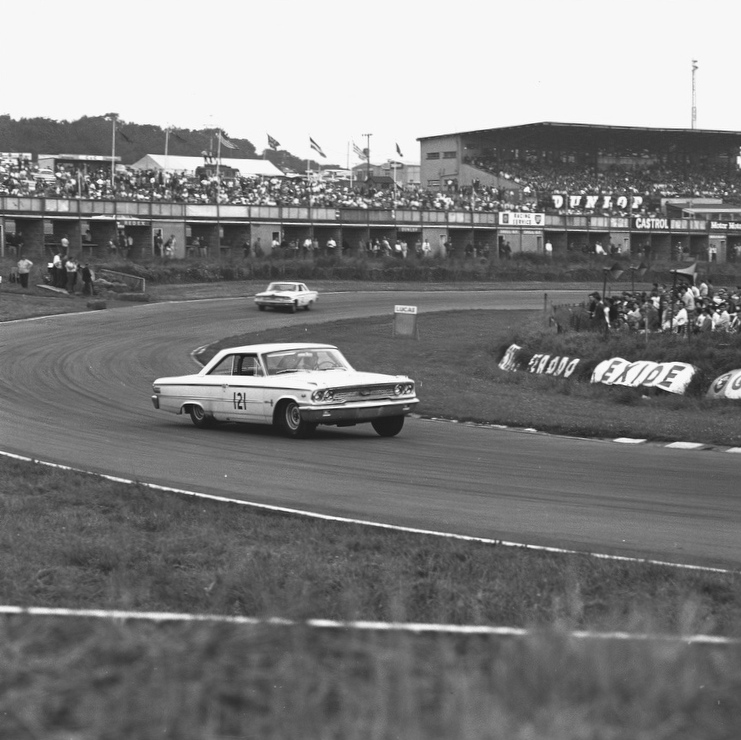
And Jim Clark, if you please, stepped from his Lotus 25 into…a Holman-Moody-prepared, Alan Brown-run, 7-litre Ford Galaxie.  20793Featuring lightweight panels, blueprinted V8 and stripped interior, this two-door “fastback” Galaxie was one of three Ford-commissioned, Holman and Moody-prepared cars to colour the British touring car scene in 1963. One Galaxie, owned by John Willment (who knew Holman and Moody well from his interests in marine engines) immediately won races in the skilful hands of Jack Sears;  the Alan Brown car was effectively a “guest” Galaxie, driven by Dan Gurney, Jack Brabham and, at Brands, Jim Clark; and Sir Gawaine Bailey, the very rapid baronet, owned and drove the third car.  Lee Holman, son of John, was 18 when, in early 1963, he was asked to drive the Alan Brown Galaxie from the H-M headquarters in Charlotte, North Carolina, to the port of New York.  “We put some Brillo pads up the exhaust to try to dampen the sound,” remembers Lee, “but the biggest help were the $100 bills I took with me to pay off the traffic cops!  One of them stopped me somewhere in Virginia so I showed him the paperwork about the car being owned by the Ford Motor Company and being shipped to the UK for racing and he was so impressed that he let me go…”
It’s hard to picture it, now – Jim, Graham, Trevor, Tony Maggs, Lorenzo and Innes all rushing back to England to race their widely-different cars at this Brands International.  Jim wasn’t even in the big race!  Instead, he could relax down at the lower end of the paddock with Alan Brown and the mechanics, settle himself into the Galaxie’s spacious, padded “bucket” seat and apply some of the intel he’d been given by Dan. The left-hand-drive Galaxie had a “four-speed, on-the-floor (L-shaped) shifter”, a lap seat belt only, a deeply-dished plastic steering wheel and a lateral (ie, not longitudinally-braced) roll-bar.  Driving it was all about taming the power – ie, minimising the wheelspin and the oversteer….and allowing for brake fade.20787
Why was Jim racing that Monday in a car he’d never even tested?  As much as Jim loved to drive nimble sports cars on the road like the Lotus Elite, Lotus Elan and Porsche 356 he was also amused by the concept of big, comfortable American “slushmobiles” like the Galaxie.  And controlling the Galaxie on a race track appealed to Jim’s sense of curiosity.  Ask one of the current F1 drivers to compete in a Porsche Supercup race and their initial response – even before they considered the complication of contracts – would be to ensure that their image was not dented by the likes of a Sean Edwards; Jim had no such qualms.  He was intrigued by the concept of racing the Galaxie; he liked the Ford connection, in view of his plans to race more extensively in the US; he liked the Holman and Moody people, who were at that point doing great things with the Falcon Sprint rally cars in Europe; and he wasn’t afraid of being beaten by an ace like Jack Sears:  this was but a part of motor racing.

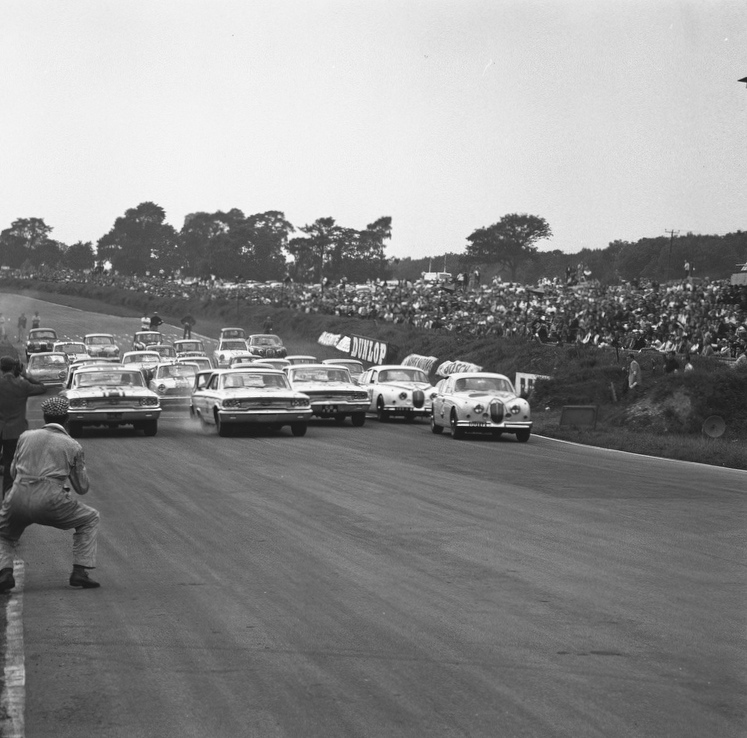
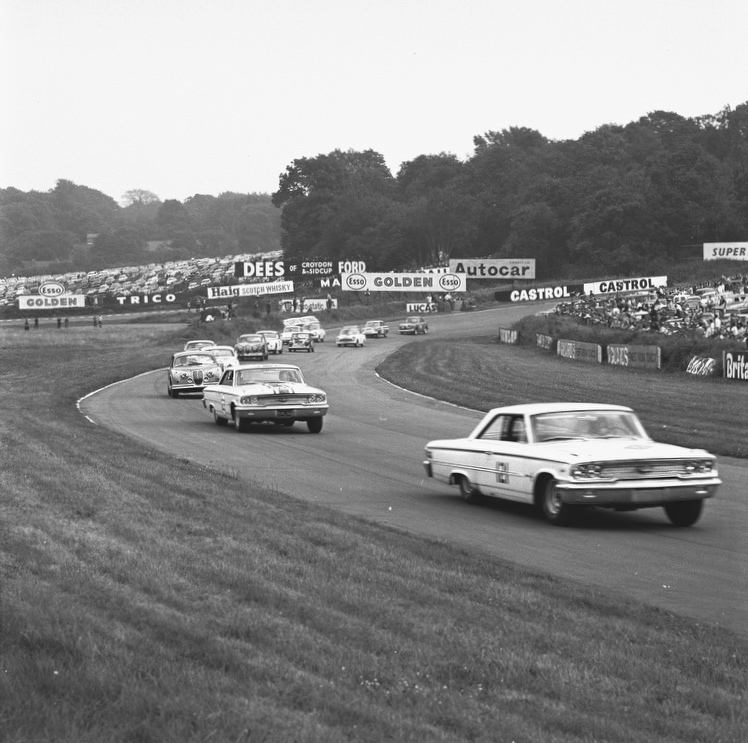
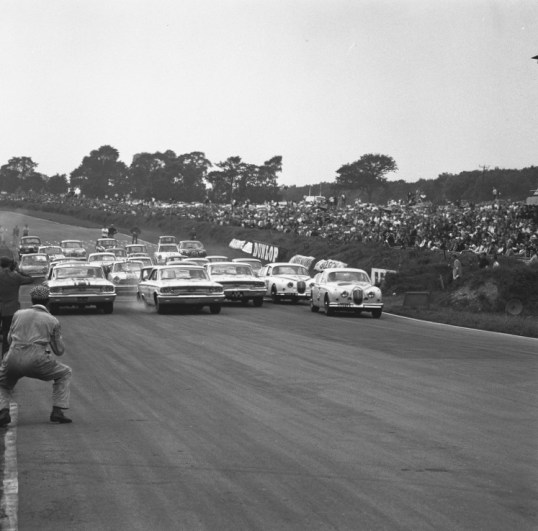
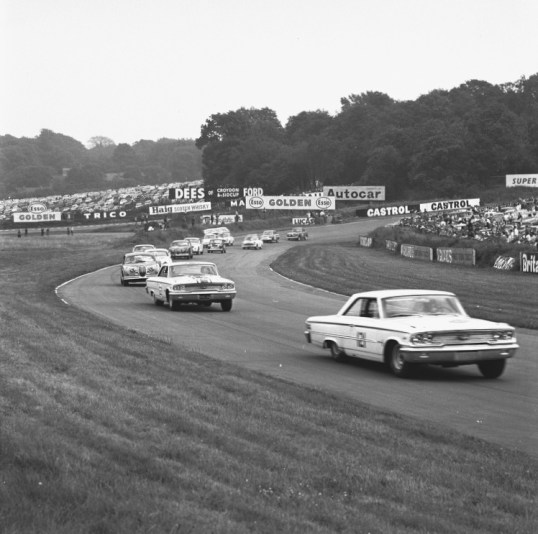
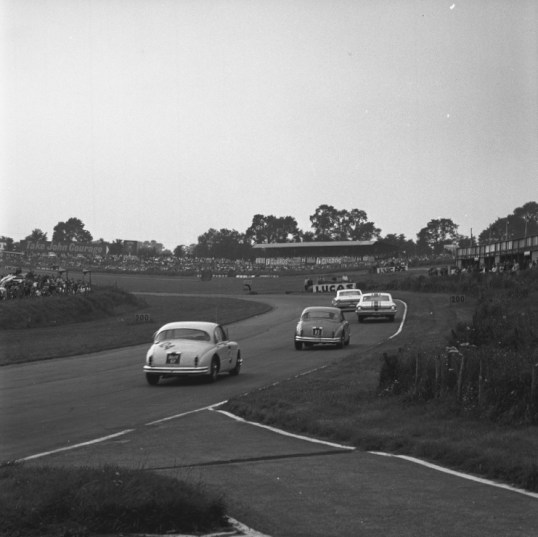
As it happened, Jim qualified second to Jack but seized the lead into Paddock Bend:  Jack’s start, on the lower side of the track, had suffered from the usual Brands Hatch wheelspin. Jim held the inside line up the hill into Druids, won the mid-corner barging match at the hairpin and headed the field into Bottom Bend, his right rear Firestone picking up the dirt as he power-slid the big Galaxie onto Bottom Straight. 20747Jack Sears had won on all types of circuit (from Silverstone to Crystal Palace) with the Willment Galaxie and was not about to fall away; it was Jim Clark, though, who emerged from the back of the circuit still in the lead.  One can hear the voice of Anthony Marsh now, as the lumbering V8s teetered into  Clearways:

“And it’s Jim Clark in front!  Clark leads from Sears and then come the three Jaguars – Graham Hill in the Coombs car, Roy Salvadori, Mike Salmon, who banged into Sir Gawaine Baillie’s slow-starting Galaxie off the line…”

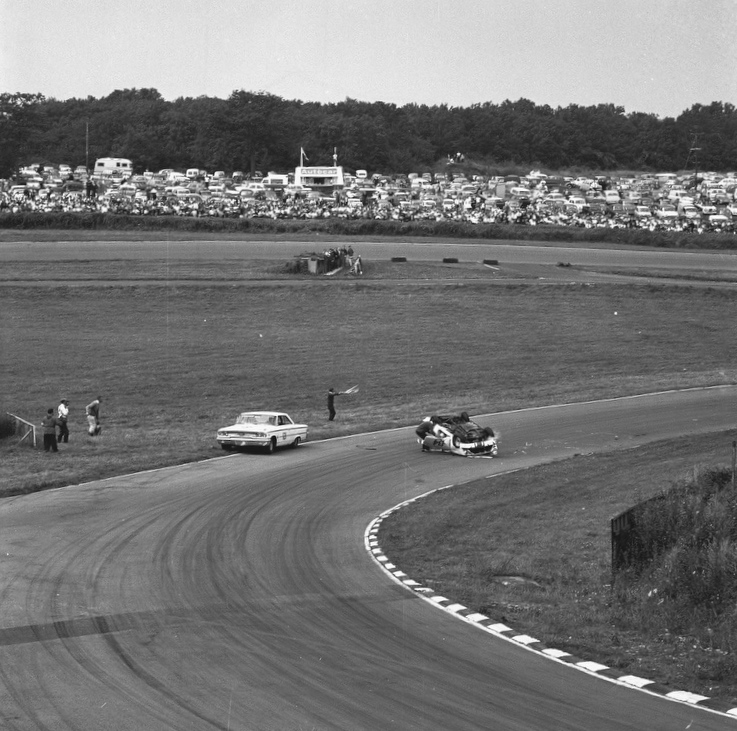
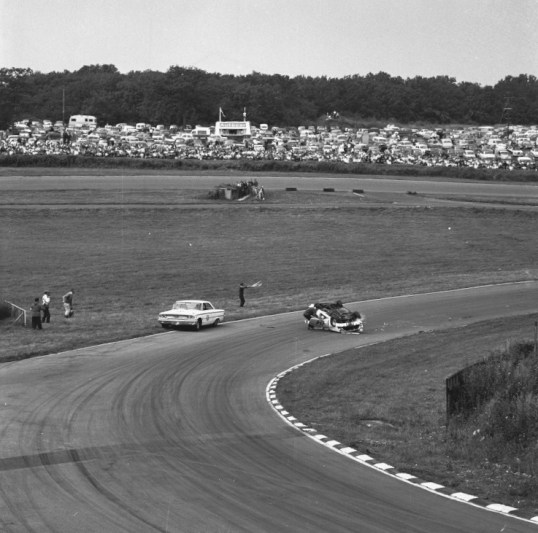
Jack, for once, ran into trouble – a punctured Firestone, to be precise.  Jim was left to win from F1 arch-rival Hill – but not without incident.  David Haynes demolished his Cortina GT on Bottom Straight right in front of Paddy Hopkirk’s Mini.  Paddy took major avoiding action on the grass – but Jim, too, was forced to put two wheels out there on the turf to miss the melee.  Fortunately, Haynes escaped uninjured.20743
So Jim won the 20-lap Slip Molyslip Trophy for B-class Group 2 saloon cars. The race was considered at the time to be so minor that no pictures at all were published in Autosport of the F1 Championship leader in the Galaxie.  Instead, the headlines went to Roger Penske, who won the Guards Trophy with his Zerex Special (basically a Cooper-Climax F1 car with bodywork). Frank Gardner’s Brabham beat the Lotus 23s in the sports car event; Bob Olthoff, who on August 18 would, with Jack Sears, win a 12-hour race in Washington, USA, in a Willment Cortina GT, took the up-to-3-litre class of Jim’s race; and Sir John Whitmore again reigned supreme in his Mini-Cooper. (Sir John would also win the GT race with his Stirling Moss special-bodied Elan.)  Balfour Place was thus heaving that Monday night – particularly as Cleopatra was on the agenda for Jim and Sally.  Jim would head over to Cheshunt on Tuesday to see Andrew Ferguson (to sort out some accounts!) – and they would leave on Wednesday for Sweden, where Jim was due to race in the non-championship F1 event at Karlskoga, near Orebro, west of Stockholm. Jim had had the pole there in 1961 but had retired from the race with that old Lotus foible – broken front suspension. Here was a chance to redress the balance.

Also eagerly awaiting the appearance of F1 stars on his home track was an Orebro 19-year-old who had over the past 18 months been winning a string of kart races.  His name was Ronnie Peterson.

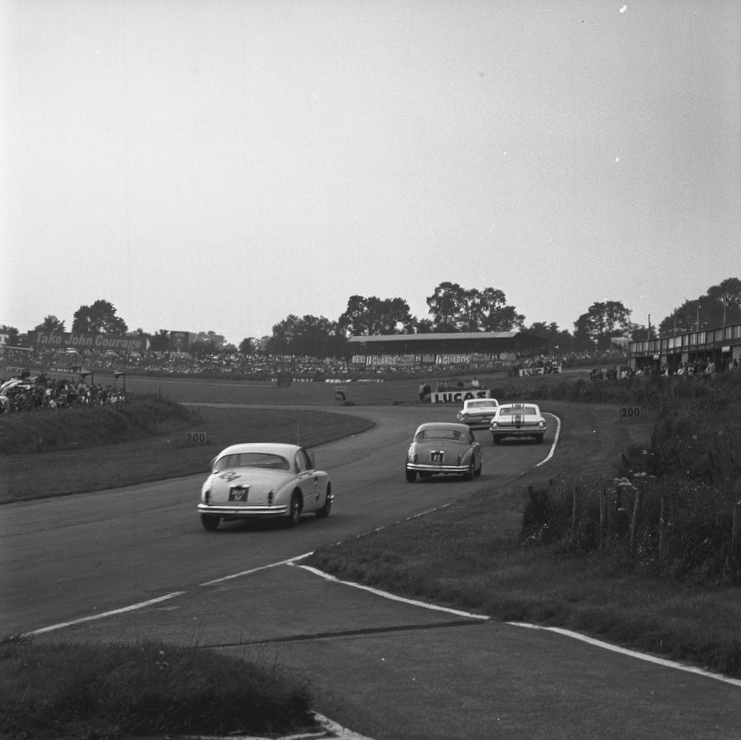
Captions, from top: Jack Sears sits on the pole with rear wheels spinning while Jim (middle of the front row) smokes away from the line.  On the right, Graham Hill is up-and-running in John Coombs’ 3.8 Jaguar;  lap one, and Jim leads Jack Sears along Bottom Straight. Amongst the Jags, Roy Salvadori has passed Graham…; rear view of the opening lap battle.  Characteristically, Jim has already begun an early, small, initial turn towards South Bank Bend (with brakes yet to be applied).  Jack, more traditionally, is beginning to brake to a wider turn-in point; within a couple of laps, Jim had begun to put a little air between his Alan Brown Galaxie and Jack’s Willment car.  Here, on the entrance to the uphill South Bank Corner, he balances an oversteer slide; Jim takes to the grass to avoid what remains of David Haynes’ Cortina GT. Images: LAT Photographic

Indy: Second Row for rookie Jim Clark

moremsportshistorySilverstone and that dramatic escape behind him, Jim Clark returned to the cauldron they call Indianapolis, this time residing at the Speedway Motel.  He and Dan Gurney were ready to roll on Monday morning – and to apply, therefore, the finishing touches to their all-important qualifying attempts.  If they didn’t make it on this first weekend there would be no Monaco Grand Prix.  It was as simple as that.  And if there was no Monaco Grand Prix, Jim Clark’s 1963 F1 season was going to become unnecessarily tough.  After losing the title in 1962 by a single point, and now having won Pau, Imola and Silverstone in quick succession, he was keen to keep the momentum going.

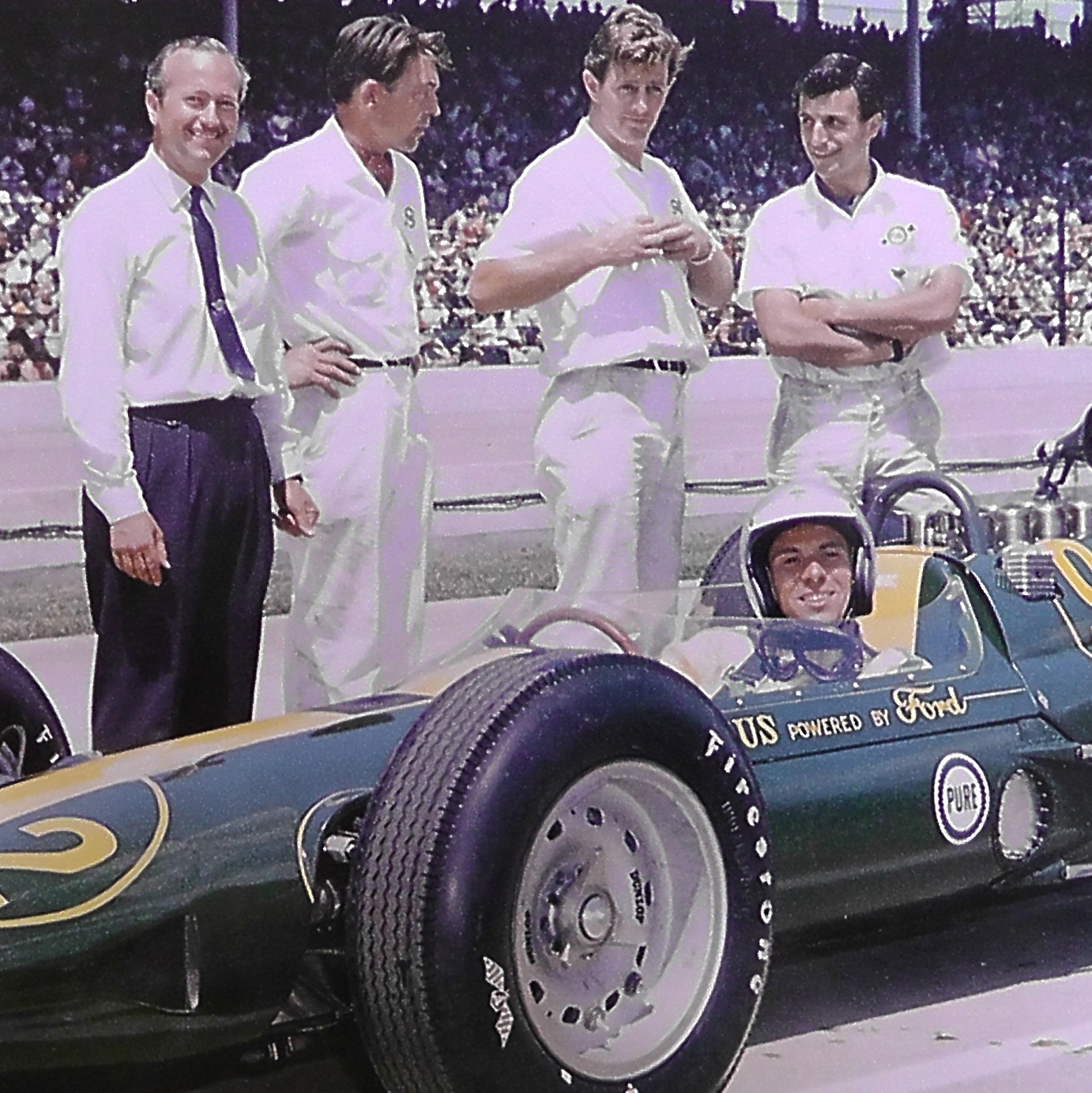
Jim was delighted to find that Hinchman and Bell were true to their word.  His brand new overalls were, he thought, a little on the gaudy side – but this was Indy; and the race suit, critically, met all the USAC regulations for flame resistance.  Hinchman didn’t seem to be in the business of two-piece suits (of the Dunlop type to which Jim was now accustomed), so this one-piece overall featured a neat little belt with a silver clip-buckle.  Once he’d decided that regular shirts and pullovers were a little too casual, Jim had never worn anything but blue Dunlop overalls – first in one-piece form and, since 1962, with a separate topped tucked into the leggings.  Now, as he tried on the Hinchmans for the first time, he saw in the mirror a completely different person.  The shiny overalls were a base primrose-yellow with mid-blue stripes down the arms, pin-striped in red.  There seemed to be no logic to the colours but he liked them all the same.  His name was embroidered at an angle below the left chest zip pocked and on the right side was a Pure logo.  Jim shrugged and packed the suit into his Leston bag.  He’d wear it in the car but, between runs, he would change quickly back into his sea-island cotton polo and slacks or perhaps his shirt and tie.  He also found a new Pure jacket waiting for him in his hotel room.  He liked it.  It was dark blue – his colour – with blue and white cuffs and collar.   Very Border Reivers.  And the Pure badge was neat and tidy.  Without even thinking about the implications for Esso, he decided then that this jacket would not only be useful at Indy but also in Europe.images

The new Bell Magnum felt only slightly heavier than his Everoak but was considerably thicker all over.  A neat white peak was clipped into place by four big studs – a significant improvement over the strap/stud arrangement that had caused so much trouble at Spa the year before, when the peak on his Everoak had been blown loose by the rush of air at high speed.  Problem was, the Bell was finished in plain silver.  Jim wanted to wear it right away, enabling him to get used to it in the build-up to qualifying.  In the meantime he would see if Bell could prepare another Magnum in dark blue.  It wouldn’t be ready for qualifying but he’d be able to take it back with him to Europe to use at Monaco.

Jim was amazed by the size of the crowd at the Speedway that Monday – and in the days that followed.  More and more, he seemed to be in demand.  Whenever he was in a public area they jumped on him for autographs and in Gasoline Alley the media were all over him.  For the perspective of a fan at the time (albeit 1966), read Don Fitzpatrick’s comment associated with our 1963 Silverstone International Trophy report.

There was a shortage of Halibrand wheels at Indy – itself a function of the trend-setting 15in Firestones being run on the Lotus 29s;  Dan, not completely comfortable with his set-up, spun his blue-and-white car into the wall; and the wind gusted up as Jim’s qualifying run approached:  it was tense and it was time to go to work.

Jim described his qualifying run thus:

“On the day of qualifying there was a fair-sized wind blowing at Indianapolis.  I knew I wouldn’t get another opportunity, and, though quite a number of cars had been out and had failed to qualify because of the conditions, I had to make a real effort.

“It was a tense time, with the wind blowing in 35mph gusts and the car was very twitchy indeed.  Three hours previously I had been going around pretty steadily at about 151.5 mph, and Colin timed one lap at 153 mph;  but these speeds were not possible when I went out for the official trials.

“Dan’s practice crash had caused some embarrassment, because he wrote-off two of the wide-rimmed wheels I was due to use on my car for qualifying.  So I did my qualifying with none of the rims matching – two wide ones on the outside wheels and narrow ones on the inside.

“Anyway, after a few minutes of gritting my teeth and fighting the wind gusts, I eventually managed to qualify at 149.750 mph, which put me in the middle of the second row.tumblr_m1lr6nfOXQ1r53nlzo1_500  You know, it’s amazing what a difference the track temperature and air temperature make to lap speeds at Indianapolis.  I went out one day and couldn’t do anything better than 148 mph.  Colin was trying to sort out the reason, and though he did everything he knew, the car just couldn’t be got round any quicker.  We realized later that the speed was being cut by the heat, and we also realized that at that time all the other drivers had parked their cars away and weren’t troubling to go out.  Local knowledge does help!

“The technique for the lap was relatively straightforward:  I dabbed the brakes going into each turn and had to smack them pretty hard when I had a full load of fuel aboard.  The difficulties about Indianapolis are the lack of distinguishing features around the circuit and the fact that there is no apex on the four turns.”

Jim had made it – and so, in the spare Lotus 29, painted in Jim’s green and yellow colours, had Dan.  They could relax.  And they could begin the rushed trip, with Colin, back to Europe.  Practice for the Monaco Grand Prix would begin on Thursday, May 23.S2530001

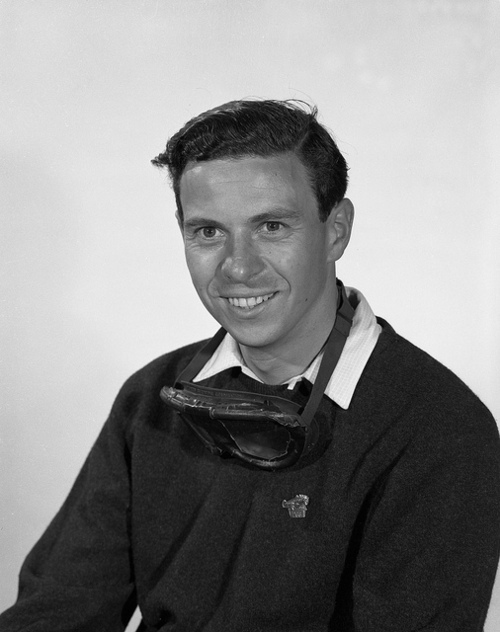
Captions from top: Jim, wearing new Hinchmans, in nail-biting mood as he listens to the pre-qualifying drivers’ briefing and draw; Middle: Jim loved the blue-and-white Pure jackets that came with the American oil company’s Indy sponsorship (via its Ford connections).  He wears it here over his Esso-badged blue Dunlops!; Above right: the official Indianapolis portrait of Jim Clark; Above: Jim, in the new silver Bell Magnum, after qualifying the Lotus 29 on the second row.  Around him, from left to right, are Colin Chapman, Jim Endruweit, David Lazenby and Colin Riley 

Pictures: Indianapolis Motor Speedway; Peter Windsor Collection; LAT Photographic

It’s 1963 and the season’s under way…


Eagle-eyed readers may have noticed that the countdown widget on the right, entitled “Fifty Years Ago”, is actually keyed to an upcoming race that happened in 1963 – in this case the Lombank Trophy race at Snetterton on March 30.

The reason for this is twofold:  one, it’s 50 years since that amazing year when Jim Clark won 70 per cent of the F1 championship rounds to secure his first World Championship.  Along the way, he also finished second in the Indy 500, won numerous non-championship F1, sports, GT and touring car events and, together with Colin Chapman’s low-line, monocoque Lotus 25, changed the face of motor racing in general.

The second reason is because 1963 and 2013 share the same days – ie, February 15 was a Friday in both years.  Because of that, and because I’ve always been fascinated by how a driver like Clark managed to cram so much racing into such a tight schedule, I’m going to try to take us through Clark’s 1963 season as 2013 unfolds.  Thus the reference to Snetterton on March 30: it was Clark’s first race of the season.  We can think of it as we think of it now – as a Saturday in (hopefully!) the early British spring.

Let me begin, then, by bringing you up to speed:  the 1962 season ended with a classic showdown in East London, South Africa.  Jim and Graham Hill went into the December 29 finale knowing that only one could win – and the title went to Hill.  Jim was leading when a bolt worked loose.  The engine slowly lost its oil.  Jim, Colin and Hazel Chapman and the Team Lotus mechanics could only sit and watch from the pits as Graham cruised to victory.

There was little time, though, for post-mortems – not that they happened much in 1962.  For most drivers, a mechanical retirement was more likely than a reliable finish;  and, after a while, as Dan Gurney once said, you got used to the disappointments.  “It was just one of those things that happen in motor racing and it couldn’t be helped,” said Jim at the time.  “Graham had become World Champion deservedly.”

Jim returned immediately to the UK while many of his peers travelled on to New Zealand and Australia for the international series.  (Graham, as newly-crowned World Champion, was obliged to spend 12 hours in quarantine in Karachi due to a flight delay – he had no yellow fever inoculation – and then contracted tonsillitis in New Zealand.  He returned to England for an operation, leaving his Ferguson in the hands of Innes Ireland, and then flew back to Australia for the Feb 10 AGP at Warwick Farm.)  I’m not exactly clear why Jim didn’t compete in the Antipodies that January/February.  Team Lotus had given him a one-off drive in a Lotus 21 at Sandown Park, Victoria, in March, 1962, but didn’t enter the 1963 series in either New Zealand or Australia.  I suspect this was because Colin Chapman had decided to put a massive effort into the new Indianapolis 500 programme and had scheduled early-year tests for the new Lotus 29 in both in the UK and the USA.   The Ford-powered Indy car ran first at Snetterton in February, where it was set up with normal, symmetric suspension.  “To my mind, the engine we had in for that first test didn’t go too well, because the timing was a little out,” Jim told Alan Brinton.  “But though we were a trifle disappointed with the power, the car was certainly quicker on the straights than anything I’d driven before.  Even in this state the prototype comfortably broke my existing 2.5 litre lap record by a couple of seconds.”

Almost immediately afterwards, Jim flew to Ford’s high-speed proving ground in Kingman, Arizona, a circuit Jim described as “a beautiful track, about five miles around, with two banked curves each of about 1.25 miles.”  Dan Gurney, who had instigated the Lotus Indy programme, and who was to race a second Lotus 29 at Indy, was also present at the Kingman tests.  “We lapped at about 165 mph without using much of the banking,” recalled Jim.  “It was quite a change after the F1 Lotus and made for exciting driving.”

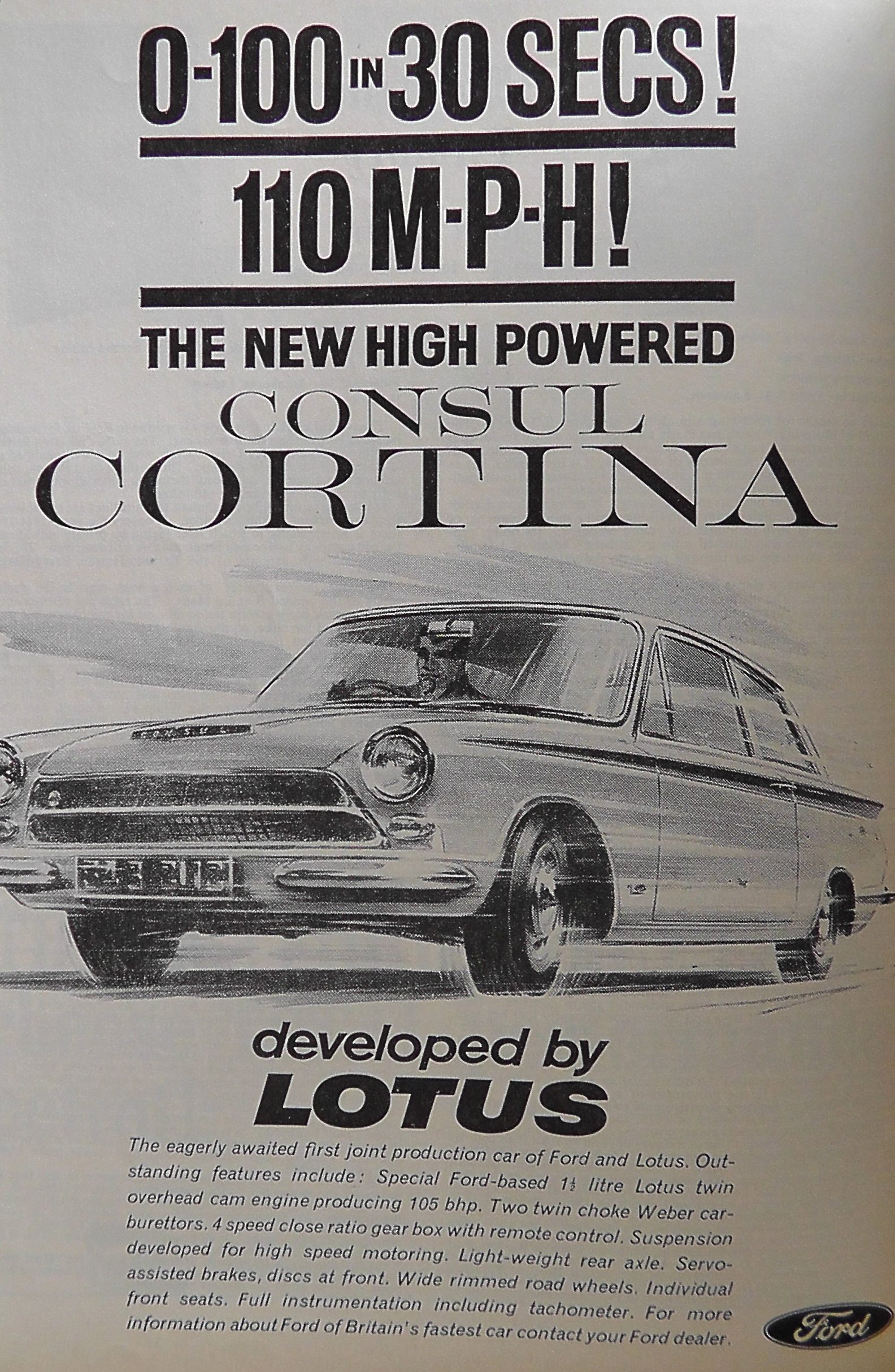
Those runs complete, Jim then returned to the UK – to Edington Mains, his farm on the Scottish Borders. 08-26-2010_53 He would move to a London base in 1964 but in 1963 his home was still in Scotland – and frequent were his road trips to and from the Lotus factory in Cheshunt.  The Lotus Elan had yet to be released so, for now, Jim was driving a prototype Lotus-Cortina.  “A number of development Lotus-Cortinas were built but when the model was announced in January, 1963, there was just the one vehicle built to the proper specification,” he wrote in Jim Clark at the Wheel.  “As it turned out, the Lotus-Cortinas were not raced until late in the season – but they proved to be worth waiting for.   I had already tried the Harry Mundy-inspired twin-cam engine in an Anglia in 1962 and I first drove a Cortina with a 140bhp version of the same engine in October, 1962.   It really surprised me and gave me just about as much of a thrill as the F1 car.  On the way to Snetterton for trials I thought the acceleration was out of this world for a family saloon but on the circuit for the first time I found the handling a bit odd.  That afternoon we had a good chuckle at Colin.  He decided to take the car round just after a short rain shower.  He left the pits and then suddenly there was silence.  We climbed into our cars and tore around the circuit to find Colin standing there, peering under the bonnet of the Cortina, muttering something about the engine cutting out.  I happened to notice some criss-cross tyre marks on the road behind him, so I sidled up to him, suggesting that perhaps an ignition lead had probably come loose when he had spun the car.  He turned bright red and admitted that he hadn’t been sure which had happened first!”

We’ll report next from the 50-lap, 133-mile non-championship F1 Lombank Trophy at Snetterton, where the entry includes two works BRMs for Graham Hill and Richie Ginther, a single Team Lotus entry for Jim Clark, Bruce McLaren in the works Cooper and two BRP Lotus 24s for Innes Ireland and Jim Hall (of future Chaparral fame).    I see also that Morris Nunn is entered in a Cooper;  it’ll be interesting to see how he gets on.  Graham Hill and Roy Salvadori head the Saloon Car field with their 3.8 Jaguars (although Sir John Whitmore should be spectacular in the works Mini-Cooper) and the new World Champion will be out again in the 25-lap Sports Car race, this time in the John Coombs Jaguar E-Type.  Can’t wait.

S2290002

Lunch with Sir John

I lunched yesterday with Sir John Whitmore, PhD – a phenomenal racing driver from the mid-sixties and today an acclaimed lecturer and best-selling author.  Sir John was famous for his drives for Alan Mann (mostly in Lotus Cortinas) but he was also a Shelby Cobra man extraordinaire.  His drive in the 1965 Tourist Trophy at Oulton Park with the Alan Mann Shelby Cobra Roadster – and particularly his four-wheel-drifts through Old Hall – live in the annals of time.

For a leaking exhaust had left Sir John weak and nauseated after the first heat of that TT in early May.  He spent the two-hour interval breathing through an oxygen mask.  Emerging from the medical room (there were no “Centres” in those days!) John was greeted by these words from Alan Mann:  “John.  You’re going to win the GT class.  I’ve studied your lap times from the first heat.  If you hadn’t stopped for tyres and fuel you would have won it.  And that’s what we’re going to do now.  I’ve calculated that if you’re careful enough with the fuel and tyres, but still quick enough, you’ll run out of fuel on the last lap…” John didn’t want to drive;  he still hadn’t fully recovered.  He trusted Mann completely, though: and so he climbed into the left-hand seat of that Cobra and raced it with such touch and feel that he was able to run non-stop, just as Mann had predicted.  In the pits, Mann faked a countdown to a pit stop that would never happen:  “L10…..L5…..L1…..IN….”. John stayed out.  He was having difficulty breathing;  his vision was fading; but he crossed the line to win the GT class and to finish fourth overall behind the pure racing machinery driven by Denny Hulme (Sid Taylor Brabham BT8), a brilliant David Hobbs (Harold Young Lola T70) and David Piper (Ferrari 250LM).  And Mann had been perfect in his predictions:  the Cobra ran out of fuel on the slow-down lap and its tyres were worn to the canvas.

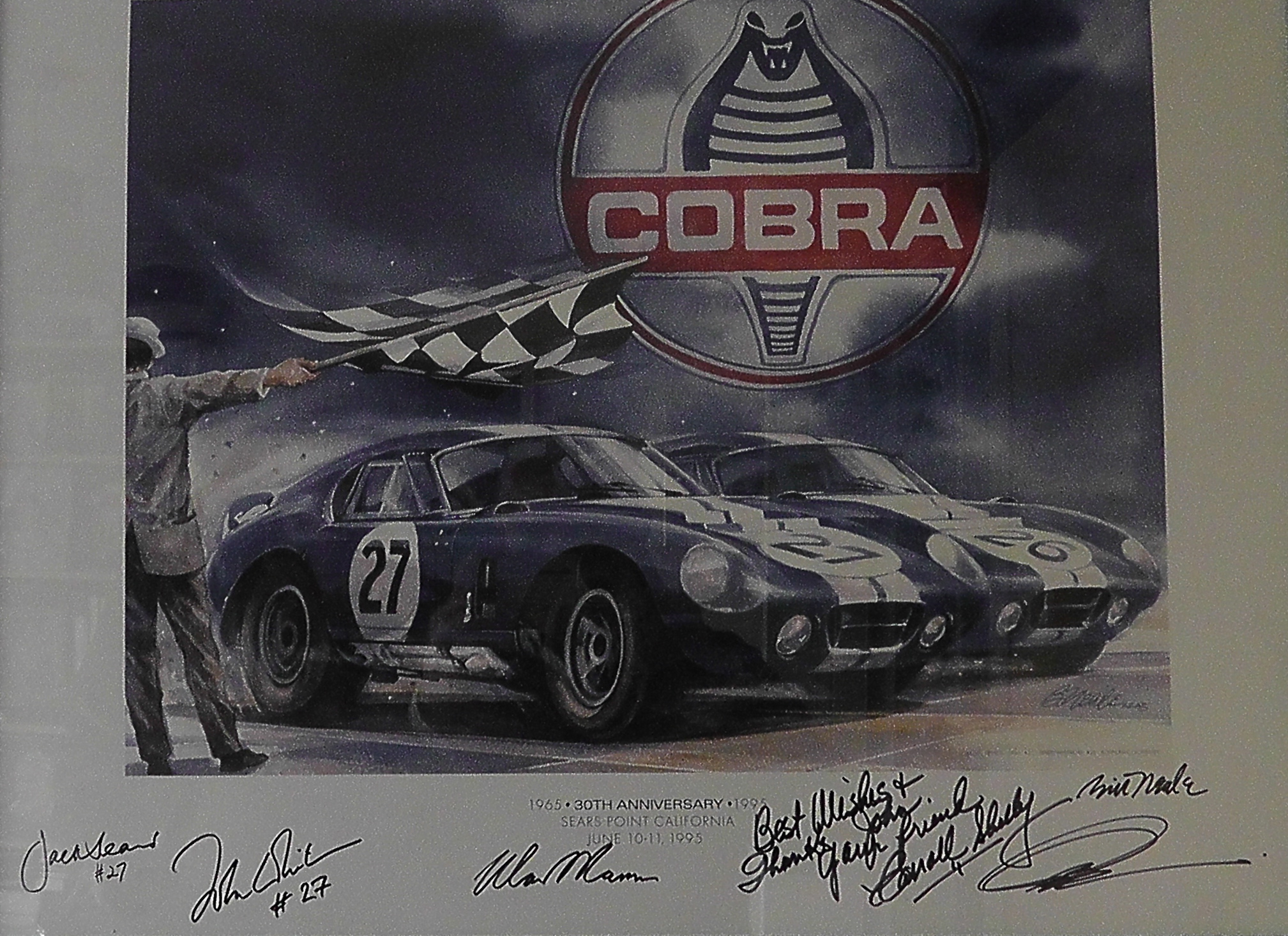
“That was the race of my life,” said Sir John yesterday.  “If I have to look back at a day on which I was able to do something remotely heroic, this was it…” We talked about the recent passings of both Alan Mann and Carroll Shelby.  And this framed picture on his office wall caught my eye.  It is signed by Sir John’s colleague and friend, Jack Sears;  by Sir John and Alan Mann; by the artist, Bill Neale (far right); and by Carroll Shelby.  The inscription from Carroll reads: “Best Wishes and thanks, John.  Your friend, Carroll Shelby”.

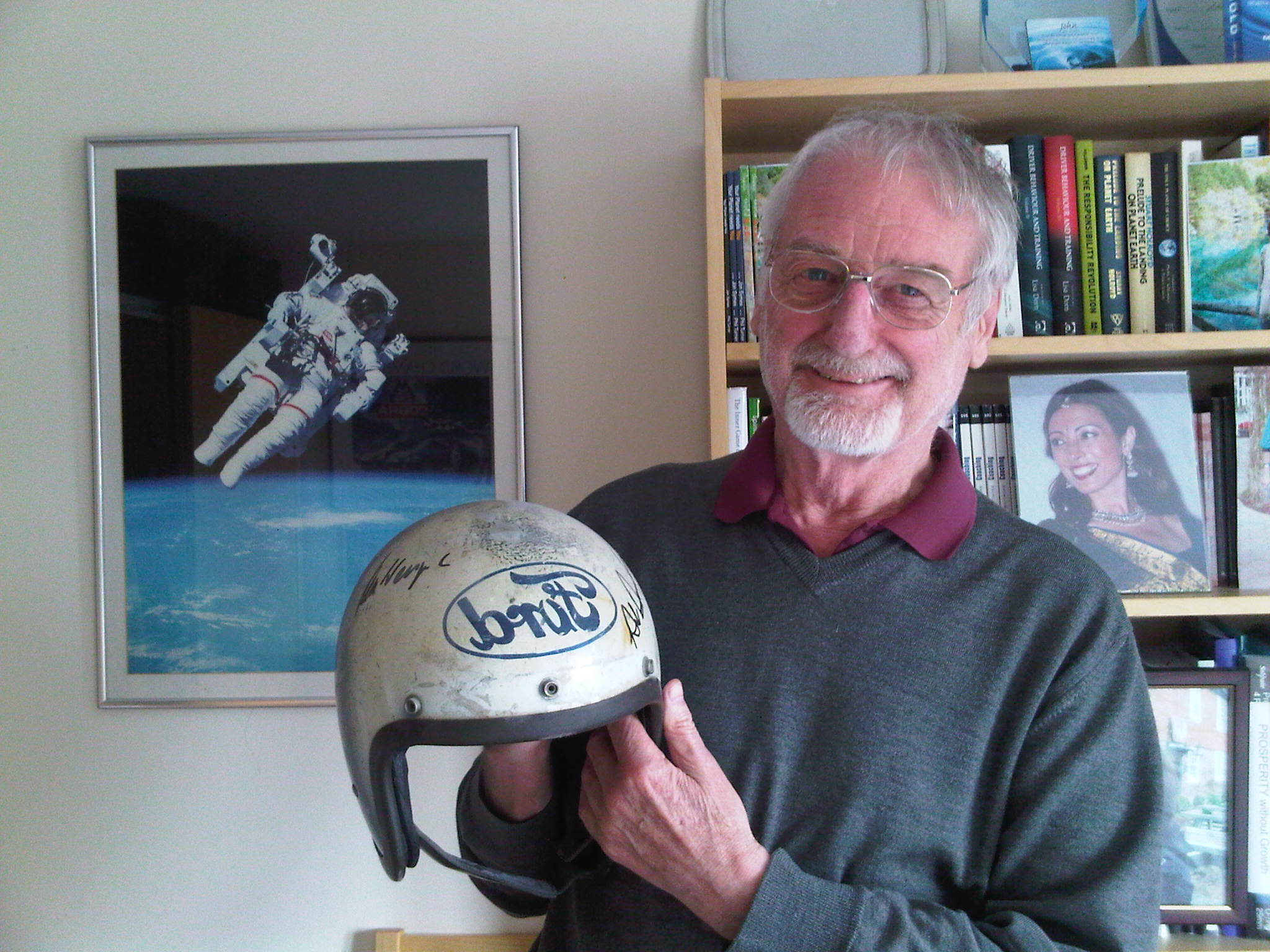
Sir John also showed me the helmet (below) he wore at the Targa Florio in 1965, when he drove an open (Alan Mann) Ford GT40.  Unusually, the Bell Magnum carried a reversed Ford logo.  “Why?” I asked. “Ah.  That was an idea of a friend I met in California called Kenny Howard,” replied Sir John.  “He thought it would be fun for the drivers I was about to pass to see what sort of car I was driving!  He was an artist – a wonderful guy who worked in Bud Ekins’ motor-cycle shop.  I met him through Steve McQueen because Bud did the stunts in the Mustang featured in ‘Bullitt’.  He painted the helmet for me and then signed the back of it in the name by which we all knew him at the time – Von Dutch.  He died in 1992 but I gather the brand he started has gone on to be a huge multi-national success….”

Post Navigation