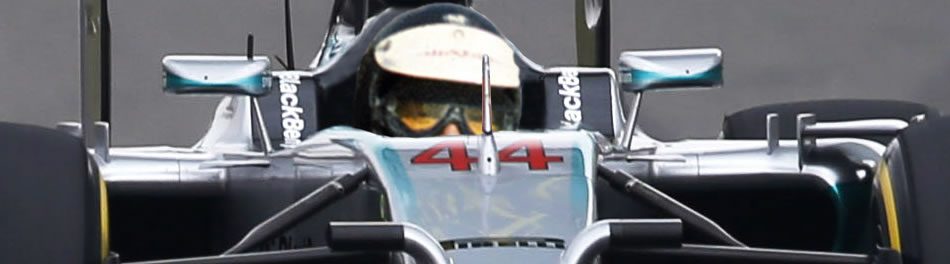
Notes from Jerez testing

Jenson Button at Turn Five – relatively late approach but beautifully balanced

Paul di Resta at Turn Five – not too far from Jenson
- A nice circuit, Jerez, for the spectator. Two hard braking areas – into Turn One and also into the hairpin – allow uninterrupted views of the entire braking and turn-in process; and Turn Five – a fast, uphill right-hander, can be watched from the outside in all its glory. The wind was chilly on Day Two, when I finally managed to have a decent look at the action, but the sunshine was non-stop. Stunning were the Andalucian hills and sky.
- Michael Schumacher was supremely good into Turn One, staying way over on the right of the straight, accelerating through to seventh gear with the car unloaded, before angling back to the left at the last possible moment. Granted, Michael on this day still had the benefit of a blown diffuser. Relative to the Michael of 2010/11, however, this was an altogether different driver. He braked to a point on the left of the road, still with the car at perhaps 15 deg from “straight and parallel”, then nudged the Mercedes into the right-hander, downshifting against increasing steering load. This plainly asked a lot of the car – but the grip was there and Michael used it almost to perfection in a long run in the middle of the day. Only at 4:45, and then again at 5:50, when the shadows were long and the Pirellis were getting a little tired, did I see Michael revert to a little of what we saw a little of in the last two years. Catching diResta, he braked a metre or two late into Nine, ran wide…but still minimised the damage with some nice manipulations. In short, Michael was Michael this day in Jerez. I think he likes the new Pirellis.
- Mark Webber also looked sharp and very quick, although out of the last corner, and towards Turn One, he began his diagonal perhaps 50 metres earlier than Michael (as is Mark’s regular style). Perhaps 200rpm go missing here. Slightly too-early throttle application against abrupt steering load also gave him quite a lot of mid-corner understeer in the middle of One, but, into Two, a downhill, right-hand hairpin, Mark was faultless. Always looking for an earlier upshift, and a master of “floating” the car – letting it settle for a millisecond, with minimal inputs – Mark in Jerez looked every bit the winner of the previous race. And then, through Turn Five, Mark showed just how phenomenally quick he can be. He and Michael dominated the afternoon on this fast corner, the substance of which is almost blind when you’re sitting in an F1 car. Superb to watch.
- Kimi looked great in all the slow corners, even if he twice missed his braking point into the chicane just before day’s end. All the old Kimi was on show – the great use of a decreasing brake pedal pressure against steering load, the exquisite feel for the right moment to load-up the car with steering. He was almost in Michael’s wheeltracks on the stretch from the last corner into Turn One – almost but not quite. Kimi’s E20 was straight as it crossed the timing line but he began his diagonal to the outside perhaps 20m earlier than Michael. Maybe 50rpm lost here. Out at Turn Five – the daunting, fourth-gear corner – Kimi was a tad disappointing, frequently leading the car in from a point about a metre later than Michael or Mark and thus effectively running out of road mid-corner. I’m sure he was saying afterwards that the car suffers here from understeer but to my eye his initial manipulations were not helping the problem.
- Paul di Resta looked very good, I thought. He’s developed into a sort of Barrichello-Button hybrid. His general approaches are not as soft – as late – as those of Rubens but he has all of Rubens’ rhythm and timing. His engine sounds also suggest that he has much of Jenson’s suppleness of footwork from mid-corner to exit, even if he does put a lot of energy onto the loaded, outside front at the expense of the torque that Jenson generates from the inside rear. Paul looks like a driver who can go round and round all day without varying his lap times (given the inevitable variables) by more than a tenth or two.
- Daniel Ricciardi to me did not look comfortable in the Toro Rosso. Into Turn One there was a nice, late diagonal but this was followed by a frantic-looking, last-minute dive for a bit of “flat car” to get the thing stopped. He was very (relatively) late turning-in into Two, and heavy on the loaded front – and the pattern was similar into the much-faster Turn Five. This gave him a nice, clean, safe exit, of course, but if you freeze-framed Daniel mid-corner alongside, say, Mark you’d see a Toro Rosso with lots of room between it and the marbles and a Red Bull with about 2cm to spare…
- Pastor Maldonado was out late in the Williams FW34 – around 4:00pm – but at Turn Five, where I was watching at that point, he was sensationally fast. The Williams looked very good at this fast corner, which I think augers well for the season ahead. The car seemed less effective into the hairpin, and through the slow-speed chicane, although Pastor was on hard tyres and a very heavy fuel load at this point so it was difficult to judge. In terms of his driving, Pastor looked excellent, I thought – neat, precise and efficient.
- Heikki Kovalainen was similarly concise in the new Mike Gascoyne car, although I have to confess that I found it quite difficult to watch him in detail because of the eyesores that are those yellow wheels. They worked on Lotus 18s and 25s but even Colin Chapman switched to black wheels for the 33; and no-one with any feel for Lotus would run either a Caterham or a Lotus 7 on yellow rims. Change, please!
- Jenson Button, as ever, just made the whole thing look absurdly simple. There were none of Michael’s straight lines or Mark’s mid-corner high-speed flicks. The McLaren just went round and round, di Resta-like, always on the conventional racing line, always under perfect control. Does it have any vices? Is it quick? I have no idea. Jenson makes bad cars look just as good as quick ones. It didn’t appear slow; I can tell you that.
- Felipe Massa looked very good late in the day, when he was finally able to string some laps together (prior to that, Ferrari were in telemetry mode: out-lap, in-lap, out-lap, in-lap). The new Ferrari gave the impression of being fast on both slow and fast corners – and I say “gave the impression” because Felipe appeared to be driving well within the car’s limits at every given moment. And he was doing so with a nice, taut entry phase, just as he used to have in the good old days. No reason to be anything but positive about Ferrari at this early stage of the day.
- Strange how the “ugly” nose sections of the 2012 cars blend into the background when you’re watching them on the circuit. I barely noticed, them, I must say; and the Williams FW34, into the sun, looked fabulous, as I say.
- It was fun to bump into two “locals” in the Jerez paddock – Malaga residents Dave Price (who gave Nigel Mansell his first big F3 break in 1979 and in 2012 will be running McLaren GTs) and Jo Ramirez, the Mexican who played important roles in the careers of the Rodriguez brothers, the Gulf Porsche 917s, Francois Cevert and Ayrton Senna. Both looked to be in the peak of condition, which only goes to prove that winter sunshine is not only good for new F1 cars but also excellent for us humans, too.













 peterwindsor.com